From climate change to poverty to healthcare, the large, complex social, environmental and economic problems we face today are too big for any one organisation to tackle alone. They require us to work together in new ways to address the root causes of problems and to create new outcomes that can change entire systems.
The failure of many of the systems that underpin modern life is increasingly difficult to avoid, so it’s not surprising that interest in ‘systems innovation’ is growing fast. At the Point People, we’ve seen pioneers emerging in this field from different sectors, leading very different kinds of organisations and speaking very different professional languages.
We had a hunch that these frontrunners could tell a compelling story about what systemic innovation looks and feels like in practice. So we put them in front of a camera and asked them a handful of questions.
This project was made possible thanks to the generous support of Green Templeton College, the University of Oxford
Systems Changers
Although we spoke with people from very different backgrounds, common insights emerged that crossed these professional boundaries. These fall into six themes:
First The craft of collaboration is vital to systemic change. This is easy to say, much harder to do in practice. The interviews highlight key ways in which deep collaboration can occur, as well as some of the significant barriers to achieving true partnership.
Second Narrative is crucial. Narratives help people understand how the systems they live in are socially constructed. They help us become aware of how we prop up failing systems, and how we can build new ones.
Third Theory and practice need to be understood as a double helix, inextricably linked. Our interviewees used different language to make this point – from appreciative enquiry to agile development – but behind this lies a shared, deeply held commitment to learning and iteration.
Forth
Systems change involves liminal spaces. Innovators need to be able to move in and out of the systems they are trying to change. Even when they are outside of the status quo, they are able to maintain a dialogue with it. If designed well, these liminal spaces can hold unstable groups of people together in the collective pursuit of change.
Fifth
Systems change looks more like a movement than like change led from either ‘top down’ or ‘bottom up’. Successful systems changers need to understand how to orchestrate multiple points of intervention, and align diverse interests with a common goal.
Sixth Systemic leaders are unafraid of the unknown – in fact, they embrace uncertainty. They are able to identify points of intervention and act in the face of complexity. They combine a desire to understand systems with a realisation that they will always have to take action without perfect knowledge.
Just as there were important points of agreement, the interviews also highlighted important tensions and questions:
Is it is possible to design for systems change at all?
Is systems change revolutionary or an evolution? .
Is systems change an elitist discourse that excludes more than it enables?
Do organisations and institutions play a key role in achieving systems change; or are they obstacles, part of the old system that gets in the way?
[Great reflection and interesting learning – I recommend clicking on the links, especially the ‘learning partner’ one towards the end, and browsing the Lankelly Chase website if interesting in this topic]
Eighteen months ago we set out to work alongside a few partners in places to explore how we can support people and institutions nurture the conditions for change to flourish locally. This followed 18 months of seeking advice and input from as many people as possible about the role a funder could most usefully play, and not play, in this respect. From the initial 18 months emerged 9 system behaviours that people felt were present when change was flourishing at an individual, organisational and place level. Behaviour such as people seeing themselves as part of an interconnected whole.
We had a learning partner, a group of Associates with a range of skills/expertise and a few partners in local places. We didn’t have a definitive plan or process. We knew the why. We knew the system behaviours. We had an initial sense of the how – working with associates to start conversations – we didn’t have a sense of the where next. We wanted to start with a range of options as we didn’t want to lock ourselves into one approach too quickly. We wanted to experiment and try out different things – and for it to be responsive to what people locally said.
Our entry into places varied. The work in York, Barrow and Manchester emerged out of projects we were funding there already. We were happy with this, because we knew we needed to start somewhere.
By the time we started conversations with Barking & Dagenham and Gateshead, we had become much more confident about our role, our approach to change and our comfort with not knowing where next. The conversations here started with local authorities and focused more on the systems behaviours.
When we brought together the associates, we brought together people who had a range of skills/expertise that people in places had asked for. Skills and expertise that complemented each other. Some we were working with already and others were new. We envisaged a ‘core team’ of associates, talking to partners locally, holding up mirror to what is going on in places and supporting them to start seeing their local systems. The brief for them was wide. We imagined that they would call on each other and us as they grappled with the local issues. We imagined that we would fade out once we had the associates in place. We imagined that the people in places would make their decisions on the change needed. So what have we learned?
We poorly occupied our role
By asking the Associate to hold the relationships and create a process for bringing people together, we were asking them to hold difficult conversations, remain neutral in the face of conflict locally, challenge power dynamics and hold a process of working with emergence in places faced with austerity and pressure.
Two things happened – local partners wanted to keep in touch with us, to talk about the work and hear our views and at the same time we were trying not to tread on the Associates’ toes.
We have realised that we need to collectively hold the process and work alongside associates and local partners as co-inquirers.
A clear process to hold the uncertainty
We started with a wide approach, to experiment with different approaches. We genuinely didn’t know the best approach and wanted to be open to an alternative view.
We’ve learnt that if you don’t know what to do and want to embrace uncertainty and remain open to what emerges, then clarity is needed elsewhere – for example about processes – structured support and reflection are also essential.
At the same time people are uncomfortable with people not knowing – we were continually asked us ‘What is Lankelly’s view? What does Lankelly Chase want/expect?’
Spaces to bring people together make sense of their system(s) were the most promising
For us the Elephants work offered some of the most fruitful learning towards our approach as it created collaborative spaces for people to explore ways of building the health of systems, starting with dialogue to see how they can have a different kind of relationship. It confronted the issues of power, history and voice. It was an opportunity for two groups who rarely come together to collectively make sense of their systems, observing together and experimenting with ideas together.
Invest in collaborative leadership and relationships, not just projects
External funding can be seen as an opportunity to offload responsibility for complex and resource-intensive functions. It can mean that local partners see a particular project as the responsibility of one agency (say the police) and conclude that something is getting done, therefore they don’t have to do anything.
We want to support collaborative leadership, where the health of the systems is everyone’s responsibility.
Creating more powerful learning experiences
We have had to go on a journey with our learning partner. Our original conversation was to create learning circles and support local actors to reflect on the decisions they are making. For a number of reasons this hasn’t yet been possible. We didn’t commission an evaluation, because we don’t know what success looks like yet, and we were worried that an evaluation looking at predetermined outcomes would drive behaviour to meet those rather than being open. Instead they refocused to create spaces for all of us to reflect on our work through in time feedback (feedback in the moment) and through time (feedback to do better next time). While this has been of value, it has also meant that people in places have not had guided the learning process. Therefore, we want to go back to our original aim of creating learning spaces to explore what’s emerging and what needs to happen next.
It’s been an amazing 18 months, full of rich learning, deepening partnerships, sparks of change. It’s taught us a lot about the role of a national funder working in place, supporting change to flourish at a systems level. Our biggest learning – money is incredibly important and as important are the other things that we don’t always give enough recognition to – support, processes, our relationships, learning and being responsive to feedback.
This is from Yeu Wen, who can be contacted at https://about.me/simplexity
Inspired by the work done in System viability of organizations and the aetiology of organizational crisis : A Quantitative Assessment of Stafford Beer’s Viable System Model – https://dspace.library.uu.nl/handle/1874/356772,
I propose a variation of the original research question posed in the thesis above as the following…
To what degree do the necessary and sufficient conditions for organizational viability, as defined by Beer’s Viable System Model, predict Organizational Crises, using a new science of causality based on Chaitin, Solomonoff and Kolmogorov Algorithmic Probability?
See www.algorithmicdynamics.net for details of the concept of algorithmic probability
These are early stages for the research so conversations are sought!
Purpose: Are entrepreneurial opportunities discovered or created? The debate around this question has crucial implications for successful organizational change management in the business world. The present conceptual paper transcends this debate by embedding the concept of the entrepreneurial opportunities within a Luhmannian systems – theoretical framework which accentuates the unique role of organization and change in the age of functional differentiation. The purpose of this paper is to show how the strategic navigation of the borders between function systems such as politics, science, education, religion, art, or, of course, economy leads to the discovery or creation new opportunities for both business and social entrepreneurship. Design/methodology/approach: The paper combines…
Head of Digital Grant Making at Big Lottery Fund & Co-founder of the Point People. Previously Strategic Design Director at Doteveryone. www.cassierobinson.work
The *how* of systems change
A few weeks ago, the Point People ran a one day workshop for Lankelly Chaseand their Place Based Associates, talking through some of the thinking, methods and tools we use for designing systemically for change.
This is part of the Point People’s ongoing relationship with Lankelly Chase to help build the field of ‘systems change’ and especially the need that we all feel to “democratise” it. My colleague Ella Saltmarshe is writing a longer blog post about that, coming soon!
The idea of the day was that through us sharing *how* we do things, those that joined the session could go away and use some of tools in their own work — all of whom are involved in place-based systems change. Some of the participants included Collaborate, MEAM and Save The Children’s Local Systems Change team.
We tried to deliver the session in a way that made practical sense — when might the different tools and approaches be useful? How do you use them? And with whom?
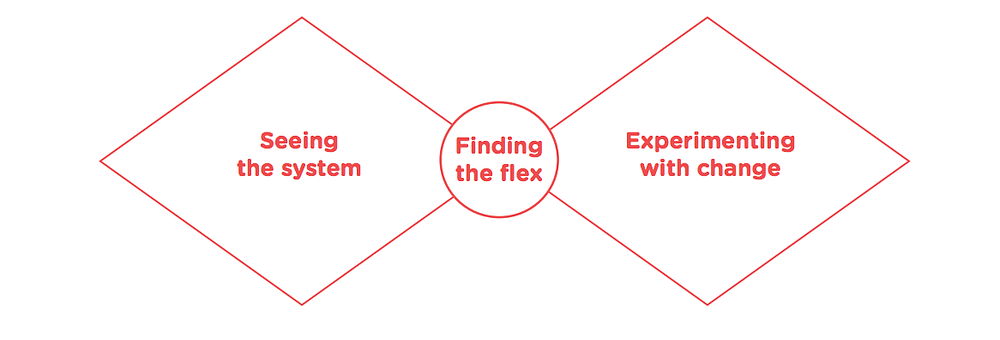
The slides we created for the session are here. They show the different elements of the Systems Changers programme (Seeing the System, Finding Flex, Experimenting with Change), some of the tools and methods we use, and when we use them. We hope people find them useful.
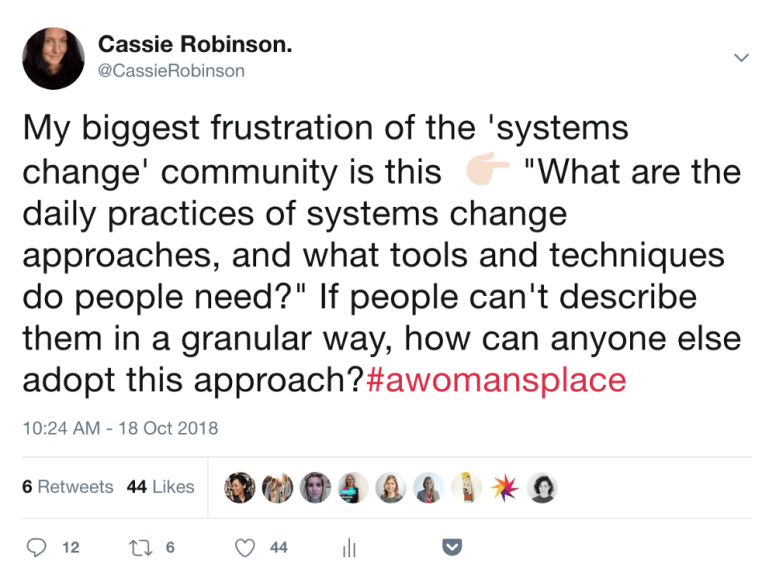
After the session I reflected (and then tweeted) on how organisations doing “systems change” work need to get much better at describing, in detail, what they actually do. It was also one of the things that made our work for Agenda(#awomansplace) really challenging— when we were doing interviews with ‘systems change practitioners’ they seemed to find it incredibly hard to get down to detail.
I think there’s a lot of..
“Build coalitions and relationships across the system”
“Work with power”
“Build empathy and trust”
“Agree on shared outcomes”
“Demonstrate generous leadership” etc etc…
….but if people want these approaches to spread then what’s needed is a much more granular telling and showing of the *how* — hence my tweet.
Thank you to Ella Saltmarshe and Jennie McShannon, my co-designers and co-facilitators on the day.
In our world of cost-cutting and “efficiency” we try to scale things up. We do something we think is meaningful and then roll it out to apply to many people or to many situations or to many places. This scaling-up enterprise does not make good sense, if we pay attention. In the world of finance scale may be everything, and that is a measure of how poorly finance captures the meaning of value. In the world of relationships, when we try to do something more broadly, meanings change. Sometimes meanings are not even recognisable between the local and the more general. What we take to be the same thing becomes something completely different.
In my work exploring the meanings of organisational systems, this, historically, has been the place where managers and students of systems fail to follow. Their difficulty revolves around the notion of purpose and alignment. They cannot accept that what happens locally in an organisation can have a quite different purpose and weltanschauung than other parts of the organisation that use what the local part does in some way. They think everyone has to be on the same hymnsheet. (Which in turn implies that they think that everyone can be on the same hymnsheet…)
As we often do, lets look at how ecosystems work. Organisms in an ecosystem are not on the same hymnsheet. We are a bit prone to label the ecosystemic relationships as, for instance, predator-prey, or symbiosis, or parasitic, all of which imply binary focus on two species. When we get to more complex relationships we quickly get confused and lost. But if you think of the development of an ecosystem as endless complexification, this is not hard. An organism or two or three interact because they do. Their lifecycles and their interactions create potential ecological niches that other organisms move in to exploit. That is the complexification process, and it looks miraculous to us because everything is recycled, there is zero waste, and it all dovetails beautifully.
In this miraculous dovetailing, there is no alignment of purpose: in fact, arguably the notion of purpose does not belong or apply. There is no negotiation or design of the relationship between the newcomer organism and the existing system. Complexification is not by consent. This is more like the vibrant local economies of some urban centres: people find ways to make a living in totally surprising modes of existence. If that is not pretty it is often because of grossly exploitative metasystems like money systems and military repression that do not exist in natural systems.
My allotment vegetable patch is more productive than the same area of a farmer’s field growing vegetables. It is more productive because I can take care of the way many different crops and plants interact in useful and productive ways. Allotments don’t scale either.
Useful models
If complexification happens via continuous inventive interventions, our models to help us understand what is going on need to recognise local ways of being and their actual interactions.
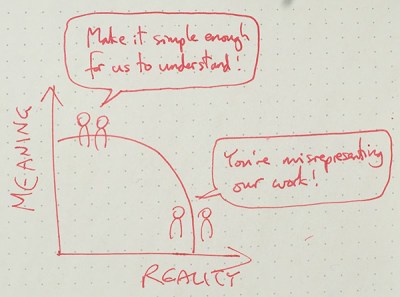
Steve Whitla uses a curve to model the spread from high degree of shared meaning to a high degree of detail and accuracy.[1] Which isn’t to say that there’s less nuance at the shared meaning end of things, but that the detail is local to individual contexts, the truly shared portion being vanishingly small.
A simple example. I spoke with a small charity whose work was to defuse tensions on university campuses. Wonderful work. Typically, they would mentor the leaders of various religious societies, working with them to put on events that would get people mixing across sectarian divides. They got comedians to come and entertain people across religions and built ways to resist exclusion and narrowness.
Often, the nature of these students’ lives was to live at home in families that were both strict and suspicious of multicultural agendas and institutions. It was and is clear that a major eruption of religious/ethnic hatred could totally undermine if not destroy a university and what it stood for.
I explored with the CEO what that would allow her to do with her clients, the university administrations. And we came to the conclusion that a university might need to test its ability to cope with a major incident, in the style of a military exercise but with totally different values! Whereas the mentors have an interest in students mingling and understanding each other better, the university admin has to maintain the integrity of the university and discharge its duty to care for students as judged by parents and their communities.
So, the meanings available at the scale of a student religious society and the meanings available at the level of university admin are quite certainly different and quite possibly misaligned. Although that must be understood it absolutely does NOT mean that the work done by the mentors is anything other than invaluable in trying to manage the situation. You might also want to ponder the relationship between an identity card security system and these two contexts.
Another example of the illusion of scalable meaning is the standard operating procedure or business process. The real work is never standard, is always sensitive to the local context of each interaction. It’s well known that if, as workers, you want to bring a business to its knees, you don’t go on strike but follow the processes, robotically, in what’s known as ‘work to rule’. You don’t even need to go to any lengths of absurdity, simply stop filling in the inevitable gaps that arise in and between the official processes.[2]
Projection of meanings
I worked closely with a chap who thought he knew it all. The implication of his all-encompassing ego and hubris was that, in the spirit of Conway’s Law, all organisational solutions that he proposed had a vital role for a guru to be wise and to subtly direct operations and language and culture and learning. (Yes, I am clearly still a bit bruised!) What I learned the hard way was this: what people see in a situation is often a projection of their own needs and deficits,[3] and the more strongly they insist on it as being objective, the more likely it is to be a projection.
The particular issue that this chap could not grasp was the practical organisational implications of local autonomy. Basically, for him, autonomy was a great thing to have, but it would still need to be manipulated to suit organisational goals. People of all ilks, from small children up, learn so quickly when they are fascinated by what is in front of them. The implication of autonomy is that people will find local solutions to local problems that deal with all the crazy idiosyncrasies of people around them: if and only if that can be fun.
The more you impose a framework, the more the meanings of pedagogues and administrators get imposed on the situation. Recent research finds that even the abstract thought that a teacher might, at some future point, want to measure what a student has learned is enough to seriously inhibit the learning itself. And you already know that I don’t think teachers know what students should be learning anyway. Since projected meanings are hell to deal with, it is better not even to go there. Just say no in a gently serious way!
Certainly, in the Viable Systems Model, that is, according to the model for systems to be viable in the first place, autonomous systems are made of autonomous systems. I can probably admit to having many parts of my mind that are interestingly discordant with each other: I am already a system of systems. When I join a bunch of others to do something, that is a further composition of systems that I hope are each viable and autonomous otherwise we are into groupthink and various unhealthy forms of alignment. And what we have sketched above consists of this bunch of people doing one thing with its own local meanings interacting with other groups doing other things to build complexity and potential. It doesn’t always work and it has to be allowed to fail.
When my colleague wanted me to unpack the VSM for him he always got stuck at the same point: what if this bunch of people want those autonomous systems over there to behave differently? Its like all those diversities: ethnic diversity, diversity of sexual orientation, neurodiversity, social system diversity, language diversity etc. that mysteriously collapse into some government minister knowing how to “educate” them all. Why doesn’t everyone just laugh? It is so easy to throw the baby of meaning out with the bathwater of knowing better!
Scale and meaning
Returning from France the other day we stopped for lunch with a friend in Normandy. The lunch included a squash and cucumber salad from the garden just outside the window, and a selection of cheeses produced by neighbours. Needless to say, it was delicious and so welcome. Another French friend surprised me by needing to go to the supermarket to get exciting items like loo rolls. She explained that in her Paris flat she never gets the car out and will only buy food at local shops, so when she was out and about visiting friends in the car she needed to stock up.
To understand these situations fully you would use a technique like Nora Bateson’s warm data labs. You would need to understand the web of completely particular relationships involved. But it is easy to see that neither of these situations scales: there is just no way to get the value in the situation if it is scaled up. It is almost as if the source of much of the value is resisting the economic and managerial dogma that scale is to be celebrated and pursued. Scale is for loo rolls, period.
There is no idyll here. The French neighbours in both little stories are not necessarily pleasant or reasonable or helpful. But place is place, and idiosyncrasy and downright oddness are what place is built on. Idiosyncrasy is the practical working out of autonomy in a place where it is possible to express one’s quirks, where suburban marshalling into sameness happens less. Some of those cheeses were heaven but one for instance had lots of hay sticking to it and apparently tastes very different at different times of year.
Scale and time
I had a discussion with a person from BAE about warships. Apparently as things were then, when a new warship is ordered and built, the contract says that after 25 years of a projected 50-year life it will need a full refit. To facilitate such a refit there must be full knowledge preserved about the current systems, so that they can be upgraded as necessary. It turns out that this is impossible. After 25 years none of the designers and engineers involved in the original design are available or if they are they no longer know how things work. The documentation in all its glory is as undecipherable as the systems themselves. This is the gap between local meaning at the time and the interpretation of the historical material when time has elapsed.
The same effect happens over space/geography when there is any attempt to apply uniform regulation. Philip points out that the provision of a shed with walls on three sides for the comfort of smokers obliged to smoke outside has very different implications in Finland and in Spain, even though the regulation is “the same”.
So, meaning is inescapably created by particular people at a particular time in a particular context. The ability to evoke that meaning with other people in other times and places is fraught, and may be more in the domain of the novelist than the producer of technical documentation. Everyone at some time wants to believe differently and everyone has to find out time and again that this piece of ancient wisdom remains true.
Trying to recreate the context of a past time or another place in order to understand the meanings that held then is the business of historians and social geographers. We can simply note that such things are never settled as fact and remain in a state of perpetual challenge especially if they resonate with crucial meanings in the present.
We can even observe the creation of this effect. If we try to document how meanings change over time as the situation changes what happens is that we fail to notice significant changes. That is a weasel statement, because the significance that we fail to notice often only becomes significant later, even thought the event if you like occurred earlier. You only have to try and write an honest diary to observe this effect. Or even to read old diaries and ask yourself if they were honest. Truly everything real is in the relationships that give meaning to people, and all real work involves understanding how those relationships change when we act.
[2] A recent example from Virgin Trains: the platform guard at Euston station insisted on seeing ‘the original’ PDF of my electronic ticket, because scanning the same barcode from a screenshot was clearly insecure and prone to copying. Nevermind that you and I could share the same email account, or that I could have arranged the travel for you, or forwarded you the email, etc etc. I wonder what he would have done if I’d presented a printed copy of the same PDF ticket. I wager it would have passed without comment.
[3] In a projection, of course, we see things in other people that if we recognised them as coming from ourselves would be unacceptable.
Sometimes back-of-an-envelope drawings take on a life of their own. Here’s one I drew a few months back that keeps generating more and more interesting conversations.
We’ve christened it the “meaning curve”, and I think it neatly describes why organisations (and individuals) struggle to have the sorts of conversations that could lead to positive change.
The graph shows what happens when you take your communication, decide how many people are likely to understand it and care (y-axis – “shared meaning”), then plot that against how well it reflects reality (x-axis – “accuracy”).
What you find is that there’s usually a trade off.
The more accurately you try to represent or describe reality, the more complex and hard to understand your depictions tend to be, so you find a certain group of people camped out at the bottom-right of the curve: Engineers, solution architects, scientists, analysts, specialists.
On the other hand, if your job is to create things that make sense to people, you’re going to find it hard going if you’re not allowed to (at the very least) make some broad generalisations. So at the top-left of the curve you tend to find salespeople, marketing agencies, PR professionals, speechwriters etc.
There’s a lot to be said about the other two quadrants as well, but for now let me just use the model to make a simple point: The two ends of the curve represent not just different types of communication, but different attitudes to life.
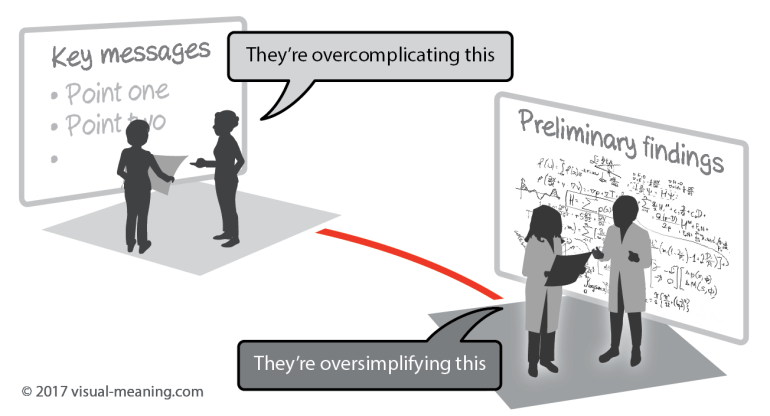
In my fifteen years of consulting, it has never ceased to amaze me how uninterested some people can be in whether or not what they are saying is true, and equally how uninterested other people can be in whether or not anyone understands what they’re saying. The sort of widespread, meaningful, reality-based conversations that could lead to change do not happen because these two dispositions just don’t get where each other are coming from.
So, for example the system engineer creates an amazing model of the organisation that explains all kinds of complex phenomena, but it never sees the light of day because they lack the ability to explain it (let alone sell it) to upper management. The programme manager commits to a ludicrously optimistic timeline, because they don’t have the time (or the patience) to get to grips with the complexity that each of the project managers keep introducing to the planning process. The solitary genius who makes seminal discoveries deep in the bowels of the organisation, but only gets to continue their work because they have a “minder” who provides a human interface for the rest of the business. The marketing manager who doesn’t want to listen to the product designers explain why their preferred strapline doesn’t accurately reflect the capabilities of the product. And so on.
Do you see any of these patterns around you? If so, maybe try drawing the curve on a whiteboard and asking your team whereabouts they see themselves.
Unless the conversations start to meet up in the top right, the chances are that nothing positive is going to shift. The challenge is that this requires compromise on both sides.
POSTSCRIPT: After I first wrote this, it triggered a very healthy debate in the office. We intend this article, as with all our work, to be an example of top-right quadrant communication (both highly meaningful and conforming to reality). What we learned was that if you are of a bottom-right corner disposition, you are likely to take issue with how loosely I have defined terms – isn’t “accuracy”, for example, conflating veracity and precision? If you are of a top-left corner disposition, you are probably thinking this post was long enough without a postscript containing terms like “veracity” and “precision”. And therein lies the moral of the story.
We aim to significantly expand our understanding of the causal mechanisms underlying natural and artificial systems and to develop new tools to offer new mechanistic insights into the nature and sequence of molecular events inherent to cellular reprogramming..
Algorithmic Information Dynamics is an exciting new field put forward by our lab based upon some of the most mathematically mature and powerful theories at the intersection of computability, algorithmic information, dynamic systems and algebraic graph theory to tackle some of the challenges of causation from a model-driven mechanistic perspective, in particular, in application to behavioural, evolutionary and molecular reprogramming.
Current and future research directions include: algorithmic feature selection, algorithmic model generation; connections between spectral graph theory and algorithmic complexity; the study of non fine-tuned models of causal networks; and applications of our algorithmic calculus to disentangling interconnected multilayered networks.
One year before passing away, Marvin Minsky, widely considered the founding father of Artificial Intelligence, described what turns one of our main conducting lines of research. Together with Sydney Brenner’s direction — the 2002 Nobel prize in Physiology or Medicine laureate awarded by the Karolinska Institute — it completes the picture of what our lab strives:
It seems to me that the most important discovery since Gödel was the discovery by Chaitin, Solomonoff and Kolmogorov of the concept called Algorithmic Probability which is a fundamental new theory of how to make predictions given a collection of experiences and this is a beautiful theory, everybody should learn it, but it’s got one problem, that is, that you cannot actually calculate what this theory predicts because it is too hard, it requires an infinite amount of work. However, it should be possible to make practical approximations to the Chaitin, Kolmogorov, Solomonoff theory that would make better predictions than anything we have today. Everybody should learn all about that and spend the rest of their lives working on it.
Marvin Minsky
Panel discussion on The Limits of Understanding
World Science Festival
NYC, Dec 14, 2014
Biological research is in crisis, and in Alan Turing’s work there is much to guide us … Although many believe that ‘more is better’, history tells us that ‘least is best’. We need theory and a firm grasp on the nature of the objects we study to predict the rest … The concept of the gene as a symbolic representation of the organism — a code script — is a fundamental feature of the living world and must form the kernel of biological theory.
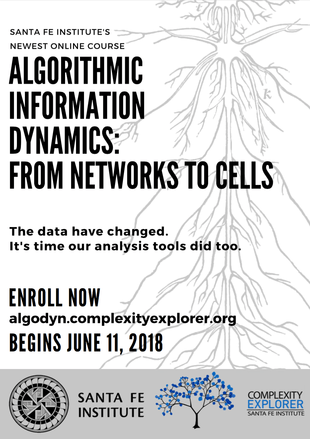
Online course on Algorithmic Information Dynamics now open
A Computational Approach to Causality and Molecular Biology: From Complex Networks to Reprogramming Cells
Almost 300 people have already enrolled in only the first 3 days. Enrol here.
Course poster and trailer:
ABOUT
The Algorithmic Dynamics Lab is a spin-off group of the Unit of Computational Medicine and the result of a long-term collaboration between experts in algorithmicinformation theory, dynamical systems, network science, machine learning and computational biology sharing interests in fundamental science and in applications to programmability of natural and artificial systems and cognitive, genetic and evolutionary biology.
To this end, we have created research teams each tacking different fundamental questions, one is devoted to introducing cause and effect in the practice of data analytics and the introduction of model-based reasoning complementing and enabling current statistical machine learning approaches (including deep learning) to better deal with questions of causation. Related to this, a major challenge is how to combine the power of symbolic computation in its fundamentally discrete form with the power of essentially continuous fields such as differentiable programming and dynamical systems.
Our aim is to introduce and exploit the most powerful mathematical theories bringing to bear mature concepts (such as multi-scale dynamics, spectral theory, and algorithmic inference) in solving some of the most pressing problems in the areas of systems modelling.
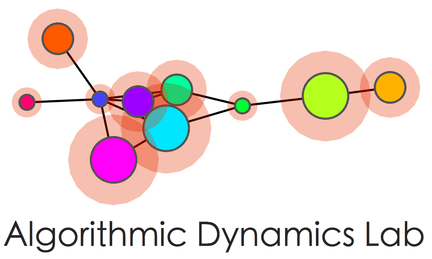
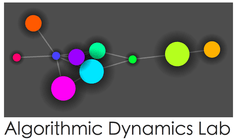
Our logo epitomizes the type of phenomena we aim to help disentangle. The graph is described in paper J24 and its generating mechanism is a very simple, recursive short computer program, yet it produces a network with complex graph-theoretic properties. The graph also displays maximal Shannon entropy when described by its degree sequence and measures by an uninformed observer but minimal Shannon entropy when looking at its adjacency matrixthereby showing the failure of statistical mechanics approaches and of computable measures in general such as Entropy to characterize causal non-random macroscopic systems.
SISTER LABS
On the one hand, our sister Living Systems Lab led by Prof. Jesper Tegnér at KAUST is setting up a 3 million USD state-of-the-art lab with the latest equipment for single cell sequencing and in vivo manipulation technology to steer and reprogram single cells using the reprogramming methods that we have developed at CompMed and AlgoDyn. The cell lines and organisms to be used are stem cells, immune cells and cancer cells.
On the other hand, the Algorithmic Nature grouphas developed some of the main numerical methods at the core of the conceptual framework that is fuelling our pursuit of a better understanding of the causal mechanisms and first design principles of natural and artificial evolving systems, including a sophisticated online calculator that provides estimations of algorithmic complexity and logical depth by way of the powerful concept of algorithmic probability that combines traditional probability with computation. We continue to foster and nurture connections between our sister labs in order to further the development of such numerical and conceptual methods as well as to explore aspects of animal and human behaviour from this algorithmic and powerful perspective (see paper J23).
Algorithmic Machine Learning
Dr. Santiago Hernández Dr. Juergen Riedel Allan Zea
Connecting the Discrete and Continuous Dr. Luan Ozelim Dr. Alejandro Puga Candelas Yanbo Zhang Masters and PhD Students
Liu Weilong Alberto Hernández
Research Programmers Allan Zea Santiago Hernández Antonio Rueda-Toicen
Former Postdoctoral Fellows
Dr. Liliana Badillo
Formerstudents Jakub Olczak Yue Deng Ronnie Rodrigues Ahmed Mohamed Michael Doullis Santiago Hernández Lucas Venturini Yanbo Zhang
Research and Practice for Social Good in a Complex World
April 15-17, 2019
Washington, DC
CONFERENCE
BRINGING RESEARCHERS AND PRACTITIONERS TOGETHER TO ADVANCE SOCIAL GOOD IN A COMPLEX WORLD
CAPS 2019 is the 3rd International Conference on Complexity and Policy Studies. The conference is a cross-disciplinary conference that brings together researchers, practitioners, and funders to explore the application of insights from the study of complex systems to public policy with a special emphasis on social good. The conference gives practitioners and researchers the opportunity to learn from each other, explore collaborations and hear from funders about the most promising ways to fund their projects.
Systems Intelligence (SI) is a concept introduced in 2004 by the principal investigators. The research group develops the conceptual basis of this competence and studies its different forms and manifestations in personal and organizational contexts. We seek to distribute knowledge and stimulate interest in Systems Intelligence in different fields including management practices, learning organizations, education, human relationships, etc.
By Systems Intelligence we mean intelligent behaviour in the context of complex systems involving interaction and feedback. A subject acting with systems intelligence engages successfully and productively with the holistic feedback mechanisms of her environment. She perceives herself as part of the whole, the influence of the whole upon herself as well as her own influence upon the whole. Observing her own interdependency with the feedback-intensive environment, she is able to act intelligently.
We have also developed a test for self-evaluation. You can take the SI-test here. If you want to use the SI-test in your own projects you can find related material and instructions here.
Original introduction of the concept of Systems Intelligence:
Intervene, don’t overthink – the new mantra of systems designNovember 2, 2018 by World Economic Forum 1 CommentUN-Habitat/Julius Mwelu Cities in developing countries like Nairobi in Kenya continue to grow rapidly.This article is brought to you thanks to the strategic cooperation of The European Sting with the World Economic Forum.Author: Tim Brown, Chief Executive Officer, IDEOArchitects and urban planners of the mid-20th century believed they had the skill and the right to redesign how cities worked. Enamored with the automobile and challenged by increased urban migration, planners such as Robert Moses and architects from Le Corbusier to Frank Lloyd Wright proposed a variety of utopian schemes. Not all were built, but those that were had unforeseen consequences. High-level freeways cleaved neighborhoods, and the demolishing of traditional urban districts made way for high-rise developments that became sources of crime and misery.This “top-down” urban planning created radical change, but also resulted in cities that failed to provide for the multiple needs of the people who inhabited them. Indeed, it was the failure to take into account the needs of ordinary citizens that led to the rise of the New Urbanist movement led by Jane Jacobs and Lewis Mumford. Jacobs, in her groundbreaking book The Death and Life of Great American Cities, made the case for a more grassroots, human-centered approach to urban design based on building social capital through mixed-use neighborhoods.As we look to lead the development of new interconnected systems, enabled by the Fourth Industrial Revolution, we would do well to learn from the mistakes of 20th-century planners and architects. Their utopian proposals were an example of both too much and too little design. Too much in that there was an assumption that the needs of all stakeholders could be understood and designed for at the outset. Too little in that designers failed to create a process or platform that could accommodate for the needs of all stakeholders over time.Instead, an approach to the successful deployment of design in systems leadership might be based on answering three questions: why design, how to design and when to design?
[What a rich source of systems thinkers and systems thinking the OU courses have been!]
[Update: apologies, Helen has pointed out that I put the whole article here without the Creative Commons license – my mistake! It is below.
NB 1, I feel I should probably do short intros to pieces and then a link to the original, which would make the front page easier to scan and redirect more people to the original – my failure to do this often is down to laziness and not being certain where to create the ‘fold’ and stop the content. I’ll try to break that bad habit.
and, 2, I suspect it would also be clearer and easier if I put the ‘link to source’ at the top of the post – the browser plugin I use, ‘press this’, automatically puts it at the bottom, below a sample (badly formatted, no images) of the content. Will try to change this too]
Creative Commons Licence
Just Practicing by Helen Wilding is licensed under a Creative Commons Attribution-NonCommercial-ShareAlike 4.0 International License.
Recently I wrote a post on Situations which ended as follows:
But, in spite of all the commonalities, there is a distinction in the way that TU811 treats situations of interest compared to the way TU812 treats situations of concern…
In TU811, it is perfectly possible to adopt a first order stance – using systems approaches to analyse a situation of interest that you stand apart from. You can take the mindset of a consultant asked to advise or make recommendations to someone in government or in an organisation. It is possible to be objective and distant, to lack ownership of and for the situation. I say possible, you don’t have to engage with the situation that way but you can still engage pretty effectively as a systems practitioner if you do.
In comparison, when TU812 talks of situations of concern, they tend to be situations you experience directly – something you are part of. This means a first order stance is more constraining and it is more appropriate to adopt a second order stance. Here your personal engagement with the situation and the other people who are part of it matters. Your emotioning, understandings, actions and interactions can have an influence on whether the situation improves or declines. Your own action and interaction matters.
In the last few days, I have been reflecting on this in the light of closer reading of the work of Ison (2017) and various works by Checkland (e.g. 1985) which formed the basis for Ison’s conceptual model of what it is to think about practice.
The particular aspects I have been reflecting on are the way in which the practitioner and the situation can be perceived to relate to each other.
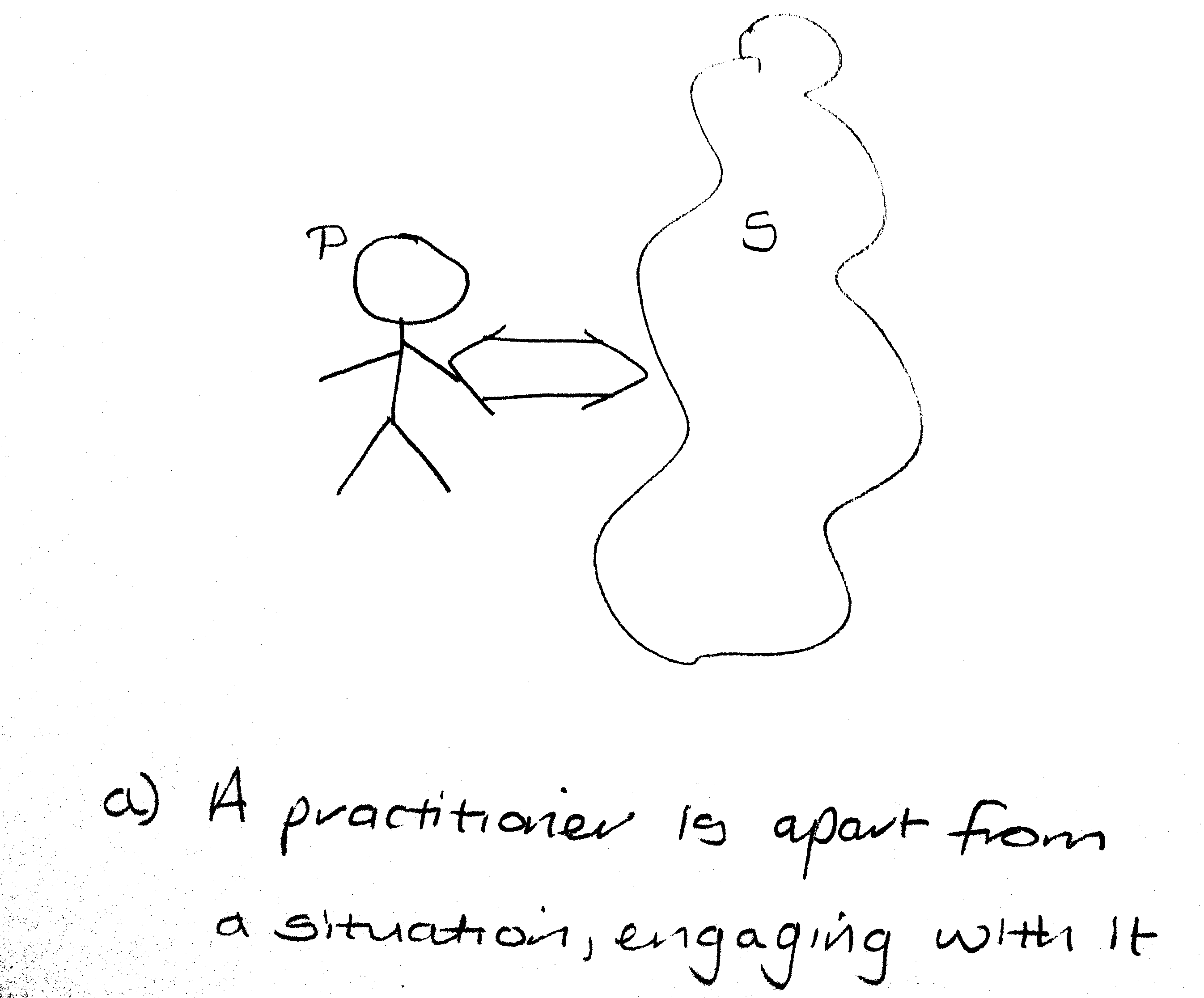
In Checkland’s various diagrams of the nature of research, his SSM model and the LUMAS model, the practitioner(s) doesn’t always get much prominence – when they do appear they are also sometimes referred to as a user(s) of a methodology. In general though, the practitioner is depicted apart from the situation, engaging with it from a distance (as in my Figure a).
Figure a: A practitioner is apart from a situation engaging with it
Ison (2017) also depicts the relationship in this way in his Figure 3.5 (p.50) which aims to elucidate what happens when a practitioner thinks about their practice – a dynamic which involves a practitioner (P) engaging with a situation (S) with a framework of ideas (F) and a method (M) (the PFMS model)
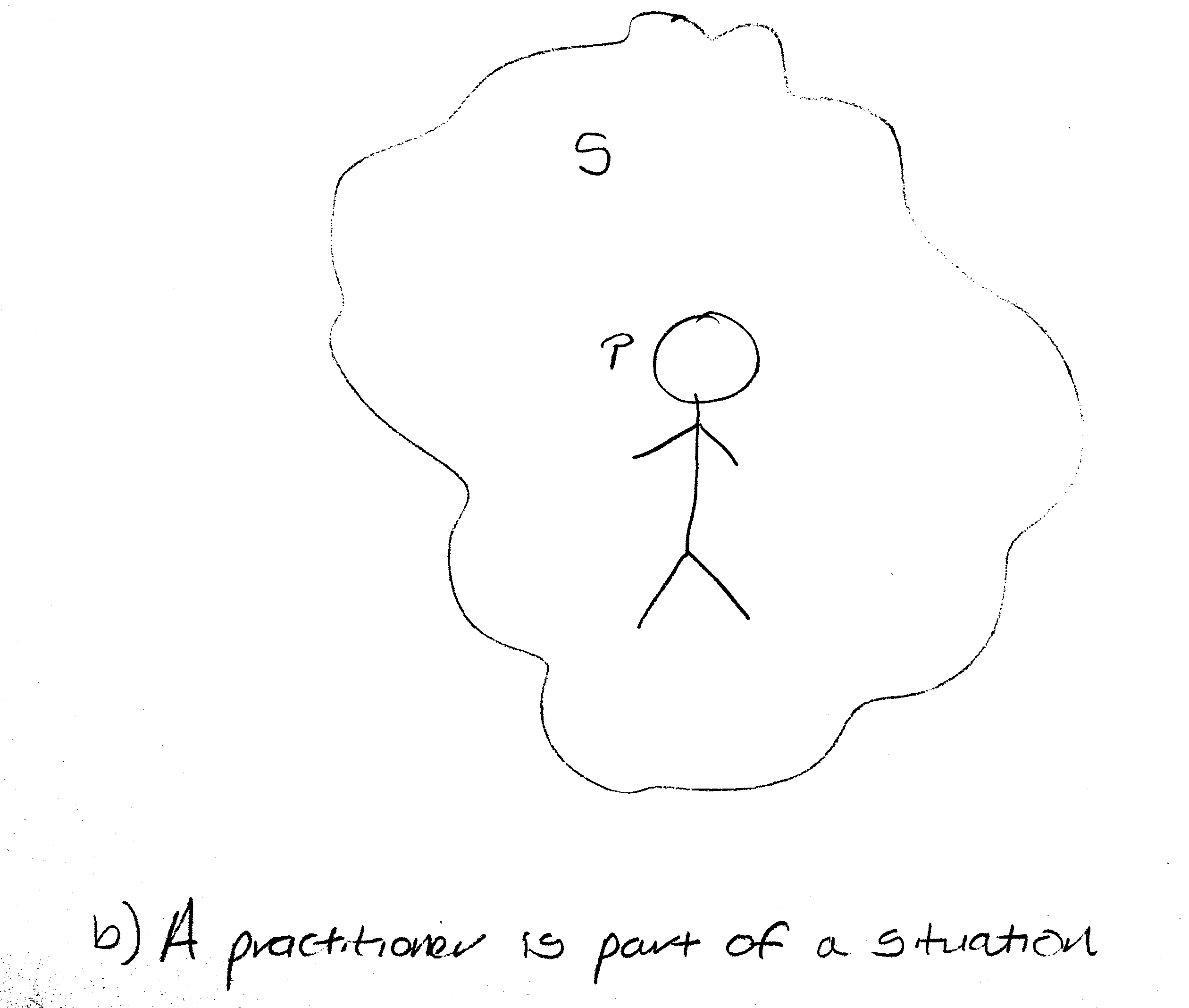
When I wrote the previous blog, I concluded that it is sometimes more appropriate to adopt a second order stance – to recognise that you are part of the situation (as in my Figure b).
Figure b: A practitioner is part of a situation
My recent insights have arisen from reading the the explanations that Ison (2017) gives when talking about the PFMS model (enhanced by some prompts in some personal correspondence with him).
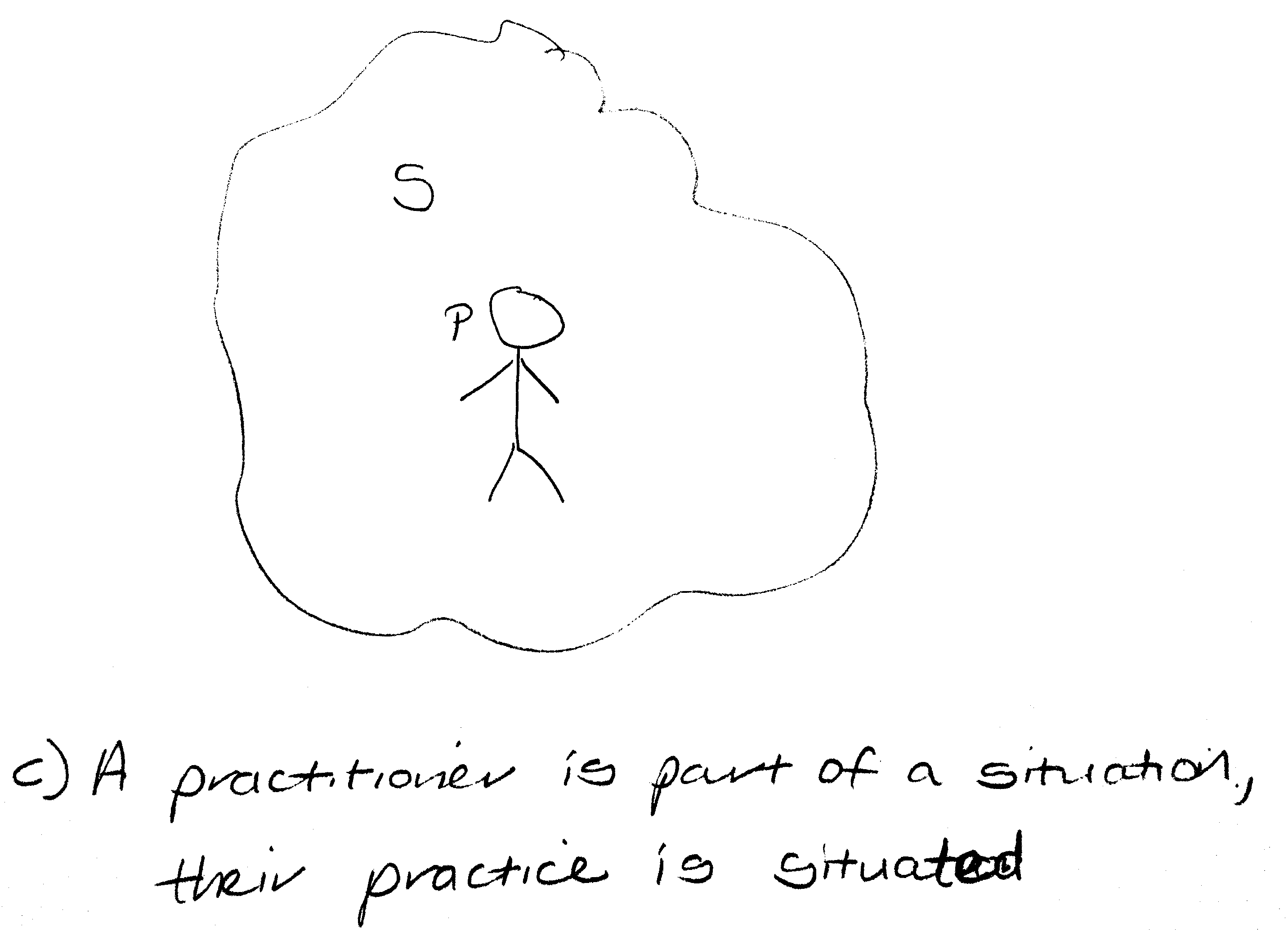
He emphasises that all practice is situated, which changes the text in my Figure b to Figure c.
FIgure c: A practitioner is part of a situation, their practice is situated
Ison (2017) isn’t alone in bringing attention to the situated nature of practice. I also like the explanation of Kemmis et al (2014) who coin the term ‘practice architectures’ to refer to the arrangements that afford certain practices and constrain others. Three different arrangements can be distinguished:
“Cultural-discursive arrangements that support the sayings of a practice, material-economic arrangements that support the doings of a practice, and social-political arrangements that support the relating of the practice. These arrangements […] hold practices in place, and provide the resources (the language, the material resources, and the social resources) that make the practice possible” Kemmis et al (2014, p.110)
But I get a sense that Ison (2017) is emphasising something different to Kemmis et al (2014). Rather than consider the situation as the context of the practice, it is more that ‘the situation’ is one particular element of practice (alongside P, F and M) worth understanding. He states:
“If you are alert you will recognise that this figure [i.e. his Figure 3.5] abstracts the practitioner (P) out of the situation (S) [as in my Figure a], yet I said at the beginning of this chapter that all practice is situated. To hold on to my claim I must ask you to imagine an animation in which the practitioner (P) and all the other elements, begin inside S [as in my Figure c]; what [the figure] depicts is an expanded abstraction from these initial conditions”. (p.50)
So the situation (S) in Ison (2017)’s depiction is best thought of as the situational element of practice. This is different to what I have been thinking – I think I have thought of it more like Checkland uses it in terms such as ‘research area’ or ‘the problematic situation’ – the issue that the practitioner is investigating or wanting to intervene in (like concerns about obesity or youth violence). This is also informed by my use of ‘situation of interest’ during TU811 as per the previous blog I refer to above.
There are similiarities of course – a practitioner may want to understand and act purposefully to change the situational element of their practice and, in doing so, they need to recognise that it has a history and a future (or to draw on Vickers (as Checkland did) it’s helpful to consider it a flux of events and ideas changing through time).
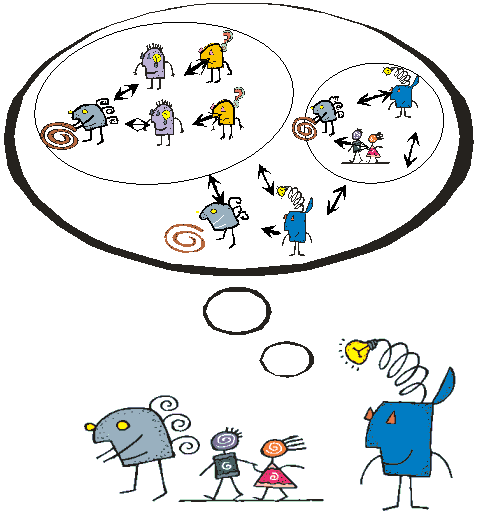
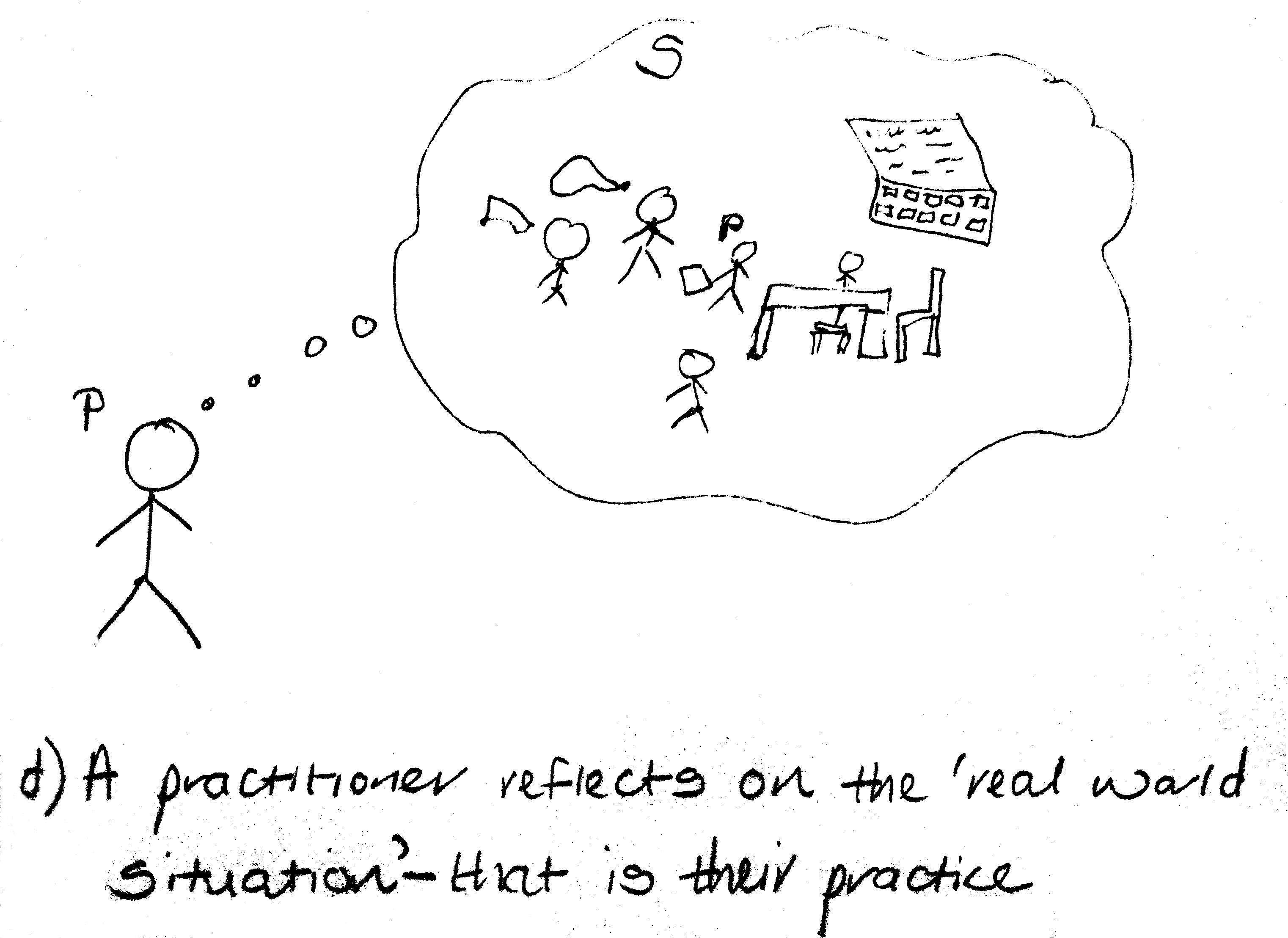
There is a further step to take as well – another level of abstraction. Ison (2017)’s model includes a person (who may be the same as the practitioner) thinking about the practice dynamic. He refers to all that exists in the thought bubble as a ‘real world situation’ and makes the point that that is his preference in a footnote. So in that sense, the practitioner reflects on the ‘real world situation’ – that is, their practice (see my Figure d).
Figure d: A practitioner reflects on the ‘real world situation’ – that is, their practice
That ‘real world situation’ is messy and complex so Ison (2017) invites people to think about it in terms of four elements or components and their relationships – the practitioner (P), their framework of ideas (F), the methods they use (M) and the situational (S) element. This is a heuristic – a device that helps to explore the ‘real world situation’ that is my practice – it isn’t a description of practice itself.
So in my research ‘policy work practice and its development’ is the phenomenom I am interested in – I am not just thinking about it, I am researching it. I am not just thinking about my own practice, I am considering policy work practice in a more general sense. In Checkland’s terms, practice is my ‘research area’ and whilst I have been informed by all the ideas above so far I do actually need to more explicitly declare the framework of ideas that informed my choice of methodology and the way I have approached the literature and my data. That’s what I am currently struggling with – it’s something like my Figure e.
Figure e: A practitioner (researcher) reflecting on their research practice to examine policy work practice and its development
Enough mental gymnastics for today – I do need to come back to this though. There is another layer in there too – somewhere in the middle – that of the action research participants seeking to understand their practice – a process which generated data for me to analyse and create findings.
References
Checkland, P. (1985), From Optimizing to Learning: A Development of Systems Thinking for the 1990s. The Journal of the Operational Research Society, 36(9), pp.757–767.
Ison, R. (2017), Systems practice: how to act Second Edition., Milton Keynes/London: The Open University/Springer Publications.
Kemmis, S., McTaggart, R. and Nixon, R. (2014), The action research planner: doing critical participatory action research, Singapore: Springer Link. [electronic edition]



 Steve Whitla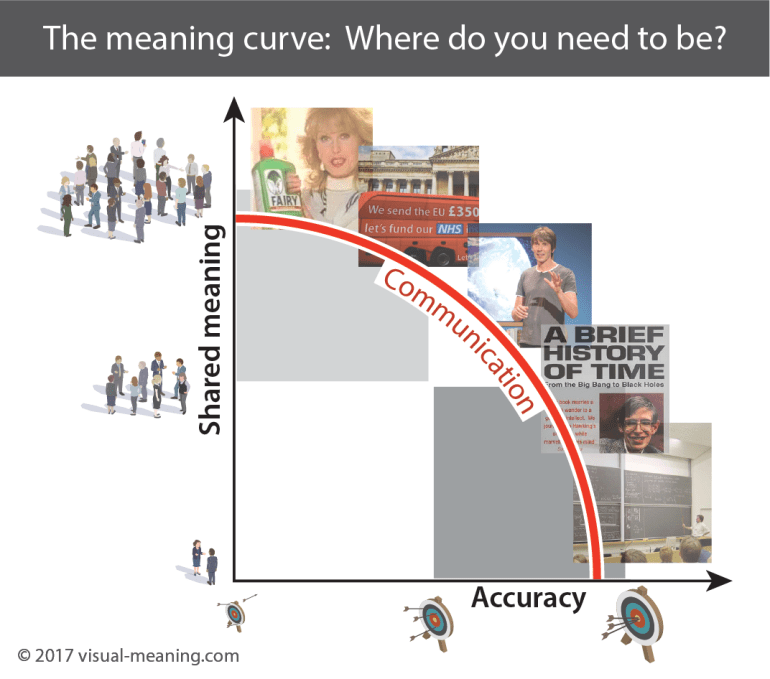


























You must be logged in to post a comment.