General complexity: A philosophical and critical perspective

cxdig's avatarComplexity Digest

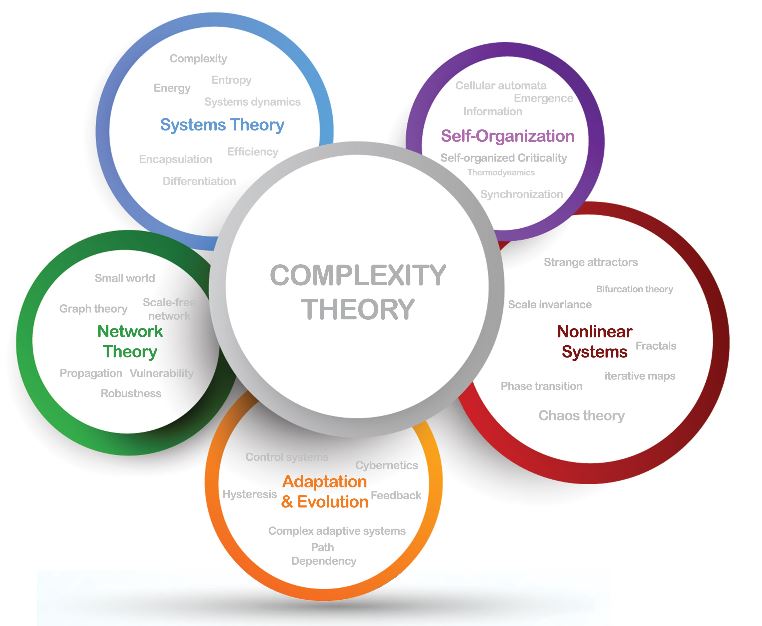
In this paper we argue that a rigorous understanding of the nature and implications of complexityreveals that the underlying assumptions that inform our understanding of complex phenomena are deeply related to general philosophical issues. We draw on a very specific philosophical interpretation of complexity, as informed by the work of Paul Cilliers and Edgar Morin. This interpretation of complexity, we argue, resonates with specific themes in post-structural philosophy in general, and deconstruction in particular. We argue that post-structural terms such as différance carry critical insights into furthering our understanding of complexity. The defining feature that distinguishes the account of complexity offered here to other contemporary theories of complexity is the notion of critique. The critical imperative that can be located in a philosophical interpretation of complexity exposes the limitations of totalising theories and subsequently calls for examining the normativity inherent in the knowledge claims that we make. The conjunction of…

View original post 60 more words

UK Cybernetics Society 50th anniversary conference – 22 September

50th Anniversary Conference

The Conference will be held on Saturday 22nd September 2018
The Council Room, King’s College, 152-170 Strand, London WC2R 1ES

Programme

9.30     Registration

10.00 The Power of Systems: How Policy Sciences Opened up the Cold War World Dr. Egle Rindzeviciute, Associate Professor (Reader) in Sociology, Kingston University London, and author of the book with the same title.

10.45 Sketches of Another Future: Cybernetics in Britain, 1940-2000” Prof. Andrew Pickering, Emeritus Professor of Sociology and Philosophy, University of Exeter, and author of “The Cybernetic Brain: Sketches of Another Future”.

11.30 Break

11.45 When Science Becomes Engineering in a Non-linear World Prof Peter Cochrane OBE, Professor of Sentient Systems, University of Suffolk, former Head of Research at BT, and author of “Uncommon Sense: Out-of-the-Box Thinking for an In-the-Box World”

12.30 Systems Practice: How to Act in Situations of Uncertainty and Complexity in a Climate-Change World Ray Ison, Professor of Systems, Open University, and author of the book of the same title.

1.15 Lunch at Aldwych Cafe, Starbucks, Pret a Manger etc

2.30 Radically Constructing Ethics Dr Ben Sweeting, Principal Lecturer, University of Brighton and researcher in cybernetics and systems thinking amongst designers.

3.15 Making Systems Ethical: The Ethical Regulator Theorem” Mick Ashby, Archivist of the W. Ross Ashby Digital Archive, an AI language developer and researcher in the cybernetics of ethics.

4.00 Break

4.15 Producing Desirable Social Systems” Prof. Raul Espejo, President of the World Organisation of Systems and Cybernetics, an academician of the International Academy for Systems and Cybernetic Sciences, and Past Professor of Systems and Cybernetics at the University of Lincoln.

5.00 Be Careful What You Wish For: The Internet of Unintended Consequences Wendy M. Grossman, Technology Journalist and author or editor of several books including Net.wars.

5.45 Break

6.00 Cybernetics and the Control of Complex Human Systems Jeffrey Johnson, Professor of Complexity Science and Design, Open University, and Vice-president of the UNESCO UniTwin Complex Systems Digital Campus.

6.45 Panel question and answer session for any speaker.

Finish at 7.15 to be followed by dinner at 7.30pm at Salieri’s Restaurant, Strand.

Cybernetics Society members, staff, students and alumni of King’s College are admitted free of charge. Non-members may apply to join at the conference. The membership fee for the three months to the end of the year is £5. The student membership fee for the three months is £2.50. Application forms will be made available on the day. If you are considering attending please email so that we can estimate numbers. If you are contemplating joining us for dinner, please let us know for restaurant booking.

Further information on the Society and an application form is available on our website here.

Please put the date in your diary now.

See more including speaker profiles and abstracts in source: The Cybernetics Society

Considering Appropriate spatial-temporal Scale — bigger and faster isn’t always better! Daniel Christian Wahl

Considering Appropriate spatial-temporal Scale — bigger and faster isn’t always better!

An excerpt from ‘Exploring Participation’ (D.C.Wahl, 2002)

In their book Ecological Design, Sim Van der Ryn and Stuart Cowan introduce the concept of ‘scale-linking’. They argue that since we traditionally have studied the world using the language, metaphors and tools of a single discipline at a time, we have been predisposed to “seeing process on a single scale”.

Van der Ryn and Cowan believe that this approach is insufficient in capturing the underlying phenomena, since:

“Nature’s processes are inherently scale linking, for they inherently depend on the flow of energy and materials across scales. … Global cycles link organisms together in a highly effective recycling system crossing about seventeen tenfold jumps in scale, from the ten-billionth of a meter (the scale of photosynthesis) to ten thousand kilometres (the scale of the Earth itself).”139

In their opinion:

“Scale-linking systems imply a holism in which everything influences, or potentially influences everything else — because everything is in some sense constantly interacting with everything else. Nature is infused with the dynamical interpenetration of the vast and minute, an endless dervish mixing. Matter and energy continually flow across scales, the small informing the large and the large informing the small …

Unless we work with nature’s own finely tuned scale-linking systems we endanger the stability of life on the planet… If we are to properly include ecological concerns within design, we must take seriously the challenge offered by scale linking. We need to discover ways to integrate our design processes across multiple levels of scale and make these processes compatible with natural cycles of water, energy, and material.”140

— Van der Ryn & Cowan

Van der Ryn and Cowan argue that fractal geometry provides a tool to study the geometry of scale linking, as it helps to connect remarkable ranges of scale “from twig to tree, from rivulet to watershed.”141 They see our failure not to pay attention to scale-linking and therefore not to match the human flows of energy and materials to the limits of a particular landscape as a critical cause of the current environmental crisis. [Note: This is an excerpt from my 2002masters dissertation in Holistic Science at Schumacher College. Be mindful that I wrote this 15 years ago and enjoy!]

Sim Van der Ryn’s Ecological Learning Curve (Source)

Continutes in source: Considering Appropriate spatial-temporal Scale — bigger and faster isn’t always better!

Systems thinking open access articles from MDPI

See below for a rich list of articles. I note from a quick google that MDPI is a not entirely uncontroversial publisher (https://en.wikipedia.org/wiki/MDPI seems balanced) – broadly it seems that they are not on ‘predatory journals’ lists but their academic quality has sometimes been called into question. However, some interesting titles here and you can judge for yourself.

 
systems-logo www.mdpi.com

Dear Readers,

We are pleased to announce the publication of the following issue of Systems:

Systems, Volume 6, Issue 2 (June 2018)

Table of Contents

Special Issue Modelling of Economic Systems

Article: Adding Feedbacks and Non-Linearity to the Neoclassical Growth Model: A New Realm for System Dynamics Applications
by Lukáš Režný and Vladimír Bureš
Systems 20186(2), 8; doi:10.3390/systems6020008

Article: Efficient and Equitable Climate Change Policies
by Socrates Kypreos, James Glynn, Evangelos Panos, George Giannakidis and Brian Ó Gallachóir
Systems 20186(2), 10; doi:10.3390/systems6020010

Article: How to Express and to Measure Whether an Economic System Develops Intensively
by Petr Wawrosz, Jiří Mihola and Jana Kotěšovcová
Systems 20186(2), 24; doi:10.3390/systems6020024

Article: Monetary and Fiscal Policy Interactions in the Czech Republic
by Pavel Rezabek and Petr Doucek
Systems 20186(2), 25; doi:10.3390/systems6020025

Special Issue Governance Change in Organizational and Territorial Systems

Article: Online Academic Networks as Knowledge Brokers: The Mediating Role of Organizational Support
by Elena-Mădălina Vătămănescu, Andreia Gabriela Andrei, Patrizia Gazzola and Gandolfo Dominici
Systems 20186(2), 11; doi:10.3390/systems6020011

Article: Mapping Digital Co-Creation for Urban Communities and Public Places
by Monika Mačiulienė
Systems 20186(2), 14; doi:10.3390/systems6020014

Special Issue Systems Thinking

Article: Using Systems Thinking to Understand and Enlarge Mental Models: Helping the Transition to a Sustainable World
by Edward J. Garrity
Systems 20186(2), 15; doi:10.3390/systems6020015

Article: Modeling Isomorphic Systems Processes Using Monterey Phoenix
by Kristin Giammarco and Len Troncale
Systems 20186(2), 18; doi:10.3390/systems6020018

Communication: Natural Systems Thinking and the Human Family
by Daniel Papero, Randall Frost, Laura Havstad and Robert Noone
Systems 20186(2), 19; doi:10.3390/systems6020019

Article: Maturity Models for Systems Thinking
by Pamela Buckle
Systems 20186(2), 23; doi:10.3390/systems6020023

Special Issue Civil/Environmental Systems Design

Article: Resilience of Critical Infrastructure Elements and Its Main Factors
by David Rehak, Pavel Senovsky and Simona Slivkova
Systems 20186(2), 21; doi:10.3390/systems6020021

Further Publications

Article: Conceptual Framework for Product Service Systems
by Amir Pirayesh, Guy Doumeingts, Marco Seregni, Sergio Gusmeroli, Ingo Westphal, Lara Gonzalez, Carl Hans, María José Núñez Ariño, Alessandro Canepa Eugenio and Andoni Laskurain
Systems 20186(2), 20; doi:10.3390/systems6020020

Article: Evolution of ERP Systems in the Cloud: A Study on System Updates
by Elise Bjelland and Moutaz Haddara
Systems 20186(2), 22; doi:10.3390/systems6020022

Special Issues Open for Submissions

Human Factors in Complex Systems
(Deadline: 31 August 2018)

Deep Learning and Optimization Techniques for Intelligent Transportation System
(Deadline: 1 October 2018)

Enterprise Systems & Gamification
(Deadline: 31 October 2018)

Systems Thinking
(Deadline: 31 October 2018)

Systems Thinking: Concepts, Issues, and Applications in Large Complex Systems
(Deadline: 31 December 2018)

A Systems Approach to Sustainability within Agenda 2030 and across SDGs
(Deadline: 28 February 2019)

Artificial Intelligence Knowledge Representation
(Deadline: 30 June 2019)

To access the full list of Special Issues, please click here

To manage your journal subscriptions, please log in to http://susy.mdpi.com/user/subscriptions
MDPI
Postfach, CH-4020 Basel, Switzerland
Office: St. Alban-Anlage 66, CH-4052 Basel, Switzerland
Tel. +41 61 683 77 34
Fax +41 61 302 89 18
www.mdpi.com
Twitter Facebook LinkedIn Google+

It’s a wicked problem, stupid! (revisited) | CSL4D

A bit over 5 years ago I first learned about wicked problems. So I looked at the oft-cited seminal article by Rittel & Webber of 1973 and tried to make sense of it (see old post). There was a lot of information in the article, which made it a bit confusing. The most often quoted part of the article is the list of ten characteristics of wicked problems. These ten points seem to be clear to most people, but to me it remained a bit cryptical. Time for a second effort. I will make use of a second paper by Rittel entitled ‘On the planning crisis’ of 1972 (presented 1971). The reader must bear with me, because both papers are very long (on average over 8240 words each), rich and profound. I am pretty sure the essence of Rittel’s work has been properly condensed now. Here we go.

[Continues in source]: It’s a wicked problem, stupid! (revisited) | CSL4D

Ritual anti-structure as an alternate pathway to social complexity

“There is growing dissatisfaction with the traditional approach to the evolution of complex societies, which treated it principally as a sequence of transformations toward political centralization driven by the construction of increasingly vertical hierarchies by a powerful elite.”

[Aha! As I suspected, yet more proof that lazy tropes are lazy tropes… if anyone gives you a linear progressive narrative of history, they’re selling something. Don’t buy it! Don’t buy it!]

Connecting the Purpose(s) – Intelligente-Organisationen

Connecting the Purpose(s)

The VSM as a Way of Looking at the World and How to Align Visions in Order to Create a Unifying Meta-Purpose

The discussions about the so called „Organizational Purpose“ have reached in recent years a new level – at least in my perception. Of course there always was (and will be) a never ending debate about what the „true“ purpose of an organization might be. I am pretty sure, that it is crucial to distinguish between the imagined/visionary purpose and the results an organization „really“ achieves. The imagined/visionary purpose is here purely a mental projection or a bet on how the future might look like. There is the definition of Stafford Beer who said that the purpose of an organization is what it does – in short POSIWID. This distinction is important, because people often mix up the Purpose of an Organization and its Vision. In this respect I am a great fan of looking at the Imagined Purpose (aka Vision) and Achieved Purpose (aka Production) separately.

For the Reflective Practitioner, who does not only want to understand how the „thing“ works, as an Expert would do, two questions arise: what should one do with the above mentioned distinction in the real world, in a real company with existing constraints? How to deal with the difference of the imagined outcomes and truly achieved goals?

For me and my cognitive biased brain the VSM offers an elegant, plausible and aesthetic way to understand this pseudo-paradox and connect the different functional and systemic (Sub-) Purposes of a System (in the context of the VSM).


Micro Excursion I

Elegance, Plausibility and Aesthetics are not necessarily parameters in a scientific way of thinking. They could promote the distribution of Bullshit and must be treated with greatest skepticism. Nevertheless I use them as indicators, if a solution is simple enough, but not too simple (in order to re-phrase Albert Einstein).


How can the VSM help to connect the different Functional (skill and task related) and the Systemic (VSM-like) Purposes of an Organization?

This question might sound quite academic, but out there in the wild life of business I do see an urging relevance for the topic mentioned in the headline. It needs in economic/social systems an integrated way to connect the Functional Purpose of the different units with the VSM-System-specific responsibilities. It’s about enabling a „Holistic Whole“. The following example might be useful to illustrate the application of the VSM for this matter.

Continues in source: Connecting the Purpose(s) – Intelligente-Organisationen

Improvisation Blog: Redundancy and the Communication of Meaning in Music: Bach’s 3-part Invention (Sinfonia) no. 9 in F minor

Saturday, 21 July 2018

Redundancy and the Communication of Meaning in Music: Bach’s 3-part Invention (Sinfonia) no. 9 in F minor

Hindemith chose Bach’s F minor 3 part invention for analysis to demonstrate his theory of composition in “The craft of musical composition”. It is a fascinating piece – one of Bach’s most chromatic and expressive pieces of keyboard writing, and rather like other extraordinary musical moments (like Wagner’s musical orgasm in Tristan), it raises the question “What is going on?”. I like Hindemith’s theory very much (although not as much as I like his music!), but his analysis sent me on my own analytical journey through the lens of information theory.

What happens in music, I believe, is the unfolding of a structure where multiple constraints are interwoven and overlaid. Information theory can provide some insight into this (as is discussed in a very recent paper from Loet Leydesdorff, myself and Inga Ivanova in the Journal of the Association for Information Science and Technology: https://onlinelibrary.wiley.com/doi/full/10.1002/asi.24052), and particularly the meaningfulness of the communication.

When considering music from the perspective of information theory, there are three fundamental problems to be overcome:

  1. Music has no object of reference. So how is meaning communicated without reference?
  2. Music emerges over time, producing novelty and unfolding a diachronic structure which appears to be linked to its synchronic structure. For this reason, music is not ergodic, unlike the use of letters in a language: its entropy over one period of time is not the same as its entropy over a different period of time.
  3. Music’s unfolding novelty is not arbitrary: novelty in music appears to be a symmetry-breaking process similar to that found in epigenesis where both synchronic and diachronic symmetries gradually define structure
The first page of Bach’s music looks like this:
Here’s a performance:
The piece is fugal, and obviously in three parts, there is a very bare texture, and this bareness seems to contribute to the expressiveness of the music. However, there is a harmonic structure which is articulated throughout the piece, and a reduction of the harmonic written as chords per beat, looks something like this:
This kind of harmonic reduction is very common in music analysis as a method for getting at the “deep structure” of music (particularly in Schenker). It is typical of Bach’s music that the harmonic reduction is very much like a chorale (hymn). In trying to understand how Bach’s music works, we can start by asking about the relation between the harmonic reduction and the finished piece.
At first glance, from an information theory perspective, the block chords of the reduction seem to remove a considerable amount of entropy which exists in the movement of parts in the original. It does this by compressing the variety into single “beats”, which taken as an entirety have an entropy of 1. However, the variety compression makes more apparent the shifting harmonies. Written in chord symbols, this is an extended I (tonic) – V (dominant) – I (tonic) movement, interspersed with diminished chords (which are harmonically ambiguous) and a oscillation between major and minor chords. But if one was to calculate the entropy of the harmony, it wouldn’t be that great.

Continues in source: Improvisation Blog: Redundancy and the Communication of Meaning in Music: Bach’s 3-part Invention (Sinfonia) no. 9 in F minor

An artificial life approach to the origins of the genetic code

a very interesting approach to using embodiment as an explanatory principle for origins of life.

“A growing number of artificial life researchers propose that making progress on the problem of the origins of life requires taking seriously life’s embodiment: even very simple life-like systems that are spatially individuated can interact with their environment in an adaptive manner. This behavior-based approach has also opened up new perspectives on a related unsolved problem, namely the origin of the genetic code, which can now be seen as emerging out of iterated interactions in a community of individuals. Thus, artificial life demonstrates that the dominant scientific strategy of searching for the conditions of Darwinian evolution should be broadened to consider other possibilities of optimization.”

Release | Stakeholder Theory: A Luhmannian Perspective

Dr. Steffen Roth's avatarDr Steffen Roth

Valentinov V., Roth S., and Will M. G. (2018), Stakeholder theory: A Luhmannian perspectiveAdministration and Society, online first [SSCI 1.761, Scopus, CNRS***, ABS**, VHB**].

Abstract: We explore the cross-fertilization potential between stakeholder theory and Niklas Luhmann’s social systems theory. Social systems, such as corporations or nonprofits, are defined by complexity reduction and operational closure, which may render them insensitive to their environment and undermine their sustainability. This vision resonates with stakeholder theory’s arguments on the importance of the corporate responsiveness to stakeholder interests. The suggested common ground between the theories yields novel insights into key concepts of stakeholder theory such as the contrast between the jointness of stakeholder interests and trade-off thinking, the normativity of the stakeholder idea, and the meaning of corporate social responsibility.

Keywords: stakeholder theory, social systems theory, Niklas Luhmann, normativity, organizational multifunctionality.

Full article available for download here.

View original post

Understanding Society blog: Downward causation

Tuesday, July 17, 2018

Downward causation

I’ve argued for the idea that social phenomena are generated by the actions, thoughts, and mental frameworks of myriad actors (link). This expresses the idea of ontological individualism. But I also believe that social arrangements — structures, ideologies, institutions — have genuine effects on the actions of individual actors and populations of actors and on intermediate-level social structures. There is real downward and lateral causation in the social world. Are these two views compatible?

I believe they are compatible.

The negative view holds that what appears to be downward causation is really just the workings of the lower-level components through their aggregation dynamics — the lower struts of Coleman’s boat (link). So when we say “the ideology of nationalism causes the rise of ultraconservative political leaders”, this is just a shorthand for “many voters share the values of nationalism and elect candidates who propose radical solutions to issues like immigration.” This seems to be the view of analytical-sociology purists.

But consider the alternative view — that higher level entities sometimes come to possess stable causal powers that influence the behavior and even the constitution of the entities of which they are composed. This seems like an implausible idea in the natural sciences — it is hard to imagine a world in which electrons have different physical properties as an effect of the lattice arrangement of atoms in a metal. But human actors are different from electrons and atoms, in that their behavior and constitution are in fact plastic to an important degree. In one social environment actors are disposed to be highly attentive to costs and benefits; in another social environment they are more amenable to conformance to locally expressed norms. And we can say quite a bit about the mechanisms of social psychology through which the cognitive and normative frameworks of actors are influenced by features of their social environments. This has an important implication: features of the higher-level social reality can change the dispositions and workings of the lower-level actors. And these changes may in turn lead to the emergence of new higher-level factors (new institutions, new normative systems, new social practices of solidarity, …). So enduring social arrangements can cause changes in the dynamic properties of the actors who live within them.

Could we even say, more radically and counter-intuitively, that a normative structure like extremist populism “generates” behavior at the individual level? So rather than holding that individual actions generate higher-level structures, might we hold that higher-level normative structures generate patterns of behavior? For example, we might say that the normative strictures of patriarchy generate patterns of domination and deference among men and women at the individual level; or the normative strictures of Jim-Crow race relations generate individual-level patterns of subordination and domination among white and black individuals. There is a sense in which this statement about the direction of generation is obviously true; broadly shared knowledge frameworks or normative commitments “generate” typical forms of behavior in stylized circumstances of choice.

Does this way of thinking about the process of “generation” suggest that we need to rethink the directionality implied by the micro-macro distinction? Might we say that normative systems and social structures are as fundamental as patterns of individual behavior?

Consider the social reality depicted in the photograph above. Here we see coordinated action of a number of soldiers climbing out of a trench in World War I to cross the killing field of no mans land. The dozen or so soldiers depicted here are part of a vast army at war (3.8 million by 1918), deployed over a front extending hundreds of miles. The majority of the soldiers depicted here are about to receive grievous or mortal wounds. And yet they go over the trench. What can we say about the cause of this collective action at a specific moment in time? First, an order was conveyed through a communications system extending from commander to sergeant to enlisted man: “attack at 7:00 am”. Second, the industrial wealth of Great Britain permitted the state the ability to equip and field a vast infantry army. Third, a system of international competition broke down into violent confrontation and war, leading numerous participant nations to organize and fund armies at war to defeat their enemies. Fourth, the morale of the troops was maintained at a sufficiently high level to avoid mass desertion and refusal to fight.  Fifth, an infantry training regime existed which gave ordinary farmhands, workers, accountants, and lords the habits and skills of infantry soldiers. All of these factors are part of the causal background of this simple episode in World War I; and most of these factors exist at a meso- or macro-level of social organization. Clearly this particular group of social actors was influenced by higher-level social factors. But equally clearly, the mechanisms through which these higher-level social factors work are straightforward to identify through reference to systems of individual actors.

Think for a minute about materials science. The hardness of titanium causes the nail to scratch the glass. It is true that material properties like hardness depend upon their microstructures. Nonetheless we are perfectly comfortable in attributing real causal powers to titanium at the level of a macro-material. And this attribution is not merely a way of summarizing a long story about the micro-structure of metallic titanium.

I’ve generally tried to think about these kinds of causal stories in terms of the idea of microfoundations. The hardness of titanium derives from its microfoundations at the level of atomic and subatomic causation. And the causal powers of patriarchy derive from the fact that the normative principles of partriarchy are embedded in the minds and behavior of many individuals, who become exemplars, enforcers, and encouragers of compliant behavior. The processes through which individuals acquire normative principles and the processes through which they behaviorally reflect these principles constitute the microfoundations of the meso- and macro-power of patriarchy.

So the question of whether there is downward causation seems almost too easy. Of course there is downward causation in the social world. Individuals are influenced in their choices and behavior by structural and normative factors beyond their control. And more fundamentally, individuals are changed in their fundamental dispositions to behavior through their immersion in social arrangements.

Source: Understanding Society: Downward causation

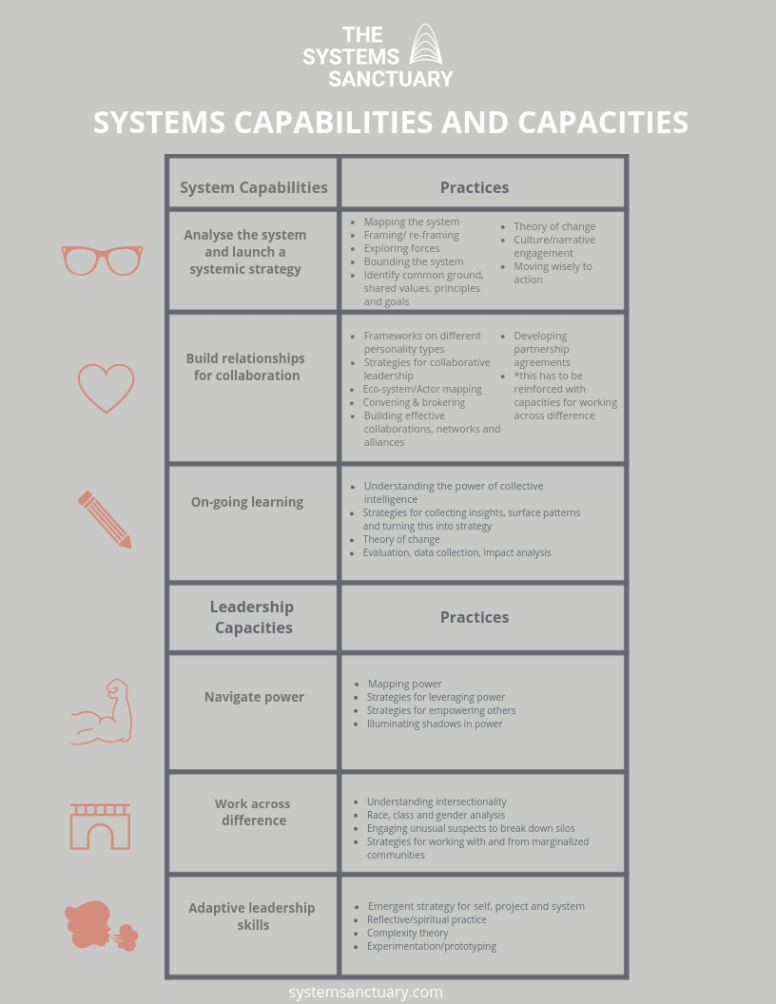
Systems Studio newsletter July 2018

[As usual, the excellent monthly newsletter from The Systems Studio]

Source: Top Inspiration, Events and News on Systems Change 

System change consulting skills programme | Health Education England

[Full disclosure – I offer this kind of thing too 🙂 Look good]

System change consulting skills programme

Healthcare leaders are increasingly required to facilitate transformational change in and across their system and organisations, often without power or authority.


The network of Northern Leadership Academies in the North East, North West and Yorkshire & Humber have collaborated to offer an in-place programme for leaders tasked with transformational change within the system. This programme has been designed to challenge and support leaders to develop their confidence, skills and mindset to work in a ‘change consultant’ capacity when engaging in organisational, cross-organisation and system change transformation and programmes of work.

Invitation to apply

Senior healthcare professionals working on a transformational change project or leading/supporting a strategic, complex system change are invited to apply. Alternatively, you may be a senior OD/HR or transformation professional working in and/or supporting others with transformational change projects? For example:

  • a clinician leading transformation programmes associated with The Sustainability Transformation Planning (STP) / Integrated Care Systems (ICS) / Accountable Care Organisation (ACS) new models of care, primary care home
  • a senior leader working to strategically transform their organisation.
  • a system change leader working across organisations
  • a senior OD/HR and transformation professional working in strategic OD

This programme will provide you with an intensive development experience designed to extend your confidence and skills to step into a system change leadership role utilising a system change consulting approach.

About the programme

The programme is highly experiential, using live, real time system transformation challenges experienced by participants. Learning is highly practical and can be readily applied between modules and in on-going work supported by a vibrant network of peer consultants.

Being an enabler and leader of transformational change across a system draws on a blend of relationally based consultancy skills, mindset, processes and techniques. How we connect with and relate to others impacts our ability to influence. Impactful and effective systems change agency isn’t simply about advocating a point of view, but rather how you choose to use your informal authority and presence to benefit the wider system.

The programme will help you to:

  • Be a confident, competent and courageous system change leader who can collaborate well, and influence system change and transformation ‘in place’ across your local healthcare system
  • Share the benefits of taking a more consultative and relationship-based approach to system-wide transformation, and follow a consultancy-led process
  • Have greater levels of self-awareness and a deeper understanding of how you impact others, how to use yourself more effectively to enable transformation and change, and identify your future development needs
  • Develop your perspective and mindset as to what creates successful transformation across the system and draw on a range of tools and approaches to assist you.
  • Identify how you could use your skills as a change leader and facilitator to work at a system level and support system-wide transformation outside your current organisation in the future.

There is an expectation that following the programme you will be more involved in working across your local healthcare system to support wider system transformation projects or work-streams.

Application process

Participation on the programme is dependent on a successful application , submitted by 25 July 2018. Participants should have ready opportunity for involvement in systems change/transformation projects

For further information contact leadershipenquiries.yh@hee.nhs.uk in the first instance.

Source: System change consulting skills programme | Health Education England

New article on entraining chaotic dynamics

woah… mind ‘splode.
literally… metaphorically.

“Use of Self as an Instrument of Change” Study – thanks to CoCreative Consulting newsletter, plus other links

Thanks to the excellent newsletter from the excellent CoCreative Consulting (The Work is Growing! News, resources, and tools for system change – have a look for much more on collaboration, systems change, and network building), I found this piece:

“Use of Self as an Instrument of Change” Study

Dr. Mee-Yan Cheung-Judge of Quality & Equality and Professor David W. Jamieson of the University of St. Thomas have released an intriguing new survey about how we as change leaders use ourselves intentionally as instruments of change. Although the research team is focused on the field of OD, we got permission to invite people who are leading and facilitating change in larger systems. With over 137 assessment items (the intent of the survey is to narrow their future inquiry), we found the survey to be a useful and compelling tool for self-reflection.To participate, you must have 5 or more years of OD practice experience, internally or externally, or 5 years of actively facilitating complex systems change. Find more information here

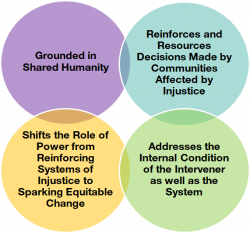
Also, (links with further info in newsletter link at top), two great visual pieces – agendas in collaborative innovation, and systems conditions guiding their (CoCollaborative) work:

s
search
c
compose new post
r
reply
e
edit
t
go to top
j
go to the next post or comment
k
go to the previous post or comment
o
toggle comment visibility
esc
cancel edit post or comment