h/t to this mini-thread on twitter by Olivia Guest
This might be the coolest book cover: Yelena Saparina, Cybernetics within us (1966). Talk about things never changing about hype! She's got great ideas too about if machines can think that echo Ada Lovelace and many others. Link below! pic.twitter.com/8q8n5IsAPN
Can a rat tell the difference between a Raphael Madonna and a Picasso Girl in Blue? Would a Martian (if there is such a thing) recognize a live cat after having seen a photograph of one? Can a “seeing”electronic machine be made to tell a cat from a dog or an A from a B? How would it go about “computing” the image? And is “machine thinking”anything like human thinking?
These and other such problems are investigated in the branch of cybernetics that studies living systems: bionics, as this ultramodern science is now called. It developed when scientists began to compare the design and operation of electronic systems with living organisms. Our body, they found, is a complex cybernetic system controlled by countless self-regulating devices. In fact, every single cell of our body is an automatic control device in its own right. Millions upon millions of tiny cybernetic units are constantly at work within us. They maintain normal blood pressure, control the composition of the gastric juices, ensure the rhythmic contraction of the heart and lungs, and do a thousand other things that come under the heading of “vital functions”of the organism.
How they work and how our body functions is described in this popular exposition, which requires no previous knowledge of cybernetics, biology, electronics, or any other subject for that matter (except reading, of course).
The book was translated from the Russian by Vladimir Talmy and was published by Peace in 1966.
Cybernetics Within Usby Yelena SaparinaPublication date 1966Topics science, popular, mir publishers, peace publishers, machine, perception, learning, vision, language, information, logic, circuits, pleasure centre, brains, cognition, cybernetics, cognitive science, automata, molecules, interaction, systems, levels, neural architecture, neurons, mindCollection mir-titles; additional_collectionsLanguage EnglishCan a rat tell the difference between a Raphael Madonna and a Picasso Girl in Blue? Would a Martian (if there is such a thing) recognize a live cat after having seen a photograph of one? Can a “seeing”electronic machine be made to tell a cat from a dog or an A from a B? How would it go about “computing” the image? And is “machine thinking”anything like human thinking?These and other such problems are investigated in the branch of cybernetics that studies living systems: bionics, as this ultramodern science is now called. It developed when scientists began to compare the design and operation of electronic systems with living organisms. Our body, they found, is a complex cybernetic system controlled by countless self-regulating devices. In fact, every single cell of our body is an automatic control device in its own right. Millions upon millions of tiny cybernetic units are constantly at work within us. They maintain normal blood pressure, control the composition of the gastric juices, ensure the rhythmic contraction of the heart and lungs, and do a thousand other things that come under the heading of “vital functions”of the organism.How they work and how our body functions is described in this popular exposition, which requires no previous knowledge of cybernetics, biology, electronics, or any other subject for that matter (except reading, of course).The book was translated from the Russian by Vladimir Talmy and was published by Peace in 1966.
The year of 2024 marks the 25th anniversary of the publication of evoloops, an evolutionary variant of Chris Langton’s self-reproducing loops which proved that Darwinian evolution of self-reproducing organisms by variation and natural selection is possible within deterministic cellular automata. Over the last few decades, this line of Artificial Life research has since undergone several important developments. Although it experienced a relative dormancy of activities for a while, the recent rise of interest in open-ended evolution and the success of continuous cellular automata models have brought researchers’ attention back to how to make spatio-temporal patterns self-reproduce and evolve within spatially distributed computational media. This article provides a review of the relevant literature on this topic over the past 25 years and highlights the major accomplishments made so far, the challenges being faced, and promising future research directions.
What are the deeper reasons why our world is hurtling headlong toward social, ecological, and climate collapse? In her recently published book, The Story Is in Our Bones: How Worldviews and Climate Justice Can Remake a World in Crisis, author and activist Osprey Orielle Lake helps us discern these reasons in the dominant worldview based upon extraction and exploitation.
The book shows how the interlocking crises of colonialism, racism, patriarchy, capitalism, and ecocide have set us on this course, and opens a portal to an alternative path of restoration and justice. Building on her experience working with global leaders, systems-thinkers, climate justice activists, and Indigenous Peoples, Osprey weaves together ecological, mythical, political, and cultural insights to summon a new way of being and thinking—showing that another world is possible.
In this Deep Transformation Network live interactive conversation, Osprey will discuss with Jeremy Lent the central themes arising from her book and her work. As founder of the Women’s Earth and Climate Action Network (WECAN), Osprey has stood with Indigenous women land defenders around the world in their struggle for policies that prioritize social, racial and economic justice, and Indigenous and human rights. Jeremy will explore with Osprey how her experience of frontline activism has informed her thinking, and how the ancient story that is in our bones can lay the groundwork for an alternative Earth-centered, vibrant future.
Event Details
This online event will be hosted by the Deep Transformation Network. It is free and open to all. Following the initial conversation, DTN members will be invited to ask questions and engage directly with Osprey and Jeremy.
[In which both Wolfram and Jaimungal suddenly seem much more sympathetic to me – perhaps because they genuinely appreciate each other and each others’ company – but also because this is such fun second order cybernetics, I can even forgive the speculation on The Nature of God (which in turn has fascinating connections to the current episode of Weird Studies, on the Devil)… worth a listen, I think]
Limicon 2024 is a month-long emergent online convention for the Liminal Web and anyone liminal-curious (Game B, metamodern, integral, tpot, etc).
Part we-space, part choose your own adventure, part field-nurturing experiment, Limicon 2024 is an open-space convention from March 6th – April 3rd, where participants can co-create the events and possibilities that they want to attend.
Sign up today for $25 for a month of events at Limicon2024 dot com.
—————-
**WHY?**
We find ourselves in a liminal space between worlds, entrenched in a metacrisis, and embedded in cultural systems that are inadequate for regenerative future civilization.
We need to come together and co-navigate these uncertain times together.
—————-
**WHO?**
This event is for those in the LIminal Web or those on the edges.
We welcome practitioners, artists, ritual builders, philosophers, community weavers, scientists, activists and fans of liminal, integral, metamodern, game b, tpot, bildung, and regen communities.
We embrace anyone drawn to the question: How do we become the humans we need to be, both individually and collectively, to be in service to hospicing the old systems and midwifing the new systems that are emerging?
1. Come together – Sign up at Limicon2024 dot com 2. Surface possibilities – Add yourself to the Network Map and co-create the event schedule on the Limicon Miro https://miro.com/app/board/uXjVNEa8tqg=/ 3. Be present and Attune – Be open to connection and possibilities. Attune to what is already here. 4. Reflect and Evolve – Notice: What is happening? What are we learning? How are our connections evolving? What conversations want to emerge?
—————-
**WHEN?**
As we collectively emerge from the winter, it is time to spring up together and jolt the field into liveliness.
Limicon runs 2 weeks before and after Spring Equinox (March 6th – April 3rd).
—————-
**WHERE?**
Sign up today for $25 for a month of events at Limicon2024 dot com.
ample codeIllusions of magic and smoke rings in codeAbout← Conway’s mobProper JSON and property bags →Into the Tar PitPosted: May 19, 2020 | Author: Einar | F
[Another discovery of another little planetary system in the universe of systems |complexity|cybernetics – this is ‘the system’ primarily of matching the right balanced of general/early/specialist interventions in speech and language therapy, though it does have a role for chidlren and families too]
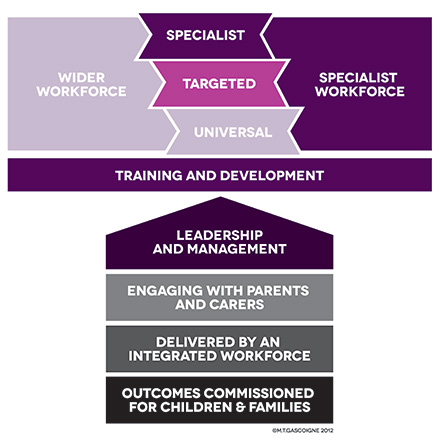
WHAT IS THE BALANCED SYSTEM®?
The Balanced System® is a whole system strategic approach to supporting children and people with a whole range of needs, that has primarily come out of work in the area of speech, language and communication.
Marie Gascoigne has been developing the Balanced System® framework for over 15 years. It is used by a whole range of stakeholders, including commissioners from all disciplines and providers, particularly of therapy services.
As the diagram shows, it is a see-saw model with a set of blocks that provide the base above which balanced support is delivered.



You must be logged in to post a comment.