All at 5-6:30pm UK time
Wednesday 31st January Dr. M Zargham From Viable Organizations to Viable Ecologies
Wednesday 6th March Dr. Pile Bunnell Language as an Enabling Constraint for Viability
Wednesday 3rd April Professor Andrew Pickering Cybernetics and the Environmental Crisis
Wednesday 8th May Dr. Peter Robertson The Sapient Paradox as the consequence of a cybernetical bifurcation in the evolution
You can watch all the recordings of the 2023 Webinar Series (and the first webinar this year) on our webinar recordings webpage: https://metaphorum.org/webinar-recordings
You can join any of the webinars by following this link: https://us02web.zoom.us/j/81943981395
Dr. M Zargham
From Viable Organizations to Viable Ecologies
Jan 31st. 5:00- 6:30 pm (UK wintertime)
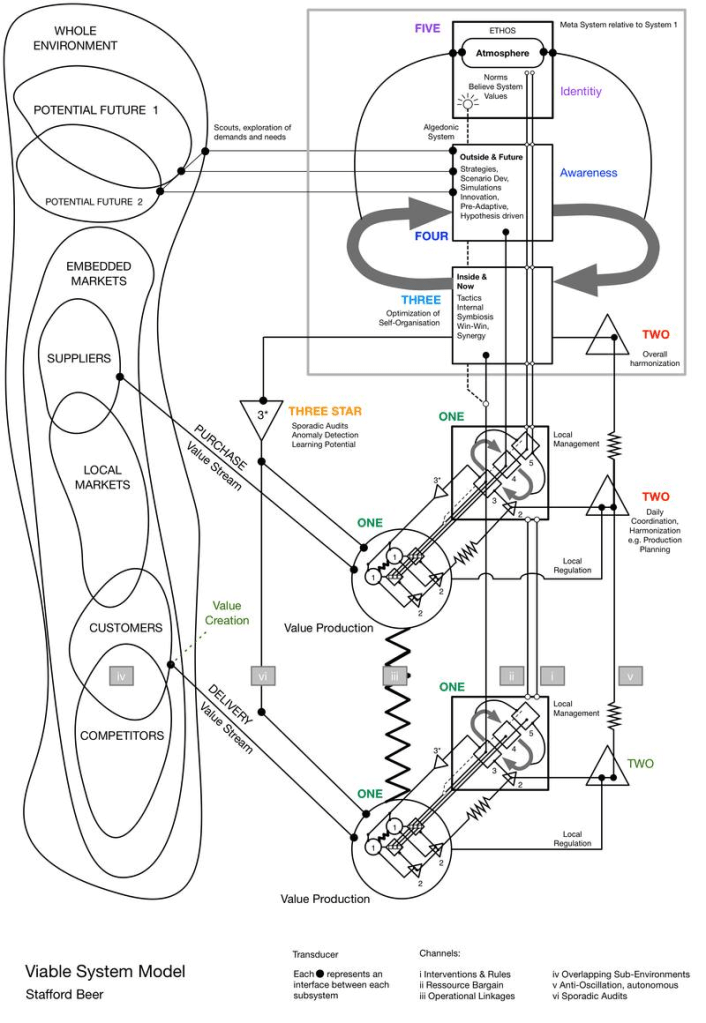
This workshop presents an approach to organizational analysis and design, leveraging Stafford Beer’s Viable System Model (VSM) as well as methods for mapping an organization’s environment and its interactions across a range of regulatory modalities. The first part of the workshop is a presentation which explores how these models can be applied to understand an organization’s infrastructures and internal dynamics in relation to external environmental pressures. Specifically, these models are applied to the analysis of an organization developed by the speaker over the past 7 years, alongside many collaborators.
The second part of the workshop is a guided discussion which explores the potential of emerging technologies to foster networks of smaller, self-governed entities – as compared to the common monolithic organizational archetypes. This segment explores how new technologies can support the development and maintenance of organizational infrastructures that increase viability without loss of variety. Attendees will brainstorm environmental forces such organizations must navigate, as well as the tools and practices available to ride or buttress against those forces – concluding with a discussion of potentially actionable steps toward this future.
Michael Zargham is the founder and Chief Engineer at BlockScience, as well as a board member and research director at the Metagovernance Project. He holds a PhD in Electrical and Systems Engineering from the University of Pennsylvania with a focus on Optimal Dynamic Resource Allocation Policies in Networks. Zargham’s research focus is on Generalized Dynamical Systems with special attention to complex networked systems. This research has been applied in the design and analysis of systems across the domains of governance, economics, and technology. His work has been funded by a variety of sources including private businesses, governments, NGOs, and non-profits.
Professor Andrew Pickering
Cybernetics and the Environmental Crisis
March the 6th. 5:00- 6:30 pm (UK)
Foreshadowing the disasters of the Anthropocene, in the late 1960s Gregory Bateson developed a cybernetic analysis of the environmental crisis which was then starting to be recognised. He argued that its roots lay in dualist fantasies of control of nature which inevitably produced unintended and sometimes catastrophic spin-offs—Silent Spring. The implication Bateson drew was that we need to think differently, non-dualistically. We have to understand that we are not the masters, not in control. But thinking is not so much the problem as acting. Our actions, not our thoughts, were killing the songbirds, exterminating whole species and filling the atmosphere with greenhouse gases. In this talk I therefore want to explore a distinctively cybernetic pattern of acting in the world.
Taking as my example adaptive attempts to restore the ecosystem of the Colorado River, I seek to map out a stance in the world that I call acting with nature, in contrast to our usual stance of acting on it—in Heideggerian terms a stance of poiseis rather than enframing—characterised by an experimental attunement to nature’s emergent agency—finding out what natural systems want to do and finding ways to get along with that. Acting as if we are indeed part of a world which we cannot control but are swept up in. I discuss the exploratory phase of acting-with as the staging of a dance of human and nonhuman agency, with a dynamically regularised choreography of agency as a possible endpoint.
I emphasise the performative skeleton of adaptive management (and of the style of cybernetics I have written about before): it is primarily about doing things in the world, not anything cognitive: knowledge, calculation, science. In that sense, my example outlines a way of ‘doing without science,’ a different paradigm from modernity. But going one step further, we can note the ancillary role of scientific modelling in our example, which I try to understand along the lines of Stafford Beer’s remarks in 1968 on ‘continually aborting’ corporate plans.
Given time, I can mention other examples of cybernetic acting-with, including the Room for the River project in western Europe, an approach to ‘natural farming’ developed in Japan, Aboriginal techniques of fire-control in Australia, and Amazonian animism. Though not an immediate antidote to the Anthropocene, I think these are the sorts of practices that can in time chip away at it from below.
BIOG
Andrew Pickering completed a PhD in particle physics before moving into science and technology studies, which he taught for many years at the University of Illinois at Urbana-Champaign, before returning to England in 2007 and joining the University of Exeter, where he is now professor emeritus of sociology and philosophy. His research focusses on couplings of the human and the nonhuman. He is the author of Constructing Quarks: A Sociological History of Particle Physics, The Mangle of Practice: Time, Agency, and Science and The Cybernetic Brain: Sketches of Another Future. He is currently completing a book on our relations with nature and the environment.
Dr. Pile Bunnel
‘Language as an Enabling Constraint for Viability’
April the 3rd, 2024. 5:00-6:30 pm (UK summertime)
We are usually unaware that language imposes constraints on how we perceive, think and act, even as it is central to all that we do. What language enables is clearly apparent: all the cultures, technologies and designs we humans have created are grounded in our ability to coordinate with each other as we plan, organize, act and create, and evaluate what we have done. What language constrains and hides is far more difficult to see, yet there are clues in our experiences. I will delve into some of those clues to provide grounds for reflections and conversations concerning how our vocabulary biases what we can do and how we do it. What, for example, do some of our distinctions—such as for example “system”, “feedback”, “observer” and “recursion” enable us to see and think about while at the same time, what other thoughts and actions are made invisible or inaccessible by how we understand and use these words? This has consequences for viability and ethical living, as that requires that we be able to harmonize with both the obvious and the implicit, the visible and the hidden dimensions of our lives on this planet.
Pille has a background in ecology and ethology. After finishing her doctorate studies in Berkeley half a century ago, she began her professional life as a research associate at the University of British Columbia, followed by nearly two decades as an international environmental consultant. Leaving the consulting field, she taught postgraduate courses in systems methods and systems thinking at Royal Roads University for a further couple of decades and became active with several professional systems societies (ASC, ISSS and CybSoc).
References
Bunnell, P. (2021). Stories and Alternative Stories. Constructivist Foundations 16(1): 084–087. https://constructivist.info/16/1/084
Bunnell P. (2020). Reflections on Languaging. Constructivist Foundations 15(3): 152–155. https://constructivist.info/15/2/152
Maturana H. R. (1988). Ontology of observing: The biological foundations of self-consciousness and the physical domain of existence. In: Donaldson R. E. (ed.) Texts in cybernetic theory: An in-depth exploration of the thought of Humberto Maturana, William T. Powers, and Ernst von Glasersfeld. American Society for Cybernetics (ASC) conference workbook.
Maturana H. R. (2006). Self-consciousness: How? When? Where? Constructivist Foundations 1(3): 91–102.
Maturana H. R., Mpodozis J. & Letelier J. C. (1995). Brain, language and the origin of human mental functions. Biological Research 28(1): 15–26.
Maturana H. R. & Mpodozis J. (2000). The origin of species by means of natural drift. Revista Chilena de Historia Natural 73(2): 261–310.
Maturana H. R. & Poerksen B. (2004). From being to doing: The origins of the biology of cognition. Translated by Wolfram K. Köck and Annemarie R. Köck. Carl-Auer, Heidelberg.
Maturana H. R. & Verden-Zöller G. (2008). The origin of humanness in the biology of love. Edited by Pille Bunnell. Imprint Academic, Exeter.
Vaz, N.M. (2022). Immunity and Intentionality. Accepted for Constructivist Foundations 17, No. 4.
Dr. Peter Robertson
The Sapient Paradox as the consequence of a
cybernetical bifurcation in the evolution.
May the 8th, 2024, 5:00-6:30 pm (UK)
My presentation intends to illustrate one different view on the cybernetical history of humankind that is emerging in the natural sciences, not to assume any answer but to inspire more exploratory questions.
Why did humankind create such a moral and ecological mess of this world, and why have we done that for only about 10,000 years? This question might be related to the Sapient Paradox, which emerged after decades of archeological and neurophysiological research (Donald, 2009; Iriki, Suzuki, Tanaka, Bretas Vieira, & Yamazaki, 2021; Renfrew, 1996, 2007, 2008a, 2008b; Renfrew, Frith, & Malafouris, 2009; van der Leeuw, Lane, & Read, 2009). As we know it today, the human brain has been in its actual shape for at least about 60,000 years and probably much longer. Still, the explosion of human development and rational thinking only happened at the beginning of the Neolithic period, about 10,000 years ago, just a fraction of the 3.7 billion years of life on Earth. This “explosion of human development” happened without any change in the brain. During these 3.7 billion years, evolution developed the complexity of life as we observe it today. Until 10,000 years ago, the complete diversity and interactions of living forms were part of a self-organizing, ecologically controlled system. The rhythms of life cycles of birth, growth, and death kept the system surviving and becoming more complex during evolution. From our modern human perspective, it took millions of years for this process to see a recognizable change. We are used to calling this “slow.” The human brain was no exception, inspiring Renfrew in 1966 to ask: “What created the modern mind without changing the brain’s anatomy? The human brain today is not different from 60,000 years ago, but the behavior is.
The short answer is that humankind started becoming sedentary, externalizing its behavior (= non-ecological manipulation of an ecosystem), disconnecting from the rhythm of nature, and escaping ecological control, causing an exponential process with a speed of change never seen before in 3.7 billion years. The consequences of this ecological dislodgment might have been the cause of the derailment from the ecological order, allowing both so-called human advances and an ecological and cognitive mess in this world to emerge. For a species to survive in evolution, it needed to have enough complexity to match the complexity in the environment. To match a complex system, one needs to be as smart as the system, maybe a little bit smarter, but not much. Evolution doesn’t waste energy being smart without a purpose. Ashby’s law of requisite variety is the scientific version of this principle. Combined with the law of least action, it also means that the brain could only evolve as brilliantly as the environmental ecosystem but never much brighter. Without any option to change the brain and its integration within the ecological environment, derailment might have been the only way to escape ecological control and grow as fast as humankind did without becoming smarter. The cause of today’s moral and ecological mess might be the same that created all human progress. Another related paradox is that the advances of the last 10,000 years might not be caused by human beings being smarter than nature but, in reality, being more stupid. Being less smart than nature might have been, and still might be, a fundamental condition for escaping ecological control and creating a non-ecological exponential development speed.
Peter Robertson focuses on decision-maker dynamics in business transformation. He has over 30 years of experience as an international corporate adviser at KPMG (Amsterdam) and Human Insight (London) and as an executive lecturer and associate professor at universities in the Netherlands, China, and the USA. Peter developed an organization-ecological assessment suite of tools, available in sixteen languages, based on the work of Nobel laureates Lorenz and Tinbergen. He is the author of “Always Change a Winning Team,” which describes the early development and history of the organization-ecological approach.
Peter works primarily with boardrooms, executives, and senior teams of high-tech, telecom, financial industry, and medical technology firms. This includes large corporates and startups located in Europe and the USA. Peter teaches at the Nyenrode Business University in the Netherlands and is an associate of Change Logic, Boston, USA. His focus is organization-ecology, culture-independent ways of cooperation, and life-cycle dynamics. He is a member of the International Society of Systems Sciences and the American Society of Cybernetics. Before building his career in corporate life, Peter studied medicine and worked in immunology at the University of Amsterdam and the Mayo Clinic (Rochester, Minnesota). He later specialized as a psychiatrist-psychotherapist, with a sub-specialization in neurology.




You must be logged in to post a comment.