Networks and Biology: Wiring ourselves into a bad theory
The one thing that can be said about networks is that they are easy to draw. Anyone who’s done “join the dots”, or who has looked at a map, or studied physiology or neuroanatomy understands networks in their essence: a set of points joined together with lines. The join-the-dots pattern permeates the natural world like a kind of fractal motif. But what we see and what things actually are, are not the same. How would we know if networks actually exist?
In order to know whether a network is real, we would have to be able to establish some kind of correlation between our observations of the network’s structure (which is “the network”), its behaviour, and any changes we might make to that structure. Obviously, if the network is human-made, then the relationship between an electronic network’s structure, how it behaves, and predictable outcomes in the light of changes to it would seem to be straight-forward. But in complex artificial networks, such as those defined by machine learning models, predictability in the light of network change is elusive. We are strangely unbothered by this, because we see the same type of unpredictability in natural networks.
Before being born, until the day we die we depend on systems
We are largely unaware of our dependence on systems, until we need them, or when they fail us — when governments and health systems seem unable to protect us from a pandemic, when the economy is in poor health and we cannot find work, when flood defence systems fail, the car breaks down, high levels of pollution impact our health, crime rates surge, we are the victim of a cyber security attack, or our internet connection fails.
Given their fundamental importance to each and every one of us, should we not have a far better understanding of systems — the way they work and their impact on us? This question led to the formation of the Critical Systems Forum, a think tank hosted by the Enlightened Enterprise Academy. It will focus on both Critical Systems Thinking and Practice, sharing knowledge and offering courses.
A widespread understanding of the benefits of Critical Systems Thinking and Practice will be valuable to government, business, and organisations of all types in all sectors. They will be able to: Mitigate system failures and underperformance; Maximise the chances of positive outcomes from systems design, change, and management; Demonstrate systemic leadership; Address problems holistically; Take better decisions; Be more innovative; Undertake organisational transformation; Get the best out of people and teams; Provide service excellence; Demonstrably contribute to societal and environmental improvement; and promote inclusion. Our work will produce a growing body of knowledge that the leaders of enterprises will be able to access whenever it is needed. They will also be able to read, or watch, up to date research and interviews from a wide range of international sources.
Dr Michael Jackson invited the Enlightened Enterprise Academy (EEA) to establish a ‘think-tank’ with a focus on Critical Systems Thinking and practice, in relation to major social, environmental, and organisational issues, and relevant to businesses and organisations in all sectors.
The invitation followed separate discussions between Dr Jackson and Paul Barnett, Founder of the EEA, regarding the design of executive education courses in Critical Systems Thinking and Practice (CST&P), starting early 2021.
That conversation was itself preceded by Dr Jackson’s participation in the conference “Undaunted: How Successful Leaders Face Up to Wicked Problems and Avoid Predictable Surprises” which took place in March 2020 at the Royal Society of Arts in London. The focus was problem solving, complexity, decision making, risk and systems thinking.
The Critical Systems Forum is now being designed and developed for a launch in in early 2021. A Draft Development Plan will be considered by the Steering Committee that is currently being formed.
In today’s post, I am looking at the Maximum Entropy principle, a brainchild of the eminent physicist E. T. Jaynes. This idea is based on Claude Shannon’s Information Theory. The Maximum Entropy principle (an extension of the Principle of Insufficient Reason) is the ideal epistemic stance. Loosely put, we should model only what is known, and we should assign maximum uncertainty for what is unknown. To explain this further, let’s look at an example of a coin toss.
If we don’t know anything about the coin, our prior assumption should be that heads or tails are equally likely to happen. This is a stance of maximum entropy. If we assumed that the coin was loaded, we would be trying to “load” our assumption model, and claim unfair certainty. Entropy is a measure proposed by Claude Shannon as part of his information theory. Low entropy messages have low information content or…
As a promoter of systems thinking, I’ve discovered a big missing piece.
Systems thinkers present their body of work as essential to building strong relationships, creating resilient systems, coordinating efforts across diverse stakeholders, and generally making the world a better place. But when it comes down to it, I haven’t seen examples of systems thinkers working together at the scale that I believe is warranted, and crucial. I haven’t seen a higher rate of co-promotion among systems thinking schools and luminaries than among other interest groups.
This is a cry for help from a little, local systems thinker (me) to the world of big, luminary systems thinkers. I would expect to see a high level of coordination among a global community of systems thinkers, which would help me in my work, but this is not happening, yet. (An alternative title to this blog entry might be, “Can we create an ecosystem of systems thinkers?”)
ABSTRACT: Between 1899 and 1906, Alexander Bogdanov developed a scientific philosophy intended to substantiate the basic principle of historical materialism—the idea that existence determines consciousness—in terms of the most advanced science and empiricist epistemology/ontology of his day. At the same time, however, he strove ‘to answer the broad needs of our workers for an overall worldview’, and in the process of doing so he elaborated a complete philosophical system and a holistic worldview. Although his intention was to serve the proletariat and advance socialist revolution, Bogdanov also provided the sort of integral vision of the interconnectedness of the individual, society, and the cosmos that the Russian intelligentsia had traditionally pursued. Bogdanov adopted a number of the principles of nineteenth-century German and Russian idealism, including the concept of the unity of the subject and the object and the ideas that the laws of thought…
Welcome to the home of Systemist – the journal of the UK Systems Society.
Our mission is to promote dialogue among academic and practitioner Systems thinkers. We believe that ‘experience without theory is blind, but theory without experience is mere intellectual play’. Our aim is therefore to to promote developments in our discipline.
We publish papers from any perspective in Systems thinking or practice. These may include hard, soft, critical, philosophical or applied approaches. We also welcome case studies from practice.
The total defence (TD) concept aims to provide an effective crisis response structure by increasing society resilience. However, the complexity of its structure regarding resource mobilization and management process highlights the need for a complexity‐oriented approach in the operationalising of TD. We study the application of TD during the COVID‐19 crisis and explore what makes the TD a viable system with resilience capabilities in the face the crisis. We apply the Viable Systems Model as a methodology to compare the viability of the United Kingdom and Norwegian TD systems, both of which use systems networks to achieve resilience, and contrast the different outcomes of each country. Our analysis highlights that: Managing the complexity of the TDS requires that all of the involved agencies proactively adopt a transparent approach to a joint decision making. This demands a wide range of sources of innovative solutions at different levels. Joint exercises, developed by the responsible agencies, enhance mutual understating of roles and responsibilities and crisis response structure. This calls for institutionalized support to dedicate resources. To avoid communications challenges, involved agencies in the TDS need to adopt an open messaging strategy, highlighting how to deal with uncertainties in communicating of decisions and action.
The processes of Warm Data do not produce artifacts.
Information: the gathering of senses through differences that make differences in the Warm Data processes are alive. By that I mean that the way in which the senses are sensing, and the information is forming is not grabbable. Nor should they be. This is a source of frustration for some, and a relief to others. Either way it is just how it is.
The prototype for the absent minded professor, Wiener helped win WWII and created the field of cybernetics.By Marcia WendorfDecember 05, 2020Wikimedia
Fundamental to the study of engineering is the field of cybernetics, which is the science of communications and automatic control systems in both machines and living things. The field of cybernetics has played a role in the development of artificial intelligence, computer vision, robotics, and neuroscience.
The “Father of Cybernetics” is one of the most eccentric mathematicians ever to have lived, and this in a field noted for its eccentrics. His name was Norbert Wiener.
Very much about ‘changing the system’, so it’s debatable whether it’s systems thinking-related, but anyway, very interesting, certainly well funded, and very active right now.
Together, we are allies working for a total change in the systems people come up against when they experience tough times.
Total Change
The New System Alliance is striving for total systems change, a paradigm shift, where people can take control and together, we can respond in a new way to finally make systems work for people
WHY?
The current system doesn’t work. Changing elements of a broken system and coming up with new approaches isn’t working.
Systems
We want to break down the constant focus on what’s wrong with people. We want to stop the approach that puts people on pathways rather than listening to them.
WHY?
People told us current systems often embarrass, humiliate and at worst, trap and institutionalise, often forcing people to sacrifice their dignity to survive.
Tough Times
The New System Alliance believes that people should not be defined by labels or negative situations. Tough times should be a brief transition in someone’s life – not an identity or a life sentence.
WHY?
The current system defines people by their weaknesses, rather than who they are as an individual, their unique context and their strengths.
WHAT’S NEXT
You believe that systems surrounding tough times need to change
You are open to new ideas, even the big scary ones!
You want to lead change alongside other like-minded allies
Be a part of the change… 140 New System Allies and counting!
Latest Events
The New System Alliance 4th December 2- 3:30The New System Alliance founding partners welcome everyone in to be part of this exciting and brave new home for lively conversation and most importantly, action!Register
After years of listening and learning from the realities of people’s lives and from the experiences of passing power and control back to people; Mayday Trust, Changing Lives, Homeless Network Scotland and Platfform all recognised the same problem – one of the biggest challenges people face going through tough times is the system itself. So with the vital support of the National Lottery Community Fund, they have formed the New System Alliance to totally transform the system.
New System Alliance is founded by Mayday Trust and Partners. Mayday Trust is a charity and company limited by guarantee, registered in England and Wales. Charity Registration Number: 1035524 Company Registration Number: 2911222
WHAT’S NEXT
You believe that systems surrounding tough times need to change
You are open to new ideas, even the big scary ones!
You want to connect with others who have an appetite for change
“Please, don’t make systems work for people, because this is […] everything that’s wrong with the sector. Making stuff work for others. Help people discover & steer and own their own pathways for a change” 😍
It’s time for better questions: Living up to the idea of as many as possible, as long as good as good as possible
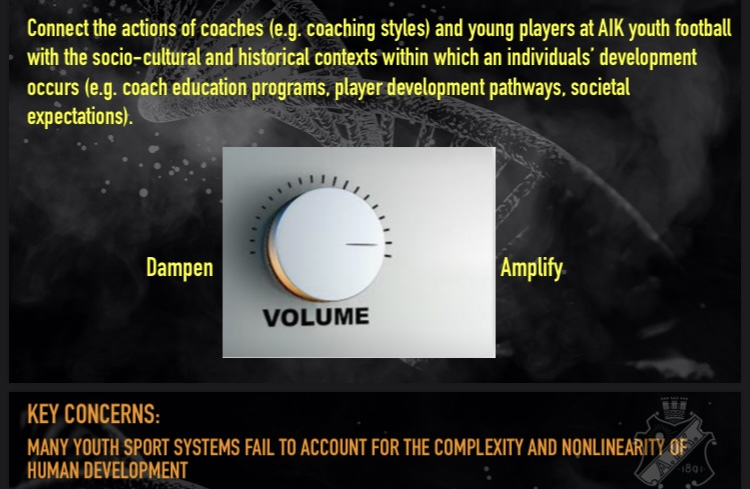
There is an ongoing discussion within youth football around the subject of ability grouping. The practice of early selection and de-selection of children through ages and stages are now central tenets of player development programs around the world (Güllich, 2014; Rongen et al., 2018) and have become a common point of departure for these discussions. Often pyramid like in structure, these type of development programs have been termed by Bailey and Collins (2013) as the Standard Model of Talent Development. Lacking in both empirical and conceptual validity this model is based on the presumption that development and performance in sport are conceptually linear and predictable (Bjørndal, Ronglan & Andersen, 2017).
As we hurtle towards the end of 2020, now feels like a good time to stop and look back at the year that has been; a year of disruption and pain, but also innovation and opportunity. To support this process of reflection, the Observatory of Public Sector Innovation convened a series of global events under the banner of “Government After Shock”. Around the world, the Government After Shock events took different forms, and focused on different themes. But all were connected by three key questions – what do we need to leave behind, what do we want to keep, and what should we do differently?
CPI hosted three Government After Shock events from our teams across the globe – Washington, London and Melbourne. This article captures our reflections from the Melbourne event, which explored Thinking in Systems in Government. Specifically, the session focused on exploring the following:
To build on the momentum that COVID has generated around thinking in systems, what do we need to keep doing, believing and being; what do we need to leave behind, and what do we need to start doing, believing and being?







 Systems Community of Inquiry

You must be logged in to post a comment.