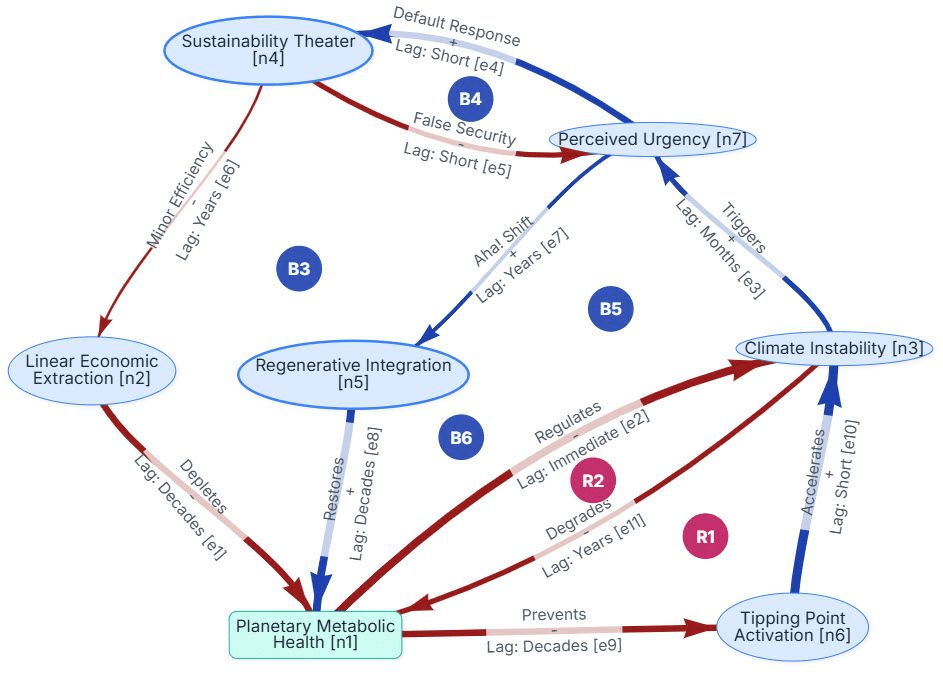
Free 90 Minute AI Modeling Tools Workshop – Create diagrams such as the one below, completely documented, along with an Aha! Paradox, and emotional story embracing the relationships, usually in 10 min or less. The Workshop will be at 11 am Eastern Time (New York) on Feb 19th, and I’ll send out the Zoom link info 1 day and 1 hour before the workshop. Just reply to this post, and I’ll put you on the list.
In the previous post we computed what is variously described as the difference map, the difference proposition, or the local proposition of the proposition at the point where and
In the universe of discourse the four propositions can be taken to indicate the so‑called “cells” or smallest distinguished regions of the universe, otherwise indicated by their coordinates as the “points” respectively. In that regard the four propositions are called singular propositions because they serve to single out the minimal regions of the universe of discourse.
Thus we can write so long as we know the frame of reference in force.
In the example the value of the difference proposition at each of the four points may be computed in graphical fashion as shown below.
The easy way to visualize the values of the above graphical expressions is just to notice the following graphical equations.
Adding the arrows to the venn diagram gives us the picture of a differential vector field.
The Figure shows the points of the extended universe indicated by the difference map namely, the following six points or singular propositions.
The information borne by should be clear enough from a survey of these six points — they tell you what you have to do from each point of in order to change the value borne by that is, the move you have to make in order to reach a point where the value of the proposition is different from what it is where you started.
We have been studying the action of the difference operator on propositions of the form as illustrated by the example which is known in logic as the conjunction of and The resulting difference map is a (first order) differential proposition, that is, a proposition of the form
The augmented venn diagram shows how the models or satisfying interpretations of distribute over the extended universe of discourse Abstracting from that picture, the difference map can be represented in the form of a digraph or directed graph, one whose points are labeled with the elements of and whose arrows are labeled with the elements of as shown in the following Figure.
Any proposition worth its salt can be analyzed from many different points of view, any one of which has the potential to reveal previously unsuspected aspects of the proposition’s meaning. We will encounter more and more such alternative readings as we go.
Let’s run through the initial example again, keeping an eye on the meanings of the formulas which develop along the way. We begin with a proposition or a boolean function whose venn diagram and cactus graph are shown below.
A function like has an abstract type and a concrete type. The abstract type is what we invoke when we write things like or The concrete type takes into account the qualitative dimensions or “units” of the case, which can be explained as follows.
Let be the set of values
Let be the set of values
Then interpret the usual propositions about as functions of the concrete type
We are going to consider various operators on these functions. An operator is a function which takes one function into another function
The first couple of operators we need are logical analogues of two which play a founding role in the classical finite difference calculus, namely, the following.
The difference operator written here as
The enlargement operator, written here as
These days, is more often called the shift operator.
In order to describe the universe in which these operators operate, it is necessary to enlarge the original universe of discourse. Starting from the initial space its (first order) differential extension is constructed according to the following specifications.
where:
The interpretations of these new symbols can be diverse, but the easiest option for now is just to say means “change ” and means “change ”.
Drawing a venn diagram for the differential extension requires four logical dimensions, but it is possible to project a suggestion of what the differential features and are about on the 2‑dimensional base space by drawing arrows crossing the boundaries of the basic circles in the venn diagram for reading an arrow as if it crosses the boundary between and in either direction and reading an arrow as if it crosses the boundary between and in either direction, as indicated in the following figure.
Propositions are formed on differential variables, or any combination of ordinary logical variables and differential logical variables, in the same ways propositions are formed on ordinary logical variables alone. For example, the proposition says the same thing as in other words, there is no change in without a change in
Given the proposition over the space the (first order) enlargement of is the proposition over the differential extension defined by the following formula.
In the example the enlargement is computed as follows.
Given the proposition over the (first order) difference of is the proposition over defined by the formula or, written out in full:
In the example the difference is computed as follows.
This brings us by the road meticulous to the point we reached at the end of the previous post. There we evaluated the above proposition, the first order difference of conjunction at a single location in the universe of discourse, namely, at the point picked out by the singular proposition in terms of coordinates, at the place where and That evaluation is written in the form or and we arrived at the locally applicable law which may be stated and illustrated as follows.
The venn diagram shows the analysis of the inclusive disjunction into the following exclusive disjunction.
The differential proposition may be read as saying “change or change or both”. And this can be recognized as just what you need to do if you happen to find yourself in the center cell and require a complete and detailed description of ways to escape it.
At Systems Thinking Systems Practice, 24-26 March 2026, University of Hull, we will again run Skills Training Workshops.
These workshops were a huge success at SysPrac25, with many of them oversubscribed.
They will take the form of interactive workshops, which will further develop your skills or introduce you to new approaches you may not have encountered before.
To vote visit https://docs.google.com/forms/d/e/1FAIpQLSfsLoKstfeA5BwI8pK5kAb25abdUAhLeKe2s51Xp4Gmxw_FAg/viewform before 20 February 2026!
The conference: https://stream.syscoi.com/2026/01/25/2026-conference-systems-thinking-and-systems-practice-hosted-by-the-university-of-hull-centre-for-systems-studies-css-systems-and-complexity-in-organisation-scio-and-the-or-society-24-26-march/
An efficient calculus for the realm of logic represented by boolean functions and elementary propositions makes it feasible to compute the finite differences and the differentials of those functions and propositions.
For example, consider a proposition of the form graphed as two letters attached to a root node, as shown below.
Written as a string, this is just the concatenation .
The proposition may be taken as a boolean function having the abstract type where is read in such a way that means and means
Imagine yourself standing in a fixed cell of the corresponding venn diagram, say, the cell where the proposition is true, as shown in the following Figure.
Now ask yourself: What is the value of the proposition at a distance of and from the cell where you are standing?
Don’t think about it — just compute:
The cactus formula and its corresponding graph arise by replacing with and with in the boolean product or logical conjunction and writing the result in the two dialects of cactus syntax. This follows because the boolean sum is equivalent to the logical operation of exclusive disjunction, which parses to a cactus graph of the following form.
Next question: What is the difference between the value of the proposition over there, at a distance of and from where you are standing, and the value of the proposition where you are, all expressed in the form of a general formula, of course? The answer takes the following form.
There is one thing I ought to mention at this point: Computed over plus and minus are identical operations. This will make the relation between the differential and the integral parts of the appropriate calculus slightly stranger than usual, but we will get into that later.
Last question, for now: What is the value of this expression from your current standpoint, that is, evaluated at the point where is true? Well, replacing with and with in the cactus graph amounts to erasing the labels and as shown below.
And this is equivalent to the following graph.
We have just met with the fact that the differential of the and is the or of the differentials.
It will be necessary to develop a more refined analysis of that statement directly, but that is roughly the nub of it.
If the form of the above statement reminds you of De Morgan’s rule, it is no accident, as differentiation and negation turn out to be closely related operations. Indeed, one can find discussion of logical difference calculus in the personal correspondence between Boole and De Morgan and Peirce, too, made use of differential operators in a logical context, but the exploration of those ideas has been hampered by a number of factors, not the least of which has been the lack of a syntax adequate to handle the complexity of expressions evolving in the process.
Table 1 shows the cactus graphs, the corresponding cactus expressions, their logical meanings under the so‑called existential interpretation, and their translations into conventional notations for a sample of basic propositional forms.
Table 1. Syntax and Semantics of a Calculus for Propositional Logic
The simplest expression for logical truth is the empty word, typically denoted by or in formal languages, where it is the identity element for concatenation. To make it visible in context, it may be denoted by the equivalent expression or, especially if operating in an algebraic context, by a simple Also when working in an algebraic mode, the plus sign may be used for exclusive disjunction. Thus we have the following translations of algebraic expressions into cactus expressions.
It is important to note the last expressions are not equivalent to the 3‑place form
Submissions for presentations of papers, panel discussions, workshops, performance sessions, and creative contributions, inspired by George Spencer-Brown’s work and life, are now warmly invited for the Laws of Form 2026 Conference (LoF26).
There is no charge to attend or present at the conference.
Submission Guidelines
Please submit an extended abstract (up to 300 words) outlining the content and structure of your proposed contribution. Please include:
• Title of your presentation
• Name, affiliation, and contact email address
• Format preference (paper presentation, panel discussion, workshop, creative, etc.)
• Short biographical note (≤ 150 words)
• Any AV / technical / access requirements
• Submission deadline Sunday 1st March 2026
• Notification of acceptance 31st March 2026
Facilities for remote video presentations will be available for those unable to attend in person.
If you have a Google account you may prefer to upload your submission here:
https://forms.gle/zknFvXWQXzmfQtn2A
As with previous conferences, and subject to peer review, contributions may be published in Distinction: Journal of Form (College Publications Ltd) or in future volumes of the Spencer-Brown Society book series Marked States.
Venue
University of Cambridge
Faculty of Education
184 Hills Road
Cambridge CB2 8PQ, United Kingdom
Monday 10 August – Friday 14 August 2026
Social & Cultural Events
In addition to the conference, optional events will include:
• Punting on the River Cam
• Evensong at King’s College Chapel
• A meal at the Eagle pub, where, on 28 February 1953, Francis Crick dramatically announced that he and James Watson had “discovered the secret of life.”
Support
LoF26 is entirely free to attend, made possible through the generosity of the Faculty of Education, Cambridge University, sponsors, and individual supporters.
Donations
Contributions toward the costs of running the conference and sharing its results are deeply appreciated and help ensure that participation remains open to all. Every contribution — large or small — directly sustains the continuation of this unique, open, and evolving forum dedicated to the work and life of George Spencer-Brown. If you are able to support this ongoing work, please make a donation through our website: https://lof50.com/
Membership of the Spencer-Brown Society is open to all and free of charge. To join and receive updates on conferences and publications, please visit https://lof50.com
We look forward to welcoming you to Cambridge in August for LoF26!
The development of differential logic is facilitated by having a moderately efficient calculus in place at the level of boolean‑valued functions and elementary logical propositions. One very efficient calculus on both conceptual and computational grounds is based on just two types of logical connectives, both of variable -ary scope. The syntactic formulas of that calculus map into a family of graph-theoretic structures called “painted and rooted cacti” which lend visual representation to the functional structures of propositions and smooth the path to efficient computation.
The first kind of connective is a parenthesized sequence of propositional expressions, written to mean exactly one of the propositions is false, in short, their minimal negation is true. An expression of that form is associated with a cactus structure called a lobe and is “painted” with the colors as shown below.
The second kind of connective is a concatenated sequence of propositional expressions, written to mean all the propositions are true, in short, their logical conjunction is true. An expression of that form is associated with a cactus structure called a node and is “painted” with the colors as shown below.
All other propositional connectives can be obtained through combinations of the above two forms. As it happens, the parenthesized form is sufficient to define the concatenated form, making the latter formally dispensable, but it’s convenient to maintain it as a concise way of expressing more complicated combinations of parenthesized forms. While working with expressions solely in propositional calculus, it’s easiest to use plain parentheses for logical connectives. In contexts where ordinary parentheses are needed for other purposes an alternate typeface may be used for the logical operators.
Differential logic is the component of logic whose object is the description of variation — focusing on the aspects of change, difference, distribution, and diversity — in universes of discourse subject to logical description. A definition that broad naturally incorporates any study of variation by way of mathematical models, but differential logic is especially charged with the qualitative aspects of variation pervading or preceding quantitative models.
To the extent a logical inquiry makes use of a formal system, its differential component governs the use of a differential logical calculus, that is, a formal system with the expressive capacity to describe change and diversity in logical universes of discourse.
Simple examples of differential logical calculi are furnished by differential propositional calculi. A differential propositional calculus is a propositional calculus extended by a set of terms for describing aspects of change and difference, for example, processes taking place in a universe of discourse or transformations mapping a source universe to a target universe. Such a calculus augments ordinary propositional calculus in the same way the differential calculus of Leibniz and Newton augments the analytic geometry of Descartes.
Conference dates: 14–18 September 2026 Pre-conference dinner: 14 September 2026
Submission Deadline: 15 May 2026
Conference Theme
Coded as the distinction between actual and potential, meaning (Sinn) occupies a central position in Niklas Luhmann’s theory programme. As the shared medium in which both psychic and social systems operate, meaning enables observation, selection, and the continuous opening of horizons of possibility. As a medium without an outside (Luhmann, 1995a; 1995b, 62), meaning is notoriously inescapable for meaning-processing observers (Morales, 2025), and such are the blind spots and paradoxes it entails (Tække, 2025).
In his major theoretical works, Luhmann (1995b; 2012; 2013) distinguished three dimensions of meaning—the factual (this/that), the temporal (before/after), and the social (ego/alter). Each of these dimensions relates to a distinct sub-theory of his systems-theoretical programme: the factual dimension grounds the theory of social differentiation, the temporal dimension the theory of social evolution, and the social dimension the theory of communication (Roth 2009; Sohn, 2021). As shown by Andersen (2003), each of these meaning dimensions moreover corresponds to a dedicated strategy of deparadoxifying the inescapable paradox of observation, while they also allow for analytically differentiating forms of social systems, depending on how meaning is stabilised as semantics and processed across objects, time, and social relations (Harste, 2021; Jönhill, 2012).
What Luhmann did not adequately address, however, is how these dimensions of meaning come about, and why meaning should be structured into precisely three dimensions rather than more—or fewer (Roth, 2021). While the triadic architecture of meaning has become canonical in systems theory, its underlying logic remained explicitly unresolved.
More recent contributions have returned to this problem by reconstructing meaning dimensions in relation to the basic questions of observation—such as what, when, and who—and by exploring whether additional questions (where, how, why, and possibly others) may correspond to further, systematically expandable dimensions of meaning (Roth and Kaczmarczyk, 2026).
Meaning Dimension
Basic Question
Code
Focus
Spatial
Where?
here/there
The locus of observation
Temporal
When?
before/after
The process of observation
Factual
What?
this/that
The object of observation
Social
Who?
ego/alter
The observer
Modal
How?
thus/otherwise
The manner of observation
Motivational
Why?
intent/accident
The purpose of observation
…
…
…
…
Table: Six (or more?) dimensions of meaning as oriented by basic questions, codes, and observational foci (adapted from Roth and Kaczmarczyk, 2026)
From this perspective, Luhmann’s triad appears not as a closed architecture but as a reduced form of a broader, potentially open framework for analysing meaning and—tentatively—deparadoxifying the paradox of observation.
Against this backdrop, the Luhmann Conference 2026 invites contributions that revisit, rethink, and extend the concept of meaning under contemporary conditions of complexity. Under the guiding theme Meaning. Observed with …, the conference foregrounds meaning not as a static concept but as a dynamic medium of observation—one that allows for distinctions to be drawn, alternatives to be imagined, and contingency to be processed.
As such, the ellipsis in this year’s conference title is intentional. It signals an openness to different observational standpoints, theoretical instruments, and empirical domains. Rather than prescribing a single perspective, the conference asks how meaning is observed, transformed, stabilised, and contested when observed with different distinctions, media, and systems.
Key Orientations
Building on ongoing debates within social systems theory and beyond, the conference particularly welcomes contributions engaging with one or more of the following orientations:
Meaning and observation: second-order observation, reflexivity, and the observation of observation in social and psychic systems.
Psychic systems, consciousness, personality, and personhood: renewed engagement with consciousness, sense-making, psychology, psychotherapy, and their relation to identity formation across psychic and social systems.
Artificial and technological mediation of meaning: AI, artificial communication, algorithmic decision premises, and their implications for meaning-processing systems and structures of expectation.
Possibility, contingency, and alterity: forms of meaning that resist closure, reduction, or authoritarian simplification; imagination, counterfactuals, and non-necessary social orders.
Meaning and society: values, polarisation, populism, inter-systemic relations, pathologies of meaninglessness, and strategies of complexity reduction.
Expanding architectures of meaning: theoretical work that revisits or extends established three-dimensional models of meaning, including novel distinctions, questions, or sub-programmes within systems theory.
These themes are not exhaustive. Contributions from sociology, organisation studies, political theory, economics, education, cultural studies, literary studies, communication and media studies, cybernetics, philosophy, and related fields are explicitly encouraged, provided they engage meaning as a central analytical concern.
Programme Committee:
Nico Buitendag, University of the Free State, South Africa
Lars Clausen, UCL University College, Odense, Denmark
Michal Kaczmarczyk, University of Gdansk, Poland
Vincent Lien, University of Cambridge, United Kingdom*
Steffen Roth, Excelia Business School, La Rochelle, France, and University of Cambridge, United Kingdom
Augusto Sales, Brazilian School of Public and Business Administration (FGV-EBAPE), Rio de Janeiro, Brazil, and Yale University, New Haven, United States of America
Tilia Stingl de Vasconcelos Guedes, University of Applied Sciences for Management & Communication, Vienna, Austria
The organising committee is currently negotiating dedicated publication opportunities for the Luhmann Conference 2026. A considerable number of Luhmann Conference Community members are supporting Kybernetes, an important forum for research in cybernetics and systems thinking. Previous Luhmann Conferences have been or are currently being published in edited volumes or special issues of journals such as
Febbrajo A. and Harste G. (2013). Law and Intersystemic Communication. Understanding “Structural Coupling”. London: Ashgate 2013.
Historical background
In the 1980s, Hans-Ulrich Gumbrecht and Ludwig Pfeiffer co-organised a number of conferences at the Inter-University Centre of Post-Graduate Studies (IUC) in Dubrovnik in the former Yugoslavia, now Croatia. Starting in 1981, Luhmann attended several of these conferences. Conference proceedings were published in a series of five rather big volumes at the important Suhrkamp Verlag (Der Diskurs der Literatur- und Sprachhistorie, 1983; Epochenschwellen und Epochenstrukturen im Diskurs der Literatur- und Sprachhistorie, 1985; Stil, 1986; Materialität der Kommunikation, 1988; Paradoxien, Dissonanzen, Zusammenbrüche, 1991). Many of these works were dedicated to semantic history and to a system theory of art. The IUC was shelled during the siege of Dubrovnik in 1991, and for some years the conferences could not take place. Today, the IUC has been completely restored both physically and in spirit. The series resumed subsequent to the complete restoration of the IUC premises and, in turning increasingly international, became known under the sub-headlines “Observed with Niklas Luhmann’s systems theory” or “Observed with social systems theory”, respectively.
Practical information
The conference fee is EUR 200 for early career scholars (PhD students and post-Docs two years from their first PhD) and EUR 250 for everybody else. The amount is due in advance by bank transfer once your submission is accepted and registration confirmed. Once transferred, the fee is not refundable. The IUC is located in the vicinity of the famous medieval city of Dubrovnik. Accommodation is available in one of the many Dubrovnik hotels (Hotel Imperial is the closest to the IUC, but rather expensive. Hotel Lero is more affordable and located about 1.5 kilometres (1 mile) from the IUC. Another popular form is one of the many private accommodations (Room or “Sobe”) which are relatively cheap and can be found everywhere. Do make sure to book well in advance to get the best price. The IUC also provides affordable but limited accommodation in the building itself. The conference fee includes catering during coffee breaks. All other meals are taken at restaurants and cafés in town. The Dubrovnik airport is situated about 20 kilometres south of Dubrovnik and connected to the town by regular shuttle busses. Travel by car and ferryboat is somewhat more complicated, though beautiful. The weather in September is normally sunny and 25-30° C, though rain is not impossible. Whereas the weather is perfect for beach activities, buildings do still heat up considerably at this time of the year. The air conditioning systems in the conference rooms are therefore set at temperatures around 21° C, which implies that they are in continuous operation. Persons who get cold easily are therefore advised to bring a jacket and a light scarf.
Luhmann community groups and supporters @socialmedia
A reader once told me “venn diagrams are obsolete” and of course we all know how unwieldy they become as our universes of discourse expand beyond four or five dimensions. Indeed, one of the first lessons I learned when I set about implementing Peirce’s graphs and Spencer Brown’s forms on the computer is that 2‑dimensional representations of logic quickly become death traps on numerous conceptual and computational counts.
Still, venn diagrams do us good service at the outset in visualizing the relationships among extensional, functional, and intensional aspects of logic. A facility with those connections is critical to the computational applications and statistical generalizations of propositional logic commonly used in mathematical and empirical practice.
All things considered, then, it is useful to make the links between various styles of imagery in logical representation as visible as possible. The first few steps in that direction are set out in the sketch of Differential Logic to follow.


 of the proposition
  at the point
  where
where  and
and 
 the four propositions
  can be taken to indicate the so‑called “cells” or smallest distinguished regions of the universe, otherwise indicated by their coordinates as the “points”
  respectively. In that regard the four propositions are called singular propositions because they serve to single out the minimal regions of the universe of discourse.
 so long as we know the frame of reference in force.
 the value of the difference proposition
  may be computed in graphical fashion as shown below.


 indicated by the difference map
  namely, the following six points or singular propositions.
 should be clear enough from a survey of these six points — they tell you what you have to do from each point of
  in order to change the value borne by
  that is, the move you have to make in order to reach a point where the value of the proposition
  is different from what it is where you started.
 on propositions of the form
  as illustrated by the example
  and
and  The resulting difference map
 Abstracting from that picture, the difference map
  and whose arrows are labeled with the elements of
  as shown in the following Figure.
![\begin{array}{rcccccc} f & = & p & \cdot & q \\[4pt] \mathrm{D}f & = & p & \cdot & q & \cdot & \texttt{((} \mathrm{d}p \texttt{)(} \mathrm{d}q \texttt{))} \\[4pt] & + & p & \cdot & \texttt{(} q \texttt{)} & \cdot & \texttt{~(} \mathrm{d}p \texttt{)~} \mathrm{d}q \texttt{~~} \\[4pt] & + & \texttt{(} p \texttt{)} & \cdot & q & \cdot & \texttt{~~} \mathrm{d}p \texttt{~(} \mathrm{d}q \texttt{)~} \\[4pt] & + & \texttt{(} p \texttt{)} & \cdot & \texttt{(} q \texttt{)} & \cdot & \texttt{~~} \mathrm{d}p \texttt{~~} \mathrm{d}q \texttt{~~} \end{array}](https://s0.wp.com/latex.php?latex=%5Cbegin%7Barray%7D%7Brcccccc%7D++f+%26+%3D+%26+p+%26+%5Ccdot+%26+q++%5C%5C%5B4pt%5D++%5Cmathrm%7BD%7Df+%26+%3D+%26++p+%26+%5Ccdot+%26+q+%26+%5Ccdot+%26++%5Ctexttt%7B%28%28%7D+%5Cmathrm%7Bd%7Dp+%5Ctexttt%7B%29%28%7D+%5Cmathrm%7Bd%7Dq+%5Ctexttt%7B%29%29%7D++%5C%5C%5B4pt%5D++%26+%2B+%26++p+%26+%5Ccdot+%26+%5Ctexttt%7B%28%7D+q+%5Ctexttt%7B%29%7D+%26+%5Ccdot+%26++%5Ctexttt%7B%7E%28%7D+%5Cmathrm%7Bd%7Dp+%5Ctexttt%7B%29%7E%7D+%5Cmathrm%7Bd%7Dq+%5Ctexttt%7B%7E%7E%7D++%5C%5C%5B4pt%5D++%26+%2B+%26++%5Ctexttt%7B%28%7D+p+%5Ctexttt%7B%29%7D+%26+%5Ccdot+%26+q+%26+%5Ccdot+%26++%5Ctexttt%7B%7E%7E%7D+%5Cmathrm%7Bd%7Dp+%5Ctexttt%7B%7E%28%7D+%5Cmathrm%7Bd%7Dq+%5Ctexttt%7B%29%7E%7D++%5C%5C%5B4pt%5D++%26+%2B+%26++%5Ctexttt%7B%28%7D+p+%5Ctexttt%7B%29%7D+%26+%5Ccdot+%26+%5Ctexttt%7B%28%7D+q+%5Ctexttt%7B%29%7D+%26+%5Ccdot+%26++%5Ctexttt%7B%7E%7E%7D+%5Cmathrm%7Bd%7Dp+%5Ctexttt%7B%7E%7E%7D+%5Cmathrm%7Bd%7Dq+%5Ctexttt%7B%7E%7E%7D++%5Cend%7Barray%7D&bg=ffffff&fg=000000&s=0&c=20201002)


 has an abstract type and a concrete type. The abstract type is what we invoke when we write things like
  or
or  The concrete type takes into account the qualitative dimensions or “units” of the case, which can be explained as follows.
 be the set of values
 be the set of values
 as functions of the concrete type
 is a function which takes one function
 written here as

 is more often called the shift operator.
 its (first order) differential extension
  is constructed according to the following specifications.
![\begin{array}{rcc} X & = & P \times Q \\[4pt] \mathrm{d}X & = & \mathrm{d}P \times \mathrm{d}Q \\[4pt] \mathrm{d}P & = & \{ \texttt{(} \mathrm{d}p \texttt{)}, ~ \mathrm{d}p \} \\[4pt] \mathrm{d}Q & = & \{ \texttt{(} \mathrm{d}q \texttt{)}, ~ \mathrm{d}q \} \end{array}](https://s0.wp.com/latex.php?latex=%5Cbegin%7Barray%7D%7Brcc%7D++X+%26+%3D+%26+P+%5Ctimes+Q++%5C%5C%5B4pt%5D++%5Cmathrm%7Bd%7DX+%26+%3D+%26+%5Cmathrm%7Bd%7DP+%5Ctimes+%5Cmathrm%7Bd%7DQ++%5C%5C%5B4pt%5D++%5Cmathrm%7Bd%7DP+%26+%3D+%26+%5C%7B+%5Ctexttt%7B%28%7D+%5Cmathrm%7Bd%7Dp+%5Ctexttt%7B%29%7D%2C+%7E+%5Cmathrm%7Bd%7Dp+%5C%7D++%5C%5C%5B4pt%5D++%5Cmathrm%7Bd%7DQ+%26+%3D+%26+%5C%7B+%5Ctexttt%7B%28%7D+%5Cmathrm%7Bd%7Dq+%5Ctexttt%7B%29%7D%2C+%7E+%5Cmathrm%7Bd%7Dq+%5C%7D++%5Cend%7Barray%7D&bg=ffffff&fg=000000&s=0&c=20201002)
 means “change
  means “change
  ”.
”. requires four logical dimensions,
  but it is possible to project a suggestion of what the differential features
  reading an arrow as
  in either direction and reading an arrow as
  in either direction, as indicated in the following figure.
 says the same thing as
  in other words, there is no change in
  over the differential extension


 or, written out in full:

 at a single location in the universe of discourse, namely, at the point picked out by the singular proposition
  in terms of coordinates, at the place where
  or
or  and we arrived at the locally applicable law which may be stated and illustrated as follows.


 into the following exclusive disjunction.
 graphed as two letters attached to a root node, as shown below.
 .
. may be taken as a boolean function
  where
where  is read in such a way that
  means
means  and
and  means
means 


 and its corresponding graph arise by replacing
  and
and  in the boolean product or logical conjunction

 plus and minus are identical operations. This will make the relation between the differential and the integral parts of the appropriate calculus slightly stranger than usual, but we will get into that later.
 as shown below.




 or
or  in formal languages, where it is the identity element for concatenation. To make it visible in context, it may be denoted by the equivalent expression
  or, especially if operating in an algebraic context, by a simple
  Also when working in an algebraic mode, the plus sign
  may be used for exclusive disjunction. Thus we have the following translations of algebraic expressions into cactus expressions.
![\begin{matrix} a + b \quad = \quad \texttt{(} a \texttt{,} b \texttt{)} \\[8pt] a + b + c \quad = \quad \texttt{(} a \texttt{,(} b \texttt{,} c \texttt{))} \quad = \quad \texttt{((} a \texttt{,} b \texttt{),} c \texttt{)} \end{matrix}](https://s0.wp.com/latex.php?latex=%5Cbegin%7Bmatrix%7D++a+%2B+b+%5Cquad+%3D+%5Cquad+%5Ctexttt%7B%28%7D+a+%5Ctexttt%7B%2C%7D+b+%5Ctexttt%7B%29%7D++%5C%5C%5B8pt%5D++a+%2B+b+%2B+c++%5Cquad+%3D+%5Cquad+%5Ctexttt%7B%28%7D+a+%5Ctexttt%7B%2C%28%7D+b+%5Ctexttt%7B%2C%7D+c+%5Ctexttt%7B%29%29%7D++%5Cquad+%3D+%5Cquad+%5Ctexttt%7B%28%28%7D+a+%5Ctexttt%7B%2C%7D+b+%5Ctexttt%7B%29%2C%7D+c+%5Ctexttt%7B%29%7D++%5Cend%7Bmatrix%7D&bg=ffffff&fg=000000&s=1&c=20201002)

 -ary scope. The syntactic formulas of that calculus map into a family of graph-theoretic structures called “painted and rooted cacti” which lend visual representation to the functional structures of propositions and smooth the path to efficient computation.
 to mean exactly one of the propositions
  is false, in short, their minimal negation is true. An expression of that form is associated with a cactus structure called a lobe and is “painted” with the colors
 to mean all the propositions
 may be used for the logical operators.


You must be logged in to post a comment.