Pengjuan Zu, Karina Boege, Ek del-Val, Meredith C. Schuman, Philip C. Stevenson, Alejandro Zaldivar-Riverón, Serguei Saavedra
Science 19 Jun 2020: Vol. 368, Issue 6497, pp. 1377-1381 DOI: 10.1126/science.aba2965
Plants emit an extraordinary diversity of chemicals that provide information about their identity and mediate their interactions with insects. However, most studies of this have focused on a few model species in controlled environments, limiting our capacity to understand plant-insect chemical communication in ecological communities. Here, by integrating information theory with ecological and evolutionary theories, we show that a stable information structure of plant volatile organic compounds (VOCs) can emerge from a conflicting information process between plants and herbivores. We corroborate this information “arms race” theory with field data recording plant-VOC associations and plant-herbivore interactions in a tropical dry forest. We reveal that plant VOC redundancy and herbivore specialization can be explained by a conflicting information transfer. Information-based communication approaches can…
Hello! I wanted to share with you an upcoming event with Fritjof that you can watch via livestream. The details are below. Fritjof Capra’s interview on Stan Grof followed by Live Q&AThursday, June 25 12:00 noon San Francisco, 3:00 PM New York, 4:00 PM Sao Paulo, 8:00 PM London You can watch the livestream via Vimeo at: https://vimeo.com/414185857.
Event Description: Fritjof Capra recounts how his blending of quantum physics and Eastern philosophies was paralleled in Stan Grof’s merging of psychology and spirituality. The resulting collaboration between the two men brought scientific grounding to Transpersonal Psychology. Fritjof describes the interrelated nature of the universe, and how Stan’s work provided an experiential opportunity to explore this reality. He also notes how the new understanding of emergence validates Stan’s perspective on mental illness – as an inability to integrate experiences that can be resolved if fully explored. Fritjof ends by emphasizing the need to shift away from a mechanistic world view to one of networks that cooperate and seek novelty. Following the recorded interview, there will then be a live Q&A with the filmmakers.
The event is free and no preregistration is required. We hope you can join this upcoming online event with Fritjof.
This special issue was inspired by papers presented during the inaugural Social Innovation and Complexity Stream at the 9th International Social Innovation Research Conference (ISIRC) in 2017. The introduction of a complexity stream at the 9th ISIRC builds upon two previous International Conferences on Social Entrepreneurship, Systems Thinking and Complexity that were held at Adelphi University, Garden City, New York in 2008 and 2010.
The theme of the 9th ISIRC was ‘Beyond Boundaries? Organizations, Systems and Social Innovation’. In line with the conference theme, the call for papers for the Social Innovation and Complexity Stream was particularly interested in receiving abstracts that explored the role of complexity theory for social innovation beyond boundaries.
Our current breakdown of leadership, infrastructure, networks, and cooperation have been tested and exposed during this pandemic. And what’s glaringly obvious is our fundamental disconnect from ourselves, each other and the planet.
So how does systems thinking change everything?
What are the warning signs that we need to heed?
How can we adapt, not just to survive, but to thrive?
How do we balance our global and local needs in the coming times?
How do we stay cognizant of who benefits and who gets exploited through developing technologies and governance?
Listen in as Darcy dives into the game-changing approach of systems thinking to tackle our greatest challenges ahead.
Harish’s Notebook – My notes… Lean, Cybernetics, Quality & Data Science.
Copernican Revolution – Systems Thinking: In today’s post, I am looking at “Copernican Revolution”, a phrase used by the great German philosopher, Immanuel Kant. Immanuel Kant is one of the greatest names in philosophy. I am an Engineer by profession, and I started learning philosophy after I left school. As an Engineer, I am trained to think about causality in nature – if I do this, then that happens. This is often viewed as the mechanistic view of nature and it is reliant on empiricism. Empiricism is the idea that knowledge comes from experience. In contrast, at the other end of knowledge spectrum lies rationalism. Rationalism is the idea that knowledge comes from reason (internal). An empiricist can quickly fall into the trap of induction, where you believe that there is uniformity in nature. For example, if I clapped my hand twenty times, and the light flickered each time, I can then (falsely) conclude that the next time I clap my hand the light will flicker. My mind created a causal connection to my hand clapping and the light flickering. David Hume, another great philosopher, challenged this and identified this approach as the problem of induction. He suggested that we, humans, are creatures of habit that we assign causality to things based on repeat experience. His view was that causality is assigned by us simply by habit. His famous example of challenging whether the sun will rise tomorrow exemplifies this:
Join Us for the First System Dynamics Hackathon (that we know of!)
Society Sponsor, University of Bergen, is piloting the first of hopefully many System Dynamics hackathons.
President Birgit Kopainsky and members Brooke Wilkerson, Anaely Aguiar, Christina Gkini, and others have been instrumental in pulling this together and hope that you will join them in this inaugural event.
Clients and experts in different domains have already convened to build a causal map of the system. Now you have 48 hours to turn it into a simulation model and suggest policies, strategies, and solutions.
There will be mentors available to help throughout the event which will be hosted online next week (June 25th 16:00 – 27th 16:00 CEST). In addition to eternal glory and an opportunity to network with brilliant people in the field, there will be a cash prize of 5000 NOK to the winner.
Sign up to help the City of Bergen, the location of our virtual conference, get cracking on policies to be fossil-free by 2030.
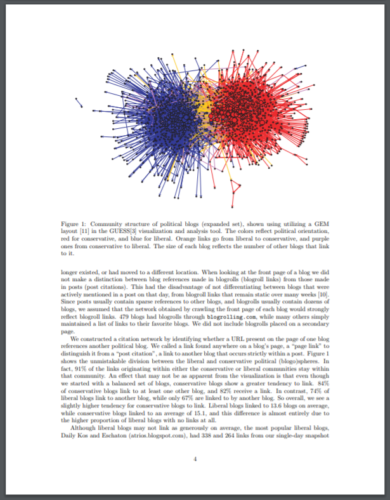
While people like looking at network maps, do they have an appreciation for the meaning, based on the underlying mathematics?
The current state of interpreting network maps is basically an accepted but criticized practice. Some do it well, some do it wrong, but no one can actually provide a precise reason why it works (or seems to).
This refers back to a 2005 paper Divided They Blog , a paper by Lada Adamic and Nathalie Glance (search on Google Scholar):
The paper was published in 2005 and has been hugely cited (2551 times in 2019 according to Google Scholar). I have two stories about this image, a tale and a horror story, which together form a bigger story.
Originally published on May 13, 2013 for Ethnography Matters, I’m republishing the post for the launch of the new Ethnography Matters Medium channel. I’ve updated the article with a case study from my time at Nokia where I witnessed their over-dependence on quantitative data. I’m continuously blown away by how much my original post in 2013 sparked a discussion about the integration of Thick Data and Big Data. Since then, I have talked about this topic with EPIC conference, Republica and Strata. I also gave a TED talk targeted for business leaders. Just last year, Word Spy created an entry of Thick Data, referencing my original post as the resurgence of the term. My goal is to create more opportunities to feature people who are doing this kind of integrative work inside organizations. Please reach out if this kind of work is up your alley. You can start by joining a community of people who are at the forefront of this work at Ethnography Hangout Slack’s #datatalk channel. Thank you to IDEO’s Elyssa He for translating this article into Chinese, 大数据离不开 “厚数据”, published on 36kr and Paz Bernaldo for translating this into Spanish.
Organizational theory and practice have been evolving for over 80 years. Its scientific base is in general systems theory, and specifically open systems theory which describes/includes living systems. Systems engineering and computer science are, likewise, derived from the science of general systems theory. The most popular organizational trends today stem from these theoretical roots – socio-technical organization design, agile development and practice, and digital platform organization design.
This workshop presents the open systems model, its core architecture and principles, and how it’s being used in the most innovative applications of innovative organization design today. In addition, the course has a focus on the role of the organization practitioner in the facilitation of design choices and operating model. What we offer is an “applied open-system thinking” framework. It is therefore both historical / conceptual and practical applied to our current world.
Who should join us
Those interested in designing the future of work/organizations and how to best bring this forward
Next generation of organization designers
Internal and external consultants (Organization Development and Organization Design)
Those attracted to systems thinking and eco-system design
Those doing Dev/Ops, Digital Transformation, Agile & Scrum, Lean & 6 Sigma, and Network and System Design
Managers and leaders on the front lines of organizations and ecosystems
EPISODE 1
The evolution of Open Systems Theory and Practice: from SocioTechnical System, to Agile Development, to Digital Platform Design.
What is STS and how is it “reframed” in the 21st century. The roots and history with lots of how does it translate/apply to today. The organization as an open system: theory and principles and finding the right balance between efficiency and adaption – ambidexterity.
In this session we will set the foundation for all four modules and discuss pre and post work for each episode.
DATE: 01 July 2020 TIME: 17:00 – 19:00 CEST FORMAT: COURSE PRICE: €9 + VAT LANGUAGE: ENGLISH TOTAL SEATS: 24 YOU WILL USE: ZOOM, MIRO, GOOGLE DOCS
To show the gradual shift from hierarchy to networks, and how networks are designed for performance. One of the questions for this session is: what replaces hierarchy? Overview of model and functionality of AWS (Adaptive Work Systems) and Agile (Balanced Optimization Model).
Episode 2 shares case examples (Global Pandemic, Migration from the Middle East and Africa to Europe, Migration from Central America to the US, European Electrical Grid) and looks at applications of STS thinking to implications for current and near future reality.
DATE: 08 July 2020 TIME: 17:00 – 19:00 CEST FORMAT: COURSE PRICE: €29 + VAT LANGUAGE: ENGLISH TOTAL SEATS: 24 YOU WILL USE: ZOOM, MIRO, GOOGLE DOCS
Digital socio-technical design (including ecosystem design)
To define digital socio-technical design: structure, processes, how it works. This is about the future and possibilities, what could a STS applied world of the future look like. Building on lessons from the 1st two modules. The case here is the pandemic and its implications and outcomes, near term and 20 years out.
DATE: 15 July 2020 TIME: 17:00 – 19:00 CEST FORMAT: COURSE PRICE: €29 + VAT LANGUAGE: ENGLISH TOTAL SEATS: 24 YOU WILL USE: ZOOM, MIRO, GOOGLE DOCS
Organization design consulting:Applications in the new world
For participants to understand that design is driven from strategic and customer data, not a faddish model. “An aha moment that creates a new story, a new pattern of connections in your brain. Once you have had an insight, you cannot go back to the old way of thinking.”
This session is the “Insight – Action” session, so to speak. During this module we really focus on how to bring STS to today’s current realities and apply.
DATE: 22 July 2020 TIME: 17:00 – 19:00 CEST FORMAT: COURSE PRICE: €29 + VAT LANGUAGE: ENGLISH TOTAL SEATS: 24 YOU WILL USE: ZOOM, MIRO, GOOGLE DOCS
A way forward, expressed with clarity, preferably as a story. This “capstone session” focuses on applying STS to your situations/clients; Integrating STS with other professional frameworks (it is not an either-or, but a both-and); and, STS as applied research.
DATE: 29 July 2020 TIME: 17:00 – 19:00 CEST FORMAT: COURSE PRICE: €29 + VAT LANGUAGE: ENGLISH TOTAL SEATS: 24 YOU WILL USE: ZOOM, MIRO, GOOGLE DOCS
This paper proposes a definition of systems thinking for use in a wide variety of disciplines, with particular emphasis on the development and assessment of systems thinking educational efforts. The definition was derived from a review of the systems thinking literature combined with the application of systems thinking to itself. Many different definitions of systems thinking can be found throughout the systems community, but key components of a singular definition can be distilled from the literature. This researcher considered these components both individually and holistically, then proposed a new definition of systems thinking that integrates these components as a system. The definition was tested for fidelity against a System Test and against three widely accepted system archetypes. Systems thinking is widely believed to be critical in handling the complexity facing the world in the coming decades; however, it still resides in the educational margins. In order for this important skill to receive mainstream educational attention, a complete definition is required. Such a definition has not yet been established. This research is an attempt to rectify this deficiency by providing such a definition.
On the evening of August 25, 1970, Margaret Mead (December 16, 1901–November 15, 1978) and James Baldwin (August 2, 1924–December 1, 1987) sat together on a stage in New York City for a remarkable public conversation about such enduring concerns as identity, power and privilege, race and gender, beauty, religion, justice, and the relationship between the intellect and the imagination. By that point, Baldwin, forty-six and living in Paris, was arguably the world’s most famous living poet, and an enormously influential voice in the civil rights dialogue; Mead, who was about to turn seventy, had become the world’s first celebrity academic — a visionary anthropologist with groundbreaking field experience under her belt, who lectured at some of the best cultural institutions and had a popular advice column in Redbook magazine.
They talked for seven and a half hours of brilliance and bravery over the course of the weekend, bringing to the dialogue the perfect balance of similarity and difference to make it immensely simulating and deeply respectful. On the one hand, as a white woman and black man in the first half of the twentieth century, they had come of age through experiences worlds apart. On the other, they had worlds in common as intellectual titans, avid antidotes to the era’s cultural stereotypes, queer people half a century before marriage equality, and unflinching celebrators of the human spirit.
Besides being a remarkable and prescient piece of the cultural record, their conversation, the transcript of which was eventually published as A Rap on Race (public library), is also a bittersweet testament to one of the recurring themes in their dialogue — our tendency to sideline the past as impertinent to the present, only to rediscover how central it is in understanding the driving forces of our world and harnessing them toward a better future. This forgotten treasure, which I dusted off shortly after Ferguson and the Eric Garner tragedy, instantly stopped my breath with its extraordinary timeliness — the ideas with which these two remarkable minds tussled in 1970 had emerged, unsolved and unresolved, to haunt and taunt us four decades later with urgency that can no longer be evaded or denied.
Although some of what is said is so succinctly brilliant that it encapsulates the essence of the issue — at one point, Baldwin remarks: “We’ve got to be as clear-headed about human beings as possible, because we are still each other’s only hope.” — this is nonetheless a conversation so complex, so dimensional, so wide-ranging, that to synthesize it in a single article or highlight a single dominant theme would be to instantly flatten it and strip it of power. Instead, I am going to do something I’ve never done in nearly a decade of Brain Pickings — explore this immensely valuable cultural artifact in a multi-part series examining a specific viewpoint from this zoetrope of genius in each installment, beginning with Mead and Baldwin’s tapestry of perspectives on forgiveness, the difference between guilt and responsibility, and the role of the past in understanding the present and building a more dignified future.





 Systems Community of Inquiry
You must be logged in to post a comment.