
Do Systems Exist? A continued chat about systems thinking
Event Information
Description
A view or perspective on the world
Ways of Seeing a blog by Nitzan Hermon
Versions of Complexity
07 Apr 2020
I have had the pleasure of co–teaching Complexity by Design at Parsons SDM last semester, and engage with wonderful thinkers and institutes in this space.It is becoming increasingly clear that complexity thinking (definition to come later) is a core part of modern life. This was discussed in different circles before we all got into this state of unknowingness.
I have been working with a very acute definition of complexity, but given that the field is emerging (no pun intended) I wanted to linger a moment on its positionality.
I have been working with 2.5 versions of complexity: a partial list of links and resources to follow.
V1: Scientific:
Santa Fe Institute, and their Complexity Explorers Group on FBNew England Complex Systems Institute
MIT Center for Collective Intelligence
Scale: The Universal Laws of Growth, Innovation, Sustainability, and the Pace of Life in Organisms, Cities, Economies, and Companies
other topics include: chaos, fractals, bio-mimicry, modeling, netLOGO
V2: Management
Jennifer Garvey Berger’s booksCynefin Framework
Robert Kegan
The Standing Ovation Problem
V 2.5: self leading
A lot of the leadership advice, individuation, Jungian ideas of synchronicity, and adjacent thinking on signifiers and semiotics are all very much complexity friendly.Mostly because they accept the behaviorist nature of our world (the noise in your head is different than the noise in mine).
My working list of axioms around complex systems is:
interconnected over rules design: they are not designable
in fact: emergence (‘it just happens…’ as one student informally articulated) is the opposite of design
A system is as complex as we need it to be: we can exercise reduction if the situation allows, and seek extra details (context) when the solution slides off the problem
Complex systems are open ended
hence a machine can never be truly intelligent by the way (I recommend Marcus’ book for those interested in that point)
Complicated systems–like a car, computer program or the highway system–are an elaborate stacking of known constructs.
We can model the difference between complex and complicated as the difference between designing a highway system or designing less accidents.
p.s. I am sure I left links out, please comment with ideas and suggestions – I would love to add to this list.
via Systems Thinking Ontario – 2020-05-11
May 11 (the second Monday of the month) is the 79th meeting for Systems Thinking Ontario. The registration is on Eventbrite at https://making-changes.eventbrite.com.
How do Systems Changes become natural practice? Stepping through a previously prepared set of slides, we’ll have a slow discussion on history-making, commitment, argumentation and pattern language (or however much we can cover in about 90 minutes). The agenda will draw from:
For May, we’ll complete the four-lecture series as in February, March and April, based on the fourth lecture in the Systemic Design course, of the master’s program in Strategic Foresight & Innovation at OCADU. Our modified program has been to use the slides as a foundation, on which we nurture a conversation that encourages participants to develop a personal appreciation through collective sensemaking.
Venue:
Suggested pre-reading:
For those who want listen or read ahead, web video and digital audio are available as:
Agenda in link
Post-meeting artifacts
Bloggers are encouraged to write about their learning and experiences at the meeting. Links will be added to this page.
via System Dynamics meets COVID-19 Tickets, Thu 28 May 2020 at 09:30 | Eventbrite
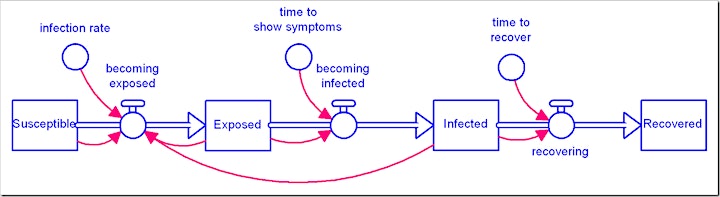
The event will briefly describe how system dynamics is suited to the modelling of an epidemic and a generic approach that will be reflected in three key contributions:
Kim Warren, Strategy Dynamics Ltd, will describe his work with Maurice Glucksman with the Pan-African Network for Rapid Research, Response & Preparedness for Infectious Diseases Epidemic (PANDORA) entitled Local outbreaks and local issues need local models.
Mark Gregson, Consultant with the Whole Systems Partnership, will outline his work in the Kent & Medway system entitled Reflections on developing a whole system demand and capacity model for an Integrated Health and Care System in the UK.
Erik Pruyt, Center for Policy Exploration Analysis and Simulation in the Netherlands, will speak on Aggregated Systems Models towards Integrated Assessment Models linking COVID19 Epidemics, Economics, Livelihood across National, Regional and Local Scales: the Cases of Namibia, the Netherlands, and Peru.
SEIR diagram source: ISEE Systems 2020 (https://blog.iseesystems.com/)
via System Dynamics meets COVID-19 Tickets, Thu 28 May 2020 at 09:30 | Eventbrite
https://www.umio.io/#homepage
Health Ecosystem Value Design 2.0
Now live
We are delighted to announce the launch of the fully revised version of Health Ecosystem Value Design® 2.0, our comprehensive health and wellbeing ecosystem design, co-production and transition framework.
Version 2.0 of the Health Ecosystem Value Design® framework rises to the challenge of the “no return to normal” that Covid-19 offers us.
It provides:
A revised means to study health and disease by framing health ecosystems around a particular context of human experience, disease or condition
A new “beyond biomedical” conception of health as individual, family, community and social group capacities or powers of acting
A novel approach to explore and understand the emergence (both decline and recovery) of lived health experience over a duration of time
A way to see and address real underlying structural forces that produce health and disease, as well as health and care system powers or ideologies, priorities, practices and outcomes
A dynamic relational health ecosystem value model that moves beyond narrow exchange or transactional and outcome conceptions
The first ever ecosystem value design method and capabilities diagnostic and development tool
Health Ecosystem Value Design® follows a “U” logic, method and flow. Each step in the “U” shown below contains a template for enquiry into Real Lived Experiences with Health, assemblages, structures and forces of health and the design of Health Ecosystem Value.

From their email:
|
|
|
|
|
Shared for a friend of a friend
Draft systems thinking reading list
Benjamin.taylor@systemspractice.org
Intro
A very partial and incomplete list!
Advice: there are *so many* flavours of systems thinking / complexity / cybernetics – do yourself a favour and don’t flog through stuff that doesn’t work for you, find things that bring your mind alive.
Start with the articles and skim through.
Many of the books can be found online for free (often pirated) – monoskop.org is good – useful for many modern management books (read the first chapter and you’ve got all the ideas) and for the old, deep stuff (read enough to see if you want to dive in) – but do buy the book if you value it.
Have a look at the core systems and the practice requirements at https://www.instituteforapprenticeships.org/apprenticeship-standards/systems-thinking-practitioner/ – you need both to be a systems practitioner
General RedQuadrant reading list (public service transformation with a flavour of systems thinking):
https://docs.google.com/document/d/19ji4L38JVVJiWj9EiSglY–q_rn_fr6a7G4MjnuDYK0/edit?usp=sharing
Groups to join:
For COVID-19, Rob Young has set up a facebook group to collate all systems-related updates – https://stream.syscoi.com/2020/04/07/please-join-and-contribute-covid-19-resources-systems-community-facebook-group/
Systems Community of Inquiry https://stream.syscoi.com/
(replaces model.report – systems thinking repository and discussion – see https://syscoi.com/model.report/model.report/newest.html for static archive)
Systems thinking network https://www.linkedin.com/groups/2639211
systems thinking facebook groups at
SCiO – Systems and Complexity in Organisation
Nick Ananin’s systems thinking events map worldwide) https://goo.gl/4PXkCg
Other key systems thinking groups:
Illuminate/SIGNAL – building the field of systems change https://mailchi.mp/cf0bdef6497a/illuminate
Systems Convening – Bev and Etienne Wenger-Trayner are writing a manual, and a good group has formed: https://groups.io/g/systems-convening / https://wenger-trayner.com/systems-convening/
Systems innovation – http://systemsinnovation.io/ and slack at http://systemsinnovationteam.slack.com
Articles
Systems One: An Introduction to Systems Thinking – Draper L. Kauffman Jr. https://drive.google.com/file/d/1btuVMWRAIg0PelXOOJ07ddq0f_nTPTP7/view?usp=sharing (short book – 48 pages)
Making Work Systems Better – Luc Hoebeke (book – 138 pages) https://drive.google.com/file/d/17btE9GsAMi2M5j418IgDLhpNoR5lK3rR/view?usp=sharing
Epistemological Crises, Dramatic Narrative, and the Philosophy of Science – Alasdair MacIntyre https://drive.google.com/file/d/1VPkr5mIn8vnBw_mMl5rCOgMYroyYCx4p/view?usp=sharing (journal publication – 20 pages)
A first lesson in meta-rationality – David Chapman https://meaningness.com/metablog/bongard-meta-rationality
Barry Oshry’s Organic Systems Framework (power+systems) – human systems.
An Overview of the Soft Systems Methodology – Stuart Burge (article – 14 pages) https://drive.google.com/file/d/1ngzFoLZScboUurv6TF47F3QkgXCh8vpG/view?usp=sharing
Leverage Points: Places to intervene in a System – Donnella Meadows (article – 21 pages) https://drive.google.com/file/d/18lO4QcbqBUhlm0EmtkjeauwDInhp1H_G/view?usp=sharing
Dancing with systems – Donnella Meadows
http://donellameadows.org/archives/dancing-with-systems/
A Systems Literacy Manifesto – Hugh Dubberly (presentation – 59 slides) https://drive.google.com/file/d/1OHQqAkwL48YM8iB4R7vJqJdLbd8SxmG7/view?usp=sharing
The Viable Systems Model
Simple Rules for a Complex World – Kathy Eisenhardt, Donald Sull (short article – 12 pages) https://hbr.org/2012/09/simple-rules-for-a-complex-world
Adaptiveness in human social organisation: some guiding principles – Michael Church (journal publication – ten pages) https://cmapspublic.ihmc.us/rid=1LLD90NQ0-N92GXZ- 29CZ/ADAPTIVENESS%20IN%20HUMAN%20SOCIAL%20ORGANISATION.htm
Chris Argyris: Theories of action, double-loop learning and organizational learning (journal publication – 23 pages) https://drive.google.com/open?id=1FMrOWbkU0BAJzbDlawwIjb6oOZkgNMSZ
Systems Approaches to Public Sector Challenges: Working with Change, OECD (free)
Wicked Solutions – Williams and Van ‘t Hof
https://writing.dawsoncollege.qc.ca/wp-content/uploads/2018/10/Wicked-Solutions-Second-Edition.pdf
Government
Treaty for Government – a systems thinking approach to Government – Ed Straw http://www.treatyforgovernment.com/ (book – 254 pages)
The Hidden Power of Systems Thinking – Ray Ison and Ed Straw
https://smile.amazon.co.uk/Hidden-Power-Systems-Thinking-Governance/dp/1138493996/
Stand & Deliver: A Design for Successful Government – Ed Straw (presentation – 21 slides) https://drive.google.com/file/d/1A8NTYzR78SbWci9Lcl3xLB_eMqqMD9xS/view?usp=sharing
Seeing Like a State: How Certain Schemes to Improve the Human Condition Have Failed – James Scott (long book – 460 pages)
https://smile.amazon.co.uk/Seeing-Like-State-Condition-Institution/dp/0300078153
Barry Oshry’s Organic Systems Framework (power+systems)
Navigating Complexity: The Essential Guide to Complexity Theory in Business and Management Arthur Battram (book – 270 pages)
Amazon: https://www.amazon.co.uk/Navigating-Complexity-Essential-Business- Management/dp/185835899X/ref=sr_1_3?ie=UTF8&qid=1427326475&sr=8- 3&keywords=navigating+complexity&pldnSite=1
RedQuadrant library: https://redquadrant.libib.com/#36939049X
The Fractal Organisation – Patrick Hoverstadt (book – 338 pages)
Amazon: http://smile.amazon.co.uk/Fractal-Organization-Creating-Sustainable- Organizations/dp/0470060565/ref=sr_1_1?ie=UTF8&qid=1427326460&sr=8- 1&keywords=the+fractal+organisation
RedQuadrant library: https://redquadrant.libib.com/#1029021X
Thinking in Systems: A Primer – Diana Wright, Donella H. Meadows (book – 240 pages)
Amazon: https://smile.amazon.co.uk/Thinking-Systems-Primer-Diana-Wright/dp/1844077268
RedQuadrant library: https://redquadrant.libib.com/#1031733X
Images of Organization – Gareth Morgan (long book – 520 pages)
Amazon: https://smile.amazon.co.uk/Images-Organization-Gareth-Morgan/dp/1412939798
RedQuadrant library: https://redquadrant.libib.com/#1029098X
The Little Book of Beyond Budgeting – Steve Morlidge (book – 96 pages) https://smile.amazon.co.uk/Little-Book-Beyond-Budgeting-Organisations/dp/1785899287
Unlocking Leadership Mindtraps – Jennifer Berger (article – 24 pages) https://drive.google.com/file/d/1G6SFoI5YnsATXtXXWlIwJl_zIL6ojGfb/view?usp=sharing
(book – 168 pages) Amazon: https://smile.amazon.com/Unlocking-Leadership-Mindtraps-Thrive- Complexity/dp/1503609014
The Systems Thinking Playbook – Meadows and Sweeney
https://redquadrant.libib.com/#4133211X
Complexity: The Emerging Science at the Edge of Order and Chaos – Mitchell Waldrop
https://redquadrant.libib.com/#15288900X
Out of Control – Kelly
https://redquadrant.libib.com/#21553244X
Systems Thinkers – Ramage and Shipp
https://redquadrant.libib.com/#15289113X
Systems Approaches to Management – Michael Jackson
https://smile.amazon.co.uk/gp/product/030646506X/ref=dbs_a_def_rwt_bibl_vppi_i1
Systems Approaches to Managing Change – Reynolds and Howell
https://redquadrant.libib.com/#15289094X
Systems Thinking for Social Change – Stroh
https://redquadrant.libib.com/#60844152X
The Systems Approach and Its Enemies – West Churchman
https://redquadrant.libib.com/#21553177X
The Brain of the Firm – Beer
https://smile.amazon.co.uk/Brain-Firm-2e-Classic-Beer/dp/047194839X
Safety Differently: Human Factors for a New Era, Second Edition – Dekker
https://redquadrant.libib.com/#44506149X
Strong Towns – Marohn
https://smile.amazon.co.uk/Strong-Towns-Bottom-Up-Revolution-Prosperity-ebook/dp/B07YGC4K4V
From their newsletter:
|
||||||||
|
via Webinar: Building Capacity for Systems Change – Academy for Systems Change

With the current pandemic amplifying existing systemic failures, the time is right to come together as facilitators of systems change and sense into what is important for us to tend to now and going forward as a collective, emerging field.
At the end of last year, the Academy came together with 29 other organizations working in the field of systems change to find ways to reinforce and complement one another’s work. We emerged from that experience with, among other things, a shared priority of centering equity and healing of systems and ourselves in our work. We feel that the current pandemic and the inequities it has exposed have only exacerbated the need for centering equity and healing and we’d love to connect with others who are interested in advancing work in these areas.
The recently published report, Convening The Capacity Builders, aims to support systems leaders around the world. It covers key emerging themes in the field, including healing systems, entering equity, learning about learning and responding to disruptive change.
This webinar will discuss the key themes highlighted in the new Convening the Capacity Builders report. It is an opportunity to connect and discuss insights that emerged from a unique convening of systems change capacity building organizations.
via Adult Development and the COVID Crisis – Academy for Systems Change


Leading developmental theorists, Robert Kegan and Lisa Lahey recently hosted a webinar on “Adult Development and the COVID Crisis” and have made this resource available to a wider community in the hope it may add to the healing/helping energy this extraordinary situation has unleashed.
They have made it available in several ways, and we’d like to share with our entire Academy community:
Alternatively, they have divided the video into two half-hour pieces, for viewing separately or consecutively:
“All of this starts with awareness, noticing our feelings, our reactions. That is what makes it possible for us to have a relationship to those feelings. By contrast, when we are unaware of our feelings, they are in charge…Noticing our feelings, though, means we can step aside from them, to whatever degree, and we can look at them…And that move is what animates all developmental shifts, no matter how small.” – Dr. Lisa Lahey
2. How can we better realize the transformational potential of this global pandemic?
“We were a sick world before the virus. The systems which we have created — which in many ways have been an enormous advance to human evolution — those systems are clearly not able to solve our current problems. The virus has the potential to show us even more deeply that we are first of all members of one single vulnerable species just trying to make its way on one single fragile planet. The more that we come to experience that, the bigger is the transformative potential–that these systems, valuable though they may be, are just constructions.” – Dr. Robert Kegan
Many thanks to Lisa Lahey and Bob Kegan for making these resources easily accessible for everyone. Please feel free to pass this on to whomever you think may benefit.
Shared under
 Creative Commons Attribution-NonCommercial-ShareAlike
Please go to the excellent
for more
via Developing my thinking about the development of thinking | Just Practicing


Just recently I’ve read a couple of articles. They are both about the development of thinking in an educational context. One is about developing critical thinking (Moon, 2005) and the other is about the teaching of systems concepts and therefore of interest to the development of systems thinking (Salner 1986).
Both of the articles use theories of adult cognitive development or epistemological development as the foundation for their arguments. In short, they argue that critical thinking (Moon article) and understanding of systems concepts (Salner article) are not possible until the adult has reached a certain stage of development and have integrated particular epistemological assumptions into their world views. Both articles are written from a ‘pedagogical’ perspective so go onto discuss what educators can do to create the conditions where post-18 students can progress the development of their thinking – even if they are not consciously aware of it.
The first theory is by Kitchener (1983) and is explained in the Salner article – although I have come across it before in Bawden’s work on critical social learning systems. Kitchener’s theory is about levels of cognitive processing. There are three levels – level one is the cognitive task of thinking itself. Level two is referred to as metacognition – the types of tasks used to think about and monitor the quality of thinking whilst you are doing it. The third level is referred to as ‘epistemic cognition’ – it is about thinking epistemically – thinking about the foundations of thought.
If I think about my own experience of epistemic cognition, it isn’t something that came naturally to me. First of all of course you don’t know you don’t know… then I came across a language to help me reflect I could understand it more. One of the key points I remember is learning about the difference between positivist, post-positivist and post-modernist research and their different epistemological stances – so getting the language from the ‘philosophy of science’ helped me to think about and have conversations about my views and in the process develop them.
Moving onto epistemological development – the changes that occur at Kitchener’s level three whether you are conscious of it or not – the Moon article draws predominantly on the work of Magolda which identifies four domains of ‘knowing’.
The Salner article on the other hand, predominantly draws on the work of Perry. Perry identified nine positions through which a student moves developmentally but these can be reduced to three main stages.
There are clearly synergies between the work of Magolda and the work of Perry. And I also found Moon’s argument about critical thinking and Salner’s argument about understanding systems concepts very similiar – that these are not possible until a student has reached contextual knowing/contextual relativism. If a student has not developed their epistemology to recognise pluralism and relativism then it is simply not possible to appreciate and appraise multiple partial perspectives to reach a judgement or conclusion (critical thinking) or to practice epistemological and methodological pluralism and be conscious of your choices in messy situations (key competence of systems practitioner).
As I’ve been writing, I’ve realised I’ve come across another perspective related to this issue of developing thinking but this one comes under the heading of ‘wisdom’. In TU811 People stream, we were introduced to the work of Baltes and Staudinger (2000) who have developed five criteria for wisdom.
The first two criteria are relevant to any kind of expertise – factual knowledge (know about) and procedural knowledge (know how). The other three are more relevant to wisdom. They are:
Looking at these criteria for wisdom in the light of Magolda’s and Perry’s theories, makes me think that ‘wisdom’ too would not be possible if an adult has not developed contextual knowing/contextual relativism.
So what?
When you get a group of systems thinkers into a real or virtual room (what would be the collective known for a group of systems thinkers – an emergence, perhaps?) it isn’t long before the talk turns to “how do we get others (in our workplaces, in society) to ‘get it’?” We talk of using systems approaches, we talk of more formal introduction of systems ideas, we talk of ‘modelling’ through what we ourselves do or say.
But what if, those who don’t ‘get it’, haven’t had the necessary experiences (in education or elsewhere) to develop contextual knowing/contextual relativism? Salner’s observations of students operating in dualistic or multiplistic stage (symptoms include getting more stuck in systemic thinking and falling back on the non-systemic; being more likely to reduce complexity to familiar categories; and, being more likely to regard their perspective as the way it is) seem rather too familiar. So these theories of epistemological development are important beyond the educational setting – to managers as well as educators; to all staff (including managers) as well as students; to organisational development as well as educational culture; to personal development as well as curricula development.
It all seems a bit overwhelming!
Moon, Jenny (2005) ‘We seek it here… a new perspective on the elusive activity of critical thinking: a theoretical and practical approach’, [online] Available from: http://escalate.ac.uk/downloads/2041.pdf.
Salner, Marcia (1986) ‘Adult cognitive and epistemological development in systems education’, Systems Research, 3(4), pp. 225–232.
Baltes, P.B. and Staudinger, U.M. (2000) ‘Wisdom: a metaheuristic (pragmatic) to orchestrate mind and virtue toward excellence’, American Psychologist, 55(1), pp 122-126
Please comment on this on the LinkedIn article (not here), where I have also commented.
via How to Make Systems Thinking a More Natural Act | LinkedIn


To address the many difficult challenges we face from local to organizational to global levels, we need to approach the challenges differently. This includes leveraging systems thinking, design thinking, complexity thinking, agile approaches, etc, etc. However, this “deep thinking” is not easy, and it is currently not a natural process. But we can make it easier, and we can make it something that is much more natural to business people and other people who need to solve complex problems.
This article recaps the ST-TO+ presentation and the presentation that triggered it, and then provides insights that might help us understand how we can make systems thinking+ a more ‘natural act’.
To understand “Why Deep Thinking is Not a Natural Act”, Srikanth Ramanujam used experiential exercises and a range of resources at Systems Thinking+ Toronto to show some different ways people think and how automatic cognitive processes (Daniel Kahneman’s fast thinking) can interfere with the deeper, considered, slower thinking. The presentation concluded with a discussion of:
Srikanth’s presentation was triggered by Professor Ricardo Valerdi’s “Why/When Systems Thinking is Not a Natural Act” video and academic paper. Valerdi writes ST is not a natural act because
our systems “favor mechanisms tuned to dealing with immediate surface features of challenges.”
Our education and business systems’ “mechanistic/reductionist” approaches to decision-making and acting “inhibit” the development of the cognitive processes necessary for ST.





 Systems Community of Inquiry
You must be logged in to post a comment.