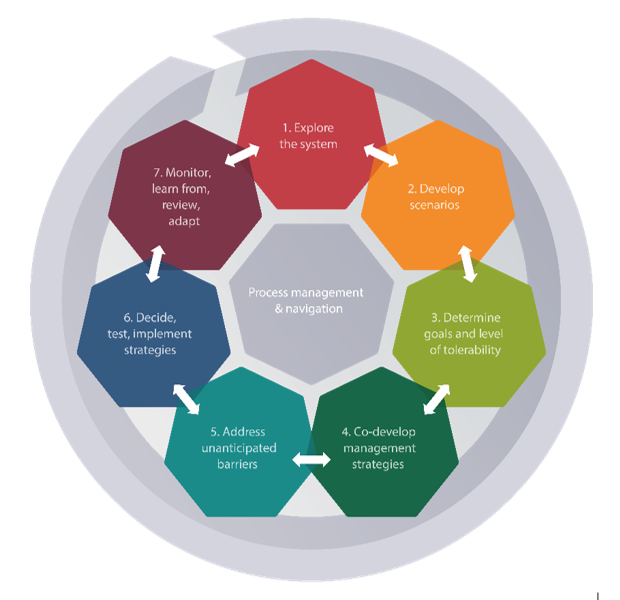
Enactive Management – de la Cerda (2007), with Humphreys and Saavedra (2018), and Ramírez-Vizcaya and Froese (2019)

I think this is part of the puzzle 🙂


Source: [PDF] Self Management : an Innovative Tool for Enactive Human Design | Semantic Scholar

Published 2007

Self Management : an Innovative Tool for Enactive Human Design

O. García de la Cerda

The purpose of this paper is to present an innovative and creative approach to the problemD solution in decision making, based on the understanding of decision makers as human beings, and decision making processes as human networks, in an organizational context. This approach basically consists of the development of a powerful ontological tool for the observation, self-observation, design and innovation of human beings from passive observers towards enactive observers, who have to make decisions and solve problem situations through the interactions in which they participate. This tool named CLEHES© (Body – Language – Emotion – History – Eros – Silence) allows to develop not only all the human potential inside us, but also to bring all organizational resources, such as information technology and communications, into the decision makers bodies, to invent and re-invent new human practices that can create value to our organizations. Several applications of this tool have taken place in different domains and organizational contexts with amazing results, which have been the focus of continuous research projects and managerial education instances


Source: (PDF) Enactive management: A nurturing technology enabling fresh decision making to cope with conflict situations

Enactive management: A nurturing technology enabling fresh decision making to cope with conflict situations

Abstract
The focus of this paper is observation, self-observation, and enactive management of organizational conflict situations whereby a community, an organization, or a human being has the possibility of recognizing their resources and generating changes in their practices if they so desire, and making fresh decisions, in the sense that different ontological dimensions are involved. We show how considering Body¹- Language- Emotions- History- Eros- Silence can configure a nurturing technology call CLEHES. This tool has been applied for diverse people, groups, communities, and organizations that need and wish to develop their own skills to inquire conflict practice resolutions, in order to learn as a human decision support system. Conflict situations are understood as interactions, a breakdown in-between CLEHES from the individual or social standpoints. This tool allows observing the boundaries of conflict situations and building an observer system with the ability to manage, solve, or attenuate the situation, enabling fresh decision-making attending to the context in which the organization moves. This learning process happens in a constructed place called an Enactive Laboratory where strategies are developed to cope with the domains and context in the perceived individual and human activities systems. We present a case study focusing on a Learning Family Mediators System.


Source: Frontiers | The Enactive Approach to Habits: New Concepts for the Cognitive Science of Bad Habits and Addiction | Psychology

Front. Psychol., 26 February 2019 | https://doi.org/10.3389/fpsyg.2019.00301

The Enactive Approach to Habits: New Concepts for the Cognitive Science of Bad Habits and Addiction

  • 1Philosophy of Science Graduate Program, National Autonomous University of Mexico (UNAM), Mexico City, Mexico
  • 2Institute for Philosophical Research (IIF), National Autonomous University of Mexico (UNAM), Mexico City, Mexico
  • 3Institute for Applied Mathematics and Systems Research (IIMAS), National Autonomous University of Mexico (UNAM), Mexico City, Mexico
  • 4Center for the Sciences of Complexity (C3), UNAM, Mexico City, Mexico

Habits are the topic of a venerable history of research that extends back to antiquity, yet they were originally disregarded by the cognitive sciences. They started to become the focus of interdisciplinary research in the 1990s, but since then there has been a stalemate between those who approach habits as a kind of bodily automatism or as a kind of mindful action. This implicit mind-body dualism is ready to be overcome with the rise of interest in embodied, embedded, extended, and enactive (4E) cognition. We review the enactive approach and highlight how it moves beyond the traditional stalemate by integrating both autonomy and sense-making into its theory of agency. It defines a habit as an adaptive, precarious, and self-sustaining network of neural, bodily, and interactive processes that generate dynamical sensorimotor patterns. Habits constitute a central source of normativity for the agent. We identify a potential shortcoming of this enactive account with respect to bad habits, since self-maintenance of a habit would always be intrinsically good. Nevertheless, this is only a problem if, following the mainstream perspective on habits, we treat habits as isolated modules. The enactive approach replaces this atomism with a view of habits as constituting an interdependent whole on whose overall viability the individual habits depend. Accordingly, we propose to define a bad habit as one whose expression, while positive for itself, significantly impairs a person’s well-being by overruling the expression of other situationally relevant habits. We conclude by considering implications of this concept of bad habit for psychological and psychiatric research, particularly with respect to addiction research.


A curriculum for meta-rationality )(What they don’t teach you at STEM school) | Meaningness – and some summary posts on David Chapman’s ideas

Other links:

To quote from https://meaningness.com/fluidity-preview/comments:

[I distinguish] three sources of “nebulosity”: linguistic ambiguity, epistemological uncertainty, and ontological indefiniteness. The first two are “problems in the map” and the third is “problems in the territory.”

Generally, it seems rationalism tries to deal with the map problems, and ignores the territory problems. (The “Guide to Words” is about linguistic ambiguity; and Bayes/decision theory/etc. are about epistemological uncertainty.)

“Fluidity” or “meta-rationality” is about territory “problems.” That is, the world is inherently fluid/mushy/vague, independent of any being’s beliefs about it.

I don’t know of any discussion by rationalists of ontological indefiniteness. The unstated background assumption seems to be that the world is perfectly well-behaved: facts are definitely true or false. It is just stuff in our brains (language and beliefs) that are imperfect.

Ontological remodelling – it’s not just that ‘the map is not the territory’, it’s that the territory is inherently fluid/mushy/vague: https://meaningness.com/eggplant/remodeling

How do we know? https://meaningness.com/metablog/meta-systematic-judgement

Nebulosity and pattern: https://meaningness.com/monism-dualism-recursion

Monism and dualism are opposites. But because each is obviously wrong, each turns into the other when cornered. A devious trick!

Monism is the stance that fixates sameness and connections, and denies differences and boundaries. Dualism is just the other way around: it denies sameness and connections, and fixates differences and boundaries.

Both these confused stances sometimes show themselves to be obviously wrong. The complete stance of participation recognizes that samenesses and differences, boundaries and connections, are all real, but also always somewhat nebulous: ambiguous and fluid. This is obviously accurate, but usually less convenient. Monism and dualism are simpler, and deliver particular emotional payoffs—some of the time.

not eternalism or nihilism but meaningness, not monism or dualism but participation, not causality or chaos but flow: https://meaningness.com/all-dimensions-schematic-overview

Pattern: https://meaningness.com/pattern

Nebulosity: https://meaningness.com/nebulosity

Terminology: emptiness and form, nebulosity and pattern: https://meaningness.com/terminology/emptiness-form-nebulosity-pattern

Pattern and nebulosity on the Deconstructing Yourself podcast: https://meaningness.com/metablog/deconstructing-yourself-6

Pattern and Nebulosity, with David Chapman


The syllabus for a curriculum teaching meta-rational skills: how to evaluate, combine, modify, discover, and create effective systems.

Source: What they don’t teach you at STEM school | Meaningness

This post sketches a hypothetical curriculum for developing these meta-systematic capabilities. It’s preliminary; perhaps even premature. There is no existing presentation of this subject that I know of, which makes it more difficult than it should be. My understanding of the topic draws on a dozen academic disciplines, each written in its own unnecessarily obscure code. Both my understanding, and the pedagogical structure I’m proposing, are tentative and incomplete.

Partly this presentation hopes to inspire some readers to pursue meta-systematicity; partly it is a plan for a large project that I hope to pursue myself; partly I hope you will give feedback, make suggestions, or contribute ideas to the project too!

Goal and audience

The overall goal is to take you from systematic rationality to meta-rationality as quickly and painlessly as possible. The curriculum should re-present insights I’ve found in many semi-relevant fields, as clearly and simply as possible, in STEM-friendly terms, in a structured, sequential format.

Learning meta-systematic skills shouldn’t be so hard, and meta-systematic understanding is particularly valuable in STEM. It is inherently somewhat conceptually difficult; but probably not as difficult as, say, senior-year undergraduate physics. However, it does have cognitive prerequisites.

This curriculum is for people who have mastered systematic rationality, specifically in a STEM framework. For the most part, you have to have a thorough understanding of how to work within systems before it’s feasible to step up and out of them, to manipulate them from above. There are other routes to mastering systematic rationality—through experience as a manager in a bureaucratic organization, for instance—but this curriculum will assume a STEM background.

The minimum requirement might be an undergraduate STEM degree; but research experience at the graduate level may be needed. You have to have seen how many different systems work, and—more importantly—how they fail. At the undergraduate level, you are mainly shielded from the failures, and systems get presented as though they were Absolute Truth. Or, at least, they are taught as though Absolute Truth lurks somewhere in the vicinity, obscured only by complex details. Recognizing that there is no Absolute Truth anywhere is a small downpayment on the price of entry to meta-systematicity.

That may already have set off warning bells. Woomeisters and postmodernists say things like that—and if you think they are horribly wrong, I agree!

This curriculum is about how to do STEM better. It is not about taking you out of a STEM worldview into some alternative. Everything here is on top of that view. It addresses limitations in the way STEM is typically taught and practiced, but does not contradict any of its content. There is no woo involved—including no STEM-flavored woo, such as neurobabble or quantum or Gödel woo.

In fact, a critical step is letting go of some of STEM’s own woo—quasi-religious beliefs about the ability of rationality to deliver certaintyunderstanding, and control. For that letting-go, the meta-systematic mode demands that one develop an additional cognitive style. Routine STEM is easy for those who are precise and rigid of mind, and so find promises of certainty, understanding, and control particularly comforting. Meta-systematicity requires openness, flexibility, daring, and uncommonly realistic common sense—as well as technical precision.

I’ll begin with some preliminary definitions, and provide a brief overview of the curriculum. Then most of the page goes through the syllabus, organized into ten modules, in more detail. That is still just a summary, which may be difficult to make sense of on its own. I’ve included in it links to resources that provide more explanation; some of my own web pages, and articles and books by others. At this stage in the project, even these leave many holes, which I hope to fill gradually. Many of the books are seriously difficult reading; the hypothetical curriculum would extract and explain clearly their relevant points.

Some loose definitions

By system, I mean, roughly, a collection of related concepts and rules that can be printed in a book of less than 10kg and followed consciously. A rational system is one that is “good” in some way. There are many different conceptions of what makes a system rational. Logical consistency is one; decision-theoretic criteria can form another. The details don’t matter here, because we are going to take rationality for granted.

Meta-systematic cognition is reasoning about, and acting on, systems from outside them, without using a system to do so. (Reasoning about systems using another system is systematic, and meta, but not “meta-systematic” in this sense.1) Meta-rationality, then, is “good” meta-systematic cognition. Mostly I use the terms interchangeably.

One field I draw on is the empirical psychology of adult development, as investigated by Robert Kegan particularly. This framework describes systematic rationality as stage 4 in the developmental path. Stage 5 is meta-systematic. However, as far as I know, no one from this discipline has applied the stage theory to STEM competence specifically. Empirical study of cognitive development in graduate-level STEM students would be helpful,2 but in the absence of that I’m working from a combination of first principles, bits of theory taken from many apparently-unrelated disciplines, anecdata, and personal experience.

According to this framework, there is also a stage 4.5, in which you lose the quasi-religious belief in systems, but haven’t yet developed the meta-systematic understanding that can replace blind faith. Stage 4.5 leaves you vulnerable to nihilism, including ontological despair (nothing seems true), epistemological anxiety (nothing seems knowable), and existential depression (nothing seems meaningful). It’s common to get stuck at 4.5, which is awful.

Continues in source: What they don’t teach you at STEM school | Meaningness

Supervenience – Wikipedia, the free encyclopedia | Model Report: Systems Thinking, Modeling and Simulation News

Source: Supervenience – Wikipedia, the free encyclopedia | Model Report: Systems Thinking, Modeling and Simulation News

W. Ulrich’s Home Page: A Mini-Primer of Critical Systems Heuristics

Key readings – https://wulrich.com/readings.html

Another overview – https://www.betterevaluation.org/en/plan/approach/critical_system_heuristics

A brief introduction by Werner Ulrich (pdf) http://projects.kmi.open.ac.uk/ecosensus/publications/ulrich_csh_intro.pdf

Other overviews:

  • https://i2s.anu.edu.au/resources/critical-systems-heuristics

Source: CSH | W. Ulrich | Ulrich’s Home Page: A Mini-Primer of Critical Systems Heuristics


Abstract “Critical Systems Heuristics,” also just called “Critical Heuristics” or “CSH,” is a framework for reflective practice based on practical philosophy and systems thinking. The basic idea of CSH is to support boundary critique – a systematic effort of handling boundary judgments critically. Boundary judgments determine which empirical observations and value considerations count as relevant and which others are left out or are considered less important. Because they condition both “facts” and “values,” boundary judgments play an essential role when it comes to assessing the meaning and merits of a claim. Their systematic discussion can help bridge differences of perspectives across disciplines and between experts and non-experts. They also lend themselves to a specific critical employment, calledemancipatory boundary critique, against claims that do not uncover their underlying boundary assumptions. CSH can thus serve as a tool for coproducing knowledge as well as for critical and emancipatory purposes on the part of people concerned by, but not necessarily involved in, the definition of relevant facts and values.

Critical systems heuristics (Ulrich 1983) represents the first systematic attempt at providing both a philosophical foundation and a practical framework for critical systems thinking. The Greek verb heurisk-ein means to find or to discover; heuristics is the art (or practice) of discovery. In management science and other applied disciplines, heuristic procedures serve to identify and explore relevant problem aspects, questions, or solution strategies, in distinction to deductive (algorithmic) procedures, which serve to solve problems that are logically and mathematically well defined. Professional practice cannot do without heuristics, as it usually starts from ‘soft’ (ill-defined, qualitative) issues such as what is the problem to be solved and what kind of change would represent an improvement.

critical approach is required since there is no single right way to decide such issues; answers will depend on personal interests and views, value assumptions, and so on. A critical approach does not yield any single right answers either; but it can support processes of reflection and debate about alternative assumptions. Sound professional practice is critical practice.

CSH aims to support reflective professional practice through a critical employment of the systems idea. The methodological core idea is that all problem definitions, proposals for improvement, and evaluations of outcomes depend on prior judgments about the relevant whole system to be looked at. Improvement, for instance, is an eminently systemic concept, for unless it is defined with reference to the entire relevant system, suboptimization will occur. CSH calls these underpinning judgments boundary judgments, as they define the boundaries of the reference system (the situation or context considered relevant) to which a proposition refers and for which it is valid.

Accordingly, the methodological core idea of CSH is to support systematic processes of boundary critique. To this end, CSH offers (among other concepts) a table of boundary categories (Figure 1) that translates into a checklist of twelve critical boundary questions (Ulrich 1987, 1996, 2000). These can be used:

  1. To identify boundary judgments systematically;
  2. To analyze alternative reference systems for defining a problem or assessing a solution proposal; and
  3. To challenge in a compelling way any claims to knowledge, rationality, or ‘improvement’ that rely on hidden boundary judgments or take them for granted.

The first two applications are basic for dealing with multiple perspectives in basically cooperative settings. They can help people understand why in respect to one and the same situation, their considerations of “fact” and “value” differ. They can thus help to bridge such differences or at least, to promote mutual understanding and cooperation in handling them. The third application, by contrast, leads to an emancipatory employment of systems thinking called emancipatory boundary critique. It offers both those involved in and those affected by professional practice an opportunity to develop a new kind of critical competence, a competence that will not depend on any special theoretical knowledge or expertise with respect to the problem or situation in question that would reach beyond what is available to ordinary citizens.

In short, CSH can be defined as a critical methodology for identifying and debating boundary judgements.

Continues in source: CSH | W. Ulrich | Ulrich’s Home Page: A Mini-Primer of Critical Systems Heuristics


Model of hierarchical complexity – Wikipedia

Alternative article – https://metamoderna.org/what-is-the-mhc/


Source: Model of hierarchical complexity – Wikipedia

Model of hierarchical complexity

From Wikipedia, the free encyclopedia

Jump to navigationJump to search

The model of hierarchical complexity (MHC) is a framework for scoring how complex a behavior is, such as verbal reasoning or other cognitive tasks.[1] It quantifies the order of hierarchical complexity of a task based on mathematical principles of how the information is organized, in terms of information science.[2] This model has been developed by Michael Commons and others since the 1980s.

Zachary Stein on Education in a Time Between Worlds

perspectivainsideout's avatarINSIDE OUT

Perspectiva is developing a new project called The Transformative Education Alliance, or TEA. A major inspiration for it is Education in a Time Between Worlds, a book by the philosopher of education Zachary Stein. Zachary is now helping Perspectiva to develop TEA. Here he talks to Caspar Henderson about major themes in the book.

Caspar Henderson: Let’s start with what you call “the central importance of education as an aspect of the global meta crisis.” Tell me something about what that means.

Zachary Stein: We’re in a situation where it seems like in order to have a viable future for humanity the challenge is one of technical and scientific problems to be solved such as the future of computing and ways to tackle environmental problems such as carbon emissions. There is some truth to this. But it’s also the case that none of those problems will be…

View original post 4,567 more words

Bowen Family Systems Theory

This keeps coming up for me, so here it is.

What are the eight interlocking concepts of Bowen Family Systems Theory?

http://www.vermontcenterforfamilystudies.org/about_vcfs/the_eight_concepts_of_bowen_theory/


Eight concepts (pdf) http://courses.aiu.edu/FUNDAMENTALS%20OF%20FAMILY%20THEORY/SESSION%203/3.pdf


Source: Theory – The Bowen Center


THEORY

Home>Theory

How to Cite the Online Version of One Family’s Story

Kerr, Michael E. “One Family’s Story: A Primer on Bowen Theory.” The Bowen Center for the Study of the Family. 2000. http://www.thebowencenter.org.

The eight concepts presented here are available in printed form on the online store. One Family’s Story: A Primer on Bowen Theory is available in single copies and at a discount for bulk purchases.

Preface

Bowen family systems theory is a theory of human behavior that views the family as an emotional unit and uses systems thinking to describe the complex interactions in the unit. It is the nature of a family that its members are intensely connected emotionally. Often people feel distant or disconnected from their families, but this is more feeling than fact. Families so profoundly affect their members’ thoughts, feelings, and actions that it often seems as if people are living under the same “emotional skin.” People solicit each other’s attention, approval, and support and react to each other’s needs, expectations, and upsets. The connectedness and reactivity make the functioning of family members interdependent. A change in one person’s functioning is predictably followed by reciprocal changes in the functioning of others. Families differ somewhat in the degree of interdependence, but it is always present to some degree.

The emotional interdependence presumably evolved to promote the cohesiveness and cooperation families require to protect, shelter, and feed their members. Heightened tension, however, can intensify these processes that promote unity and teamwork, and this can lead to problems. When family members get anxious, the anxiety can escalate by spreading infectiously among them. As anxiety goes up, the emotional connectedness of family members becomes more stressful than comforting. Eventually, one or more members feels overwhelmed, isolated, or out of control. These are the people who accommodate the most to reduce tension in others. It is a reciprocal interaction. For example, a person takes too much responsibility for the distress of others in relationship to their unrealistic expectations of him, or a person gives up too much control of his thinking and decision-making in relationship to others anxiously telling him what to do. The one who does the most accommodating literally “absorbs” system anxiety and thus is the family member most vulnerable to problems such as depression, alcoholism, affairs, or physical illness.

Dr. Murray Bowen, a psychiatrist, originated this theory and its eight interlocking concepts. He formulated the theory by using systems thinking to integrate knowledge of the human species as a product of evolution with knowledge from family research. A core assumption is that an emotional system that evolved over several billion years governs human relationship systems. People have a “thinking brain,” language, a complex psychology and culture, but people still do all the ordinary things other forms of life do. The emotional system affects most human activity and is the principal driving force in the development of clinical problems. Knowledge of how the emotional system operates in one’s family, work, and social systems reveals new and more effective options for solving problems in each of these areas.

The unmapped chemical complexity of our diet | Nature Food (2019)

This is a fantastic, simple, necessary, and powerful article.

It also encapsulates quite neatly my thoughts including reservations about the complexity ‘brand’. This is about purely scientific-realist level reductionist done better, at a more appropriate scale, with technical solutions. It’s about analysis which doesn’t recognise hierarchically-interacting effects or emergence. It mentions the microbiome, and differences between humans, which is good, but doesn’t even nod to the real layers of complexity in the system of human health related to food – I can understand not mentioning any of the effects of farming, supply chains, sustainability etc, since they operate at at least one remove – but the health effects of food cannot merely be reduced to interactions of molecules. Context, environment, epigenetics, attitude of mind, exercise are all a completely interacting part of the picture.

Maybe all that just isn’t appropriate for this kind of article, maybe that’s just the way science has to work – and the final long paragraph does suggest it’s not far from the authors minds:

To appreciate the transformative potential of a deeper quantitative understanding of the nutritional dark matter, we must realize that our genetic predispositions to specific phenotypes and pathophenotypes can conceivably be modified by these food-based molecules. Indeed, while we cannot currently change the genetic basis for disease, we regularly modulate the activity of our subcellular networks through the food we eat, diminishing the impact of some mutations and enhancing the role of others. This differential modulation of subcellular networks explains why individuals with strong genetic predispositions to heart disease can lower the chance of developing the disease by up to 70% with proper lifestyle choices56, within which dietary changes play a dominant role56,57. This finding implies that an accurate mapping of our full chemical exposure through our diet could lead to actionable information to improve health. Recent trends in nutrition research, aiming to explore the synergies, competitions and interactions among the entire matrix of what constitutes a food product, increasingly acknowledge the complexity of the problem, and the need for new tools to address it58. We must embrace this irreducible complexity to be able to integrate changes in the food supply, the role of the microbiome and personalized dietary patterns, so that we can eventually offer individually tailored food-based therapies and appropriate lifestyle choices for disease prevention and lifespan optimization.

But I can’t help having a ‘so near, and yet so far’ response to this. It’s great, it’s essential, but it isn’t enough, it isn’t systemic enough, and it risks closing eyes to true complexity.


Source: The unmapped chemical complexity of our diet | Nature Food

Published: 

The unmapped chemical complexity of our diet

The Genetics of Design | The Biology behind Design that Delights

The Biology behind Design that Delights

Source: The Genetics of Design | The Biology behind Design that Delights

Improvisation Blog: Out of Chaos – A Mathematical Theory of Coherence

Source: Improvisation Blog: Out of Chaos – A Mathematical Theory of Coherence

Tuesday, 24 December 2019

Out of Chaos – A Mathematical Theory of Coherence

One of my highlights of 2019 was the putting together of a what is beginning to look like a mathematical theory of evolutionary biology, with John Torday of UCLA, Peter Rowlands in Liverpool university, using the work Loet Leydesdorff and Daniel Dubois on anticipatory systems. The downside of 2019 has been that things have seemed to fall apart – “all coherence gone” as John Donne put it at the beginning of the scientific revolution (in “An Anatomy of the world”):

And new philosophy calls all in doubt,
The element of fire is quite put out,
The sun is lost, and th’earth, and no man’s wit
Can well direct him where to look for it.
And freely men confess that this world’s spent,
When in the planets and the firmament
They seek so many new; they see that this
Is crumbled out again to his atomies.
‘Tis all in pieces, all coherence gone,
All just supply, and all relation;
Prince, subject, father, son, are things forgot,
For every man alone thinks he hath got
To be a phoenix, and that then can be
None of that kind, of which he is, but he.

The keyword in all of this (and a word which got me into trouble this year because people didn’t understand it) is “Coherence”. Coherence, fundamentally, is a mathematical idea belonging to fractals and self-referential systems. It is through coherence that systems can anticipate future changes to their environment and adapt appropriately, and the fundamental driver for this capacity is the creation of fractal structures, which by definition, are self-similar at different scales.

In work I’ve done on music this year with Leydesdorff, this coherent anticipatory model combines both synchronic (structural) and diachronic (time-based) events into a single pattern. This is in line with the physics of David Bohm, but it also coincides with the physics of Peter Rowlands.

When people talk of a “mathematical theory” we tend to think of something deterministic, or calculative. But this is not at all why maths is important (indeed it is a misunderstanding). Maths is important because it is a richly generative product of human consciousness which provides consciousness with tangible natural phenomena upon which its presuppositions can be explored and developed. It is a search for abstract principles which are generative not only of biological or social phenomena, but of our narrative capacities for accounting for them and our empirical faculties for testing them. Consciousness is entangled with evolutionary biology, and logical abstraction is the purest product of consciousness we can conceive. In its most abstract form, an evolutionary biology or a theory of learning must be mathematical, generative and predictive. In other words, we can use maths to explore the fundamental circularity existing between mind and nature, and this circularity extends beyond biology, to phenomena of education, institutional organisation and human relations.

When human organisations, human relations, learning conversations, artworks, stories or architectural spaces “work”, they exhibit coherence between their structural and temporal relations with an observer. “Not working” is the label we give to something which manifests itself as incoherent. This coherence is at a deep level: it is fractal in the sense that the pattern expressed by these things are recapitulations of deeper patterns that exist in cells and in atoms.

These fractal patterns exist between the “dancing” variables involved in multiple perceptions – what Alfred Schutz called a “spectrum of vividness” of perception. The dancing of observed variables may have a similar structure to deeper patterns within biology or physics, and data processing can allow some glimpse into what these patterns might look like.

Fractal structures can immediately be seen to exhibit coherence or disorder. Different variables may be tried within the structure to see which displays the deepest coherence. When we look for the “sense” or “meaning” of things, it is a search for those variables, and those models which produce a sense of coherence. It is as true for spiritual practice as it is for practical things like learning (and indeed those things are related).

2019 has been a deeply incoherent year – both for me personally, and for the world. Incoherence is a spur to finding a deeper coherence. I doubt that we will find it by doing more of the same stuff. What is required is a new level of pattern-making, which recapitulates the deeper patterns of existence that will gradually bring things back into order.

What is Structural Memetics? And Why Does it Matter?

Chuck Pezeshki's avatarIt's About Empathy - Connection Ties Us Together

belowkanab2crop.jpgBelow Kanab Creek, Grand Canyon, 2003

A quick editorial note — lately, I’ve been referring to my work as ‘structural memetics’ — with the intent of expanding a concept of knowledge generation with memes along the same line as genetics — laying out general principles to follow about how humans generate knowledge.  Much of this material has already been created on this blog, but I wanted to consolidate and summarize it in one place.

Bored, and seeking the never-ending references, I Googled up Melvin Conway, whose famous law serves as the backbone for most of my developed insights.  Turns out he’s still alive — and on Twitter.  So.. I tweeted back at him.  And he responded, saying he’d take a look at my work.  

Short version of a longer story — I hurried up with this post so he wouldn’t have to dig.  I think it’s pretty complete.  So…

View original post 2,724 more words

A New Thermodynamics Theory of the Origin of Life | Quanta Magazine (2014)

Thanks to a tweet from @pezeshkicharles (also https://empathy.guru/) for reminding me of this piece, via posting the ‘Big Think’ article at https://bigthink.com/ideafeed/mit-physicist-proposes-new-meaning-of-life (I don’t recommend you click on this, loads of adware etc and a promised video which I can’t get).

Source: A New Thermodynamics Theory of the Origin of Life | Quanta Magazine

This is well worth a read – I don’t claim to have any real scientific understanding, but what I said in response to the tweet was:

“This is really intriguing to me – reminds me of this narrative of developing complexity – stream.syscoi.com/2019/11/06/ada and the message which didn’t quite get into this systems change write-up – forumforthefuture.org/Handlers/Downl – that the purpose of ‘systems change’ is ultimately to support the development of the universe’s unfolding complexity.

“This is (a) Alan Watts’ ‘ah yes, the rock in space is peopling’ (like a tree ‘fruits’), and (b) I *think* it’s the piece I’ve been trying to re-find for some time which essentially makes the point that negentropy / complexity is actually a mechanism of longer-term entropy.

“(And we must remember that the unfolding complexity is essentially ‘hierarchical’ as well as networked in nature)”

While the statement ‘everything that develops in nature is necessarily in the nature of nature’ might seem a truism of the ‘Eureka! You’ve discovered water’ type, it’s the kind of thing I get excited about.


Source: A New Thermodynamics Theory of the Origin of Life | Quanta Magazine


Content I took from the BigThink piece when I originally posted this at https://model.report/s/4eliay/mit_physicist_proposes_new_meaning_of_life_big_think

MIT Physicist Proposes New “Meaning of Life”

MIT physicist Jeremy England claims that life may not be so mysterious after all, despite the fact it is apparently derived from non-living matter. In a new paper, England explains how simple physical laws make complex life more likely than not. In other words, it would be more surprising to find no life in the universe than a buzzing place like planet Earth.

What does all matter—rocks, plants, animals, and humans—have in common? We all absorb and dissipate energy. While a rock absorbs a small amount of energy before releasing what it doesn’t use back into the universe, life takes in more energy and releases less. This makes life better at redistributing energy, and the process of converting and dissipating energy is simply a fundamental characteristic of the universe.

[S]imple physical laws make complex life more likely than not.

According to England, the second law of thermodynamics gives life its meaning. The law states that entropy, i.e. decay, will continuously increase. Imagine a hot cup of coffee sitting at room temperature. Eventually, the cup of coffee will reach room temperature and stay there: its energy will have dissipated. Now imagine molecules swimming in a warm primordial ocean. England claims that matter will slowly but inevitably reorganize itself into forms that better dissipate the warm oceanic energy.

[T]he second law of thermodynamics gives life its meaning.

The strength of England’s theory is that it provides an underlying physical basis for Darwin’s theory of evolution and helps explain some evolutionary tendencies that evolution cannot. Adaptations that don’t clearly benefit a species in terms of survivability can be explained thusly: “the reason that an organism shows characteristic X rather than Y may not be because X is more fit than Y, but because physical constraints make it easier for X to evolve than for Y to evolve.”


Prologue: a short history of cybernetics – Kauffman, Umpleby, and Epilogue: possible futures for cybernetices – from New Horizons for Second Order Cybernetics ed. Riegler Mueller (2017)

PROLOGUE: A SHORT HISTORY OF CYBERNETICS (2017)

Louis H. Kauffman, Stuart A. Umpleby

Prepared for the book, New Horizons for Second Order Cybernetics Edited by Alexander Riegler and Karl H. Mueller World Scientific, 2017]


https://cpb-us-e1.wpmucdn.com/blogs.gwu.edu/dist/d/257/files/2016/11/2017-Preface-for-World-Scientific-book-8-w-title-p-1a6cyu0-2-zntkap.pdf

Also

https://www.academia.edu/35684594/PROLOGUE_A_SHORT_HISTORY_OF_CYBERNETICS


Epilogue: Possible Futures for Cybernetics

Karl H. Müller, Stuart A. Umpleby & Alexander Riegler

https://blogs.gwu.edu/umpleby/files/2016/11/Epilogue-final-draft-5-q6vpef.doc

also

https://www.academia.edu/35684598/Epilogue_Possible_Futures_for_Cybernetics

Seasonal thoughts from the toolshed

>I wrote this message for participants in the RedQuadrant Way tool shed, and thought I might share it more widely<


Hello all

This is a little thought from the toolshed by way of season's greetings, as I have a chance of some reflective time. I think that an important part of understanding this practice we call consultancy, or change, or systems change, or whatever… is to understand the roots, and the history, and to listen to the elders. You'll find a lot of that in the toolshed, one way or another.

For years, I've been trying to find a piece I wanted from Marv Weisbord, which I thought was a reflection at the end of his long consulting career – which encompassed work in Bethlehem Steel, where FW Taylor undertook his famous experiments – and from which I vividly remember two quotes – one was 'let sleeping dogs lie' – don't discuss the undiscussable, and the other was a piece about a senior executive who was always disclosing his desire to retire. This was greeted positively by his team, and the consultants helped them work through implications and possibilities. Then they came back a year later – and there he was, still working, still talking about his plan to retire… soon.

I always thought this piece was 'Techniques to Match Our Values' – until I actually read it again 🙂

Thanks to my twitter network, I now know that I was really thinking of 'Let People Be Responsible'. Both pieces, and another one headlined 'Requiem for Bethlehem' are attached.

Techniques to match our values – https://www.dropbox.com/s/lrsrpmfeby6f2vi/Techniques%20to%20Match%20Values.pdf?dl=0

Requiem for Bethlehem – https://www.dropbox.com/s/z2oweb9lavmu506/Requiem%20for%20Bethlehem.pdf?dl=0

Let people be responsible – https://www.dropbox.com/s/mu60prut2q7zxo8/let%20people%20be%20responsible.pdf?dl=0

What I find fascinating is that 'let people be responsible' ​​is the piece I wanted, but isn’t quite the piece I ​​remembered. What I really want is a mashup of the history in Techniques to Match Values/Requiem for Bethlehem… and the ‘let sleeping dogs lie’ (not actually quoted in here – I was sure it was!) of this piece 😀

​It does contain some of the essence of that, though (and, btw, is co-written by Weisbord’s partner in business and life, Sandra Janoff). The quote I’m looking at is:

“Let People Hide Their “Hidden Agendas.”

“We never ask people what they are not saying. We see this as a form of subtle coercion that undermines a group’s willingness to accept responsibility. If people wish to conceal their “real” feelings or “real” data that is a choice they must live with. Their choice is, for us, the real data. In our philosophy, people have a right to hold back.”

You’ll hear a similar thing if you listen to these two reflective consultants, perhaps in their twilight years: Peter Block (episode 41) and Ed Schein (episode 49) on the Amiel Handelsman show – https://amielhandelsman.com/the-amiel-show/

​So, the Christmas message I have for you is this. Yes, there are many crises out there and in here, several of them existential. Yes, we can be forgiven a sense of urgency. And sometimes we need pace and drive and bravery and determination and even self-sacrifice. And, sometimes, an alternative is to let people live with their choices. To turn to our communities, to gifts, to ourselves, to care and gentleness. To let sleeping dogs lie. Allow yourself that that is a possibility.

​cheers

Benjamin​

​PS oh yes – and one of the original triggers for this is that Marvin Weisbord did retire. And he went back to one of his other careers, as a pianist – I got the below this month from the Future Search Network mailing list 🙂

Dear Friends and Colleagues,

We thought you would like to know what Marv is up to these days!

Not one to completely retire, he and his friend Alan Tripp have created theSenior Song Book – an album with Alan’s lyrics and Marvin’s music, with vocals by a few local FSN Members.

Marv says…. “ I never dreamed I’d be doing this in my old age, nor that I’d be having so much fun. Send my best to the FSN members, and wish them a happy seniorhood when they’re done hanging up flip charts.”

Click the “TV and Press” link on the home page for news and interviews with Marv and Alan. The Washington Post is running a feature on them soon, and PBS will film them this week!

Enjoy the website, download a few tunes and purchase the CD!


The inspirational story behind

The Senior Song Book™”


At age 99 Alan Tripp wrote a poem called Best Old Friends” to celebrate the many new friends he made a the Pennsylvania retirement community where he lives. As a gift for Alan’s 100th birthday, his younger friend and neighbor, 88 year-old Marvin Weisbord, set the poem to music. That was the spark that launched Senior Song Book with this dynamic songwriting duo, and inspired a whole community to sing, dance and perform along with them

Alan had long lamented that there was no new music being written for seniors, and he vowed to fill that void. He wrote many more lyrics, imagining how they would sound as show tunes and pop songs – from swing and tango to rumba and rock ‘n roll. Marvin, an accomplished jazz pianist, set the words to music and with his band, the Wynlyn Jazz Ensemble, performed the songs live for their enthusiastic neighbors, and fine-tuned each number to the “swing of the crowd.”

At age 102 Alan decided to take the now substantial collection of songs into the recording studio and produce an album.

The result is The Senior Song Book – music that will transport you back to the 1940s, with lyrics written in the 2020s.

Enjoy the website, download a few tunes and purchase the CD!

EDIT 2022-12-20 (since I can’t reply, not sure why)
Updated links for those two podcasts:

Episode 41: Peter Block On Ambition, Authenticity, And Community [The Amiel Show]

Episode 49: Ed Schein On Humble Consulting [The Amiel Show]

—–
EDIT 2024-03-10 since this post mysteriously cannot be ‘replied to’

Link to a piece by Chris Mowles which shares many of these same features (which I believe is in tune with his core beliefs and practices)

“I can only guess at the significance of what goes on in the group, what is being negotiated, part-revealed or expressed diplomatically.”

View at Medium.com

podcast – Karl H. Muller et al., “New Horizons for Second-Order Cybernetics” (World Scientific, 2017) | New Books Network

A nice example of a really juicy and interesting podcast – many more at https://newbooksnetwork.com/category/science-technology/systems-and-cybernetics/


Source: Karl H. Muller et al., “New Horizons for Second-Order Cybernetics” (World Scientific, 2017) | New Books Network

ALEXANDER RIEGLER, KARL H. MULLER, STUART A. UMPELBY

New Horizons for Second-Order Cybernetics

WORLD SCIENTIFIC 2017

April 13, 2018 Tom Scholte

In their volume, New Horizons for Second-Order Cybernetics (World Scientific, 2017), editors Alexander RieglerKarl H. Muller and Stuart A. Umpelby have assembled almost 60 articles, including their own analyses, in order to test what they have dubbed the Klein-Martin-Hypothesis that: “As a research program, second-order cybernetics was a) insufficiently developed, b) has had no sustainable consequences for other scientific disciplines in the past, and c) will remain mostly irrelevant in the future.” Surveying the expansive terrain covered by the contributing authors, from scientific domains such as mathematics, psychology and consciousness research, and non-scientific ones such as design theory and theatre studies, they conclude that, while the first two claims of the Klein-Martin-Hypothesis must be confirmed, the third, regarding its future prospects, can be confidently rejected. By recreating, for the first time, second-order cybernetics “in a systematic way as a comprehensive and trans-disciplinary research program” and introducing the notion of endo-research, or research from within a domain of study, this volume positions the field to amplify its potential for facilitating increasing degrees of reflexivity across all fields of inquiry and endeavor in the twenty-first century. In my conversation with editor, and master story-teller, Karl Muller, we revisit the two separate, and often confused, foundation moments of second-order cybernetics, tangle with grumpy students of Ross Ashby, celebrate Heinz von Foerster’s eightieth birthday in a crowd of over a thousand at Vienna’s city hall, and celebrate the virtues of being a “slow learner.” I hope you find your time with Karl as entertaining and stimulating as I always do.


s
search
c
compose new post
r
reply
e
edit
t
go to top
j
go to the next post or comment
k
go to the previous post or comment
o
toggle comment visibility
esc
cancel edit post or comment