Chaos and Complexity Economics (with J. Doyne Farmer)
Aug 26 2024
Physicist J. Doyne Farmer wants a new kind of economics that takes account of what we’ve learned from chaos theory and that builds more accurate models of how humans actually behave. Listen as he makes the case for complexity economics with EconTalk’s Russ Roberts. Farmer argues that complexity economics makes better predictions than standard economic theory and does a better job dealing with the biggest problems in today’s society.
EconTalkChaos and Complexity Economics (with J. Doyne Farmer)Aug 26 2024Physicist J. Doyne Farmer wants a new kind of economics that takes account of what we’ve learned from chaos theory and that builds more accurate models of how humans actually behave. Listen as he makes the case for complexity economics with EconTalk’s Russ Roberts. Farmer argues that complexity economics makes better predictions than standard economic theory and does a better job dealing with the biggest problems in today’s society.
[This is a new one on me, and not a lot of details given – if you go, read the book, or know Diana and these materials, let me know how it is!]
11,000.00 DKK
Essential Non-linear Skills and Practices for Software Professionals
As the relational complexity of our software systems increases, our traditional, linear thinking approaches are insufficient. Software professionals, especially those building interdependent software and services need to think in systems. This workshop explores practices that help us holistically grasp how all the pieces of a software system or organization connect, interact, and influence outcomes.
Systems thinking is becoming a core and critical skill. Cultivating the qualities of a systems thinker will help your career by increasing your positive impact through sound and trustworthy recommendations.
Transforming what we push to production depends on transforming how we learn, communicate, and collaborate with others. In this workshop, you’ll understand how interrelated and interdependent parts act together to create patterns. You’ll learn to create conceptual models to guide impactful decisions,
Through hands-on exercises and a real-world scenario, you’ll recognize the common mistakes orgs make when solving systems problems. You’ll use systems-thinking models and tools, and craft a recommendation amid complexity and uncertainty. Regardless of your role, these skills will help you lead impactful change within your organization.
We’ll explore:
How linear thinking limits your perspective on software systems.
How systems and nonlinear thinking help you understand and navigate complex issues arising from internal and external factors.
Methods for creating sound, cross-functional recommendations in the midst of complexity and uncertainty.
Using the Iceberg Model and leverage points to guide systemic change.
How nonlinear approaches improve the quality of architectural thinking (and is essential to systems design).
Solving a real-world systems challenge.
Providing a modern style of leadership as software becomes information systems.
We will work together on a systems challenge where there is no “right” answer, only the answers we can craft using systems thinking practices.
W. Ford Doolittle FRSC FRS (born November 30, 1941, in Urbana, Illinois), Professor Emeritus at the Department of Biochemistry & Molecular Biology of the Dalhousie University, Halifax, Canada, is an evolutionary and molecular biologist. He is a member of the US National Academy of Sciences and a Fellow of the Royal Society of Canada and the Norwegian Academy of Science and Letters. He is also the winner of the 2013 Herzberg Medal of the Natural Sciences and Engineering Research Council of Canada and the 2017 Killam Prize.
Doolittle has made significant contributions to the study of cyanobacteria. He found evidence for the endosymbiont origins of chloroplasts, and developed a theoretical basis for the initial evolution of eukaryotes. He has shown the importance of horizontal gene transfer in prokaryotic evolution.
As of 2007, he has been professor emeritus at Dalhousie University in Halifax, Nova Scotia. He received his BA in biochemical sciences from Harvard University in 1963 and his PhD from Stanford University in 1967, under Charles Yanofsky. He went on to do postdoctoral fellowships with Sol Spiegelman and Norman R. Pace.
Doolittle was elected a Fellow of the Royal Society in 2023.
In addition to his contributions to evolutionary biology, Doolittle is an artist who studied at NSCAD University, achieving a BA in photography.
Abstract:
After briefly describing James Lovelock’s Gaia Hypothesis, I’ll argue that Gaia does not reproduce, or rather that it has what Peter Godfrey-Smith would term “too many parents” to undergo natural selection according to Lewontin’s Recipe. So it does not make sense to most Darwinians. If that recipe were extended to include differential persistence as well as differential reproduction, or if the “gene’s-eye view” of Richard Dawkins as further extended by David Hull and us were adopted, then the Gaia Hypothesis would make sense. That’s what the It’s the song not the singer(s) theory does.
As you know, the Birmingham Food Council has a fine tradition in bringing people with diverse perspectives to join in in-depth, informed discussions on important matters — such as how can the UK prepare for us all have access to sufficient safe, nutritious food, given the existing and rapidly emerging threats to supplies.
Since 2018, we’ve been developing The Game in various iterations as a means to find ways to tackle this huge challenge.
The latest running of it is immersive one-day scenarios workshop. We’d love you to be there:
on 10th October
kindly hosted by Mills and Reeve Solicitors at One Centenary Way, B3 3AY
You’d have the opportunity network with a diverse group of professionals, gain unrivalled foresight on the risks ahead . . . and to join our alumni network, a collective policy influence on preparedness planning at the heart of he UK food supply system.
As soon as I heard about The Game, I knew I had to be there. And it didn’t disappoint.
Sophie Hosking, Strategic Director Neighbourhoods, Cornwall Council
A superb educational tool for leaders
Tom Hollands, Technical and Innovation Director, Raynor Foods
A really valuable exercise for assessing risks and potential solutions in our food system and what they mean for the wider society
Jon Miller, Sales Director, Partners&
Fantastic workshop, I’d not only recommend it to my peers, but everyone involved in the food system. Brilliant!
Sam Baillie, PhD agrifood researcher, Warwick University & the Royal Agricultural Society
About our work, Professor Ken Sloan, VC of Harper Adams University said, You are thought leaders in this space, and your passion for progress is infectious
___
If you’d to talk about it further, please do get in touch with me via email or give me a call, landline 0121 454 5666, mobile 07976 396 926. Discounts are available for direct or multiple bookings, and there are three discounted places for the third sector.
If you can’t make it, please do forward this email to your colleagues.
[You may need to get your browser to translate from Dutch. Teun Slujs presented at Systems Innovation 2024 last week and amongst his System Dynamics modelling, showed this cube – interesting stuff. He shared the links – I hope to share his presentation when he has a public version available]
A first prototype: The WISE Cube
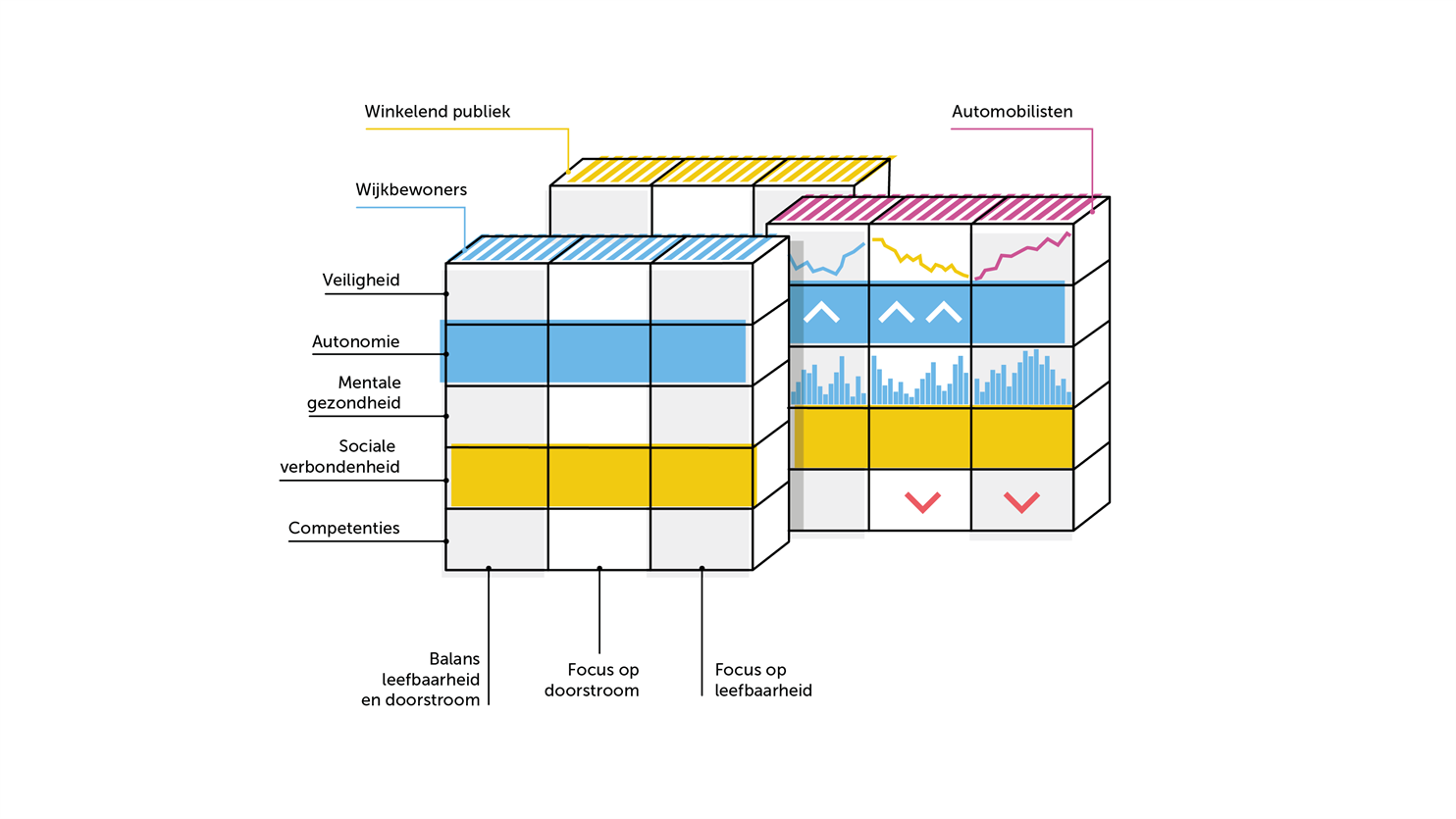
The WISE Policy Making research has led to models that can compare the effects of different policy options on social welfare. The effects of the different policy options are displayed in an interactive cube, the WISE Cube. The cube is designed in such a way that policymakers from different domains with different expertise and responsibilities can work on it together – a systemic approach.
Figure 2: The WISE Cube has three dimensions. The different policy options are horizontal, elements of well-being vertical and the different population groups from front to back.
The interactive WISE Cube provides visual insight into how policy options relate to each other in various ways. For example, a distinction is made between the effects in the short, medium and long term. The cube also offers the possibility to see per policy option how the various aspects contribute to the various dimensions of well-being.
The interactive WISE Cube is part of a prototype tool that supports the systematic completion of the ‘Grip on welfare’ method steps. With this online tool, involved parties can simultaneously complete the steps at different locations. The tool provides focus, helps with structuring and secures the results per step. Visualisations provide insight into the coherence. The tool can easily be linked to tools for modelling and data analysis, for example.
[h/t Roger James. Also a serious trigger warning – first large image in article appears to show dead bodies (in the context of the aftermath of the Rwandan massacre)]
02 Dec 2008 Bob Williams
Bucking the system: Systems concepts and developmentCIVIC ACTION,DEVELOPMENT POLICY02 DEC 2008BOB WILLIAMS
New third edition of The Solutions Focus book out this week (in UK and on Kindle)This fully revised and expanded edition comes 22 years after the first edition – proving that the book is a classic!MARK MCKERGOWMAY 08, 2024
Stepping out of the known and into reflective practice when the ground keeps shifting under our feet
By SCiO Ireland
Date and time
Wednesday, October 9 · 7:30 – 8:30pm GMT+1
Living together with uncertaintyStepping out of the known and into reflective practice when the ground keeps shifting under our feetBy SCiO Ireland30 followersFollowDate and timeWednesday, October 9 · 7:30 – 8:30pm GMT+1

 Physicist


You must be logged in to post a comment.