
Appreciating Systems Changes via Multiparadigm Inquiry | ISSS 2022 Proceedings March 1, 2023 daviding
Appreciating Systems Changes via Multiparadigm Inquiry | ISSS 2022 Proceedings – Coevolving Innovations
Category Archives: Discussion
A view or perspective on the world
SFI Press reissues Complexity, Entropy, and the Physics of Information


The workshop proceedings,Complexity, Entropy and the Physics of Information,were originally published in 1990, but contain many ideas that are still relevant today. In early 2023, the SFI Press issued a reprint of the proceedings as part of its mission to make important works of complexity science affordable and accessible. This re-publication also includes a new foreword by Lloyd.
Read the full article at: www.santafe.edu
Bobby Fishkin’s CrowdDoing
Another systems-related initiative that has been going for some time, this is a self-organising group focusing on Systems Change, meeting regularly online on Saturdays
more info including dates and links in pdf:
https://drive.google.com/file/d/1uwh4qSFFAclQGmQdSIKREZLUceqbXaMp/view
What is CrowdDoing?
CrowdDoing works in sustainability, anti-poverty, public health, education, and research. We
aim to address UN Sustainable Development Goals and beyond through our social innovation
efforts. CrowdDoing approaches each collective challenge by harnessing operating leverage for
systems change via social innovation. This allows us to identify different under-utilized
capacities that could make addressing problems in our society more feasible in the future.
Because first
CrowdDoing.world believes in the exponential potential of global collaboration to de-risk and
develop social innovations and leverage diverse capabilities to realize shared goals. CrowdDoing
leverages multiple intervention points and under-utilized capacities to achieve operating leverage
for systems change. CrowdDoing is able to achieve this kind of operating leverage for impact
across our portfolio areas from homelessness prevention, prevention derivatives, health benefits
from spending time in nature, medicinal foods for stress and anxiety, and preventing isolation as
a side effect of virtual volunteerism. All of these are anticipatory solutions which allow people to
get ahead of their risks of catastrophe. CrowdDoing leverages under-utilized capacities to make
it feasible for our solutions to potentially reach the scale of the problems we face together.
At CrowdDoing, each of us adopts a dimension of a larger challenge. We collaborate within our
convenient feasibility on this with others. We don’t expect ourselves to have every expertise. We
rely on each-other. We include broad participation by micro-leaders in systemic change through
specific social innovations that we can build together.
CrowdDoing aims to scale participation through skilled volunteering and service-learning
opportunities to help enterprises and institutions foster social innovation. Better mental health,
physical health and productivity among employees are among the intrinsic incentives that prompt
companies to adopt employee volunteer programs. Learning, creating impact, and achieving
mental and physical health benefits are intrinsic incentives that prompt employees to participate
in volunteering & service-learning programs. Service learning focused on social innovation can
be efficient simultaneously at achieving impact, and at teaching skills needed in the future.
Service learning and skilled volunteering have demonstrably been efficient and effective
approaches to helping individuals acquire skills for a VUCA (volatility, uncertainty, complexity,
and ambiguity) world in a diversity of fields—from human resources to engineering to project
management to data science. Service learning combines learning objectives with community
service in order to provide a pragmatic, progressive learning experience while meeting societal
needs. Service learning and skilled volunteering helps to bridge skill & social innovation gaps to
achieve sustainable development goals. Research shows professional development is most
effective when done in a hands-on manner through engaging challenging / new projects and
experiences. Micro-leadership at CrowdDoing means that while each person adopts a dimension
of responsibility for a collective problem in our society, each of us does not take on the worry
about the whole. We take on a level of responsibility that is safe for each of us to have comfort
in.
Initiatives list (more info in pdf)
(1) CrowdDoing is developing an app called Nature Counter which aims to promote the
benefits of spending time in nature by allowing users to track their time spent in parks and
other natural areas.
(2) Medicinal Foods & Herbs for Stress and Anxiety by CrowdDoing–now called
Flourish.Science
(3) Zero Subsidy Affordable Housing (ZSAH)
(4) CrowdDoing Catastrophic Wildfire Prevention
(5) Implicit Marginalia
(6) #systemschange is a dialogue hosted by CrowdDoing.world with leading thinkers and
practitioners in systems change, systems thinking and social innovation. This dialogue is
public facing and connects to theory and real-world problems. The conversation develops
narratives about how we can achieve agency regarding collective challenges. The
organization, CrowdDoing’s #SystemsChange brings together individuals in social
innovation, impact investing, complexity sciences, social entrepreneurship, collaboration
studies, ecosystem services, the arts, and artificial intelligence for social good. The goal is to
reach a regenerative future and address global problems before they become impossible to
solve. The conversations will be recorded for public release on video and audio platforms.
CrowdDoing also shares the output of #SystemsChange’s work on it’s Youtube channel
under #systemschange.15 CrowdDoing stewards #SystemsChange as a social innovation
organization. CrowdDoing’s #SystemsChange invites individuals to join a series of
international conversations about deepening collaboration across fields to address human and
environmental needs.
(7) Relational Capital by CrowdDoing.
(8) Project Blackthorn (the New Stock Exchange for Systems Change)
(9) Generative AI Course on Backcasting from a solar punk future on Udemy
(10) Ikigai by CrowdDoing
(11) Common App for Volunteer Request
(12) Initiative for a Systems-Change “Solar Punk Fund for Sweat Equity
Diversification”
(13) Deliberative Democracy
(14) CrowdDoing Hackathon
(15) Dopplegangers United by CrowdDoing
(16) Mutual “Debt for Nature” for Accelerated Biodiversity Conservation
(17) Radical Collaboration on Addressing Solar Punk Narrative Gap
(18) Vertical gardens in hospitals by CrowdDoing
(19) Service Learning Singularity
(20) Spaceship Earth Knowledge Management
(21) Democratization of Shareholder resolution proxy voting
(22) Crypto-Impact Potential: The CrowdDoing Crypto Impact Potential project
Club of Remy – Really-relevant Emergency Mindfully-minding You
Over a few years, ‘Jason the Goodman’ (Jason Jixuan Hu, Ph.D.) has hosted some remarkable speakers and sessions
Organizer: Club of REMY: www.clubofremy.org
YouTube: https://www.youtube.com/channel/UCJumBT3J15xhAoNs9CnrSVg/videosCall For Participation CoR Interactive Process 7-Slides Rule COR Topics 2020
Club of Remy – Really-relevant Emergency Mindfully-minding You
Events (not up-to-date)
2021 Events:
– November 10th, Wednesday
1- Klaus Krippendorff: Four theories of using language
2- Larry Richards: Bits and Pieces of a Cybernetic Approach to Language
3- Joe Velikovsky: The UNITS & LEVELS of: Language!
4- Louis H. Kauffman: Cybernetics, Language and Reflexive Domains
-October 12th, Tuesday, Chinese Session
Qiang XU, Beifang ZHOU, Susan LIU, Jason HU together: Three Critical Questions of Our Time: How Do We Resolve Conflicts Between Our Mainstream Story System And Human Knowledge Explosion Since Renaissance? What Are the Functionality of Faith System for Our Civilization and How Do We Revitalize It Today? What Are the Relationship Among Rationality, Emotionality, Sustainability and Civilization Development?
–October 6th, Wednesday
· Lucas Pawlik: Our Current Dilemma (Threats from A.I., bioweapon & “1984”)
· Michael Ellis: Global Transition to A Sustainable Civilization
· Jason Hu: Civilization Evolution at Crossroads: Options Ahead According to Multiple Agent Self-Organization Perspective
– September 8th, Wednesday
CoR Extra Special: “What Lessons We Can Learn from these Five Wars” (Part II, English Session)
(This session will last three hours with five discussants.)
1- Glenda Eoyang: USA Past, Present and Future: A Complex Adaptive Systems Perspective
2- Stuart Umpleby: Two Conceptions of War – from Two Systems of Ethical Cognition
3- Deeanna Burleson: Is It Really Unintended Consequences: Sensemaking in and around “political” conflicts
4- HUANG Ciping (rep. WEI Jingsheng): Reasons for the American Failures from Historical Perspective
5- Jason Hu: How Many Boys Are Crying Wolf & How Many Wolves Are Indeed Out There??? – A Meta-Reflection on American’s Five External Wars
September 7th, Tuesday
CoR Extra Special: “What Lessons We Learn from these Five Wars” (Part I, Chinese Session)
(This session will last three hours with five discussants.)
1- WEI Jingshen: Reasons for the American Failures from Historical Perspective 魏京生: 从历史上看美国失败的原因
2- SU Xiaokang: The Sacrifice of Utopian Morality – What We Do When Our Value of Human Rights Encounter Unrestricted War 苏晓康:道德乌托邦祭–当人权价值遭遇超限战
3- ZHOU Beifang: The Christian National Spirit And The American Mourn from Its Interventions of Local Wars 周北方:基督教立国精神与局部战争介入的美国之殇
4- LIU Susan: The Misplacement of Strategies and the Social-Psychological Foundations for Gaming Between Big States 刘苏珊:从策略的错配谈大国博弈中的社会心理基础
5- XU Qiang: Proposing State-Based Showcase Project Defending Conservative Value System Against the Progressives’ Abuse of Value 徐强:保卫保守价值观及对抗所谓“进步派”的价值滥用的州立项目建议
September 1st:
Gennady Shkliarevsky, Carl Goldberg, Peter Cariani: (Three Different Perspectives on) the Paradox of Observing, Autopoiesis, and the Future of Social Sciences.
August 4th:
Maurice Yolles: Autopoietic Efficacy – A Metacybernetic View – Some Ideas; Jonathan Huxley: Viable Society – Or Different Types of Social Structures that Fit Our Ideas in System Theory; Jason Hu: Appropriateness Between Reductionism and Holism, and Feed-left vs Feed-right – Increasing Communicative Coordination vs. Increasing Cognitive Resolution and “Realness”;
July 7th:
Lucio Biggiero: Reductionism, Weak Reductionism, Anti-Reductionism: Where Do We Place? Jerry LR Chandler: From the Perspective of the Implications of Logical Synduction and Obligation; Jason Hu: Appropriate-Reductionism with Two Strategies Derived from Ashby’s LRV – Feedleft vs Feedright – Increasing Feasibility vs. Increasing Cognitive Resolution;
June 30th:
21st Century Agoras – Cocreating Civitas of the Future through Democratic Dialogue Culture. Heiner Benking: Futures and Challenges for Democracy between Technology and Individualism; Peter Jones: The Once and Future Agoras: Sustaining People, Place, and Principles in Wicked Social Problems; Tom Flanagan: 21st Century Agoras: Translating a corporate model for inclusive collaborative design into the civic culture.
June 16th:
Second Session on Maurice Yolles’s topic of Meta-Cybernetics: William Reckmeyer: Homo Cybernetics; Jason Hu: Twelve Types of Cybernetic Circular Causalities; Maurice Yolles: From Metacybernetics to Mindset Agency Theory.
June 15th
(Chinese session, same time with English sessions from now on every Tuesday)Jason Hu & Susan Sun co-authoring project: Emergence of Totalitarian Phenomenon – from the perspective of Cultural DNA, Cultural Identity Core, and Cultural Gene Evolution and Re-engineering. Qiang Xu: Are We on A New Road to Serfdom? – Observations on American Society Today.
June 9th:
Pandemic of Bulges – How can we steer ourselves to move and eat better;
Lucas Pawlik(video); Namrata Singh(video);
June 8th:
Comparing 4 Cases of Collective Cooperation Efforts
Susan Sun: Rationality Degree in Decision-Making Perspective
Dahang Wei: Emotional Dynamics Perspective
Qiang Xu: Conflict Resolution Perspective
Jason Hu: Cultural Gene Hypothesis Perspective
May 28th: (In Chinese)
Frazer Xia: Synapse Pruning and the Formation of Cognitive Framework;
Susan Sun: A New Tool to Listen to the Cries from Afar (in Rational Decision-Making);
Jason Hu: Six Directions/Types of Cybernetic Feeds – Back, Forward, Up, Down, Left, Right.
May 26th:
Maurice Yolles: Metacybernetics: Towards a General Theory of Higher-Order Cybernetics;
Jerry LR Chandler: Third-Order Bio-cybernetics. Non-Boolean Higher-Order Categories of Living Systems;
Larry Richards: Cybernetics: A Cure for Hierarchy and Meta-Anything?
May 19th:
Mustafa Akyol: Reopening Muslim Minds: A Return to Reason, Freedom, and Tolerance;
Carl Goldberg: Obstacles for Muslims to Open Mind;
Jason Hu: My Suggestion to Jerusalem for A Possible Solution of the Deadlock, or, Why It Is Not Possible?
May 12th:
Andy Williams: Implementing a General Collective Intelligence to Radically Increase Capacity to Achieve Global Systemic Change;
Maurice Yolles: From General Collective Intelligence to Autopoietic Efficacy – Towards Synergies Across Theory;
Susan Sun: A Comprehensive Description of Rational Thinking of Individual Brain as the Basis for General Collective Intelligence – A Family Therapist Perspective;
May 7th: (In Chinese)
Jason Hu: Beyond Karl Popper How do we see our world now;
Qiang Xu: Describing New Human after Nietzsche’s Superman in Critique of Rousseau’s Wrong Ideas;
Dahang Wei: Types of Aesthetics Leading to Different Cultural Genes;
May 5th: Why Problem-Solving Becomes A Problem? Answers from Three Different Perspectives;
Klaus Krippendorff(video), Loet Leydesdorff(video), Lowell Christy(video)
April 30th: (In Chinese)
Dahang Wei:What Happens to Our Rationality After Nietzsche; Susan Sun: Edutainment Startup Promoting Rational Thinking Capacity, and Three Game Products; Qiang Xu: New Human after Superman and Jason Hu: Coordination of Several BP Ideas gemmed from CoR;
April 28th: Educational Projects for System Thinking: A Business Plan for A New Non-Profit Organization Pushing Our Ideas into Reality, A Formal Call for More Directors or Advisors;
Kerry Turner(video), John Vodonick(video),, Jason Hu(video),, Group Discussion(video),
April 23: (In Chinese) Dahang Wei: Sketch of A New Movie Project; Susan Sun: Improving Rational Thinking Capacity, Designing Tactics in War of Ideas; Jason Hu: Toolbox of Communicatics;
April 21: What Kind of Group Process the Club of Remy Members Might Like to Adopt? or, How Do We Move This Work Forward?
Jason Hu(video), Jonathan Huxley(video), Richard Knowles(video). Group Discussion(video)
April 14: Self-Organization, Hierarchy, and Its Complex Relationships in Socio-Economic Systems;
Lucio Biggiero(video), Loet Leydesdorff(video)
April 9: (In Chinese) (1) The Unrestricted Warfare Online Game to Raise Awareness of Our Situation? (2) Dot Thinking, Line Thinking, and System Thinking – A Social Media Discussion Framework for Current Affairs;
Susan Sun, Dahang Wei, Qiang Xu, Ellen Tang
April 7: Problems of Common Metaphors In Dealing with Social Systems;
Klaus Krippendorff(video), Mark Johnson(video), Bernard Scott(video), Group Discussion (video)
April 2: Isomorphy as A Power Tool in Inter/Cross/Trans-Disciplinary Learning, Information Cocoons, Social Comfort Zones, and System Thinking;
(In Chinese) Jason Hu(video), Dahang Wei, Susan Sun, Qiang Xu, Ellen Tang:
March 31: Group Processes – Goethe’s Way (Jonathan), Quaker’s Way (Lowell), and ICA ToP Way (Stuart);
Jonathan Huxley(video), Lowell Christy(video), Stuart Umpleby(video)
Our Information Cocoons and Social Comfort Zones, and “My List of Top Concerns – Individual and Social”;
Susan Sun(video), Qiang Xu, Dahang Wei, Jason Hu
Dual Universe, Double Bind and Three-Fold Vision, Schismogenesis Cases;
Lowell Christy(video), Carlos Sluzki(video)
Family Therapy Process Framework and possible Transition to Organizational and Social Interventions Including Movies;
Susan Sun(video), Dahang Wei
Quantum Entanglement as the Fundament of Life: Consciousness-based Evolution
John Torday(video), Fraze Xia(video), Mark Johnson(video), Klaus Krippendorff(video)
Using A Shared Case to Facilitate Our Mutual Understanding of Key Concepts
Lucio Biggiero(video); Loet Lydesdorff(video); Bernard Scott(video1, video2), Jason Hu(video)
Group Discussion I (video), Group Discussion II (video), Group Discussion III (video)
Facilitating Growth of Intellectual Leaders – Potential of Growing CoR into an Online Doctoral Program of System Thinking?
Qiang Xu, Dahang Wei, Jason Hu
Designing/Resigning Government Session II, continue of Jan. 27 session (by Bob Knisely, Stuart Umpleby, Lowell Christy)
George Mobus(Video), Marc Pierson(Video), Klaus Krippendorff(video)
Group Discussion 1(Video), Group Discussion 2(Video)
Critical Cybernetics (II) and Distinctions between Cybernetics and System Science
Mike Jackson(Video), Juancho Barron(Video), George Mobus(Video), Group Discussion (Video)
Distinctions between Cybernetics and System Science, and Critical Cybernetics (I)
Larry Richard(video), Klaus Krippendorff(video)
Follow-up for My View about What’s Wrong in the U.S.(Chinese Session)
Q. Xu: Noam Chomsky’s Success Case of Propagating His Ideas(video)
D. Wei: Proposal of Action Plan for Club of Remy(video)
J. Hu: Government Design Perspective II – Discussing Recent High-Impact Documentaries(video)
Designing Government (Based on Bob’s 22-minutes video: https://youtu.be/COZX9TXWnqY Bob requests everyone attending to view this video BEFORE the session so we can jump into the discussions right away.)
Bob Knisely(video), Stuart Umpleby(video), Lowell Christy(video), Group Discussion(Video)
My View about What’s Wrong in the U.S. (Chinese Session)
Michael Q. Xu(video), Dahang Wei(video), Jason Hu(video)
Digitalization and Social Responsibility
Igor Perko(video), Matjaz Mulej(video), Teodora Ivanusa(video)
The Unknown Ashby – Ultrastability (from Different Perspectives);
Manel Pretel-Wilson(video), Stuart Umpleby(video), Jason Hu(video)
YouTube site
https://www.youtube.com/channel/UCJumBT3J15xhAoNs9CnrSVg/videos
A Complexity Science Account of Humor
Wolfgang Tschacher and Hermann Haken
Entropy 2023, 25(2), 341
A common assumption of psychological theories of humor is that experienced funniness results from an incongruity between stimuli provided by a verbal joke or visual pun, followed by a sudden, surprising resolution of incongruity. In the perspective of complexity science, this characteristic incongruity-resolution sequence is modeled by a phase transition, where an initial attractor-like script, suggested by the initial joke information, is suddenly destructed, and in the course of resolution replaced by a less probable novel script. The transition from the initial to the enforced final script was modeled as a succession of two attractors with different minimum potentials, during which free energy becomes available to the joke recipient. Hypotheses derived from the model were tested in an empirical study where participants rated the funniness of visual puns. It was found, consistent with the model, that the extent of incongruity and…
View original post 72 more words
Seven methods for mapping systems – Barbrooke-Johnson and Penn – Integration and Implementation Insights
Seven methods for mapping systems
February 28, 2023
By Pete Barbrook-Johnson and Alexandra S. Penn
Seven methods for mapping systems – Integration and Implementation Insights
Implementation of Systems Thinking in Public Policy: A Systematic Review – Nguyen et al (2023)
[Double warning: a systematic review (i.e. word search on papers) and an MDPI Journal]
Implementation of Systems Thinking in Public Policy: A Systematic Review
by
Le-Khanh-Ngan Nguyen 1,2,
Bowen Jiang 1 and
Nici Zimmermann 1,*
Systems | Free Full-Text | Implementation of Systems Thinking in Public Policy: A Systematic Review
Frontiers in Complex Systems, San Miguel (2023)
[From the usually-reliable Complexity Digest. I may be tired, but I’m struggling to see why it’s noteworthy. Sharing anyway!]
FIELD GRAND CHALLENGE article
Front. Complex Syst., 16 February 2023
Volume 1 – 2023 | https://doi.org/10.3389/fcpxs.2023.1080801Frontiers in Complex Systems
Frontiers | Frontiers in Complex Systems
- Institute for Cross-Disciplinary Physics and Complex Systems, IFISC (CSIC—UIB), Campus Universitat Illes Balears, Palma de Mallorca, Spain
InFusion Labs – Creating Flexible Spaces for Practitioners to Explore and Learn
InFusion LabsCreating Flexible Spaces for Practitioners to Explore and Learn
InFusion Labs – Creating Flexible Spaces for Practitioners to Explore and Learn
Alexander Bogdanov, Stafford Beer and intimations of a post-capitalist future, Prof Mike Jackson online, March 15th, 5:00-6:30 pm Metaphorum’s Webinar Series
Join Zoom Meeting:
https://lnkd.in/enihtrxv
Alexander Bogdanov (1873–1928) was a Russian social theorist and revolutionary activist whose ‘universal organizational science’, or Tektology, is increasingly being recognized as offering stronger foundations for the systems approach than the later ‘general system theory’ of Ludwig von Bertalanffy. Had his thinking not been suppressed by Stalin, the course of Soviet history might have been different. Stafford Beer (1926–2002) was a British management scientist and consultant who was a pioneer in the development of ‘organizational cybernetics’. His best-known engagement was with the government of Salvador Allende, in Chile, seeking to use his ‘viable system model’ to create a socialist society that did not rest on a command economy. This experiment was cut short by the Pinochet coup d’etat. I have found no evidence that Beer was familiar with the work of Bogdanov, and this makes the similarities in their thinking particularly striking. This paper explores the ideas they shared. The work of other writers who have drawn on the work of Bogdanov and Beer, in formulating contemporary visions of post-capitalism, is also noted.
Bioentropy, Aesthetics and Meta-dualism: The Transdisciplinary Ecology of Gregory Bateson, Harries-Jones
Bioentropy, Aesthetics and Meta-dualism: The Transdisciplinary Ecology of Gregory Batesonby Peter Harries-Jones
Entropy | Free Full-Text | Bioentropy, Aesthetics and Meta-dualism: The Transdisciplinary Ecology of Gregory Bateson
“From Anthropology to Epistemology”: Extensions to an Autobiography of Gregory Bateson, Harries-Jones
Peter Harries‑Jones
York University (Ontario)
2021
“From Anthropology to Epistemology”: Extensions to an Autobiography of Gregory BatesonPeter Harries‑JonesYork University (Ontario)2021
“From Anthropology to Epistemology” : Extensions to an Autobiography of (…) – Bérose
IMBRICATE! Technics Lifeless and Technics Alive: Activity Without and With Content – Andrew Murphie
via @AndrewMurphie@indieweb.social
Technics Lifeless and Technics Alive: Activity Without and With Content
Andrew Murphie
IMBRICATE! Technics Lifeless and Technics Alive: Activity Without and With Content
Home | Bridging Systems
What are bridging systems?
Home | Bridging Systems
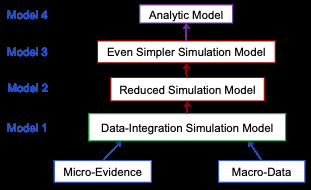
The inevitable “layering” of models to extend the reach of our understanding
Bruce Edmonds
RofASSS
There is a modelling norm that one should be able tocompletelyunderstand one’s own model. Whilst acknowledging there is a trade-off between a model’s representational adequacy and its simplicity of formulation, this tradition assumes there will be a “sweet spot” where the model is just tractable but also good enough to be usefully informative about the target of modelling – in the words attributed to Einstein, “Everything should be made as simple as possible, but no simpler”1. But what do we do about all the phenomena where to get an adequate model2one has to settle for a complex one (where by “complex” I mean a model that we do not completely understand)? Despite the tradition in Physics to the contrary, it would be an incredibly strong assumption that there areno such phenomena, i.e. that an adequate simple model…
View original post 11 more words
 Systems Community of Inquiry
You must be logged in to post a comment.