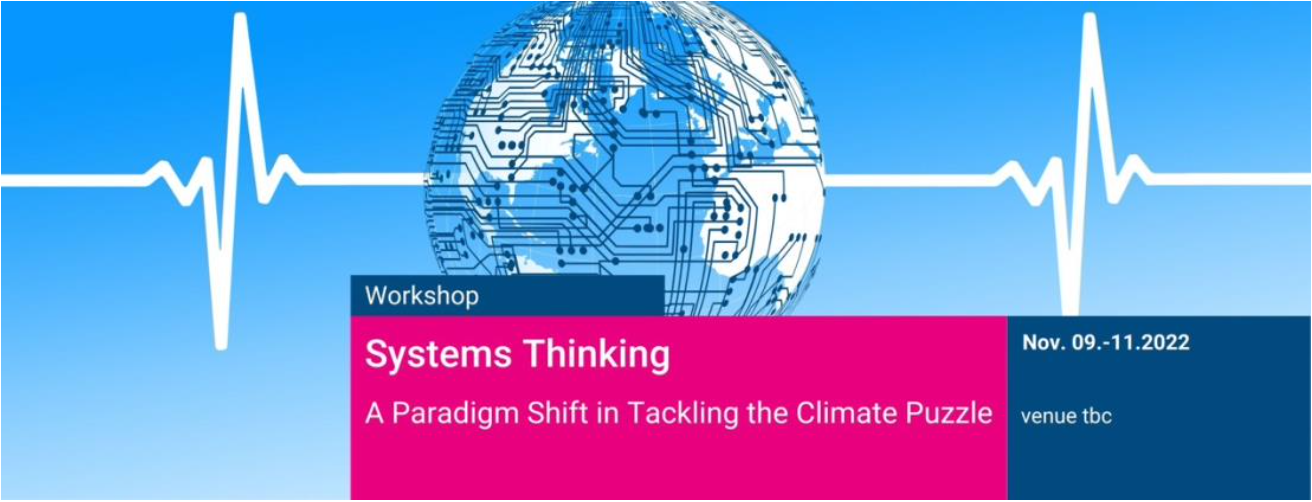
Systems Thinking – A Paradigm Shift in Tackling The Climate Puzzle. 9-11 November 2022

Systems Thinking – A Paradigm Shift in Tackling The Climate Puzzle.

9-11 November 2022

Systems Thinking – A Paradigm Shift in Tackling The Climate Puzzle. Workshop

via the Deming Forum:

View this email in your browser
Workshop participation is free of charge. Travel costs, accommodation and meals during the workshop meals are provided by FNF.ABOUT THE WORKSHOP
 
All organisations face complex challenges and opportunities. Today’s challenges are often created at the intersection of social, technological, environmental, economic, governance and geo-political tensions. This has led to fragmentation of policy solutions that have unintentionally imposed burdens on employers, individuals, and the environment to harm the biosphere and the communities they were meant to protect. What if these burdens were avoidable? What if governments could equip themselves with better tools to tackle complexity? What contribution would you make if YOU had access to those same tools? Why is it a core liberal interest to acquire these tools?

What to expect?
This workshop takes you on the start of a professional development journey. You’ll explore systems thinking, a scientific tool that helps remodel decision-making processes and tackle complex interdependent issues for sustainable viability.

Systems thinking is applied in many different fields of academic research. Brought down from theory into practice it is a most critical skill to meet multiple interdependent goals that empowers us to excel both as individuals and collectively. Systems thinking explores the boundaries of what we account for in decision-making, how to fully appreciate multiple stakeholder perspectives, and how to see organisations, communities, and the planet as an interdependent system. Accordingly, systems thinking is useful right across the private, public, voluntary and community sectors – especially when set up to achieve joint objectives that they cannot realise on their own.

For liberals, improving the interconnectivity of systems in different policy fields, reducing opportunity costs, and increasing performance is a natural ambition. Systems thinking provides freedom to achieve this ambition: breaking free from where such ambitions usually get stuck. For example, systems thinking can help components of a free-market economy to grow and become resilient in an increasingly competitive world, all the while building both social value and climate protection. Ideally, this process can accelerate action toward an equitable, just, inclusive, fair, and authentic net-zero world. This, in turn results in greater freedoms for all in an interdependent world.

Why should you join?
You will dive in to a world of three-dimensional thinking that goes beyond your usual education and experience. You will raise your ability to understand the unknown unintended consequences and missed opportunities from decisions in the systems in which you live and work, and apply your insights flexibly to other and bigger problem fields, including global markets, climate change, and the environment. Learn how actions of each of us affects the many. Start thinking three-dimensionally and understand the feedback loops that can cause systemic problems to remain unsolved. Become a better decision-maker and problem-solver to harmonise operational functions and government policies. Advance positive action for the improvement of climate change, the amelioration of biosphere service levels and greater social justice, the greatest innovation today is a shift to systems thinking.
Outline
OUR EXPERTSChristopher Gleadle is CEO of The Paddy Ashdown Forum (PAF). He is a veteran consultant, speaker and trainer in critical systems thinking at the nexus of human, technical and natural systems. He has published substantially in the field and contributed ground-breaking tools, such as the Sphere Economy model, which is now a widely recognised method to apply systems thinking to economic problems. Chris specialises in teaching and promoting three-dimensional problem-solving at the interface of economic productivity, sustainability, the biosphere, and social justice.Prof. Dr. Gerald Midgley is Professor of Systems Thinking in the Hull University Business School. He also holds Adjunct Professorships at the University of Queensland, Australia; Mälardalen University, Sweden; the University of Canterbury, New Zealand; and Victoria University of Wellington, New Zealand. Gerald was Director of the Centre for Systems Studies at Hull from 1997 to 2003 and from 2010 to 2014. He has had more than 300 papers published on systems thinking, action research and stakeholder engagement, and has been involved in a wide variety of public sector, community development and resource management projects.Isabella Pucher is Director of Projects The Paddy Ashdown Forum (PAF). She is a former policy advisor and researcher with an extensive background on topics such as Europe, defence, trade, international relations, diplomacy, or Nordic Council, to name just a few. Isabelle draws on a diverse professional background from the Swedish Parliament as well as the House of Commons & House of Lords.Dr. Emma Saunders is General Manager at Genesis Biosciences an integral part of scientific innovation in the UK. With a background in Biochemistry and Genetics with Physiology, Emma Saunders drives industry-leading, performance-driven products and solutions surrounding technology and science: playing a direct role in addressing major challenges our world faces, from diagnosing and curing diseases, reducing hunger and poverty, and protecting the environment.Dr. Michael Walsh, is senior lecturer in Management, Work and Organisation at the University of Sterling. He is a member of the Sterling Institute for Health (and acted as its inaugural chair from 2009-2012), the Open Research Society and the Institute for Consulting. His expertise in critical systems thinking, action research and participative planning and problem solving underpins his research and development.



The role and power of re-patterning in systems change | by Griffith University Yunus Centre | Y Impact | Oct, 2022 | Medium

Griffith University Yunus Centre

Griffith University Yunus Centre

Griffith University Yunus Centre

The Yunus Centre at Griffith University exists to accelerate transitions to regenerative and distributive futures through systems innovation

Oct 25

The role and power of re-patterning in systems change

7 everyday patterns to shift systems towards equity

Many recent discussions about civic innovation and systems change have focused on big structural changes that need to take place if we are to grow more equitable outcomes. Along with our friends at TSI / Auckland Co-Design Lab we suspected that we also needed to explore what could happen underneath those structures at the level of more fundamental and ‘everyday’ values, mindsets, behaviours and interactions.

The role and power of re-patterning in systems change | by Griffith University Yunus Centre | Y Impact | Oct, 2022 | Medium

The Magical “All Possibilities”:

Harish's avatarHarish's Notebook - My notes... Lean, Cybernetics, Quality & Data Science.

When you have eliminated all which is impossible, then whatever remains, however improbable, must be the truth. – Holmes

Imagine that you have a coin in your hand, and you are throwing it up in the air. How would you assign probabilities for the outcome? Generally, we are taught that a coin flip has a 50% chance of tails and 50% chance of heads, assuming that we are using a fair coin. The reasoning is that there are only two possible outcomes (heads, tails). Therefore, the probability of either one happening is 50%.

I have written about Bayesian epistemology before. If we evaluate the coin flip example, there is more going on here than meets the eye. The basis of all this is – from whose perspective? In Bayesian epistemology, probability is not a feature of the phenomenon such as the coin flip. The coin is not aware of…

View original post 1,203 more words

Struggling with change: The fragile resilience of collectives

cxdig's avatarComplexity Digest

Struggling with change: The fragile resilience of collectives

Frank Schweitzer, Christian Zingg, Giona Casiraghi
Collectives form non-equilibrium social structures characterised by a volatile dynamics. Individuals join or leave. Social relations change quickly. Therefore, differently from engineered or ecological systems, a resilient reference state cannot be defined. We propose a novel resilience measure combining two dimensions: robustness and adaptivity. We demonstrate how they can be quantified using data from a software developer collective. Our analysis reveals a resilience life cycle, i.e., stages of increasing resilience are followed by stages of decreasing resilience. We explain the reasons for these observed dynamics and provide a formal model to reproduce them. The resilience life cycle allows distinguishing between short-term resilience, given by a sequence of resilient states, and long-term resilience, which requires collectives to survive through different cycles.

Read the full article at: arxiv.org

View original post

JOIN THE BATESON ANNIVERSARIES TALK ON ‘Cybernetics’ TUESDAY—OCTOBER 25th at 6 PM CEST

JOIN THE BATESON ANNIVERSARIES TALK ON
‘Cybernetics’
TUESDAY—OCTOBER 25th at 6 PM CEST
Received via the American Society for Cybernetics
REGISTER HERE TO GET THE LINK
We are excited to invite you to the Bateson Anniversaries October Conversation on Cybernetics. We would like to share the following essay with you before our session, taken from Gregory Bateson’s Steps to an Ecology of Mind—THE CYBERNETICS OF “SELF”: A THEORY OF ALCOHOLISM. 

Gregory Bateson said:“I think that cybernetics is the biggest bite out of the fruit of the Tree of Knowledge that mankind has taken in the last 2000 years.  But most of such bites out of the apple have proved to be rather indigestible — usually for cybernetic reasons…

There is also latent in cybernetics the means of achieving a new and perhaps more human outlook, a means of changing our philosophy of control and a means of seeing our own follies in wider perspective.”
(From Versailles to Cybernetics)We look forward to digesting our own follies together.

Please register below to receive the link:BATESON ANNIVERSARIES CONVERSATION ON CYBERNETICSWarmly,Leslie, Nora and Göran  Hosted by Nora Bateson, International Bateson Institute, & Bateson Idea Group 
DONATE TO OUR ONGOING WORK
The Warm Data Community, International Bateson Institute & Bateson Idea Group are mycelial networks of individuals devoted to continuing the Bateson legacy of transcontextual inquiry. Our form is liquid and in coalescence. Financial gifts would greatly support the advancement of this work.

We invite you to donate by clicking the button above.
Please include which organization you would like to have your donation go towards.

In Gratitude & Vitality

Bateson Anniversaries October Conversation: CyberneticsDate & TimeOct 25, 2022 05:00 PM in LondonMeeting Registration

Meeting Registration – Zoom

ECAS Systems Map — Early Childhood Action Strategy

ECAS Systems MapThe Systems Mapping process was facilitated by Scott Spann (Innate Strategies) and involved over 80 public and private partners in 2012.  The map documents the array of systems’ components within Hawaii’s early childhood system.  The map spotlights potential levers of change that would have the greatest impact for improving the lives our youngest children.Click the map above to see an enlarged, PDF version of the map. You can learn more about the process followed during the mapping process by reading and watching the videos on the post “Building Shared Understanding Through System Mapping.”

ECAS Systems Map — Early Childhood Action Strategy

h/t Systems Innovation

The Ratio Club: A Hub of British Cybernetics | Husbands and Holland (2008)

6 The Ratio Club: A Hub of British Cybernetics 

Get access 

Philip Husbands,

Owen Holland

https://doi.org/10.7551/mitpress/9780262083775.003.0006

  • Published: February 2008
The Ratio Club: A Hub of British Cybernetics | The Mechanical Mind in History | MIT Press Scholarship Online | Oxford Academic

American Society for Cybernetics – Beyond the Distinction Between 1st Order and 2nd Order Cybernetics (free), Sun, Oct 23, 2022 at 12:00 PM EDT

Oct 23, 2022 | 9:00 PDT, 12:00 EDT, 18:00 CEST

FREE REGISTRATION

Join us for a lively discussion of the distinction that has been a defining feature of the American Society for Cybernetics since at least 1974.

Abstract

This is an interactive panel discussion that asks the questions: Has the distinction between 1st and 2nd order cybernetics run its course, now sufficiently embedded in our cybernetic practice and thought to move on? That is, is the practice of cybernetics self-aware, explicitly embedding responsibility (and, at least implicitly, ethical considerations) when doing whatever we do? Even if not yet sufficient, should we nudge ourselves in new directions anyway?  What’s next?

Participants:

Tom Scholte, University of British Columbia
Claudia Westermann, Xi’an Jiaotong-Liverpool University
Howard Silverman, Willamette University
Mark Johnson, University of Manchester
(Im)Moderator: Larry Richards, Indiana University East

Papers / Links:

For background information, see the Wikipedia page on Second Order Cybernetics

FREE REGISTRATION

Beyond the Distinction Between 1st Order and 2nd Order Cybernetics Tickets, Sun, Oct 23, 2022 at 12:00 PM | Eventbrite

Systems change: all things to all people? – Beth Stout, Renaisi

Systems change: all things to all people? – Renaisi

Reifying Systems Thinking towards Changes | ST-ON 2022-10-17 – Coevolving Innovations

Reifying Systems Thinking towards Changes | ST-ON 2022-10-17

 October 20, 2022  daviding

The October online meeting of Systems Thinking Ontario presented an opportunity for an update on progress made by the Systems Changes Learning Circle by 2022.  A slide deck had been prepared an in-person seminar at the Universitat de Barcelona Graduate Programmes in Business, organized by Ryan C. Armstrong, one week earlier. 

Reifying Systems Thinking towards Changes | ST-ON 2022-10-17 – Coevolving Innovations

Ready-ing. Here is a link to the new Ready-ing… | by Nora Bateson | Oct, 2022 | Medium

Ready-ing

Here is a link to the new Ready-ing paper published in the journal of Systems Reseach and Behavioral Science. If it does not open the paper is pasted below.

Link: https://onlinelibrary.wiley.com/doi/full/10.1002/sres.2896

An essay on ready-ing: Tending the prelude to change

Nora Bateson

First published: 21 September 2022

https://doi.org/10.1002/sres.2896

Heiko Specking, Mervi Porevuo, Goran Janson, Motaz Attalla, Eeva Hellstrom, Steve Freedman, Mihela Hladin and Tim Gasperak are collaborating authors.

Funding information: There are no sponsors or grants for this work.

Abstract

Complexity of living systems is characterized by multicontextual, constant responsive change. This creates continuation of some patterns and discontinuation of others. While change is predictably constant, it is unpredictable in direction and often occurs at second and nth orders of systemic relationality. So what makes a living system ready to change? This is a theory of change that changes a theory of change. Before the change there is a coalescence of factors and experiences that produce a undeterminable ready-ing instead of action. What if, instead thinking of a theory of change being produced from an identified preferred goal or outcome, the focus instead was placed on the way in which a system becomes ready for undetermined change? Can unforeseen ready-ness be nourished? While linear managing or controlling of the direction of change may appear desirable, tending to how the system becomes ready allows for pathways of possibility previously unimagined.

Ready-ing. Here is a link to the new Ready-ing… | by Nora Bateson | Oct, 2022 | Medium

Alfred Korzybski, Science and Sanity: An Introduction to Non-Aristotelian Systems and General Semantics – 1933

Science and Sanity: An Introduction to Non-Aristotelian Systems and General SemanticsAlfred KorzybskiLakeville, Conn., International Non-Aristotelian Library Pub. Co.; Distributed by Institute of General Semantics (1935)

Alfred Korzybski, Science and Sanity: An Introduction to Non-Aristotelian Systems and General Semantics – PhilPapers

Sam Harris podcast with David Krakauer (2016) | Complexity & Stupidity

COMPLEXITY & STUPIDITY

COMPLEXITY & STUPIDITY

November 13, 2016

In this episode of the Waking Up podcast, Sam Harris talks to biologist David Krakauer about information, complex systems, and the future of humanity.

Sam Harris | Complexity & Stupidity

Knowing Better via Systems Thinking | U. Barcelona 2022-10-10 – Coevolving Innovations

Knowing Better via Systems Thinking | U. Barcelona 2022-10-10

 October 16, 2022  daviding

 0 Comments

Just before starting a trip to Spain, I received an invitation from Ryan C. Armstrong at the Universitat de Barcelona Business School to give some lectures.  The students in the bachelor’s programme in international business had a short mention of systems thinking in the first lecture of the operationa management class.  With that brief entry, this lecture was an opportunity to introduce a broader view of the traditions of systems thinking, in addition to the practices, theories, and methods under development by the Systems Changes Learning Circle in Toronto.

CONTINUES IN SOURCE: Knowing Better via Systems Thinking | U. Barcelona 2022-10-10 – Coevolving Innovations

Ralph Stacey Memorial Lecture 5/10/22

Chris Mowles's avatarComplexity & Management Centre

The following is the text of the Ralph Stacey Memorial Lecture which I gave at Hertfordshire Business School on Weds 5th October 2022. It accompanies the video which you will find in the post below.

The response to the lecture was give by Patricia Shaw, who co-founded the Doctor of Management programme with Ralph and the late Doug Griffin.

View original post 4,244 more words