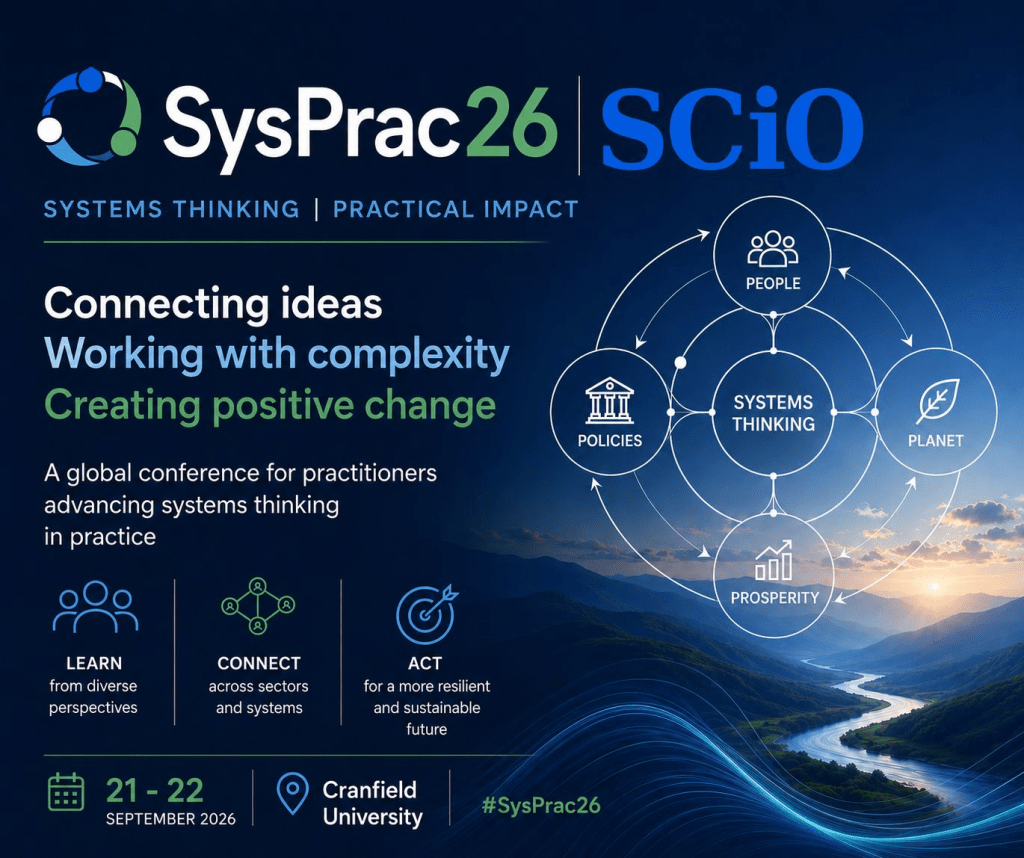
Building on the energy, insights and connections created at SysPrac25 and the Systems Thinking, Systems Practice Conference at the University of Hull, we are delighted to announce the next step in our journey to learn, connect and act together as a systems practice community.
𝗧𝗵𝗲 𝗷𝗼𝘂𝗿𝗻𝗲𝘆 𝗰𝗼𝗻𝘁𝗶𝗻𝘂𝗲𝘀
As the challenges facing organisations, communities and society become increasingly interconnected and complex, the need for practical systems thinking has never been greater.
SysPrac26 will bring together practitioners, leaders, researchers, educators, students, apprentices and those new to systems thinking alongside experienced systems professionals. Whether you are taking your first steps in the field or have been practising for many years, you will find a welcoming and inclusive environment where every perspective is valued and everyone has something to contribute.
Over two days, participants will have opportunities to:
🔹 𝗟𝗲𝗮𝗿𝗻
Explore ideas, methods and real-world applications of systems thinking through accessible sessions, practical examples and engaging conversations. Learn from experienced practitioners and fresh voices alike, and discover insights that you can apply directly in your own context.
🔹 𝗖𝗼𝗻𝗻𝗲𝗰𝘁
Meet like-minded people who share a passion for making a positive difference. Grow your network, exchange experiences, build new collaborations and develop your confidence as a systems practitioner. One of the things people valued most about SysPrac25 was simply having the opportunity to come together with others who understand the challenges and opportunities of working with complexity.
🔹 𝗔𝗰𝘁
Turn learning into impact. Discover approaches, tools and practices that help move from insight to action, enabling more resilient, adaptive and effective responses to complex challenges. Leave with ideas, connections and renewed confidence to strengthen your own practice.
Those who attended previous events often spoke about how energising it was to spend time with such a supportive and generous community. SysPrac26 aims to build on that spirit—creating a space where people feel welcome, encouraged, challenged and inspired.
SysPrac26 is more than a conference. It is part of an ongoing journey to strengthen systems thinking in practice, grow our community and increase our collective capacity to create positive change.
📍 𝗖𝗿𝗮𝗻𝗳𝗶𝗲𝗹𝗱 𝗨𝗻𝗶𝘃𝗲𝗿𝘀𝗶𝘁𝘆 📅 𝟮𝟭–𝟮𝟮 𝗦𝗲𝗽𝘁𝗲𝗺𝗯𝗲𝗿 𝟮𝟬𝟮𝟲
We look forward to continuing the conversation, deepening our practice and taking the next steps together.
More information, including opportunities to contribute, will be announced soon.
We are here engaged in the wider context of which Peirce’s systems of graphs for propositional logic and Spencer Brown’s calculus of indications constitute a prominent corner, one might even say a “cantonical field”, but still just one corner of the larger picture, abstractly syntactic and formally deductive in character.
Over and above that niche the overarching edifice of Peirce’s Logic of Science, supported by the theory of signs and the theory of inquiry, must cover all three forms of inference — abductive, inductive, deductive — plus the bridge from qualitative logic to quantitative statistics. That is the architecture of inquiry with which we’ll be occupied for quite some time.
Continuing from where I left off last time —
What intrigues me about the recently cited passages from Aristotle is the way he uses what we now regard as semiotic terms — icon, index, sign — to describe the elements and structures of logical syllogisms, including the modes of non‑demonstrative inference.
The roles of signs informing sign relations and the rules of inference guiding inquiries are subjects Peirce explored in depth. Especially in the early years the subjects of signs and inquiry are so entwined in Peirce’s relevant lectures and papers that he passes from one to the other with little sense of discontinuity between the two.
Over the years, both in Peirce’s work and the community of researchers following after, there develops such an intense focus on the problem of classifying signs that the theory of signs takes on the character of a separate subject, detached from its natural connection to the theory of inquiry.
One of our tasks is to heal that rift and regain a sense of the original common root.
The United Kingdom’s BBC Radio 4 gave the field forty-five minutes at peak listening time. Members of the Cybernetics Society gathered on Zoom meetings afterwards to share reactions, reflections, and look to the future and the activities of the Cybernetics Society.
In the Introduction of the book “Derech Hashem” (The Way of God), written around 1736 by Rabbi Moshe Chaim Luzzatto (RaMCHaL), there is a very concise and clear explanation of Systems Thinking, to prepare the readers for what they are about to experience. It is a masterpiece!
The first long paragraph of which – translated on that page from the Hebrew by Rabbi Franci Nataf, reads:
The advantage of knowing things within the framework of their parts – according to their divisions and the structures of their relationships – over their knowledge without distinction is like the advantage of seeing a garden beautified by its flowerbeds, enhanced by its paths and planted in specific rows, over seeing a thicket of reeds or a forest growing mixed together. For in truth, the perception of many parts about which we do not know their connections or true places in the structure of all that is constructed by them is nothing but a heavy and joyless burden to the intellect that desires to understand [it]. The intellect wearies itself with it; it toils, despairs, tires and has no pleasure; as it will not quench its desire to come to the purpose of any [part] that one has come to consider. For this will not come to him, since he is missing its complete context. As a great part of something is surely its relationships to those things that relate to it, and its place within its context – and this is lacking from him. So it comes out that his desire is his unresolvable burden; and his longing is his unassuageable pain. Not so is the one who knows something in its context. When he examines it, it is clearly revealed in his eyes as it [actually] is. He grows in his understanding of that to which he turns and he enjoys the beauty of his work and is exhilarated. And, in general, that which one needs to examine about his subject is [the knowledge of] its true place that we mentioned. And that is because when we surely examine all things – physical and conceptual, which is all that can be grasped by our intellects – it comes out that they are not all of one type or one function, but rather of different types and differing functions. And according to the difference in their types, so will their properties and axioms differ. And this is what compels us to distinguish between them with our intellects, so that we may truly understand them – each one according to its axioms. However the first [step in knowledge] of the types and functions is one. And that is to know to which one of them the subject belongs, meaning to the part or the whole, to the specific or the category, to the cause or the effect, to the subject or its associations. And this is what is required to know about a subject first: Is it the whole thing or a part, a category or a specific, is it a cause or an effect, is it the [actual] subject or an association?
Eventually Out of Control was translated into a few other languages. I published Out of Control 32 years ago (1994). I started writing it in 1989, which is a long time in the past for a book that promises to talk about the future. A lot in our world has changed in that time, including our attitudes about the future. Far too much has happened in the world of technology to be summed up in this note. But it is fair to wonder: how well has my book held up for the past 32 years? Is Out of Control still valid? Is it worth reading today? And what might I have written differently given what I know today? What, if anything, would I change?
The practice of complexity Talking, theorising and practicing at the Complexity and Management Conference June ’26 CHRIS MOWLES JUN 10, 2026 This year’s Complexity and Management Conference was entitled What does it mean to say the world is complex? Implications for practice. Jean Boulton kicked us off with a rich key note which grounded us in the complexity sciences and made the case for complex ontology – reality is complex.
For the rest of the day delegates discussed the implications of Jean’s presentation for their work, and some also hosted workshops of their own to convene discussions about their practice which might be of interest to others. These included Migena Shula, Kevin Flinn, Eric Wenzel, Sara Filbee, Jakub Perlak, Jana Filosof, and Franciska Fellegi.
As a reflection on the work on Saturday I gave a response on Sunday morning which was not in any way intended as a summing up, but a further opportunity for a reflexive turn on some of the themes which had emerged. It was also an opportunity to talk about, and to model, what the perspective of perspectives we refer to as complex responsive processes of relating has developed by way of practices to do justice to the insight that the social world is complex all the way down. This is in no way an attempt to claim a monopoly on the truth, but to demonstrate what 30 years of working with complexity ideas has meant for practice, the theme of the conference.
How might #SystemsThinking education be authentically redesigned? #WendyGregory + #GeraldMidgley reflect on history of MA Management Systems 1992-2003 at uniofhull.bsky.social "Emergent Innovation in Systemic Programme Design", SRBS 2026, doi.org/10.1002/sres… open access early view
After Chile: A Second Chance for a Technological Revolution in Latin America
Ben Wood, PMP Project Consultant | Builder | Systems Thinker
June 5, 2026 On September 11, 1973, fighter jets bombed the presidential palace in Santiago. By the end of the day, President Salvador Allende was dead, and the future Stafford Beer had been helping to build for Chile appeared to die with him.
Project Cybersyn was over, and Beer’s dream that cybernetics might help humanity govern itself with greater intelligence, freedom, and dignity appeared destined for the dustbin of history.
Following Chile, Beer withdrew from public life and disappeared into the mountains of Wales for the next twelve years.
Until a letter arrived from Uruguay, from a man named Victor Ganón.
“Our country would like to offer you a second chance in Latin America to implement your ideas and establish a real-time control system for Uruguay. Would you accept it?”
Beer wrote back immediately:
“I have been waiting for 12 years for just such a letter…There is only one possible answer: YES!”
He was a big character and someone deeply involved with complexity, a Boomer Uncle or Grand-uncle par excellence, I think, and someone I listened to regularly with amusement and frustration – but a true, actual, explorer and thinker, open to challenge and deeply learning focused. Just yesterday I’d listened to and sent myself the link for this excellenct interview with John Krakauer, which aligns with so much of my thinking on neuroscience:
And then I was pleased to see that his final published podcast was with Tyson Yunkaporta, his opposite in many ways – yet also someone with many similarities, finding commonality, who pays umprompted and heartfelt tribute to what he has learned from Jim, and which is openly reciprocated, and explored:
“Jim Rutt occupied a rare position at the intersection of technology, complexity science and public discourse. As chairman of the Santa Fe Institute, an internet entrepreneur, co-founder of Game B, and host of The Jim Rutt Show, he spent decades creating conversations across disciplines and communities that otherwise might never have met. His enduring contribution wasn’t a single theory or institution but a relentless curiosity about how complex systems evolve and how humans might learn to navigate them more wisely.”
That’s pretty good actually, he was big and bold but also humble, a capitalist but also a convenor, a complexity thinker but always critical. Other links:




You must be logged in to post a comment.