
The impact of individual perceptual and cognitive factors on collective states in a data-driven fish school modelWeijia Wang,Ramón Escobedo,Stéphane Sanchez,Clément Sire,Zhangang Han,Guy Theraulaz Published: March 2, 2022
The impact of individual perceptual and cognitive factors on collective states in a data-driven fish school model
Recent Updates Page 150
Jessica Flack on Twitter: “DISTRIBUTED VS CENTRALIZED: 1) not a binary distinction, 2) both architectures evolve in nature thru bottom up processes 3) both have robustness + evolvability issues. Be empirical not ideological.
DISTRIBUTED VS CENTRALIZED: 1) not a binary distinction, 2) both architectures evolve in nature thru bottom up processes 3) both have robustness + evolvability issues. Be empirical not ideological. Lamport’s contributions to CS:https://amturing.acm.org/award_winners/lamport_1205376.cfm…https://lamport.azurewebsites.net/pubs/time-clocks.pdf
Jessica Flack on Twitter: “DISTRIBUTED VS CENTRALIZED: 1) not a binary distinction, 2) both architectures evolve in nature thru bottom up processes 3) both have robustness + evolvability issues. Be empirical not ideological. Lamport’s contributions to CS: https://t.co/JtOIC5HKHt https://t.co/WvNv3Mrm76” / Twitter
Constructivism + Embodied Cognition = Enactivism: Theoretical and Practical Implications for Conceptual Change | Holton (201)
Constructivism + Embodied Cognition = Enactivism: Theoretical and Practical Implications for Conceptual Change
(PDF) Constructivism + Embodied Cognition = Enactivism: Theoretical and Practical Implications for Conceptual Change | Doug Holton – Academia.edu
Constructivism + Embodied Cognition = Enactivism: Theoretical and Practical Implications for Conceptual Change
Published 2010
The objective of this paper is to explore specific theoretical and practical implications of recent research on embodied cognition and enactivism for the design of effective learning environments, especially those targeting conceptual change. The ultimate goal is to illustrate how enactivism and embodied cognition can help meet the criteria that often define scientific progress (Laudan, 1977), for the purpose of advancing educational research and development and constructivist theory. [This work is licensed under a Creative Commons Attribution 3.0 Unported License]
Donald Schon Lecture (1989) – YouTube
Donald Schon Lecture
Donald Schon Lecture – YouTube
Video recording of Donald Schön lecture (1989)
Discovered by João Ferreira on the PHD-DESIGN discussion list (PHD-DESIGN@jiscmail.ac.uk)
Dear all,
I came across a video recording of a lecture by Donald Schön. It was published by the Iowa State University Library on YouTube.
There isn’t much information about it, but the description mentions the lecture was delivered on 4/28/1989. There is a transcript available as well.
I was delighted to see and hear Schön for the first time; I’m posting the link here because I think it may be helpful for PhD candidates looking to engage with the author’s ideas in an accessible format. During the lecture, Schön explains several of his ideas and insights that have become so influential for design theory.
Best regards,
João
Multiple Systems Thinking methods for resilience research – Wright (2012 MPhil thesis)
Multiple Systems Thinking methods for resilience research
Wright, Clare 2012.
Cardiff University
Multiple Systems Thinking methods for resilience research -ORCA
Systems View of Life with Fritjof Capra and Jeremy Lent – March 5, 9am PST
What happens when we bring together two great thinkers of Systems Theory and Deep Ecology in emergent conversation?Join us on Saturday, March 5at 9am PST / 12pm EST / 5pm GMT
for Systems View of Life. Fritjof Capra, author of many books including The Systems View of Life and Jeremy Lent, author of The Patterning Instinct: A Cultural History of Humanity’s Search for Meaning and The Web of Meaning will discuss three of the foundations of WTR – patterns, systems and deep ecology – and how we can use these theories to support our practices as activists, facilitators and change-makers. Together we will explore how evolutionary biology, history and spirituality interact and provide answers to the challenges we now face.
March 5: Systems View of Life with Fritjof Capra and Jeremy Lent
The Grammar of Systems: From Order to Chaos & Back – Hoverstadt
very exciting that this is now out!
The Grammar of Systems: From Order to Chaos & Back: Amazon.co.uk: Hoverstadt, Patrick: 9798414307754: Books
You can also see Patrick talking about this at the SCiO UK Virtual Open Meeting – March 2022
Monday 21 March, 18:30UK time
https://systemspractice.org/events/scio-uk-virtual-open-meeting-march-2022
(along with Roger Duck and Jane Searles talking about Designing Freedom Together: https://stream.syscoi.com/2022/02/08/discussion-designing-freedom-together-duck-and-searles-2021/)
The Grammar of Systems: From Order to Chaos & Back Paperback – 22 Feb. 2022
by Patrick Hoverstadt (Author)
The Grammar of Systems
If you feel as though the world has become more complex, you are not alone. There is a growing realisation of the need to deal with the complexity, uncertainty and speed of change of our world. These systemic factors increase the challenge for all of us and expose some traditional approaches which are unable to handle those challenges. This book sets out the fundamentals of Systems Thinking, a discipline developed specifically to grapple with complexity and uncertainty. It builds a compelling and useable guide to change the way you think about the world around you, for those wanting to understand or change systems, managers, policy makers and systems specialists alike.
Part One illustrates the nine thinking patterns involved in thinking like a systems thinker, which collectively form the core of Systems Thinking. Each pattern is contrasted with conventional thinking and shows the power of thinking differently, alongside practical ways to develop these patterns in yourself and your organisation. If you want a different way to be able to think about the world, the thought patterns in this book will give you that.
Part Two describes 33 Systems Laws and Principles on which Systems Thinking as a discipline was founded. These Systems laws show how both order and chaos are created in systems and the dynamic between them. The Laws and Principles provide the insight on how, when and why systems remain stable and change at the same time, and what happens when they don’t, instead collapsing into new forms or disintegrating. These powerful insights are vital for anyone designing a change or transformation.
The Grammar of Systems presents a very clear, coherent guide to the discipline of Systems Thinking.
Patrick Hoverstadt is a veteran systems practitioner, and chairs the professional body for Systems Practitioners.
UKSS Online workshop – Christine Welch March 16 at 4pm UK – Soft Systems Methodology – what it is and is not (and trailer for the UKSS conference!)
Online workshop with Dr Christine Welch – 16th March at 4.00 pm
Soft Systems Methodology – what it is and is not
UKSS Online workshop – March 16th
 Online workshop with Dr Christine Welch – 16th March at 4.00 pmSoft Systems Methodology – what it is and is not Online workshop with Dr Christine Welch – 16th March at 4.00 pmSoft Systems Methodology – what it is and is not Please book a free place here. |
| See our Online workshop event flyer for details of future events! |
| Next conferenceUKSS Conference 2022 – will be 20th/21st June at Lancaster University. The theme is ‘Systems thinking and the energy transition’Please download the advance flyer: |
Australia National University – School of Cybernetics February Newsletter
contains e.g.
We know ‘the system’ has long failed Aboriginal people – so why not cyberpunk it?
Communities are systems: What can systems thinking teach us when it comes to communities?
School of Cybernetics February Newsletter
Understanding Complexity & Organisations – Mark Eddleston
Understanding Complexity & OrganisationsMark Eddleston
Understanding Complexity & Organisations
Designing self-organising enterprises and viable systems / Patrick Hoverstadt | Intersection16 – YouTube
Designing self-organising enterprises and viable systems / Patrick Hoverstadt / Intersection16
Designing self-organising enterprises and viable systems / Patrick Hoverstadt / Intersection16 – YouTube
Women in Systems Thinking – Speaker Series | System of Systems Thinkers – Systems Thinking Marin
A Discussion SeriesThis series of events celebrates and acknowledges the important contribution of women in systems thinking. It is formulated in the spirit of facilitating a greater level of coordination among systems thinkers, as well as recognizing the crucial contributions of those whose work is more about “being” and “doing” as of equal value to “thinking.”
System of Systems Thinkers – Systems Thinking Marin
Resisting or embracing meta-rationality | David Chapman
Resisting or embracing meta-rationality
Resisting or embracing meta-rationality | Meta-rationality
How do you change the system three steps at a time? | by noelito | Feb, 2022 | Medium
https://noelito.medium.com/how-do-you-change-the-system-three-steps-at-a-time-60a5f62fe5f1
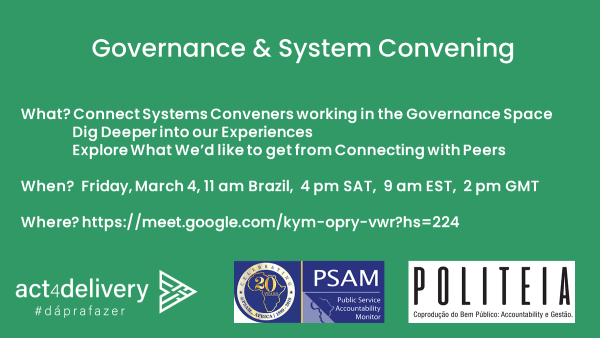
Governance & System Convening webinar – Fri, Mar 4, 2022 at 2pm GMT
Governance & System Convening
Governance & System Convening Tickets, Fri, Mar 4, 2022 at 11:00 AM | Eventbrite
MAR
04
Governance & System Convening
Free
About this event
We are excited to convene an initial conversation on systems convening and governance.
The conversation is an outgrowth of the launch of Bev and Etienne Wenger-Trayner book on Systems Convening, when a number of us expressed interest in exploring the practice of systems convening in the governance space.
Date and time
Fri, March 4, 2022
2:00 PM – 3:30 PM GMT


You must be logged in to post a comment.