This essay intends to recover human agency from holistic, abstract, even oppressive conceptions of social organization, common in the social sciences, social systems theory in particular. To do so, I am taking the use of language as simultaneously accompanying the performance of and constructing reality (my version of social constructivism). The essay starts with a definition of human agency in terms of its linguistic manifestation. It then sketches several leading conceptions of social organization, their metaphorical origin and entailments. Finally, it contextualizes the use of these metaphors in conversation, which leads to the main thesis of this essay that the reconstitutability of networks of conversation precedes all other criteria of the viability of organizational forms. The paper transcends the traditional second-order cybernetic preoccupation with individual cognition – observation and description – into the social domain of participation.
The body of work of Mike Jackson covers several major themes in OR/Systems Thinking and articulates key aspects of Critical Systems Thinking; with an interest throughout in applications to complex social challenges. In this paper, as a direct response to this Festschrift, and acknowledging his contribution to Community OR, five active UK-based researchers have engaged in their own process of community-based learning in order to articulate the ways Jackson’s work resonates with their contemporary research and practice. The researchers used a variation of the Delphi method to reflect first on the ways that the body of work of Jackson resonated with their practice and research agendas. This produced a framework of ideas. Examples from the UK and overseas are then provided to illustrate these points. Ultimately, the researchers used these experiences and reflections to produce a series of statements for developing Community OR practice (and theory)—reflecting and extending Jackson’s work.
Executive Summary
The work of Mike Jackson covers several important themes in Systems Thinking and Operational Research (OR) and articulates key aspects of Soft OR—arguably most notably, through differentiating problem-solving in different contexts (through The System of Systems Methodologies) and by encouraging the application of Systems Thinking to complex large-scale and contemporary challenges. Much of Jackson’s work reflects his interest in working on complex social challenges, indicated by his support for Community OR as an emerging subfield (indeed bringing the Community OR Unit to Lincoln during his time there as Head of School). In this paper, as a direct response to this Festschrift, and acknowledging his contribution to Community OR, five active UK-based researchers connected to the Community OR Stream of the UK Operational Research Society have engaged in their own process of community-based learning in order to articulate the ways Jackson’s work resonates with their contemporary research and practice. In undertaking this self-organised process, researchers reviewed the literature and Jackson’s contributions and articulated a number of ways his work resonates with their understanding about how Systems Thinking relates to sustainable communities in rearticulated contexts—looking increasingly now towards 2030 and 2050 global agendas. The researchers used a variation of the Delphi method to reflect first on the ways that the body of work of Jackson resonated with their practice and research agendas. This produced a framework of ideas that echoes through their own research. Examples from multiple Higher Education Institutions (in the UK and overseas) are then provided to illustrate these points. Ultimately, the researchers used these experiences and reflections to produce a series of statements and refreshed research questions for developing Community OR practice (and theory) that respond to this body of work in relation to current Grand Challenges, including environmental, social and economic ones that impact, and are impacted by, the communities we engage with. This reflective and scholarly process reinforced to us that Jackson’s work resonates as much now as it did before. We conclude that what Jackson et al. did for critical systems and emancipation, the next generation of researchers needs to reshape and extend with a greater focus on marginalised/absent stakeholders, community-led research and with a co-creation and sustainability lens including future generations and non-human stakeholders. Systems Thinking also requires the OR/Systems Thinking research community to keep co-creating relevant and meaningful approaches that enable researchers and communities to work together, but that also enable communities to work by themselves—putting communities at the heart of understanding social challenges and the solutions co-created. What seems at risk of being forgotten is how to improve the abilities of our community partners to become independent-minded researchers—not dependent on external experts. This perspective focusses on enhancing self-organisation, participation and democratic problem-solving and decision-making, rather than favouring researchers’ external interventions or impositions. In collectively reviewing the body of scholarly work from Jackson, we hope we have highlighted once more the value of re-connecting current wo0rk on these issues to the rich systemic literature that comes before.
We consider emergence from the perspective of dynamics: states of a system evolving with time. We focus on the role of a decomposition of wholes into parts, and attempt to characterize relationships between levels without reference to whether higher-level properties are “novel” or “unexpected.” We offer a classification of different varieties of emergence, with and without new ontological elements at higher levels.
Comments:
Submitted to a volume on Real Patterns (Tyler Milhouse, ed.), to be published by MIT Press
Subjects:
History and Philosophy of Physics (physics.hist-ph); Statistical Mechanics (cond-mat.stat-mech)
Emergence is a centrally important concept in science and philosophy. Indeed, the existence of higher-level emergent properties helps render the world intelligible to us — we can sensibly understand the macroscopic world around us without a complete microscopic picture. But there are various different ways in which emergence might happen, and a tendency for definitions of emergence to rely on vague or subjective criteria. Recently Achyuth Parola and I wrote a paper trying to clear up some of these issues: What Emergence Can Possibly Mean. In this solo podcast I discuss the way we suggest to think about emergence, with examples from physics and elsewhere.
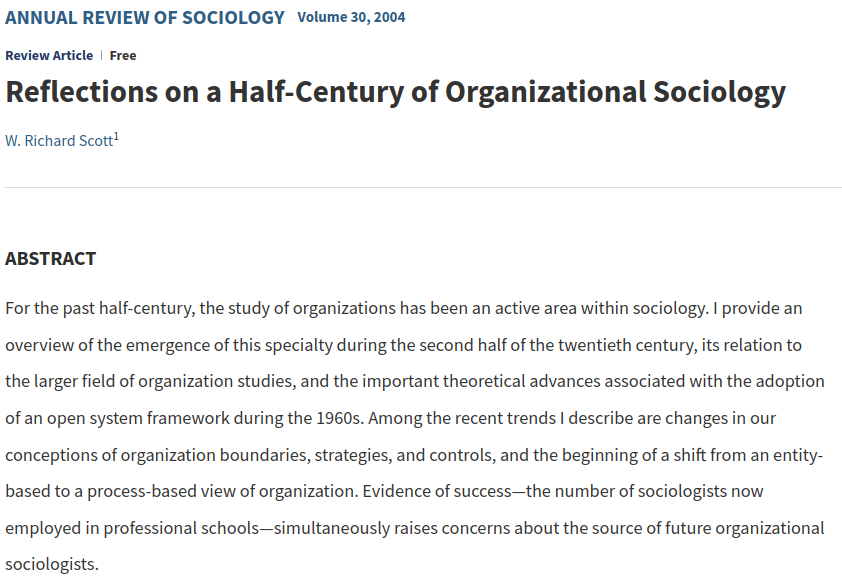
From the 1982 publication of _Organizations: Rational, Natural, and Open systems_, W. Richard Scott in 2004 reflected back on the history of organizational sociology.
> Before open system ideas, organizational scholars had concentrated on actors (workers, work groups, managers) and processes (motivation, cohesion, control) within organizations. Scant attention was accorded to the environment within which the organization operated.
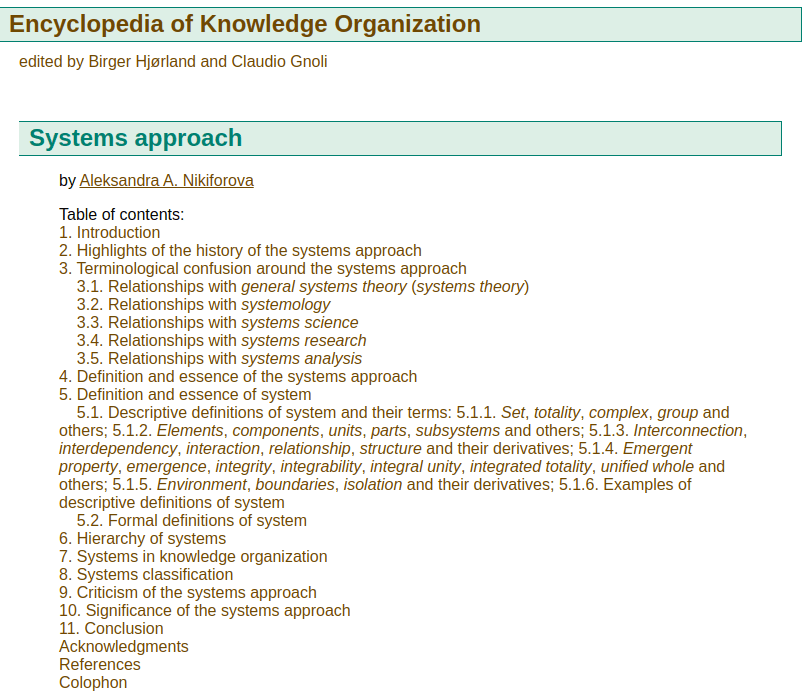
For those interested in detailed distinctions between systems approach, systems thinking, General Systems Theory, system science, etc, Aleksandra A. Nikiforova (Lomonosov Moscow State University) started an entry in the Encyclopedia of Knowledge Organization in 2022 that has been revised to 2024.
The International Society for Knowledge Organization is a “scholarly society devoted to the theory and practice of knowledge organization, bringing together professionals from different disciplines such as information science, philosophy, linguistics, and computer science, as well as special domains such as health informatics”.
From the 1982 publication of Organizations: Rational, Natural, and Open Systems, W. Richard Scott in 2004 reflected back on the history of organizational sociology.
> Before open system ideas, organizational scholars had concentrated on actors (workers, work groups, managers) and processes (motivation, cohesion, control) within organizations. Scant attention was accorded to the environment within which the organization operated.
For those interested in detailed distinctions between systems approach, systems thinking, General Systems Theory, system science, etc, Aleksandra A. Nikiforova (Lomonosov Moscow State University) started an entry in the Encyclopedia of Knowledge Organization in 2022 that has been revised to 2024.
The International Society for Knowledge Organization is a “scholarly society devoted to the theory and practice of knowledge organization, bringing together professionals from different disciplines such as information science, philosophy, linguistics, and computer science, as well as special domains such as health informatics”.
With responses from Brian Eno, Audrey Tang, Terry Winograd, Bruce Schneier & Nathan Sanders, Sarah Myers West & Amba Kak, Wendy Liu, Edward Ongweso Jr., and Brian Merchant
AR+: Naia Begiristain on meeting dilemmas to find new cultures together.
Systems Dynamics Society – Latest Published Research
International Society for the Systems Sciences, 69th Annual Conference.
The conference will be held in the UK, at the Birmingham Leadership Institute, University of Birmingham.
• Collaboration is being arranged with the University of Birmingham and other organisations with a systems emphasis.
• The proposed dates are 11th to 15th July, 2025 and there will be morning sessions only on the 15th. Conference facilities include the main assembly room and four breakout rooms.
• There are several hotels charging $150/night or less within 15 minutes walking distance of the conference venue.
• Conference fees are currently being agreed. Online attendance and one day passes may also be available, but the details are currently being firmed up.
• Volunteers are needed to help with the operation of any online setup at the venue. Please contact Jennifer Makar at admin@isss.org if you are able to help.
• Catering will include morning and afternoon tea/coffee, snacks, a daily lunch, and a final dinner at a local pub, “The Alchemist”
• Registration will open on 1st January, 2025, or thereabouts.
Special Issue! Advances in systems sciences and systems practiceSystems Research and Behavioral Science (SRBS), published by Wiley, is the official journal of the International Federation for Systems Research.
Just in time for holiday reading, Contexts presents six fresh perspectives on systemic design. As you reflect on your research and practice in 2025, find inspiration in a business case for sustainable parenting, cosmotechnics, embodied practices, urban living labs, incorporating emotions, and system healing-centered approaches.
EDITOR’S CORNER | PETER HAYWARD JONES
The SDA Publishing Team has grown over the last three years (since RSD11) and has capitalized well on the two web platforms, which we have separated to better manage the growth of publications. The RSD Symposium website, under editorial direction of Cheryl May, hosts and indexes over 1500 articles and multimedia materials from all the symposia. Following the decision to accept long-form articles in RSD10, the full conference proceedings are now an accessible, searchable, citable collection of leading studies and new ideas as they are presented in the annual symposia. Yet we are truly pleased to report the continuing progress of the innovative new journal, Contexts—The Systemic Design Journal. As we roll into 2025 with the final publication of Volume 2 articles (with the Editorial signifying its conclusion) Contexts has proven the original, hopeful concept of a low-volume, long-form scholarly journal with leading work from emerging scholars and senior thought leaders in systemic design and systems/design theory. I am also excited to announce that Contexts now has a strong foundation from which to grow, as we have invited a fourth associate editor (thank you, Ruth Schmidt) and have established a 10-member editorial board. Please search and visit this extraordinary treasure of intellectual inspiration, and consider a contribution to Contexts in the coming year.—Peter Hayward Jones, Editor in Chief
Volume 2
Contexts of Design Research, Clarifying ComplexityGO TO VOLUME
In the editorial, Peter Jones describes the emerging voices, complex challenges, and inventive approaches to design science and interdisciplinary exploration evident in the second volume, which comprises six extraordinary articles representative of the authors’ larger, ongoing research directions.
An Intervention Framework for a Business Context: A systemic design case of sustainable parenthoodHow might a systemic design process feasibly enable commercial organisations to facilitate complex societal transitions? Through a case study with a leading consumer healthcare brand, Elisabeth Tschavgova, Elise Talgorn, Charlotte Kobus, Jo van Engelen, Conny Bakker, and Sonja van Dam investigate systemic design’s impact on the company’s capabilities to address complexity. They offer a dual narrative, detailing both the client project and the six research methods employed: boundary setting, causal loop diagramming, leverage analysis, storytelling, quantitative research, and the development of insight cards. The article also describes the resulting MINT framework (Mapping Interventions and Narratives for Transformation). READ & DOWNLOADActing on Emotions: Designing with the relational dramas in welfare systemsAudun Formo Hay, together with contributors from the Oslo School of Architecture and Design and Kristiania University College—Jonathan Romm, Simen Formo Hay, Hobbe Mikae, Jenny Holm, Bjørgum, Lara van der Poel, Yijuan Wang, Anna Kristine Aarø Halvorsen, and Per Roppestad Christensen—draw on their collaborative exploration and learning. The research aimed to integrate experiential and systemic perspectives in service design to support actors in transforming complex welfare systems and include three pairs of propositions for incorporating emotions into systemic approaches to service design. READ & DOWNLOADLearnings from Black Liberation System Entanglements Part II: Our experience of system trapsIn this article, Part II, Victor Udoewa delves deeper into the harmful, context-specific system entanglements that justice workers encounter and encourages system healing-centered approaches. He identifies 15 entanglements, beginning with Neocolonialism and progressing through Institutionalizing Movements, Mythologising Mythology, Protest-Campaign-Movement Discontinuity, and an examination of justice approaches that can inadvertently entangle us in injustice. READ & DOWNLOADMethodological Pluralism in Practice: A systemic design approach for place-based sustainability transformationsHaley Fitzpatrick, Tobias Luthe, and and Birger Sevaldson explore methodological plurality and integrate quantitative scientific methods with participatory gigamapping and embodied practices. This longitudinal design inquiry engaged with communities undergoing sustainability transformations across three mountain regions: Ostana, Italy; Hemsedal, Norway; and Mammoth Lakes, California. The authors identify the need for contemplative and psychological practices in systemic design that focus on inner resilience. READ & DOWNLOADCitylab X: Towards a lens on the urban living lab as driver of systemic innovationAnja Overdiek’s exploration of the ISLE model as a lens for systemic innovation in urban living labs (ULLs) involves the study of a municipal ULL in the Netherlands (Citylab X). She observes that European municipalities increasingly use ULLs for complex situations, demanding a paradigm shift from service design to systemic innovation and a transition approach. The ISLE model is proposed as a process that might support co-creation, provide a heuristic process framework, and mobilise knowledge across ULLs and related networks. The findings include considerations for systemic design practice in ULLs. READ & DOWNLOADCosmotechnic Encounters: Designing with foodwaste, landscapes, and livelihoodsMarkus Wernli and Kam-Fai Chan consider circularity in organic waste, drawing on Daoist cosmotechnics, design research, anthropology, and diverse economies. They suggest cosmotechnic designing with the world, concluding that designing with shapelessness, integral to systemic design with situatedness and mutualistic care, “is essentially about symbiotic survivability or sympoiesis in cosmotechnics.” READ & DOWNLOAD
CALLS FOR PAPERS & CONTRIBUTIONS
Here are just a few opportunities to get you thinking about your 2025 publishing and presenting goals. Please send information you would like included in this newsletter to cheryl@systemic-design.org.
DEC 31 DEADLINE Expression of Interest Speakers | Oceania Futures SymposiumAPR 3 & 4, 2025 BRISBANE AUSDesigned as a space for learning, collaboration, and action, the symposium brings together diverse perspectives and fosters dialogue on issues central to the Oceania’s future. More info
FEB 2, 2025| TCESG25 Navigating Sustainability Transformations Towards Justice and Equity ConferenceJUNE 25–27 TCX-YORK UK | AUG 11–13 TCX-ONLINE | AUG 17 TC/ESG KRUGER NATIONAL PARK SA.Stay updated via the TC newsletter



 OPENThe following journals have adopted a continuous publishing model and accept submissions at any time.
 Systems Community of Inquiry
You must be logged in to post a comment.