How is an underlying mechanism that drives the meta- and polycrises manifested through our dominant mode of education? How might we make sense of and navigate the seemingly different and potentially conflicting approaches to addressing these crises? How might we transform the system through our ways of living?
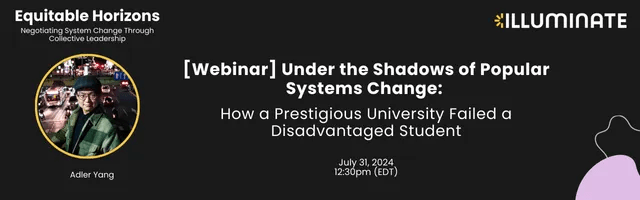
In our latest piece for the Equitable Horizons blog series, Adler Yang, examines these questions through the story of Wen, an economically disadvantaged student who excelled in a self-directed learning environment but struggled when she entered a prestigious university.
Adler Yang will also be presenting at Illuminate Systems’ webinar on 12:30, July 31 (EDT) to discuss the research behind the story (A registration link is provided at the bottom of the essay at the link below)
Keeping with the rivers of conversations metaphor, RSD13 is overflowing with contributions to systemic design that promise to deepen your research, writing, and practice. The journey has three parts: tributaries, a channel, and streams. You can explore RSD13-ONLINE tributaries, dive into the RSD13-OSLO channel, or combine all three within the context of the reflective experience of RSD13-Nordmarka Forest.
Yes, it’s true! Tore Gulden and Frederick Steier are chairing three full days of in-person workshops at OsloMet. RSD13-OSLO ticket holders can kick off their in-person experience on the weekend and Monday before the AHO sessions. We are in the process of contacting the organisers of over 20 workshops, so plan to arrive early and enjoy Oslo. These extraordinary systemic design workshops feature a range of interdisciplinary topics: systemic change, systems thinking, collaboration, transformative impact, spatial/contextual considerations, and practical, hands-on experimentation.When: October 19, 20, 21 at OsloMet
RSDX is back at RSD13
Chaired by Peter Jones and Ryan Murphy, the robust RSDX six-day agenda consists of workshops, speakers, and panels proposed by the community. RSDX is October 12 to 15 and 19 and 20, and it wraps around three days of scheduled paper talks and presentations on October 16, 17, and 18. The whole programme is online and all under the affordable RSD13-ONLINE ticket. What to expect: There are currently 13 workshops and 13 speakers/panels for RSDX and 64 papers and 37 presentations slated over the three days dedicated to scholarly work.Good to know: The RSD11 workshop series and Mapping Mondays are part of the evolving space for self-organising, peer-led online systemic design events. Proposals can be forwarded by any SDA member.
Design Journeys workshop confirmed
For everyone who loves Design Journeys—a new workshop!Peter Jones and Kristel Van Ael have organised an RSD13/RSDX workshop, “Design Journeys through Organisations: Systemic design tools for leadership” based on their popular book.
The workshop focuses on assessing prototype canvases and gaining working feedback on new tool designs designed to simulate organisational functions.Pre-requisite: Participants should have prior experience with the Systemic Design Toolkit as a pre-requisite—even if self-trained from the book and tools.How to book it: RSD13-ONLINE ticket holders will receive an email announcing workshop sign-ups. Space is limited and first-come first-served.
Update on RSD13 reviewing
Collectively, reviewers wrote 117,641 words in just five weeks. Comments encompassed critique, encouragement, and advice. It was an extraordinary effort and feedback from authors has been uniformly appreciative.This year’s collaborative, asynchronous peer-review process sets a new bar for engagement in the RSD cycle. It exemplifies the scholars spiral at work, which intends that reviewing supports the evolution of scholarship by providing appropriate points for contribution, peer feedback, and publication, all within the support of a diverse, creative, interdisciplinary community. In prior years, a selected cadre of reviewers was tasked with reviews; RSD12 opened this up, inviting the hub organisers to assign sub-reviewers across their community of interest. This year, longstanding reviewers and people new to reviewing for systemic design joined the group, creating a distributed network of peers, wider diversity, and a reasonable level of requests for each member.While our go-to reviewers, Birger Sevaldson and Peter Jones, pulled us through by covering 10% of the reviews at the second review stage, the distributed reviewers network, made up of 128 people, contributed 90%. There are 296 reviews for 83 papers and 41 presentations, an average of 2.4 reviews per paper. We made our goal of asking for a manageable number of reviews, with a median of 2 requests per person, which kept reviews fresh, comprehensive, and collegial. The average length of comments ranged from 2374 (high) to 13 (low), with a median of 352 and an average of 414 words.
Reviewing Reviewing sessions posted
The Reviewing Reviewing conversations, held in April, guided some thinking about the RSD13 process. The review process was adjusted based on the guidance from two conversations on reviewing hosted by Ryan Murphy with Peter Jones, Ray Ison, Houda Khayame, Wendy Ross, Ruth Schmidt, and Katelyn Stenger. Reviewers and authors has been very positive about the process.
Our resulting decision guidance focused on readiness for publishing and relevance to systemic design rather than acceptance/rejection. Meta-reviews were done on submissions with more than a two-point spread from reviewers, and (for RSDX) we are considering submissions that were not recommended for hidden gems, panellists, interactive sessions, and early career researcher gatherings.Where to find it: Reviewing reviewing session summaries and video are posted on the RSD website and RSD YouTube channel.
GUESS WHOSE COMING TO RSD13-OSLO?
SDA General Assemblies | AUGUST 5 & SEPT 23
Reminder: The Systemic Design Association is holding two Extraordinary General Assemblies. The meetings are online and open to everyone who is interested in contributing to a discussion of the association’s operations.EGA-1 Changes to the SDA’s Statutes | August 5, 2024EGA-2 SDA Board Elections | September 23, 2024
Only supporting members (who have made a financial contribution within one year of the EGA) can vote at the SDA General Assemblies. Renew your membership or join SDA.
NEWS | ADJACENT COMMUNITIES
Did you know Systems Thinking Ontario has met over 100 times? The group meets online and convenes at OCADU in central downtown Toronto, so it’s an excellent opportunity to connect with systemic design colleagues in and around Ontario. Looking back to look forward: The first meeting featured Ralph Glanville’s talk on Cybernetics and Creativity on December 6, 2021.
At RSD13/RSDX, Zaid Khan and David Ing discuss the group’s focus on learning from fields/topics/perspectives outside systems thinking to learn more about systems thinking and host a discussion about the traps of field-bounded interactions, how we can draw new insights about systems from untraditional places/fields, and building bridges to new communities.Noted: “Our working definition of systems thinking is: understanding the world by exploring parts and wholes. We do this by simultaneously and iteratively using analysis (what parts does this whole contain) and synthesis (which wholes contain this part).”Where to find it:https://wiki.st-on.org/home
POSTDOC OPPORTUNITIES | Tecnológico de Monterrey
Postdoctoral Researcher for Service Design Research in Health ContextsCurrently, in the School of Architecture, Art and Design, we are seeking a postdoctoral researcher to partner with the Faculty of Excellence and Tec Salud faculty in the design of community health services.Location: Monterrey, MexicoPostdoctoral Researcher in Complex System Visualization (Systemic Design)The School of Architecture, Art and Design is seeking a postdoctoral researcher to conduct collaborative research with the design faculty in visualisation for mapping complex systems. Working with Distinguished Professor Peter Jones, the postdoctoral candidate will collaborate on studies to theorise, refine, and build new concepts in systems visualisation to improve the adoption and understanding of large-scale mapping of complexity for policy proposals, complex strategic missions, and civic and institutional service programs.Location: Tlalpan, Mexico
ACKNOWLEDGEMENTS | RSD13 REVIEWERS
Based on our review statistics, let’s acknowledge colleagues whose reviews went above and beyond with three spirited awards. Drum roll, please!
LAST MILE AWARDGetting us through the finish lineBirger Sevaldson, RSD13 ChairPeter Jones,* Contexts—The Systemic Design Journal, Editor in Chief ARTICULATION AWARDHigher than average number of words per reviewThomas J McLeishVictor UdoewaPerin RuttonshaVanessa RodriguesLisa LeungAndrea CattabrigaBrogan OgilvieSergej van MiddendorpTRUE GRIT AWARDMore than three reviewsAndrzej KlimczukMarie Davidová*Abhay VohraMari Suoheimo**Thomas Maiorana*Adeline HvidstenAshley WorobecCarla SediniChiara Battistoni*Goran MaticJiayi YoungRyan Murphy**SDA board member**RSD13 academic committee member
Systems Stream at OR66, Bangor University, 10th -12th September 2024
The Chair of the Systems thinking SIG at The OR Society is hoping that members of the Centre for Systems Studies Community will be interested in presenting at the OR66 Conference which is being held at Bangor University on the 10th -12th September.
Please join us and contribute to the growing community of systems thinkers in OR who are building the necessary capabilities to make our organisations, communities and ecosystems better places to live for current and future generations. We welcome the widest possible diversity of practitioners and academics, whatever systems thinking specialism you bring or research community you have engaged with previously. The deadline to submit an abstract is the 6th May 2024.
Both James C. Scott and Friedrich Hayek articulate critiques of centralised state planning that are fundamentally epistemological in character. In particular, both emphasize the loss of knowledge resulting from attempts to achieve synoptic legibility of complex social practices. Yet while Hayek’s critique of central planning leads to an emphasis on the indispensability of the price system, Scott argues that capitalist markets are also mechanisms of perverse simplification. This paper explores the roots of this disagreement and seeks to articulate the insights that emerge from reading Hayek and Scott together on questions of markets, knowledge, and the state.
[I realise now I don’t always label preprints – heyho.
Twitter thread introducing and summarising:
“[A]ny factual AI systems created in the short-run are at best decoys. When we think these systems capture something deep about ourselves and our thinking, we induce distorted and impoverished images of ourselves and our cognition.”
The idea that human cognition is, or can be understood as, a form of computation is a useful conceptual tool for cognitive science. It was a foundational assumption during the birth of cognitive science as a multidisciplinary field, with Artificial Intelligence (AI) as one of its contributing fields. One conception of AI in this context is as a provider of computational tools (frameworks, concepts, formalisms, models, proofs, simulations, etc.) that support theory building in cognitive science. The contemporary field of AI, however, has taken the theoretical possibility of explaining human cognition as a form of computation to imply the practical feasibility of realising human(-like or -level) cognition in factual computational systems; and, the field frames this realisation as a short-term inevitability. Yet, as we formally prove herein, creating systems with human(-like or -level) cognition is intrinsically computationally intractable. This means that any factual AI systems created in the short-run are at best decoys. When we think these systems capture something deep about ourselves and our thinking, we induce distorted and impoverished images of ourselves and our cognition. In other words, AI in current practice is deteriorating our theoretical understanding of cognition rather than advancing and enhancing it. The situation could be remediated by releasing the grip of the currently dominant view on AI and by returning to the idea of AI as a theoretical tool for cognitive science. In reclaiming this older idea of AI, however, it is important not to repeat conceptual mistakes of the past (and present) that brought us to where we are today.
Reclaiming AI as a theoretical tool for cognitive scienceAUTHORSIris van Rooij, Olivia Guest, Federico G Adolfi, Ronald de Haan, Antonina Kolokolova, and Patricia RichAUTHOR ASSERTIONSCONFLICT OF INTERESTNo PUBLIC DATANot applicable PREREGISTRATIONNot applicable ReclAIming_AI_2023.pdfVersion: 2Download previous versionsCreated: August 01, 2023|Last edited: June 20, 2024Expand Download preprintViews: 22140 | Downloads: 6243AbstractThe idea that human cognition is, or can be understood as, a form of computation is a useful conceptual tool for cognitive science. It was a foundational assumption during the birth of cognitive science as a multidisciplinary field, with Artificial Intelligence (AI) as one of its contributing fields. One conception of AI in this context is as a provider of computational tools (frameworks, concepts, formalisms, models, proofs, simulations, etc.) that support theory building in cognitive science. The contemporary field of AI, however, has taken the theoretical possibility of explaining human cognition as a form of computation to imply the practical feasibility of realising human(-like or -level) cognition in factual computational systems; and, the field frames this realisation as a short-term inevitability. Yet, as we formally prove herein, creating systems with human(-like or -level) cognition is intrinsically computationally intractable. This means that any factual AI systems created in the short-run are at best decoys. When we think these systems capture something deep about ourselves and our thinking, we induce distorted and impoverished images of ourselves and our cognition. In other words, AI in current practice is deteriorating our theoretical understanding of cognition rather than advancing and enhancing it. The situation could be remediated by releasing the grip of the currently dominant view on AI and by returning to the idea of AI as a theoretical tool for cognitive science. In reclaiming this older idea of AI, however, it is important not to repeat conceptual mistakes of the past (and present) that brought us to where we are today.
[I believe I haven’t shared this tweet before regarding John McCarthy talking about coining the phase ‘artificial intelligence’ in distinction to ‘cybernetics’ for funding and out of dislike of Wiener? (In my mind, Evgeny Morozov was not the first to share this, but I can’t find an earlier tweet… oh, ok, there’s a lot more on twitter – see search below – including claim this was a self-deprecating claim (and other evidence of Wiener not being easy to get along with!)
Artificial Intelligence and its impact on the future has been making all the headlines in recent years, and rightly so, but few people realize that AI is built on a Cybernetic platform. AI is a “derivative” of Cybernetics. The latter is not only a computer science, it is a way of looking at the world.
Cybernetics vs Artificial IntelligenceJan Krikke·Following3 min read·Jan 21, 2024281Plan, Quantify, SteerArtificial Intelligence and its impact on the future has been making all the headlines in recent years, and rightly so, but few people realize that AI is built on a Cybernetic platform. AI is a “derivative” of Cybernetics. The latter is not only a computer science, it is a way of looking at the world.
I’m excited to share our with @niles_eldredge article published in “Paleobiology” @PaleoSoc on the third (Bretskyan) hierarchy of life, as Niles called it—the “zipper hierarchy” of eco-genealogical units.https://t.co/ZfLhHUD32c Shown Illustration of geobiomes by Tadas Razmas 1/n pic.twitter.com/A6SewI7wc5
And here’s an LLM generated summary of the tweet thread:
Article published in “Paleobiology” on the third (Bretskyan) hierarchy of life, called the “zipper hierarchy” of eco-genealogical units.
The synthesis of major themes in hierarchical evolution theory: ecological (Vernadskyan) and genealogical (Linnaean) hierarchies, and major transitions in evolution.
Connection between ecosystem evolution, biogeography, and the Geological Time Scale hierarchy.
Bretskyan hierarchy composed of eco-genealogical units at various scales; smallest scales involve communities integrated by biotic interactions, potentially merging into holobionts.
As spatial and temporal scales grow, biotic integration becomes less likely, with geological structures playing a central role.
Geological structures determine geomorphology, geochemistry, and climate, leading to the separation and compartmentalization of biotas by abiotic barriers.
Larger geological structures enhance the individuality of biotas, exemplified by allopatric speciation.
[Definition: Allopatry, meaning ‘in another place‘, describes a population or species that is physically isolated from other similar groups by an extrinsic barrier to dispersal.]
Hierarchical allopatry works across all time and space scales, achieving greater importance at larger scales.
Biotic entities defined by geological structures are termed Geobiomes, which emerge, persist, and fuse due to geodynamics and planetary complexity scaling.
The largest and most integrated geobiome is Gaia, confined by the outer space barrier.
Pleased to say that my new book ‘Critical Systems Thinking: A Practitioner’s Guide’ has landed. It is available from Wiley, Amazon, etc. from 19th June. The book is my best attempt to distil 40+ years experience of researching and using Systems Thinking (ST) in a way that is accessible to practitioners. The book offers an introduction to Systems Thinking and Critical Systems Thinking (CST); a description of the best known systems approaches; a guide to the mindset needed to become a systems thinker; advice on Critical Systems Practice (CSP) and case studies; and a discussion of Systemic Leadership. It is designed for leaders and managers in government, business, the public sector, the professions, and beyond who want to understand the potential of ST and use it in their work. It complements ‘Critical Systems Thinking and the Management of Complexity’ , Wiley, 2019, my earlier comprehensive account of the history of ST and the different systems approaches. I hope you like it and find it useful.
“Resequencing Systems Thinking: Practising, Theorizing and Philosophizing as Systems Changes Learning, at Year 6 of 10” [view abstract and presentation slides]
Prelude: Michael Levin is a scientist at Tufts University who many have described as one of the most revolutionary biologists of our age. His work has been featured everywhere from Scientific American to the Lex Fridman podcast and The New Yorker. I spent the past month reading a bunch of his papers and interviews in an attempt to answer the question: what is Michael Levin on about and why does it matter? The essay below is the result of that investigation.
[Gerald now has an excellent one-hour whistlestop intro to systems thinking and practice, which he’s been kind enough to deliver several times for Commissioning Academies – I think this is a version of that]
In today’s uncertain world, we need innovative tools to address novel challenges. This course introduces a systems approach to understanding and influencing human action, enabling you to more effectively navigate risks and seize opportunities in contexts where people play a crucial role.
While this course is designed for anyone interested in behavior change, it holds particular relevance for individuals looking to drive strategic change in organizations, policymaking (especially health and security), or service design.
Dates: June 24th through June 28th, 2024 Start: 9:30 am EST / 3:30 pm CET / 6:30 am PST End: 12:30 pm EST / 6:30 pm CET / 9:30 am PST
Registration Open: Wednesday, April 12th, 2024
Early Bird Registration Prices Apply: April 12th – May 31st
Understanding and Shaping Complex Social Psychological Systems In today’s uncertain world, we need innovative tools to address novel challenges. This course introduces a systems approach to understanding and influencing human action, enabling you to more effectively navigate risks and seize opportunities in contexts where people play a crucial role.While this course is designed for anyone interested in behavior change, it holds particular relevance for individuals looking to drive strategic change in organizations, policymaking (especially health and security), or service design.Dates: June 24th through June 28th, 2024Start: 9:30 am EST / 3:30 pm CET / 6:30 am PSTEnd: 12:30 pm EST / 6:30 pm CET / 9:30 am PSTRegistration Open: Wednesday, April 12th, 2024Early Bird Registration Prices Apply: April 12th – May 31st
This is the end-May 2024 monthly events mailing from SCiO. Click on the flags or group titles below to go to the events that interest you. Please remember that you can attend online events organised by any of the SCiO groups if they are held in a language you speak/understand (and you are a member if it is a member-only meeting). Further details of events may be available by clicking on the event titles below and you can also book each event directly from the Book now text.
Only SCiO UK and SCiO Nederland are continuing to have meetings over the next two months but do please note that some groups post events and add details quite late, so it is always worth checking the website – also for changes to dates and times. Please click here to see all the events in a browser.
This message is confidential to the intended recipient. It does not constitute a legally binding document on the part of either the sender or the recipient. If this message has been received by you in error please reply to: steve.hales@systemspractice.org with UNSUBSCRIBE as the title
Systems and Complexity in Organisation Ltd is a company registered in England with Company Number: 3499590 Registered address: Unit 14 Tower Street, Century Building, Brunswick Business Park, Liverpool L3 4BJ UK
SCiO’s Development Events offer an opportunity to draw upon the collective expertise of SCiO members in a friendly and supportive atmosphere. By taking Development Events online, using the Zoom meeting platform, we aim to make them accessible to more SCiO members Development Events are both for members who are just starting out on a journey to explore Systems Thinking approaches, and for those who have many years of exploration and practice.
Members only; FREE; Online event; English Book now
SCiO organises Open Meetings to provide opportunities for practitioners to learn and develop new practice, to build relationships, network, hear about skills, tools, practice and experiences. This virtual session will be held on Zoom.
Coming month, the 12th of June, we are happy to have Bill Bellows join us for an inspiring talk.Bill is an old-time friend and collaborator with our member Frans Leijse; both of them are experts in the work of W.E. Deming and have recently been successful in bringing together a group of professionals in a purposeful and liberating way.On the 12th of July(!) Bill will be in the Netherlands and we will continue the conversation live in Vianen for anybody who wants to join us there.
This is what Bill himself wrote on his talk: From The Road Not Taken to Stopping by Woods on a Snowy Evening, poet Robert Frost crafted timeless images of rural scenes as well as life’s everyday journeys. Through his prose, he also gave sage advice, including guidance on the secret to selling a horse; “Take care to sell your horse before he dies. The art of life is passing losses on.” Yet, what can be said of those who will receive these losses, be they co-workers, customers, or, more broadly, fellow members of society? And, how does this impact how systems are managed? In a very pragmatic sense, our ability to manage systems depends on our ability to see and think about systems. To paraphrase Robert Frost in his poem, The Road Not Taken, this presentation will provide insights to seeing and managing systems on a road less travelled, in which the focus shifts from actions to interactions, with a detailed explanation of both paths.All welcome; Free; Online Event; English Book now
SCIO-NL komt elke 2e vrijdag van de maand live bijeen in Vianen (Hagenweg 3c). Er staan geen vaste onderwerpen op de agenda (daarvoor organiseren we specifieke andere meetings), maar de ervaring leert dat er altijd wel een interessant gesprek op gang komt over een systemisch onderwerp. Toegankelijk voor iedereen die de jaarlijkse fee voor de live-bijeenkomsten (€50,-) hiervoor betaald. En voor gasten. Neem contact op via ed@doitogether.nl als je interesse hebt, maar nog geen lid van de club bent.
Restricted; Free; Hagenweg 3c, Vianen, Netherlands; Dutch Book now
This time we will be joined by Bill Bellows from the United States. We will continue the conversation of his presentation of the month before (12th of June).
See the 12 June meeting above for more details.
Restricted; Free; Hagenweg 3c, Vianen, Netherlands; English Book now





You must be logged in to post a comment.