First CFP : Call for papers at WCCS24 November 11 to 14, 2024, in Casablanca, Morocco ================================== In this call: Call for Papers; Call for Workshop and Invited Session Proposals.
5th Edition of World Conference on Complex Systems (WCCS24) November 11 to 14, 2024, in Casablanca, Morocco ==================================
The following three awards sponsored by Wolfram Research: -WCCS24 Best Paper Award -WCCS24 Best International PHD Student Paper Award -WCCS24 Best Moroccan PHD Student Paper Award
Each award includes: -A financial prize of US$ 1720 -A one-year subscription to Wolfram|One Personal Edition -A one-year subscription to Wolfram|Alpha Pro ==================================
Topics of interest include, but are not limited to:
-Systems thinking -System dynamics -Mathematical modelling -Mathematical ecology -Mathematical Biology -Discrete-event simulation -Network theory -Control theory -Agent-based modeling -Cellular automata -Multi-agent systems -Information theory -Evolutionary game theory -Time series analysis -Data mining -Statistical learning -Soft computing -Machine learning -Deep learning -Reinforcement learning ==================================
Areas of applications will be (but are not limited to):
– Complex Networks – Complex Engineered Systems – Complex Social Systems – Complex Computer Systems – Complexity in Epidemiology and Public Health – Urbanisation and Land Use Change – Complex Biological and Ecological Systems – Complex Management Systems
Keynote and Invited Speakers: ================================== – Stephen Wolfram, Founder & CEO of Wolfram Research, United State – Michael Bonsall, University of Oxford, United Kingdom – Hector Zenil, Immune Algorithmics and Cambridge University, United Kingdom – Sergei Petrovskii, University of Leicester, United Kingdom – Abdul Sattar, Griffith University, Australia – Ali Idri, Mohammed V University in Rabat and Mohammed VI polytechnic University, Morocco
Conference Proceedings and Special Issues: ================================== – All presented papers will be published in the conference proceedings and included in IEEE Xplore Digital Library.
Distinguished papers from WCCS24 will be invited to submit a revised and extended version to indexed International Journal: -Complex Systems (indexed Scopus – Impact factor 1.2 Clarivate/Web of Science) – ….. ================================== Important Dates
SUBMISSION : May 31, 2024 NOTIFICATION : June 30, 2024 CAMERA-READY : July 7, 2024 REGISTRATION : July 8, 2024 WCCS24 : November 11-14, 2024 ================================== Best regards, NEMICHE, Mohamed
Web-based application; ability to work from everywhere
Collaborative work of multiple modelers
OPM ISO 19450:2015 compatible
Interface with other system (DOORS, ARAS…) using OSLC, RDF
Using latest technologies
Context-sensitive modeling promotes correct-by-construction model
Backward compatibility for OPCAT models
Object-Process Methodology (OPM) is a language and approach for modeling and communicating the architecture and detailed design of complex systems of all kinds, based on a minimal universal ontology of objects and processes that transform them. By using intuitive yet formal graphics and natural language text, OPM models communicate what systems do, why and how they do it, as well as what they require to accomplish these tasks.
OPCloud main featuresWeb-based application; ability to work from everywhereCollaborative work of multiple modelersOPM ISO 19450:2015 compatibleInterface with other system (DOORS, ARAS…) using OSLC, RDFUsing latest technologiesContext-sensitive modeling promotes correct-by-construction modelBackward compatibility for OPCAT modelsObject-Process Methodology (OPM) is a language and approach for modeling and communicating the architecture and detailed design of complex systems of all kinds, based on a minimal universal ontology of objects and processes that transform them. By using intuitive yet formal graphics and natural language text, OPM models communicate what systems do, why and how they do it, as well as what they require to accomplish these tasks.
Please search or filter the resources to find those of interest to you. If you are a non-member, you will not be able to see all the videos and presentations from past SCiO Open Meetings.To find videos of Open Meeting sessions, filter on Resource type “Session” and Attachment “Yes”.Green blob means: “The material is in the public domain, you may reuse with accreditation.”Orange blob means: “The content is company confidential or content confidential, the approach may be open, please contact the author before using.”Red blob means: “Everything is protected, please contact the author before using.”
[Application of systems dynamics models to horseriding]
In this book Kerry Turner has challenged the rider – not just to improve but to really “think” about what they are doing. It is clear throughout that the author believes that the good rider should be a lifelong student of this absorbing art and it is because I wholeheartedly agree with her that I am delighted to write this Foreword. Riding is an art that involves another living being, the horse, who is as unique and individual as us. The difference between the rider and the horse is that the horse is not a volunteer. As a result we owe it to him to constantly strive to improve our skills and “connection” with him if his welfare is to be uppermost in our hearts and minds, which should be the case for all good horsemen. All too often good horsemanship is sadly measured by how many competitions have been won or difficult horses conquered, when in reality it should be measured by a state of peaceful agreement and co-operation between horse and rider – in other words HARMONY. Good harmony can only be achieved by understanding oneself first and then the horse, along with a sound grasp of technical skills. When the rider is truly aware of this and is committed to constantly strive to improve, only then can he or she reap the rewards this lifelong journey will bring. I know that by reading this book your own and your individual horse’s journey can only be enhanced. Patrick Print FBHS Chairman The British Horse Society July 2007
The Metaphorum 2024 Conference is set to take place in Berlin, Germany, at the mid of September. This two-day event will span from Monday, September 16th, to Tuesday, September 17th. This year’s conference theme centers around the role of creativity in sustaining viability. The primary conference activities are scheduled for Monday and Tuesday, to be held at The Change Hub, an innovative space dedicated to creating sustainable transformation and social impact.Additionally, the Annual General Meeting (AGM) will take place on Wednesday, September 18th. Optional pre/post-conference events and/or VSM trainings are under consideration. Nevertheless, one thing is already clear: It will be a highly interactive event!
We encourage our community to save the date and are eager to announce more details about the Metaphorum 2024 conference as soon as possible. Please note for your planning that the WOSC 2024 is scheduled to take place the week before, in case you are interested in attending both events.
Looking forward to seeing you,
Angela Espinosa, Allenna Leonard, Jon Walker, Marcus Wetzler and Mark Lambertz
Heylighen F. (2024): Why Emergence and Self-Organization are Conceptually Simple, Common and Natural, in: Proceedings of the Science Week on Complexity, (UM6P, Ben Guerir)
Why Emergence and Self-Organization are Conceptually Simple, Common and Natural
Abstract: Emergent properties are properties of a whole that cannot be reduced to the properties of its parts. Properties of a system are defined as relations between a particular input given to a system and its corresponding output. From this perspective, whole systems formed by coupling component systems have properties different from the properties of their components. Wholes tend to arise spontaneously through a process of self-organization, in which components randomly interact until they settle in a stable configuration that in general cannot be predicted from the properties of the components. That configuration constrains the relations between the components, thus defining emergent “laws” that downwardly cause the further behavior of the components. Thus, emergent wholes and their properties arise in a simple and natural manner.
This is the core of cybernetic theory and practice, the essentially transdiciplinary from which all the specialist fields grow and feed back.
This is an essential field of enquiry and learning.
Think of context and feedback and variety, of markers and cues and signs, of navigation and outcome…
Design
Almost all cybernetic activity that is not pure theory is also design work, incldujgn the design of scientific method, of theory, of its communication.
But there are also core fields recognised as belonging to design such as…
Architecture and interior design
Business design
Apps, products, services and materials design — R&D, innovation
Designing social futures and what is needed for them
Physics and chemistry especially work with material substances and the forces and organization of these, but they play a role in many fields. But from the design of research to the construction of things out of these materials and substances for a purpose, cybernetics can and does play a useful role. It dances with
Designing machine systems, e.g. AI, IoT, software, and other smart technologies
Ethical and functional consequences
Homeostatic devices and signal systems
Smart software systems (feedback and controls)
Software systems and coding practices
The internet
Semantic web and advanced coding
People
Sociology and Anthropology
Sociology and social structuration, and its concepts, eg recursive situations, context, reflexive monitoring of the flux of encounters, speech acts, Erving Goffman face-to-face social interaction as a PCT theorist…
Social Ecology/social autopoiesis
Economics, macro and micro, Nudge, behavioural economics
Integrated Sociology: General theory, Political Theory; Economic Theory, Cultural Theory
Social anthropology
History
Human Synthesis & Meta Levels, eg
Domain Analysis & Transdisciplinary Methods
Therapeutics (inc Psychotherapy, PCT Theory of Levels, Medical Science)
Social Planning
Aid and development
Crisis Solutions ( Global Warming, Degradation, Political Breakdown, Etc)
Change Design
Governance and the law
Education & training
Design thinking and practices
Architecture
Social planning and social architecture
Product design
Systems
How important has systemic thinking become!
Cybernetics is routinely equated with the systems sciences, but despite its affinities with all of them, it has a particular orientation that marks a distinction. Yet many problems are resolved when a systems discipline is united with a cybernetic.
The purpose of this contribution is to give an overview of the origins and further developments of Organizational Cybernetics, its transdisciplinary nature and its links to different areas of science, i.e., both natural sciences and the humanities.
The Evolution of Organizational CyberneticsJournalScientiae Mathematicae JaponicaeISSN1346-0862ISSN-Digital1346-0447Typejournal articleDate Issued2006-09-28Author(s)Schwaninger, Markus AbstractThe purpose of this contribution is to give an overview of the origins and further developments of Organizational Cybernetics, its transdisciplinary nature and its links to different areas of science, i.e., both natural sciences and the humanities.
[Only just come across this though it’s not very active in recent years – found it because the titular Eve Mittleton-Kelly spoke at a Systems Innovation even https://www.youtube.com/watch?v=RPa_hNN5cGk]
The EMK Complexity Group has been working for over 20 years, with organisations in the private and public sectors to address practical complex problems. In the process it has developed a theory of complex social systems and an integrated methodology using both qualitative and quantitative tools and methods.
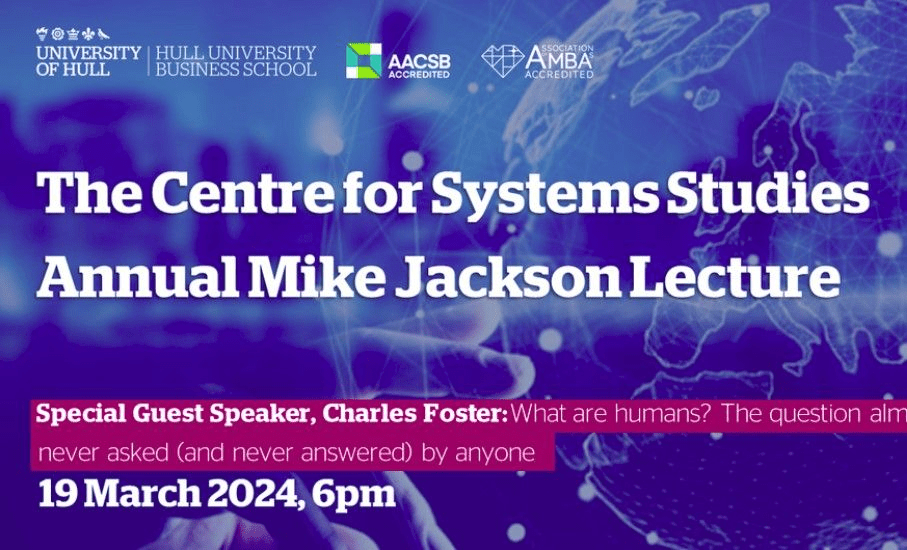
What are humans? The question almost never asked (and never answered) by anyone
Anthropologists and sociologists (at least) might be expected to have attempted an answer to the question ‘What are humans?’. But they have not. It is a vaunting, daunting question, but it is worth exploring, even if the exploration is frustrating. This lecture looks at the question through a number of lenses, suggests the least unsatisfactory answer, and goes on to ask what this answer means for the way that we should live as individuals and the way we should structure our societies.
Follow Rap4Skills and others on SoundCloud.Sign inCreate a SoundCloud account
www.rap4skills.org/ We are a passionate team, dedicated to transforming how young generations acquire vital skills for the digital age, e.g., time management, critical thinking, design thinking, empathy, digital citizenship, budgeting, etc. We believe in the power of music, particularly rap, as an educational tool. The lyrics of these skills are in the book “Rap4Skills” published on Amazon in 2023 (www.amazon.com/Rap4Skills-Prof-H…Bui/dp/B0BYR5F9MT). We have also produced a demo on YouTube and received well-warm feedback from our students and friends (Prof Hong Bui -YouTube channel).
Our project, Rap4Skills, aims to produce songs that convey vital work and life skills and engage multiple communities to spread its impacts. Your support is paramount. By contributing, you are enabling a creative education for social inclusion and social transformation. The impact of this edutainment project will go globally.
Let’s change education together, one rap at a time!
Systems ThinkingRap4Skills 1 month ago1 month agoHip-hop & RapLikeRepostShareCopy LinkAdd to Next upMore 79 plays79 View all likes4 View all reposts2Rap4Skills 1 track1FollowReportFollow Rap4Skills and others on SoundCloud.Sign inCreate a SoundCloud accountwww.rap4skills.org/We are a passionate team, dedicated to transforming how young generations acquire vital skills for the digital age, e.g., time management, critical thinking, design thinking, empathy, digital citizenship, budgeting, etc. We believe in the power of music, particularly rap, as an educational tool. The lyrics of these skills are in the book “Rap4Skills” published on Amazon in 2023 (www.amazon.com/Rap4Skills-Prof-H…Bui/dp/B0BYR5F9MT). We have also produced a demo on YouTube and received well-warm feedback from our students and friends (Prof Hong Bui -YouTube channel).Our project, Rap4Skills, aims to produce songs that convey vital work and life skills and engage multiple communities to spread its impacts. Your support is paramount. By contributing, you are enabling a creative education for social inclusion and social transformation. The impact of this edutainment project will go globally.Let’s change education together, one rap at a time!
Journeys of Growth and Belonging is a gathering series co-facilitated with storytellers who are affecting a shift to an alternative narrative in their communities and organizations. These stories give us a place to redirect our attention. They can teach us how to become relational activists, which means we are putting our experience with each other first. It invites us all to reclaim control of our collective well-being. As we have been connecting and exchanging ideas around ideas in Peter Block’s books Activating the Common Good and Community, what has become evident is the value in gathering and collectively identifying ways that we can put the Six Conversations and other common good protocols into practice. Our intention is to continue to share, learn together with, and inspire others throughout 2024 by hosting a diverse and multidisciplinary community of those who are actively co-creating communities, organizations, and a world that works for the common good of all. In addition to learning from the story, we will connect in small groups as a model of the very convening style we wish to see more of in the world. Join us to connect and witness the common good.
Date & TimeYou can choose to attend one or more of the following sessions.
We invite you to join us in a new virtual seminar series to collaboratively explore diverse research approaches and methodologies in our study of compassionate systems and systems awareness more broadly. The aim of this series from the MIT Systems Awareness Lab is to inspire communities of practitioners and researchers to work together in considering the role of research in their own systems change work.
From this series of research design seminars, we will iterate on research designs that our community can then build upon, refine, implement, and learn from with our partners.
For More Information, contact systemsawareness@mit.edu
Tuesday, January 23, 2024, 10:00 – 11:30 am EST “Systems Awareness Methodologies”
An exploration of how we understand and map the nested layers of the education ecosystem with Dr. Mette Miriam Boell along with Dr. Lukas Herrmann, and Dr. Lana Cook of the MIT Systems Awareness Lab.
* *
Wednesday, January 24, 2024, 10:00 – 11:30 am EST
“Simulations and Game-based Learning for Youth Engagement”
A design session with Dr. Eric Klopfer, Dan Roy (MIT Scheller Teacher Education Program, Education Arcade) with Gustav Boell and Youth Ambassadors (Center for Systems Awareness)
* *
Thursday, January 25, 2024, 9:00 – 10:30 am EST
“Systems Intelligence of Children”
A conversation with Dr. Jean Clinton (McMaster University), Dr. Peter Senge (MIT), Jacob Martin (Dulwich College Singapore), and Charlotte Ruddy (Dulwich College Singapore)



You must be logged in to post a comment.