Journal launched: Frontiers in Complex Systems

cxdig's avatarComplexity Digest

Frontiers in Complex Systems publishes rigorously peer-reviewed quantitative research on Complex Systems, either theoretical, experimental, mathematical, computational or data description. Field Chief Editor Maxi San Miguel at the Institute for Cross-Disciplinary Physics and Complex Systems (IFISC) in Spain is supported by an outstanding Editorial Board of international experts. This open-access journal is to become the reference and natural publication outlet for the Complex Systems community at large, and to be at the forefront of disseminating and communicating scientific knowledge and technological innovation in the field to researchers, academics, entrepreneurs, companies, policy makers and the public worldwide.

Frontiers in Complex Systems covers fundamental questions, theories and general methodologies on complex systems as well as the cross-disciplinary application of these concepts and methods, often giving rise to new disciplines. It provides a forum for cross-disciplinary communication and welcomes quantitative research from different fields including Physics, Mathematics, Computer Sciences, Artificial Intelligence, Engineering, Climate…

View original post 77 more words
A CRITIQUE OF CYBERNETICS – Jonas (1953)

A CRITIQUE OF CYBERNETICS

HANS JONAS

Social ResearchVol. 20, No. 2 (SUMMER 1953) , pp. 172-192 (21 pages)

Published By: The Johns Hopkins University Press

A CRITIQUE OF CYBERNETICS on JSTOR

pdf

Toward a Critical Technical Practice: Lesson Learned in Trying to Reform AI – Agre (1997)

Timely….

Toward a Critical Technical Practice:
Lessons Learned in Trying to Reform AI

Philip E. Agre
Department of Information Studies
University of California, Los Angeles
Los Angeles, California 90095-1520pagre@ucla.edu
http://polaris.gseis.ucla.edu/pagre/This is a chapter in Geof Bowker, Les Gasser, Leigh Star, and Bill Turner, eds, Bridging the Great Divide: Social Science, Technical Systems, and Cooperative Work, Erlbaum, 1997.

Toward a Critical Technical Practice

EconPapers: The Nondesignability of Living Systems: A Lesson from the Failed Experiments in Socialist Countries – Hu (1991)

The Nondesignability of Living Systems: A Lesson from the Failed Experiments in Socialist CountriesJixuan HuCato Journal, 1991, vol. 11, issue 1, 27-46

EconPapers: The Nondesignability of Living Systems: A Lesson from the Failed Experiments in Socialist Countries

pdf

SysThink2023: SESC-IFSR Systems Thinking Symposium Systems Thinking in the Post Pandemic Era – Beijing and online, February 21-23, 2023

[NB first I’ve heard of this, and very fiddly to sign up – not sure if I succeeded but if I did it was apparently as a delegate from Beijing Planetarium?]

Beijing and Online, February 21-24, 2023Register

The 2023 SESC-IFSR Systems Thinking Symposium aims to discuss and explore systemic impacts arising from the pandemic and explore how they are handled by drawing upon diverse, multiple, and systemic perspectives.  Systemic impacts of the pandemic within crisis management, digital economy, education, industrial supply chains and trade, life and health, scientific development and technological innovation,  and societal governance, will be explored.  The Symposium is expected to illustrate both the multi-disciplinary approach as well as systems thinking perspectives toward the COVID-19 pandemic and to facilitate dialogue among different systems modelers, practitioners and thinkers, for the purpose of aggregating knowledge and insights for future change and improvements in complex and chaotic decision-making contexts.

The Systems Engineering Society of China (SESC)  is joined by the International Federation for Systems Research (IFSR) to organize the Symposium, which will be held by online-offline hybrid mode. Worldwide influential scholars will be invited to give keynotes on Systemic impacts of the pandemic in the perspectives of diverse systems.  Considering the time difference, all keynotes talk will be arranged in the afternoon or evening of Beijing Time for convenient participation during February 21-24, 2023. 

SysThink2023 welcomes abstracts relevant to the theme of the Symposium, especially to above mentioned systems. Please submit your abstract with 200~400 words of systems impacts of the Covid-19 towards crisis management, digital economy, education, industrial supply chains and trade, life and health, scientific development and technological innovation,  societal governance, etc. If specific sessions are  planned to be organizied, please directly send proposal by email. 

2023 SESC-IFSR Systems Thinking Symposium

Sensemaking and Theory-Building | Gary S. Metcalf | ST-ON 2023-02-13 – Coevolving Innovations

 February 14, 2023  daviding

Sensemaking and Theory-Building | Gary S. Metcalf | ST-ON 2023-02-13 – Coevolving Innovations

Complexity Explorer Lecture: David Krakauer • What is Complexity? – YouTube

Complexity Explorer

6 Feb 2023

To celebrate our 10th anniversary, we’re excited to share a lecture from SFI President David Krakauer sectioning the concept of complexity and exploring complexity epistemology and emergence. https://www.complexityexplorer.org/co…

Complexity Explorer Lecture: David Krakauer • What is Complexity? – YouTube

A cybernetic concert review of Midnight Oil in Canberra: system failures, feedback mechanisms and the Indigenous Voice to Parliament – By Tom Chan(through cybernetic ‘Beer’ goggles) Feb 2023

A cybernetic concert review ofMidnight Oil in Canberra:system failures, feedbackmechanisms and theIndigenous Voice to Parliament

By Tom Chan(through cybernetic ‘Beer’ goggles)Feb 2023

A cybernetic concert review of Midnight Oil in Canberra: system failures, feedback mechanisms and the Indigenous Voice to Parliament

Just another ‘religion’…or something much more? | Squire to the Giants

Just another ‘religion’…or something much more?February 17, 2023 giantknave

Just another ‘religion’…or something much more? | Squire to the Giants

Beyond COVID: Reframing the Global Problematique with STiP (Systems Thinking in Practice) – Ison (2023)

Published: 14 January 2023Beyond COVID: Reframing the Global Problematique with STiP (Systems Thinking in Practice)Raymond L. Ison Journal of Systems Science and Systems Engineering volume 32, pages1–15 (2023)Cite this article49 AccessesMetrics

Beyond COVID: Reframing the Global Problematique with STiP (Systems Thinking in Practice) | SpringerLink

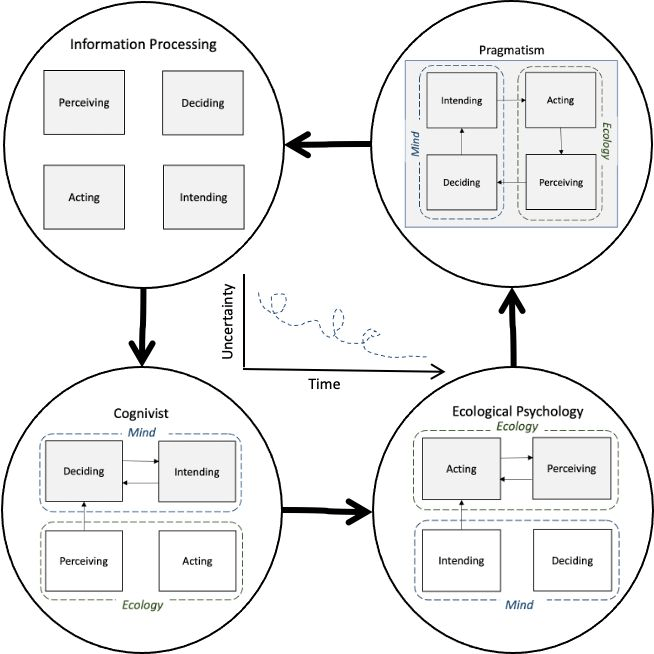
John Flach: four approaches to parsing a cognitive system

Four approaches to parsing a cognitive system. Classically, the information processing approach has parsed the cognitive system into a series of independent stages; others have focused on cognition as a computational system (computer, neural net) but have tended to diminish the components involved in perception and action; ecological psychologists have reacted by emphasizing perception and action – sometimes to the exclusion of computations. However…

continues in source

Post | LinkedIn

Systems approaches in the margin, where they don’t belong. | by Philippe Vandenbroeck | The shiftN Papers | Feb, 2023 | Medium

Philippe VandenbroeckFeb 15·3 min read·ListenSystems approaches in the margin, where they don’t belong.

Systems approaches in the margin, where they don’t belong. | by Philippe Vandenbroeck | The shiftN Papers | Feb, 2023 | Medium

Using ChatGPT to build System Diagrams — Part I | by aruva – empowering ideas | Jan, 2023 | Medium

Using ChatGPT to build System Diagrams — Part I

Using ChatGPT to build System Diagrams — Part I | by aruva – empowering ideas | Jan, 2023 | Medium

Whatever Next ? – Psybertron Asks

Closing – or probably continuing – the circle – this piece by Ian Glendinnig is a good review of Alastair MacIntyre’s ‘After Virtue’, especially in the light of ‘meaning crisis’ related shenanigans. He wrote this in 2008 and added a comment after he saw my 2018 post (here attributed as 2023) on Epistemological crises, dramatice narrative and the philophy of science (MacIntyre, 1955) (https://stream.syscoi.com/2018/09/23/epistemological-crises-dramatic-narrative-and-the-philosophy-of-science-alasdair-mcintyre-the-monist-1977/)

Ian Glendinning

[Caveat – this review may not do the subject justice, but I didn’t really notice how good a read it was until I was well into it, by which point not only did I not have any notes, but I was committed to read on to a conclusion. So from memory …  is the summary (in the bullets) any good ?]

[Post Note – Matt Kundert, in this (2008) post and the comment thread below, has turned-up as a McIntyre reference in my wider “Systems Thinking” context thanks to a (2023) post by Ben Taylor linking to an earlier (1977) piece pre-dating “After Virtue” (1981) by Al McIntyre and reviewed by Matt. And re-reading this post now in 2023, I see a wonderful irony in my use of the word “governance” in my implicitly cybernetic (psyberton-ic) context before I had made the connection explicit. What goes around comes around. ]

I’ve had a copy of Alastair MacIntyre’s (1981, 2nd Ed 1984) “After Virtue” tucked away on a bookshelf for some time. I vaguely remembered I’d bought it on the recommendation of Rev Sam, but no recollection of why it came to be tucked-away unread. [I since discover it’s Sam’s most important read ever – after being turned onto things philosophical by ZMM, like myself, and away from “scientism”, as I already was before I read ZMM, “After Virtue” turned Sam to Christianity and theology. Wow. Matt too claims MacIntyre and After Virtue as an important route to understanding the Greeks.]

Whatever Next ? – Psybertron Asks

From autopoiesis to self-optimization: Toward an enactive model of biological regulation

cxdig's avatarComplexity Digest

Tom Froese, Natalya Weber, Ivan Shpurov, Takashi Ikegami

The theory of autopoiesis has been influential in many areas of theoretical biology, especially in the fields of artificial life and origins of life. However, it has not managed to productively connect with mainstream biology, partly for theoretical reasons, but arguably mainly because deriving specific working hypotheses has been challenging. The theory has recently undergone significant conceptual development in the enactive approach to life and mind. Hidden complexity in the original conception of autopoiesis has been explicated in the service of other operationalizable concepts related to self-individuation: precariousness, adaptivity, and agency. Here we advance these developments by highlighting the interplay of these concepts with considerations from thermodynamics: reversibility, irreversibility, and path-dependence. We interpret this interplay in terms of the self-optimization model, and present modeling results that illustrate how these minimal conditions enable a system to re-organize itself such that it tends toward…

View original post 36 more words