According to Mary Midgley, philosophy is like plumbing: like the invisible entrails of an elaborate plumbing system, philosophical ideas respond to basic needs that are fundamental to human life. Melioristic projects in philosophy attempt to fix or reroute this plumbing. An obstacle to melioristic projects is that the sheer familiarity of the underlying philosophical ideas renders the plumbing invisible. Philosophical genealogies aim to overcome this by looking at the origins of our current concepts. We discuss philosophical concepts developed in Indigenous cultures as a source of inspiration for melioristic genealogy. Examining the philosophical concepts of these communities is useful because it gives us a better idea of the range of ethical, political, and metaphysical approaches that exist in the world. Members of western societies do not get a clear view of this range, in part because living in large groups presents its own constraints and challenges, which limit philosophical options. We argue that features of Indigenous philosophies, such as egalitarianism and care for one’s natural environment, are not inevitable byproducts of Native material conditions and lifestyles, but that they are deliberate forms of conceptual engineering. We propose that comparative philosophy is an integral part of the genealogical project.
President’s Series 24: Cybernetics and the Church, Discovering CyberneticsRev. Dr. Keith Elford reflects on his recently completed doctoral thesis while subsequently we will reflect on discovering cyberneticsByCybernetics Society — President’s Series
The Center Leo Apostel for Transdisciplinary Studies (CLEA) at the Vrije Universiteit Brussel (VUB), organises its first international artscience symposium: ‘Systems At Play: The Self-Organising Symposium on Self-Organisation’ in Brussels from February 15 to 18, 2023.The symposium starts from the idea that art and science are mutually beneficial means of perception and insight creation. It thus provides a transdisciplinary contact zone for artists and scientists to meet, exchange, think, share, take time, and, ultimately, play together.
Then, what shall we talk and play about? Well, it’s up to you where it ends up, but our starting points are the ideas of ‘emergence’, ‘self-organisation’, and ‘goal-directedness’. More specifically, participating artists and scientists are invited to collectively tackle creative challenges in an embodied way. We will feed and facilitate this process with presentations, conversations, workshops and live games during the day, and performances, talks and film screenings during the evening.
Rather than simply organise a symposium simply about self-organisation, we are attempting to organise a self-organising symposium on self-organisation, one that determines its own final goals through all our interactions together. We recognize that we cannot fully predict the processes, outcomes and final goal, nor do we want to. The symposium will become a shared research object, as well as a strange loop in which topic and method merge and multiply.
Artists and scientists are invited to participate through two open calls: one, to participate in the symposium; and two, to participate as well as prepare an input presentation, in the form of a talk, performance, interactive game, or film screening.
For more (practical) info on how to apply and more, please visit our event page!
RSD12: At the Systemic Design Association’s General Assembly, Evan Barba proposed that Georgetown University coordinate RSD12 as a distributed network model where a handful of “hubs” or “nodes” act as regional hosts for RSD. The proposal was enthusiastically received and approved.
Happy holidays
Message from SDA Chair Silvia BarberoI want to take this opportunity to make a special wish for the new year that we continue to connect people with design and build a future of peace and friendship. The future is now, and we are responsible for designing a better world.READ MORE
Contexts – the Systemic Design JournalPeter Jones, Editor in Chief: We’ve had a huge learning year and good results for the systemic design publication. Volume 1 will feature papers from authors Harold Nelson, Elena Porqueddu, Dulmini Perera and Tony Fry.READ MORE
RSD11
Next stepsThis phase starts by moving into production mode, with a target publication date of February 15, 2023. For authors who are revising their papers, the deadline is December 31. It’s also time to upload presentations or supporting materials. While providing anything beyond a final paper is not mandatory, these are welcome additions to the systemic design repository.READ MORE
Reflections on RSD11This year’s RSD contributions were dedicated to exploring possibilities for systemic design. A call went out to question systemic design’s emerging shape, and the growing, remarkably interdisciplinary systemic design community responded.READ MORE
Member News
Designing ComplexityThe much-awaited book, Designing Complexity: The Method & Practice of Systems Oriented Design, by Birger Sevaldson, is available in PDF and hardback. It officially launches in January but can be ordered now.Birger has also re-launched the legacy systemsorienteddesign.net with hundreds of resources: gigamapping, frameworks, tools, projects, and more. Subscribe to get notified of new articles.BOOK DETAILS & ORDER
Sign up & sign inAlthough scholarly work was core at RSD11, the experience felt more like a movement.While volunteer run, SDA needs to maintain a small operating budget to support the emergence of systemic design across a community of academics and practitioners.Please be sure to support SDA this year as a member or with a donation. The SDA member directory also has a new look, so if you opt into the directory, please update your profile.SDA MEMBERSHIP
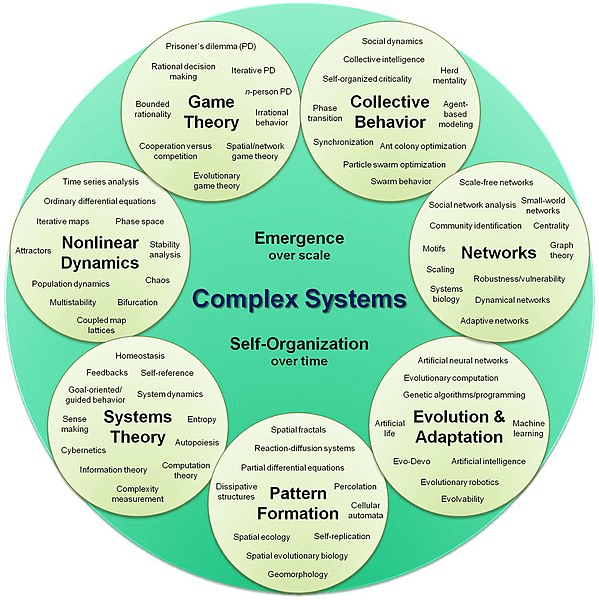
#ComplexSystems folks:After more than a decade, I am planning to update this diagram. What kind of keywords, concepts, topics, and/or research areas should be added? Let me knowhttps://commons.wikimedia.org/wiki/File:Complex_systems_organizational_map.jpg
How much carbon is stored in the aboveground biomass (AGB) of Wytham Woods aka the ‘most studied forest in the world’? Professors Mat Disney and Kim Calders thought this would be very well-known but were surprised to find this perhaps wasn’t the case after all. They discuss how their team approached their latest research.
Over the years, a number of studies have estimated the carbon stored in Wytham Woods, and many more have estimated carbon in UK woodlands more widely. These estimates generally all use empirical regression models relating tree diameter-at-breast height (DBH) (which is easy to measure) and biomass (which is not). These so-called allometric models are calibrated using harvest measurements of individual tree biomass i.e. cutting down and weighing the whole tree.
We had been using terrestrial laser scanning (TLS) at Wytham to measure the forest structure in detailed 3D in order to explore relationships of structure…
How’s this ? Open Systems Theory – Making adaptive and Lasting Change 2x3day course 17th – 19th and 24th to 26th of February 2023 – Canberra, Australia with Merrelyn Emery and Peter Aughton @Mihail Sestakov, @Alidad Hamidi, @Trond Hjorteland and @Peter Aughton are helping to organize a a course in Canberra Australia in late February on Open Systems Theory (OST), this will be facilitated by none other than Merrelyn Emery, who along with her husband Fred Emery are the experts not only on the theory of OST but also on how it can be practically applied. OST is one of the most coherent application of systems thinking that we have seen, with a thorough scientific theoretical back ground and immediate practical application supporting organisations and groups to be equipped to handle the true nature of being a viable adaptive organisation. OST is elates people and their organizations to their extended social field. It promotes participation and democracy. Learn OST through the application of theory to the methods experiencing why some methods work while others don’t. You will learn about all the OST methods, the Search Conference, Participative Design Workshop, 2 Stage Model and Unique designs. This suite of methods covers all contingencies in all contexts. To find out more please let us know or click below to find out more https://events.humanitix.com/ost_canberra/
Fri 17th Feb 2023, 3:00 pm – Sun 26th Feb 2023, 9:00 pm AEDT
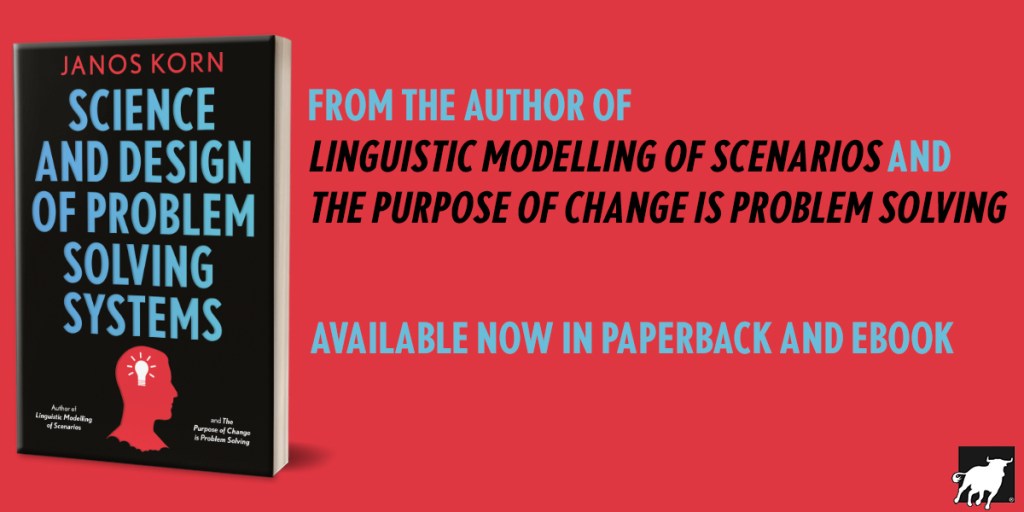
The book is about an empirical, systems theory of a general, systemic/structural view of parts of the world integrated with creative problem solving procedure with the latter generating a ‘product and systems’ design method. As an alternative to the speculative and fragmented nature of current ‘systems thinking’ and practice, the book proposes three principles of systems: ‘Generality/nested hierarchy, changes of equilibrium states and problem solving/purpose’ together with ‘linguistic modelling’ using processed, natural language or transformation of narratives of scenarios into sequences of logical conditionals, the executor of the principles. Implementation of the creative, innovative, inspirational stage leads to ‘design parameters’ which guide the detailed design of systems and products defined as any entity capable of generating interaction. Uncertainties and mathematical models are introduced at the object/agent level as required. The theory is ‘property driven’ i.e., uses qualitative, quantitative properties including social, emotive and other mental states. Elementary, systemic or structural properties are ‘1 – and 2 – place simple sentences’ which can lead to operational representations when appropriate. Meaning preserving, linguistic transformations convert a narrative or story into such sentences. A user driven approach to the analysis of ‘information’ is introduced. Recent paradigm changes and problematic issues in current ‘systems thinking’ are reviewed. The theory is based on accepted branches of knowledge such as linguistics, network theory, biology, physics, chemistry, social science as needed, it is highly teachable, introduces linguistics in addition to mathematics as a symbolic model and can inspire further research. It introduces four criteria for judging the ‘soundness’ of symbolic models. However, it needs peer review, software development to work out the dynamics of scenarios and further developments for applications to more practical problem situations in organisations, technical and natural circumstances.
How do intelligent agents spawn and exploit integrated processing regimes spanning brain, body, and world? The answer may lie in the ability of the biological brain to select actions and policies in the light of counterfactual predictions—predictions about what kinds of futures will result if such-and-such actions are launched. Appeals to the minimization of ‘counterfactual prediction errors’ (the ones that would result under various scenarios) already play a leading role in attempts to apply the basic toolkit of the neurocomputational theory known as ‘predictive processing’ to higher cognitive functions such as policy selection and planning. In this paper, I show that this also leads naturally to the discovery and use of extended processing regimes defined across heterogeneous mixtures of biological and non-biological resources. This solves a long-standing puzzle concerning the ‘recruitment’ of the right non-neural processing resources at the right time. It reveals how…
Roth S. and Valentinov V. (in press), Toward a theory of multifunctional liberalism: Systems-theoretical reflections on the nature of statehood, Systems Research and Behavioral Science.
Abstract:As neoliberalism is sinking into disrepute, states are responding to current crises by inroads on basic rights. This constellation adds urgency to the timeworn subject of statehood and its relationship to law and liberty. The paper addresses this subject by enhancing the neoliberal concept of an encased economy with James Coleman’s concept of law as indicator of social change and Niklas Luhmann’s functional differentiation. The resulting multifunctional liberalism associates liberties and rights with the autonomy of function systems—such as politics, economy, or law—and envisions an ecosystem of multifunctional organizations able to navigate the full spectrum of functional differentiation.
Keywords: Neoliberalism, law, economy, functional differentiation, social systems theory.
The author accepted manuscript of this article is available for download here.
Recommended citation: Roth S. and Valentinov V. (in press), Toward a theory of multifunctional liberalism: Systems-theoretical reflections on the nature of statehood, Systems Research and Behavioral Science.





 Systems Community of Inquiry
You must be logged in to post a comment.