The Water of Systems Change | FSG, John Kania, Mark Kramer, Peter Senge

Simultaneously deep and shallow.

via The Water of Systems Change | FSG

Foundations involved in systems change can increase their odds for success by focusing on the least explicit but most powerful conditions for change, while also turning the lens on themselves.

The Water of Systems Change aims to clarify what it means to shift these conditions. We offer the “inverted triangle” framework as an actionable model for funders and others interested in creating systems change, particularly those who are working to advance equity.

Top Takeaways

  1. Systems change is about advancing equity by shifting the conditions that hold a problem in place.
  2. To fully embrace systems change, funders should be prepared to see how their own ways of thinking and acting must change as well.
  3. Shifts in system conditions are more likely to be sustained when working at three different levels of change: explicit, semi-explicit, and implicit.
Real and equitable progress requires exceptional attention to the detailed and often mundane work of noticing what is invisible to many.

Watch the Webinar


Download

Scientific Epistemology for Physical Education Fundamental Movement Skills Prerequisites – The Sport Journal – Narcessian and Leet (2020, I think)

I’d be intrigued if anyone can get through the jargon of this one. I think it is about how people learn ‘movement skills’ (to develop sports) that will help them be healthy and active in life. And it’s about how people observe high performers and try to do the same thing themselves, and I think it concludes that it is all quite complicated but that what is clear is that what are understood as ‘fundamental movement skills’ are not fundamental nor good ways to decide who is a good performer or an injury risk, partly because of the subjectivity of PE teachers, coaches and health carers. And… something about people needing to explore and understand for themselves? Something about how people study top performers, and something about how there are earlier pre-requisites than ‘fundamental movement skills’ which are more complex and part of a relationship between observer and observed, but might be more useful in predicting performance and injury and training appropriately? If you’re interested in education, or have ever been to a first Yoga or Salsa class, please take a look and report back!

via Scientific Epistemology for Physical Education Fundamental Movement Skills Prerequisites – The Sport Journal

Scientific Epistemology for Physical Education Fundamental Movement Skills Prerequisites

Authors: Robert P. Narcessian and Janet M. Leet

Scientific Epistemology for Physical Education Fundamental Movement Skills Prerequisites

ABSTRACT

A scientific epistemology, using a systems thinking qualitative methodology for translating practice into theory, integrates mathematical and dynamical systems concepts with belief systems that are presented in this original research of unique prerequisites for fundamental movement skills (FMS) in physical education as illustrated with running. FMS prerequisites demonstrate that FMS are neither fundamental nor reliable screentests conducted on individuals by physical education teachers, coaches, and healthcare practitioners for performance readiness evaluations or injury risk assessments. FMS prerequisites identify and assess eliminating the hypothetical set of worst first moves, assess the integrity of their respective coordinative structures, and assess performers’ beliefs (i.e., preferred behaviors) with the objective to provide a new direction for researching injury risk and performance readiness. The researchers illustrate this new method with participants for FMS prerequisites in running and squatting to provide insight for the observer-performer interaction. A new observer-performer classification and non-epistemic modeling show what is known with self-discovery strategies that detect hidden skills at the observable level using four independent tasks. There were 297 participants in kindergarten through high school (213 females and 84 males; mean 14.5 years; range 5 to 17 years) and 21 participants from the community at large (15 females and 6 males; mean 31.4 years, range 12 to 94 years). A variety of running strategies of different degrees of configured complexity from which to run were self-selected and observed as preferred with and without practice or intervention. An idealized 2-joint planar multi-joint mechanism (MJM) was used to assess individual skill with respect to adding and removing constraints. Findings are presented for strategies, trends, and transitions of preferred behavior including observables that reveal hidden skills including a visual search of a hidden skill with world record Olympian sprint performances. FMS prerequisites are theorized for future study with an inverted U-model and a leading MJM hypothesis; and they provide the rudiments for injury risk assessments and performance readiness evaluations approaching optimal health biomechanically in the very early detection of flawed gross motor skill development before manifesting into the signs and symptoms of injury or poor performance.

Key words: dynamical systems, belief systems, fundamental movement skills, classification, running, physical education


A Wider Lens | Psychology Today – Kenneth Silvestri Ed.D.

Interesting series on systems thinking in psychology by Ken Silvestri

via A Wider Lens | Psychology Today

A Wider Lens

How to see your life differently.

Kenneth Silvestri Ed.D.

Why does understanding the systemic nature of risk matter in the midst of COVID-19? | PreventionWeb.net

(This one I don’t understand and I think it is mostly talking about its own document, so I can’t criticise – but some will be interested. I do think that in quoting

“Everything seems to be everything else, and I get lost in it”, Gregory Bateson

…they are doing a disservice, as while written by Bateson, this is a script clearly giving the line to ‘Daughter’. (And the reply is, on the face of it, rather patronising).

(It’s like the line in, I think, Yes, Minister – or Yes, Prime Minister – where the hapless politician Jim Hacker says ‘Neither a borrower nor a lender be. Shakespeare.’ – to be corrected by one of his superior civil servants. ‘Polonius’).

via Why does understanding the systemic nature of risk matter in the midst of COVID-19? | PreventionWeb.net

Mobility as a Service Isn’t an App, It’s a System | Loup Ventures

Just being a Negative Nellie one more time. This is an intriguing article about Mobility as a Service, but again the definition of systems thinking at its heart is rather lacking. But, it goes to interesting places.

via Mobility as a Service Isn’t an App, It’s a System | Loup Ventures

Systems Thinking is an analytical approach that considers how a system’s individual components interrelate both through time and within the context of a larger system. In part, Systems Thinking is driven by the philosophy and tactics of fields such as Human-Centered Design, Design Thinking, Service Design, Customer Experience, and related fields. We can narrow Systems Thinking down to two primary parts: 1) Component Dynamics: Understanding how an individual component delivers its value proposition to customers through the combination of front-end customer-facing and back-end non-customer facing operations and 2) System Dynamics: Understanding how individual components interrelate both to other components and the greater system of which they are a part. It is easy to see how Systems Thinking is necessary to deliver MaaS with various public and private components requiring a number of services on the front- and back-end.

The Systems Thinker – Systems Thinking: What, Why, When, Where, and How? – The Systems Thinker

On a venerable website, and/but, I believe, a very limited and partial form and presentation of ‘systems thinking’:

via The Systems Thinker – Systems Thinking: What, Why, When, Where, and How? – The Systems Thinker

The Map at the Gemba: Harish’s Notebook

Harish's avatarHarish's Notebook - My notes... Lean, Cybernetics, Quality & Data Science.

Map

In today’s post I am looking at “The map is not the territory.” This is a famous statement that is often cited to indicate that what we have is a model and not the real thing. Another statement that is quite similar is “All models are wrong, but some are useful.” The “map statement” is attributed to the Polish philosopher and the man behind General Semantics, Alfred Korzybski. A lot of Korzybski’s ideas are very well aligned with Cybernetics and Systems Thinking.

Korzybski was inspired by a paragraph in the great Bertrand Russell’s “Introduction to Mathematical Philosophy”. Russell was referring to Josiah Royce’s ideas with a map. Russell wrote:

One of the most striking instances of a “reflexion” is Royce’s illustration of the map: he [Royce] imagines [making] a map of England upon a part of the surface of England. A map, if it is accurate, has a…

View original post 1,299 more words

Systemic change: changing the conditions that hold a situation in place (with a link to Covid-19) | Marcus Jenal

via Systemic change: changing the conditions that hold a situation in place (with a link to Covid-19) | Marcus Jenal

Neutron bombs and suddenly being able to see the key economy (9 Apr., 2020, at Interconnected)

via Neutron bombs and suddenly being able to see the key economy (9 Apr., 2020, at Interconnected)

Neutron bombs and suddenly being able to see the key economy

I grew at the tail end of the Cold War. My unquestioned assumption was that I would probably live out my life in a nuclear wasteland.

One of the things we’d talk about was the neutron bomb. This type of bomb would leave cities buildings intact, and it had very little fallout so the city would be safe to occupy after it was dropped, but the people would all go. Not die, that wasn’t the myth of it, but somehow vapourised — raptured up to heaven, really. It was called the “clean” bomb. The mental image was of an urban Mary Celeste.

Amongst the misery of Covid-19, this horrifically unfair disease, which is too big for me to think about and so I’m feeling my way around it bit by bit, there is the the lockdown.

The lockdown is a neutron bomb for the economy. What if the buildings stay, and the people stay, but the economy vanishes?


continues in source: Neutron bombs and suddenly being able to see the key economy (9 Apr., 2020, at Interconnected)

Understanding Society: Thomas Hughes on electric power as a sociotechnical system

via Understanding Society: Thomas Hughes on electric power as a sociotechnical system

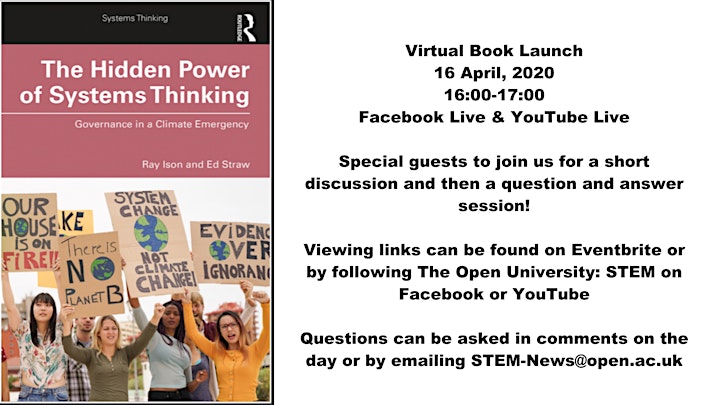
Virtual Book Launch: “The Hidden Power of Systems Thinking” Tickets, Thu 16 Apr 2020 at 16:00 UK time (online)

via Virtual Book Launch: “The Hidden Power of Systems Thinking” Tickets, Thu 16 Apr 2020 at 16:00 | Eventbrite


APR 16

Virtual Book Launch: “The Hidden Power of Systems Thinking”

Event Information

Join us for a virtual book launch of “The Hidden Power of Systems Thinking – Governing in a Climate Emergency”

About this Event

Please join us virtually on YouTube and Facebook live for the launch of the publication of “The Hidden Power of Systems Thinking – Governing in a Climate Emergency”. We have invited panel members from several governance contexts whose experiences are relevant to the book.

‘The authors’ thesis is that it is only through new systems of governance and new ways of thinking and acting that the human world can manage the climate and associated emergencies. It may be that the Covid-19 has knocked some sense into the those maintaining the current world order sufficient to grasp that the systems we have are but the systems we have, all are human inventions, and all can be reinvented. We explore how and why contemporary governance is failing. New elements in a governance system are needed: the biosphere, social purpose and the Technosphere. Failures of governance go beyond damaging our habitat to damaging inequalities in power, wealth and well-being. Preferential lobbying thrives. Ramshackle political processes are no match for these challenges.

Systems Thinking in Practice is now well into its stride in many settings. We have concluded that applied effectively it would provide the answer. This is a big claim. The book is much more than a critique of the status quo. It details 26 principles for systemic governing. These would form the core of amended constitutions. But just as Shakespeare needs a great cast to do justice to his scripts, so these new systems have to be operated by people who understand the theories of systems thinking and how to apply them in practice. The book describes the what and how of recovering systemic sensibility, acquiring systems literacy and investing in systems thinking in practice capability.

The book has been described as a persuasive, lively book that shows how systems thinking can be harnessed to effect profound, complex change. We would welcome, very much, your feedback on these proposals – and those of many others working to create a sustainable and fair world – and how they can be brought to fruition.

After a welcome from our two authors, Dr Kevin Collins will MC

We have lined up a very exciting panel for you, including:

Professor Eileen Munro from the London School of Economics

Professor John Naughton Director, Press Fellowship, Wolfson College, Cambridge

Dr Julian Corner, CEO of Lankelly Chase

And Dr Piret Tõnurist of Organisation for Economic Co-operation and Development (OECD)

After each panel member shares their points of view, we will open up to questions both via comment or by emailing STEM-News@open.ac.uk and will share an exclusive discount code to give you 20% off your purchase of the book.

If you cannot join us on the day, recordings will be available to watch on YouTube (search for The Open University: STEM) or on Facebook (@theopenuniversitySTEM) and questions sent to STEM-News@open.ac.uk and response sent within a few days.

Nick Ananin’s systems thinking events google map – always updated (and if I have this right, now embedded below)

Values and systems again – GentlySerious – Medium

via Values and systems again – GentlySerious – Medium

Why (Intervene in) Systems Changes? – Coevolving Innovations – David Ing

A series of pieces on coevolving.com from January-March of this year, which I’ll be linking out one per week (but all are on David Ing’s blog already). Here is 3/5

via Why (Intervene in) Systems Changes? – Coevolving Innovations

Why (Intervene in) Systems Changes?

With a focus on “ecological systems”, the second of four lectures planned for the Systemic Design course in the Master’s program in Strategic Foresight and Innovation at OCAD University proceeded as a timeboxed presentation:  targeting 40 minutes of content (skipping slides to stay within time constraints), followed by 10 minutes of discussion.  Since the slides are rich with content and links to sources, students were directed to pay attention to what I was saying, over trying to read the slides projected behind me.

The agenda was in four sections:

  • [preamble] Errors, Attention and Traps (Ecological Understanding)
    • Systems Changes Learning Circle (Bateson, Gibson, Ingold)
    • (Resistances to) Changing as primary system of interest
  • A. Socio-Ecological Systems Perspective
    • Tavistock Institute (Emery, Trist)
    • Organization as primary system of interest
  • B. (Social-) Ecological Systems  + Panarchy
    • Stockholm Resilience Centre (Holling, Walker, Peterson)
    • Ecology as primary system of interest
  • C. The Ecosystem Approach
    • Resilience Alliance (Waltner-Toews, Kay)
    • Sustainable development project as primary system of interest

Online, the video is available on Youtube for streaming.

Viewers who prefer to watch video on a disconnected device can download a video file.

Video H.264 MP4 WebM
January 31
(1h18m)
[20200129_OCADU_Ing HD m4v]
(HD 2666kbps 1.2GB)
[20200129_OCADU_Ing nHD m4v]
(nHD 1352kps 637MB)
[20200129_OCADU_Ing HD webm]
(HD VP8 425kbps 292MB)
[20200129_OCADU_Ing nHD webm]
(nHD VP8 224kbps 156MB)

Readers who want to follow through on web link references may want to review the slides directly.

The lecture was given twice.  The Wednesday full-time section classroom was disrupted by a water supply issue in the graduate school building, so we all decamped to a lecture theatre in the main building.  The Friday part-time section proceeded as scheduled, making that audio recording the practical foundation with presentation slides for the web video.

The acoustics in the January 31 session (part-time cohort) was better for the web video.  The digital audio for the talk on January 29 (full-time cohort) was in an auditorium with stadium seating, and a microphone. Versions boosted by 3db make quieter sections more audible.

Audio
January 29
(54m58s)
[20200129_OCADU_Ing ErrorsAttentionTraps.mp3]
(51MB)
[20200129_OCADU_Ing ErrorsAttentionTraps plus3db.mp3]
(51MB)
January 31
(59m37s)
[2020031_OCADU_Ing ErrorsAttentionTraps.mp3]
(55MB)
[20200115_OCADU_Ing ErrorsAttentionTraps plus3db.mp3]
(55MB)

Before diving into the multiple views on ecological systems, questions as to whether to intervene (as willful action following wei) or to let nature takes its course (as non-intrusive action following wuwei).  Moving away from an anthropocentric perspective, illustrating action as part or not part of nature may be clearer in observing the Canadian beaver.


The Systems School Newsletter – and (paid, online) systems change course

“all the learnings to support you through this transition”

goodies in this newsletter

  • learning: methods for the systems change framework
  • learning: power in the system
  • external learning: grounded hosting and engagement online w/ beehive production

+ starts easter monday – act fast!

  • let’s experiment!
  • facilitation and hosting guides for online events

dear systems community,

i’ve been grateful that in the last few days, my state of being is slowly shifting, from one of despair and overwhelm to inspiration and expansion.  this is coming from unexpected conversation, connections and dreaming up the future with others and i’m so grateful for it.  in this shift, i’m reminded of this quote from picasso…

inspiration exists, but it must find you working

so we’re transforming here at the systems school. i’m thinking of this less as ‘pivot’ or even adaptation, and more that we’re finding a state of flow within the complexity, bearing witness to the transformation and seeking out the energy and momentum that will carry us forward. it’s presenting us with some pretty incredible opportunities, and we hope you’ll come join us.

yours in learning.

seanna
director, the systems school
upcoming online learning events

systems methods for the systems change framework
an exciting collaboration, with all-star systems thinker dr.fiona mckenzie, director of orange compass https://www.orangecompass.com.au.  in this series we’re getting right down to practice.  each week, we will teach how to apply a systems method for one aspect of the systems change framework http://bit.ly/systemschangeframework.  you will receive facilitation guides to apply the methods, and additional resources to support your learning.

dates: wednesdays 11:00-12:30pm (melbourne time), starting may 6th for 9 weeks
zoom platform, recordings available
sliding scale fees, starting at $350+

  • week 1 – introduction to the systems change framework and systemic change
  • week 2 – systems practices
  • week 3 – purposeful engagement
  • week 4 – reflect, learn, adapt
  • week 5 – define situation
  • week 6 – gain clarity
  • week 7 – find leverage
  • week 8 – act strategically
  • week 9 – ‘ask me anything’ session

register (https://www.eventbrite.com.au/e/systems-methods-for-the-systems-change-framework-tickets-102232185218)

power in the system
we’re working with superstar facilitator lina patel (https://au.linkedin.com/in/linaxpatel) to bring you this very special offering.  originally planning for an in-person learning event we’re pivoting online to bring this content to you now as we all wrestle with how to engage in these new ways of working.

in this weekly virtual learning series, we will explore and unpack issues of power within the practice of systems thinking each thursday from 11:00am – 12:30pm melbourne time beginning may 28th

  • week 1 – how and why is power so critically important to our work in systems?
  • week 2 –  how can we examine power in systems thinking?
  • week 3 – how is power showing up in OUR system? How can we adapt and become more power literate?

register (https://www.eventbrite.com.au/e/power-in-the-system-tickets-100456594378)

grounded online hosting and engagement – by beehive productions (https://beehive-productions.net/)

**starts easter monday**
discount available – email seanna(mailto:seanna@thesystemsschool.org?subject=i%20want%20to%20register%20for%20the%20beehive%20course) – we have a group of 3 already registering for a 30% discount

our friends at beehive productions are putting on a great learning series on grounded online hosting and engagement:

“As we find ourselves adapting to a new reality, finding alternative ways to socialize, do our work, and stay in contact with loved ones near and far, many of us are going beyond the initial panic and starting to realize the incredible potential of working online.

How we meet and host each other online is more important now than ever, whether the groups we are hosting are large or small. It can be a deeply meaningful experience or it can be very frustrating. This intensive is designed to minimize the frustration and maximize the value of our online engagements.”

see more details here (https://beehive-productions.mykajabi.com/GroundedResponse)

folks here’s what we know:

  • the way we are connecting and working together is rapidly changing and we need to develop skills to do this well
  • our meta systems are transforming and breaking open to new possibilities but we need to be active participants in rebuilding these
  • we have so much to learn from traditional ways of knowing, now is the time to honour, respect and engage with these practices
  • our future possibilities are ALL of ours, to dream into being

incredibly talented folks are coming into conversation to create an experiment and we’d like to invite you to participate.  we’re creating a space to engage with everything i’ve noted above, all while recognizing this as an experiment.

we are in it for the learning, not the precision
we are in it for the connection, not the perfected outcomes
we are in it for the momentum building, not the answer
sign me up for the experiment (mailto:seanna@thesystemsschool.org?subject=sign%20me%20up%20for%20the%20experiment)
good practices for hosting online

i recently held a session and share some insight on hosting online, and in preparing for that came across a number of excellent resources others had already put together.  check them out:

here (https://drive.google.com/file/d/16KIKMiLftq54sRGG75BJ1ISFRAJcjMoo/view) are the slides i shared in the session.

s
search
c
compose new post
r
reply
e
edit
t
go to top
j
go to the next post or comment
k
go to the previous post or comment
o
toggle comment visibility
esc
cancel edit post or comment