Towards a Calculus of Redundancy | Leyersdorff (2021)

c/o Ivo Velitchkov

full chapter in source:

Towards a Calculus of Redundancy | SpringerLink

The Evolutionary Dynamics of Discursive Knowledge pp 67-86| Cite as

Towards a Calculus of Redundancy

  • Loet Leydesdorff

First Online: 01 January 2021

Abstract

In this chapter, I extend Shannon’s linear model of communication into a model in which communication is differentiated both vertically and horizontally (Simon, 1973). Following Weaver (1949), three layers are distinguished operating in relation to one another: (i) at level A, the events are sequenced historically along the arrow of time, generating Shannon-type information (that is, uncertainty); (ii) the incursion of meanings at level B is referential to (iii) horizons of meaning spanned by codes in the communication at level C. In other words, relations at level A are first distinguished from correlations among patterns of relations and non-relations at level B. The correlations span a vector space on top of the network of relations. Relations are positioned in this vector space and can then be provided with meaning. Different positions provide other perspectives and horizons of meaning. Perspectives can overlap, for example, in Triple-Helix relations. Overlapping perspectives can generate redundancies—that is, new options—as a result of synergies.

The chapter is partly based on: Leydesdorff, L., Johnson, M., & Ivanova, I. (2018). Toward a Calculus of Redundancy: Signification, Codification, and Anticipation in Cultural Evolution. Journal of the Association for Information Science and Technology, 69(10), 1181–1192. https://doi.org/10.1002/asi.24052

full chapter in source:

Towards a Calculus of Redundancy | SpringerLink

Action Research: Its Foundations in Open Systems Thinking and Relationship to the Scientific Method | Haslett (2009)

source

Action Research: Its Foundations in Open Systems Thinking and Relationship to the Scientific Method | Tim Haslett – Academia.edu

Action Research: Its Foundations in Open Systems Thinking and Relationship to the Scientific Method

Tim Haslett2009, Systemic Practice and Action Research329 Views14 Pages2 Files ▾Open systems theory,Fred EmeryShow more ▾This paper considers those interpretations of action research that can be traced to Kurt Lewin at the Research Center for Group Dynamics at the University of Michigan, and the work in social ecology by Emery and Trist at the Tavistock Institute. It locates the logical basis of these interpretations in the philosophy of pragmatism, particularly as it relates to Peirce’s inferential logic and inquiry system. Drawing on this argument, and on the significant developments in approaches to systemic thinking over the past 40–50 years, a normative set of criteria is established for action research. The paper concludes that both positivist science (which relates to closed systems thinking) and action research (which relates to open systems thinking) are essential to any complete scientific approach.

source:

Action Research: Its Foundations in Open Systems Thinking and Relationship to the Scientific Method | Tim Haslett – Academia.edu

Systems Thinking Ontario – 2021-02-08 – creative systemic research

book via: https://creative-systemic.eventbrite.ca.

source:

Systems Thinking Ontario – 2021-02-08

February 8 (the second Monday of the month) is the 87th meeting for Systems Thinking Ontario. The registration is on Eventbrite at https://creative-systemic.eventbrite.ca.

Creative Systemic Research

There is variety in schools of thought across the systemic design community. Many approach from a top-down, abstract predisposition of a world that might be. An alternative approach builds from the bottom-up, in a longitudinal appreciation of the learning in which communities develop resilience.

The Creative Systemic Research Platform (CSRP) Institute leads with the bottom-up, longitudinal perspective. It aims to nurture localized scholarly communities, distributed across multiple peri-urban regional geographies. The work of mapping and investigating emerging economies is informed by activities that include creative expression in social complexity that produces communal well-being.

The CSRP Institute incorporated in late 2020 in an Italian Swiss canton. The initial practice base is at a farm in Terre d’Ebre, Spain. These locations provide opportunities to explore practices in smaller communities and terrains, in relation with historic land use and cultural wisdom.

The co-presidents of the CSRP Institute are Susu Nousala and Jelena Sucic.

  • Susu Nousala as a professor with the College of Design and Innovation, Tongji University, Shanghai (People’s Republic of China). She has previously had research positions at Aalto University (Finland), University of Melbourne (Australia), and Chiang Mai University (Thailand).
  • Jelena Sucic is a researcher in systemic design and sustainable processes based in Switzerland. She previously led as the field specialist and project manager in the nascent research group, as she completed a double degree in the PoliTong project, completing a Master of Fine Arts in Product Service Service Design at Tongi University, simultaneously with a Master of Science in Systemic Design at Politecnico di Torino.

Susu and Jelena will be joining us in conversation via web conference, at significant time disadvantage. (At 6pm ET, they will start at midnight in Finland and Switzerland).

Venue:

Suggested pre-reading:

Related to Creative Systemic Research

  • Nousala, Susu, Kim Blanca Galindo, David Romero, Xin Feng, and Pedro Aibeo. 2020. “Systemic Preconditions and Ontological Modeling for Peri-Urban Communities.” Journal of Cultural Heritage Management and Sustainable Development (ahead-of-print). https://doi.org/10.1108/JCHMSD-05-2020-0074.
  • Sucic, Jelena, Susu Nousala, and Pier Paolo Peruccio. 2019. “Introduction to: The Value of Living Systems Beyond a Price.” Art and Design 2 (3): 66. https://doi.org/10.31058/j.ad.2019.22009.

Agenda in source

Post-meeting artifacts

Bloggers are encouraged to write about their learning and experiences at the meeting. Links will be added to this page.

book via https://creative-systemic.eventbrite.ca.

source:

Systems Thinking Ontario – 2021-02-08

Rethinking Causality, Complexity and Evidence for the Unique Patient – A CauseHealth Resource for Healthcare Professionals and the Clinical Encounter | Anjum, Copeland and Rocca (Eds) | (2020)

full book free at:

Rethinking Causality, Complexity and Evidence for the Unique Patient – A CauseHealth Resource for Healthcare Professionals and the Clinical Encounter | Rani Lill Anjum | Springer

© 2020Open Access

Rethinking Causality, Complexity and Evidence for the Unique Patient

A CauseHealth Resource for Healthcare Professionals and the Clinical Encounter

Editors: Anjum, Rani Lill, Copeland, Samantha, Rocca, Elena (Eds.)

  • This book is open access, which means that you have free and unlimited access.

This open access book is a unique resource for health professionals who are interested in understanding the philosophical foundations of their daily practice. It provides tools for untangling the motivations and rationality behind the way medicine and healthcare is studied, evaluated and practiced. In particular, it illustrates the impact that thinking about causation, complexity and evidence has on the clinical encounter. The book shows how medicine is grounded in philosophical assumptions that could at least be challenged. By engaging with ideas that have shaped the medical profession, clinicians are empowered to actively take part in setting the premises for their own practice and knowledge development. Written in an engaging and accessible style, with contributions from experienced clinicians, this book presents a new philosophical framework that takes causal complexity, individual variation and medical uniqueness as default expectations for health and illness.

Table of contents (16 chapters)

  • Introduction: Why Is Philosophy Relevant for Clinical Practice?Pages 3-11Anjum, Rani Lill (et al.)Preview
  • Dispositions and the Unique PatientPages 13-36Anjum, Rani LillPreview
  • Probability for the Clinical EncounterPages 37-54Rocca, ElenaPreview
  • When a Cause Cannot Be FoundPages 55-74Anjum, Rani Lill (et al.)Preview
  • Complexity, Reductionism and the Biomedical ModelPages 75-94Rocca, Elena (et al.)Preview
  • The Guidelines ChallengePages 95-110Copeland, SamanthaPreview
  • The Complexity of Persistent Pain – A Patient’s PerspectivePages 113-126Price, ChristinePreview
  • Above and Beyond Statistical Evidence. Why Stories Matter for Clinical Decisions and Shared Decision MakingPages 127-136Low, MatthewPreview
  • Causality and Dispositionality in Medical PracticePages 137-148Edwards, Ivor RalphPreview
  • Lessons on Causality from Clinical Encounters with Severely Obese PatientsPages 149-165Hagen, Kai BrynjarPreview
  • Reflections on the Clinician’s Role in the Clinical EncounterPages 167-178Engebretsen, Karin MohnPreview
  • The Relevance of Dispositionalism for Psychotherapy and Psychotherapy ResearchPages 179-199Lindstad, Tobias GustumPreview
  • Causal Dispositionalism and Evidence Based HealthcarePages 201-213Kerry, RogerPreview
  • The Practice of Whole Person-Centred HealthcarePages 215-226Broom, BrianPreview
  • A Broken Child – A Diseased WomanPages 227-236Kirkengen, Anna LuisePreview
  • Conclusion: CauseHealth Recommendations for Making Causal Evidence Clinically Relevant and InformedPages 237-241Anjum, Rani Lill (et al.)Preview

full book free at:

Rethinking Causality, Complexity and Evidence for the Unique Patient – A CauseHealth Resource for Healthcare Professionals and the Clinical Encounter | Rani Lill Anjum | Springer

Delegated Causality of Complex Systems – Vidunas (2018)

free pdf in source

Delegated Causality of Complex Systems | SpringerLink

Delegated Causality of Complex Systems

Axiomathes volume 29, pages81–97(2019)Cite this article

Abstract

A notion of delegated causality is introduced here. This subtle kind of causality is dual to interventional causality. Delegated causality elucidates the causal role of dynamical systems at the “edge of chaos”, explicates evident cases of downward causation, and relates emergent phenomena to Gödel’s incompleteness theorem. Apparently rich implications are noticed in biology and Chinese philosophy. The perspective of delegated causality supports cognitive interpretations of self-organization and evolution.

Introduction

Living organisms, ecosystems, human minds, societies, economic markets are widely recognized as extraordinary complex systems. They are impressively organized and possess properties that are hardly reducible to qualities of physical matter. Thereby they seem to contradict the reductionistic paradigm of fundamental causation from underlying physical processes. As yet, satisfying explanation of emerging coherent organization is a comparable challenge for reductionist and holistic philosophies (Capra and Luisi 2014; Heylighen et al. 2007). Even if the reductionist approach continues to deliver outstanding results in physics, chemistry, molecular biology, neuropsychology, much deeper understanding of living (Schrödinger 1944; Murphy and O’Neil 1995) and conscious (Kim 1998; Varela et al. 1991) agencies may require an uneasy paradigm change, after all.

I introduce a concept that can simplify and unify analysis of intricate causal relations in complex systems to a remarkable extent. This concept of delegated causality should clarify much about emergence of whole new phenomena (Clayton and Davies 2006), spontaneous order (Kauffman 1993), synergy (Corning 2005), functionality (Ariew et al. 2002), purpose and intention (Dennett 1987). If the new conception indeed refines established specialist perspectives, it will be worth revisiting sporadic revivals of Emergentism (Clayton and Davies 2006, pp. 9–26), post-Enlightenment rationalist skepticism (Clayton and Davies 2006, pp. 114), classical Greek teleologies (Ariew et al. 2002, pp. 7–30). The most rigorous contemporary relevance of the new perspective is to physics of emergence (Mainwood 2006), symmetry breaking (Anderson 1972; Moon and LaRock 2017), thermodynamics (Prigogine and Nicolis 1977; England 2013), and to information-theoretic measure of causal influence (Hoel 2017; Tononi and Sporns 2003).

A comprehensive overview of the vast, growing literature on complex systems, self-organization, emergence would not serve the purpose of this article to introduce delegated causality. This simple but subtle, overlooked kind of causality is anticipated or provoked (figuratively speaking) by critical dynamical systems with rich behavior and moderate sensitivity to the environment. The scope of my abstracted terminology will become clear with the introduction of methodology [M1]–[M3] in Sect. 3 of analyzing causal interactions. Evident implications of delegated causality will be demonstrated by a brief account of evolutionary biology (in Sect. 5) and a reference to Chinese philosophy (in Sect. 6).

This spirited article would be presentable to a scientific version of the TV show “The X-Factor” (Hackley et al. 2012). My argumentation is not deep formally, as the chief purpose is to justify the new concept by a few evocative arguments, agreeable examples, and links to existing ideas. This manner of aboutness (Yablo 2014) mirrors the general view of self-organization conveyed here. I start by reassessing contemporary modeling of complex systems in Sect. 2. The fresh kind of causality is introduced formally in Sect. 3. Section 4 examines physical reductionism in the new light, and relates emergence, downward causation to Gödel’s (1931) incompleteness theorem. The later sections deliberate a few compelling (though not entirely comfortable) implications. All together, this article is gradually making a holistic argument for a new comprehensive view by building up the context for the integrating Sect. 7.

source:

Delegated Causality of Complex Systems | SpringerLink

Causality and complexity: the myth of objectivity in science – Chem Biodivers 2007 – Mikulecky

source (full focument at https://pubmed.ncbi.nlm.nih.gov.sci-hub.se/17955472/)

Causality and complexity: the myth of objectivity in science – PubMed

Chem Biodivers

. 2007 Oct;4(10):2480-91. doi: 10.1002/cbdv.200790202.

Causality and complexity: the myth of objectivity in science

Donald C Mikulecky 1Affiliations expand

Abstract

Two distinctly different worldviews dominate today’s thinking in science and in the world of ideas outside of science. Using the approach advocated by Robert M. Hutchins, it is possible to see a pattern of interaction between ideas in science and in other spheres such as philosophy, religion, and politics. Instead of compartmentalizing these intellectual activities, it is worthwhile to look for common threads of mutual influence. Robert Rosen has created an approach to scientific epistemology that might seem radical to some. However, it has characteristics that resemble ideas in other fields, in particular in the writings of George Lakoff, Leo Strauss, and George Soros. Historically, the atmosphere at the University of Chicago during Hutchins’ presidency gave rise to Rashevsky’s relational biology, which Rosen carried forward. Strauss was writing his political philosophy there at the same time. One idea is paramount in all this, and it is Lakoff who gives us the most insight into how the worldviews differ using this idea. The central difference has to do with causality, the fundamental concept that we use to build a worldview. Causal entailment has two distinct forms in Lakoff ‘s analysis: direct causality and complex causality. Rosen’s writings on complexity create a picture of complex causality that is extremely useful in its detail, grounding in the ideas of Aristotle. Strauss asks for a return to the ancients to put philosophy back on track. Lakoff sees the weaknesses in Western philosophy in a similar way, and Rosen provides tools for dealing with the problem. This introduction to the relationships between the thinking of these authors is meant to stimulate further discourse on the role of complex causal entailment in all areas of thought, and how it brings them together in a holistic worldview. The worldview built on complex causality is clearly distinct from that built around simple, direct causality. One important difference is that the impoverished causal entailment that accompanies the machine metaphor in science is unable to give us a clear way to distinguish living organisms from machines. Complex causality finds a dichotomy between organisms, which are closed to efficient cause, and machines, which require entailment from outside. An argument can be made that confusing living organisms with machines, as is done in the worldview using direct cause, makes religion a necessity to supply the missing causal entailment.

source:

Causality and complexity: the myth of objectivity in science – PubMed

New model of fellow traveller dropped: Exopreneurs. CICOLAB Provisional Whitepaper [2021-01-28] – Google Docs

CICOLAB Provisional Whitepaper 2021-01-24

  1. What is CICOLAB?
    The Collective Intelligence Collaboratory — CICOLAB — is a peer-to-peer mutual support community for “exopreneurs”: misfit entrepreneurs who are solving adaptive challenges (which go far beyond “complex problems” that can be solved by technical fixes, to wicked messes that are coupled with a high degree of social complexity) that do not lend themselves to easy solutions. This paper goes into detail about the unique nature of exopreneurs and explains why a network of us working together to bootstrap our efforts could be profoundly transformative, both for ourselves and for the world at large.
  2. What is an exopreneur, and why do we need different structures of support?
    The following is a chart to show the difference between an entrepreneur and exopreneur. 
EntrepreneurExopreneur
Quintessential example: Elon Musk. Quintessential example: Buckminster Fuller.
Intellectual thinkers: Intellectual thinkers: Elinor Ostrom, Nora Bateson
Creates things to ultimately benefit themselves. If they build things that benefit others, it is an externality of their main goal. Work to benefit something outside themselves, like society, and sometimes at a psychological or financial cost to themselves.
Solve “problems,” which are challenges–even if highly complex ones–that can be thought to have tractable, finite solutions.   Confront messes, wicked problems, and adaptive challenges, which involve different people having various perceptions and values about what they are, what has caused them, their boundaries, and their solutions.  
Work from inside the systemWork from outside the system
Tackle problems that they can solve themselves (if they raise money)Need different mechanisms or partners in order to solve the problems that they have identified
Technical problems that require expertise to implement known solutionsAdaptive challenges that require us to develop new patterns and habits of thinking. (Reference: pdf by Heifsetz and Laurie) 
Problem resides in one person’s or one department’s jurisdictionThe problem/challenge does not have an owner. It resides in the interstices between silos, so that no entity is motivated to solve it; or worse, the problem is not even recognized at all.
The problem is recognized as something that people want to solvePeople or organizations might be blocking the resolution of this problem because the solutions do not benefit them directly, although its resolution might benefit society as a whole.
Hustle and focus will solve this problem, which has a cause-and-effect dynamic.Not dealing with “problems” to be “solved,” but rather wicked messes and adaptive challenges that call for collective intelligence processes. A diverse array of affected parties must be included in the sensemaking, criteria-making,  and decisionmaking processes and the process must rely on heavy prototyping and testing–the “solution,” therefore, cannot be seen ahead of time. Hustle and focus are not what is needed. Hustle and focus will not solve this problem.
Have expertise in the areas that they are trying to solve, or can tap the required expertiseAre either experts with decades of experience or are coming from outside the subject area, giving them a very different perspectives
Are focused, single minded and competitiveAre cross-disciplinary, open-minded, and often want to collaborate 
Resilient and stubbornResilient and stubborn
Solve problems in one areaSolve issues that reside in different areas at once, making them hard for other people to see 
Working on problems that can be solved by a profit-motivated businessWorking on problems that regular business cannot solve; new business models needed
Have an ecosystem of support, such as organizations, mentors, books, incubators, accelerators etc.Support system is fragmented, incomplete, insufficient, or non-existent.

Exopreneurs are solution-oriented like entrepreneurs, but far more comprehensive

source: https://docs.google.com/document/d/1IYuYmcQltlx7YqFETFSd8NpwmRbK_wnNUlY7sqSUPPQ/edit

Dances and Affordances: The Relationship between Dance Training and Conceptual Problem-Solving on JSTOR

source: (paywalled)

Dances and Affordances: The Relationship between Dance Training and Conceptual Problem-Solving on JSTOR

JOURNAL ARTICLE

Dances and Affordances: The Relationship between Dance Training and Conceptual Problem-Solving

Christian Kronsted and Shaun GallagherThe Journal of Aesthetic EducationVol. 55, No. 1 (Spring 2021), pp. 35-55 (21 pages)Published By: University of Illinois Presshttps://doi.org/10.5406/jaesteduc.55.1.0035https://www.jstor.org/stable/10.5406/jaesteduc.55.1.0035

JOURNAL ARTICLE Dances and Affordances: The Relationship between Dance Training and Conceptual Problem-Solving Christian Kronsted and Shaun Gallagher The Journal of Aesthetic Education Vol. 55, No. 1 (Spring 2021), pp. 35-55 (21 pages) Published By: University of Illinois Press https://doi.org/10.5406/jaesteduc.55.1.0035 https://www.jstor.org/stable/10.5406/jaesteduc.55.1.0035

Dances and Affordances: The Relationship between Dance Training and Conceptual Problem-Solving on JSTOR

Book Review: Seeing Like A State | Slate Star Codex

Book Review: Seeing Like A State | Slate Star Codex

Slate Star Codex

Book Review: Seeing Like A State

I.

Seeing Like A State is the book G.K. Chesterton would have written if he had gone into economic history instead of literature. Since he didn’t, James Scott had to write it a century later. The wait was worth it.

Scott starts with the story of “scientific forestry” in 18th century Prussia. Enlightenment rationalists noticed that peasants were just cutting down whatever trees happened to grow in the forests, like a chump. They came up with a better idea: clear all the forests and replace them by planting identical copies of Norway spruce (the highest-lumber-yield-per-unit-time tree) in an evenly-spaced rectangular grid. Then you could just walk in with an axe one day and chop down like a zillion trees an hour and have more timber than you could possibly ever want.

continues in source:

Book Review: Seeing Like A State | Slate Star Codex

David Chapman on Twitter: “Syllabi for 3️⃣ extremely interesting computer science courses taught this spring by Barath Raghavan at USC… They assign some of my essays as readings, which is how I know about them, but that’s not the main thing https://t.co/Si3G1A7NEI” / Twitter

Systems, complexity, and computer sciences (and more)

David Chapman @Meaningness Syllabi for extremely interesting computer science courses taught this spring by Barath Raghavan at USC… They assign some of my essays as readings, which is how I know about them, but that’s not the main thing https://raghavan.usc.edu

(1) David Chapman on Twitter: “Syllabi for 3️⃣ extremely interesting computer science courses taught this spring by Barath Raghavan at USC… They assign some of my essays as readings, which is how I know about them, but that’s not the main thing https://t.co/Si3G1A7NEI” / Twitter

CSS2020 full videos

cxdig's avatarComplexity Digest

62 videos total are included:

* Plenary talks are recordings as individual videos (8).
* Lightning talks are recordings of the 2 separate days (2).
* Invited and contributed talks are 6 parallel, x 2 per day, x 4 days (48).
* Special sessions (4).
You can use the search feature to look for an author by name, keywordin the title of the presentation, etc. These are all listed at the bottom of each video.

Watch at: www.youtube.com

View original post

“Sharks create oxygen”: A scientific perspective | Southern Fried Science

source:

“Sharks create oxygen”: A scientific perspective | Southern Fried Science

CONSERVATIONECOLOGYMARINE SCIENCENATURAL SCIENCESCIENCESHARKS

“Sharks create oxygen”: A scientific perspective

Posted on by David Shiffman

I want to apologize to our regular readers for stating something that should be incredibly obvious. Sharks in in no way connected to the global supply of atmospheric oxygen. If every single species of shark went extinct, there would be a variety of negative ecological effects, but a reduction in the global supply of atmospheric oxygen would not be among them. There is not a shred of scientific evidence supporting the idea that the loss of sharks would affect our oxygen supply- not a single scientific paper, not a single technical report. I’ve attended a dozen scientific conferences focusing on marine ecology or shark biology (including three international conferences) and I’ve never seen or heard of anyone presenting or even discussing this. To the best of my knowledge, not a single person who has authored a scientific paper or technical report supports this idea. Despite the complete lack of any kind of credible evidence, and despite many recent blog posts thoroughly debunking it (see here here here here here here and here ), this pseudoscience  just won’t die.

The premise of the sharks and oxygen claim is as follows:

A) Sharks, many of which are apex predators, are important in regulating marine food webs;
B) Phytoplankton, which create oxygen through photosynthesis, are in marine food webs;
C) Therefore, without sharks, phytoplankton populations will crash and we won’t have any more oxygen and we’ll all die.

A and B are reasonable enough- we know that under certain circumstances, apex predators can play important roles in structuring and regulating food webs, and we know that phytoplankton produce oxygen (though how much oxygen phytoplankton produces is another debate entirely). It’s part C of the sharks and oxygen claim that’s the problem.

continues in source:

“Sharks create oxygen”: A scientific perspective | Southern Fried Science

Polarity Thinking – Part 1 & Part 2: A Conversation with Barry Johnson – YouTube

source:

Polarity Thinking – Part 1 & Part 2: A Conversation with Barry Johnson – YouTube

Polarity Thinking – Part 1 & Part 2: A Conversation with Barry Johnson

168 views•25 Jan 202170SHARESAVEQuality & Equality652 subscribersSUBSCRIBEDThis is the 38th video produced in the ‘Just in Case…’ mini-series sponsored by Quality and Equality. In this video we are joined by Barry Johnson, the profound thinker and creator of the Polarity Map and its principles Barry has worked with business and industry, government; education; and not-for-profit organizations around the world – some of which he discusses in our video. Barry recently published two new books titled And – Volume One: Foundations and And – Volume Two: Applications, both essential reads for anyone interested in deeply studying the important work on polarities. Barry is also an avid outdoorsman and intrepid traveler, and brings head and heart together in his teaching and consulting. Barry and his wife, Dana, have 5 children and 11 grandchildren. Today, Barry shares with us Parts One and Two of his 4-Part Series on Polarity Thinking. In the first two parts, Barry explores the following questions: • Part One: o Why learn about polarities? o What are polarities? o How do you leverage them? • Part Two: o Paradoxical Change – How to use resistance to change as a resource for Stability And Change o What is the Getting Unstuck Process? Video 39 of this series will contain Parts Three and Four, and can be viewed here (INSERT LINK). Articles, Books, and Resources • www.PolarityPartnerships.com Biography In 1975, Barry created the first Polarity Map® and set of principles. Education: BA in Psychology – University of Wisconsin, Eau Claire; PH D in Organizational Development – International College, Los Angeles. Barry has worked with: Business and Industry; Government; Education; and Not-for-profit organizations around the world. He is an avid outdoorsman and intrepid traveler, and brings head and heart together in his teaching and consulting. Barry and his wife, Dana, have 5 children and 11 grandchildren. Contact Email: barry@polaritypartnerships.com

source:

Polarity Thinking – Part 1 & Part 2: A Conversation with Barry Johnson – YouTube

Be Careful Where You Tread Edmund O’Shaughnessy on LinkedIn

source:

Be Careful Where You Tread | LinkedIn

Be Careful Where You Tread

  • Published on January 26, 2021

Edmund O’ShaughnessyLead Delivery Coach at IAG5 articles Following

The year is 1915, passengers are gathering on the Chicago River wharf to board the Great Lakes excursion steamer Eastland. Within a matter of minutes, 844 passengers will have lost their lives. With 2,573 passengers and crew onboard and still tied to the wharf, the Eastland rolled over in 20 feet of water [1]. There was no time to launch the lifeboats, more passengers died than in either the Lusitania or Titanic disasters – no Hollywood movie has ever been made about the Eastland. What caused the Eastland to ‘turn turtle’? The 1912 sinking of the Titanic had given rise to the ‘lifeboats for all’ movement, and the US Congress passed a bill requiring lifeboats to accommodate 75 percent of the vessel’s passengers. The intervention intended to save lives had resulted in the Eastland becoming top heavy and a catastrophe waiting to happen.

In large-scale, sociotechnical systems where we have a desire to bring about improvements or a need to mitigate problems, rather than jumping to conclusions about what to do, it is best to start with the question, what is going on here? Stepping back and looking at the whole helps to situate ourselves and consider more clearly what we think we know, what we don’t know, and what we can know. We start by drawing a boundary around the problem space and considering what we can measure at that boundary. As we get a better sense of the situation we can move, extend or contract that boundary to understand the whole at different scales and levels – recognising always that our boundary is arbitrary and subject to change.

If we take the current pandemic as a case study, we could choose to draw the boundary at the level of a country; ideally, one with clear sovereignty and delineated geography as this reduces the number of variables to control for. We can treat what lies within the boundary as a ‘black box’ to reduce the level of complexity we have to reason about while not becoming simplistic (excessively simple or simplified: treating a problem or subject with false simplicity by omitting or ignoring complicating factors or details).

continues in source:

Be Careful Where You Tread | LinkedIn

Using complexity science to understand social problems – Netherlands Central Bureau for Statistics

source:

Using complexity science to understand social problems

Using complexity science to understand social problems

26/01/2021 10:00

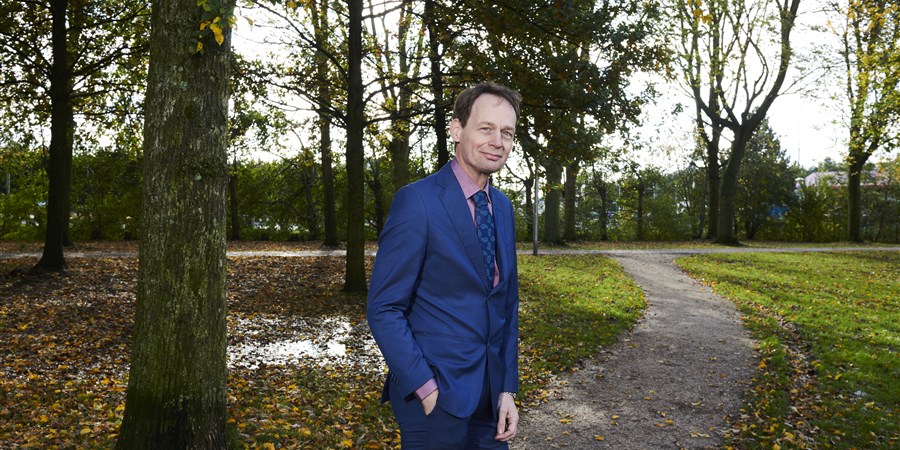
Frank Pijpers
© Sjoerd van der Hucht Fotografie / My Eyes4u productions

On 1 January 2021, Statistics Netherlands (CBS) senior methodologist Frank Pijpers was appointed Professor of Complexity for Official Statistics at the University of Amsterdam (UvA). In this position he will seek to build a bridge between CBS and science in the area of complexity theory.

The economy, the climate and social networks are all examples of complex systems made up of many components that interact with one another and are connected in networks. Complexity theory examines the collective behaviour that characterises such a system, which may be the spread of infections or the dissemination of opinions. Pijpers: ‘This can lead to a better understanding of important phenomena in society and the economy. This theory is interesting for CBS as it allows complex phenomena to be more effectively described from a statistical perspective. This is why the topic of complexity has been part of the CBS research programme since 2016.’ Pijpers is the manager of this research programme.

continues in source:

Using complexity science to understand social problems