ASC Speaker Series #4: Leonard and Richards on Stafford Beer Tickets, Sun, Mar 21, 2021 at 9:00 AM EDT

book in source:

ASC Speaker Series #4: Leonard and Richards on Stafford Beer Tickets, Sun, Mar 21, 2021 at 9:00 AM | Eventbrite

MAR 21

ASC Speaker Series #4: Leonard and Richards on Stafford Beer

by American Society for Cybernetics Free

Register

Event Information

Models are not good or bad, right or wrong, only more or less useful in a given context. — Stafford Beer

About this Event

ASC Speakers Series: Cybernetics and humans’ knowing

Abstract

During this ASC Series event Jude Lombardi will facilitate a conversation between two long-term members and past-presidents of the ASC, Allenna Leonard and Larry Richards, about the life and work of Stafford Beer (1926-2002).

As many might know, Beer was a prolific producer of many things — in a variety of domains. He was, according to Leonard, a “polymath—a scientist who painted, wrote poetry, taught yoga and cooked a delicious Yorkshire pudding.”

During our 50-minute interview, the two presenters will share their professional and personal thoughts on Stafford Beer as well as share their thoughts on two – of the many – models Stafford Beer created during his career as a cybernetician.


		ASC Speaker Series #4: Leonard and Richards on Stafford Beer image

Models are not good or bad, right or wrong, only more or less useful in a given context. — Stafford Beer

Leonard will briefly discuss the Viable Systems Model, VSM (1975) — an organizational structure made up of viable autonomous systems that are designed to survive the requirements of any dynamic environment. While Richards will briefly discuss the Team Syntegrity a process based non-hierarchical structure geared toward problem solving with a group of 10 to 42 participants.

The core of this conversation will focus on the cybernetic concepts and premises related to the models presented as identified in the attached papers. We will also explore possible similarities and differences between the two models as well as how they might complement one another.

We will then spend the last 40 minutes of this event in dialogue with attendees based on their questions and comments.

More information on each model:

book in source:

ASC Speaker Series #4: Leonard and Richards on Stafford Beer Tickets, Sun, Mar 21, 2021 at 9:00 AM | Eventbrite

VSM and its Application to Complex Organizations – Memorial Lecture – Leonard (2007)

The Viable System Model and its Application to Complex Organizations The First Stafford Beer Memorial Lecture July 8, 2007 Allenna Leonard, Ph.D.

VSM and its Application to Complex Organizations – Memorial Lecture _Leonard _2007.pdf – Google Drive

Education as a subversive activity: a proposal | Larry Richards

source:

(DOC) Education as a subversive activity: a proposal | Larry Richards – Academia.edu

Education as a subversive activity: a proposal

Larry RichardsKybernetes78 Views8 Pages1 File ▾Cybernetics,Participatory Democracy,Second-Order Cybernetics,Social transformation,Art and Social Transformation, Theory and PraxisShow less ▴Publication Name: Kybernetes

source:

(DOC) Education as a subversive activity: a proposal | Larry Richards – Academia.edu

The Hidden Power of Systems Thinking, book review: Reinventing governance | Wendy M Grossman

good to see the book continue to get attention

The Hidden Power of Systems Thinking, book review: Reinventing governance | ZDNet

The Hidden Power of Systems Thinking, book review: Reinventing governance

Tackling the climate emergency requires a fundamental change in the way governments think and operate, argue Ray Ison and Ed Straw.

By Wendy M Grossman for ZDNet UK Book Reviews | March 17, 2021 — 08:21 GMT (01:21 PDT) | Topic: Government

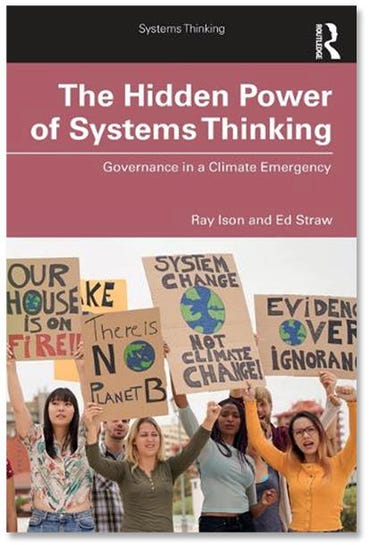
systems-thinking-main.jpg
The Hidden Power of Systems Thinking: Governance in a Climate Emergency • By Ray Ison and Ed Straw • Routledge • 340 pages • ISBN: 978-1-138-49399-5 • £34.99

The difficulty of pulling the world together to react collaboratively in the face of an urgent existential threat has been thoroughly demonstrated over the past year. The coronavirus pandemic has made it clear, even in countries not struggling with Brexit-related upheaval, just how hard it is to overcome the instinct to embrace nationalism when it comes to controlling outbreaks and sharing vaccines. 

The bigger problem we must tackle as part of post-pandemic recovery is climate change, which will require all that elusive collaboration, and more. Yet numerous countries’ governments not only fail to collaborate with each other, but they also fail to respond to their own citizens’ needs. 

The need for broad-picture thinking to address these gaps is the central thesis of two Open University academics — professor of systems Ray Ison and visiting fellow Ed Straw — in The Hidden Power of Systems Thinking: Governance in a Climate Emergency

continues in source:

The Hidden Power of Systems Thinking, book review: Reinventing governance | ZDNet

Overview of Personal Construct Theory

source:

Overview of Personal Construct Theory

Personal Construct Theory Overview

By Kendra Cherry  Fact checked by Emily Swaim Updated on September 20, 2020

Table of Contents

Personal construct theory suggests that people develop personal constructs about how the world works. People then use these constructs to make sense of their observations and experiences.

The world we live in is the same for all of us, but the way we experience it is different for each individual. For example, imagine that you and your friend are going for a walk in the park and you spot a large brown dog. You immediately see a graceful and adorable animal that you would like to pet.

Your friend, on the other hand, sees a threatening animal that she wants to avoid. How can two people have such a different interpretation of the same event?

According to psychologist George Kelly, personality is composed of the various mental constructs through which each person views reality. Kelly believed that each person was much like a scientist. Just like scientists, we want to understand the world around us, make predictions about what will happen next, and create theories to explain events.

continues in source:

Overview of Personal Construct Theory

Collective intelligence – Wikipedia

source

Collective intelligence – Wikipedia

Collective intelligence (CI) is shared or group intelligence that emerges from the collaboration, collective efforts, and competition of many individuals and appears in consensus decision making. The term appears in sociobiologypolitical science and in context of mass peer review and crowdsourcing applications. It may involve consensussocial capital and formalisms such as voting systemssocial media and other means of quantifying mass activity.[1] Collective IQ is a measure of collective intelligence, although it is often used interchangeably with the term collective intelligence. Collective intelligence has also been attributed to bacteria and animals.[2]

continues in source:

Collective intelligence – Wikipedia

What can we learn from nature’s experience of catastrophes? | Aeon Essays – Ruth DeFries

source:

What can we learn from nature’s experience of catastrophes? | Aeon Essays

Nature’s playbook

From termite queens to the carbon cycle, nature knows how to avoid network collapse. Human designers should pay heed

Photo by Kristian Bell/Getty.

Ruth DeFries

is Denning Family Professor of Sustainable Development at Columbia University in New York and a member of the US National Academy of Sciences. Her most recent book is What Would Nature Do? A Guide for Our Uncertain Times (2021). She lives in New York.

3,500 words

Edited by Sally Davies

Nature is famously, gloriously complex. But it wasn’t always so. When the Earth was young, physics ruled. Steam spewed from prodigious volcanoes and seeped through the cracked surface, transforming our planet into an ocean-covered mass, circling in the darkness. The physics that governs a phase change from steam to water in the oceans is as true today as it was 4.5 billion years ago. Gas would turn to liquid on any planet at any time, so long as the temperature and air pressure oblige. Then, as now, the laws of physics were predictable and straightforward.

But the history of life that followed from that fateful phase change didn’t proceed along such a simple trajectory. Its evolution over billions of years defies simple rules and predictable outcomes. Nature became a complex system, a tangled web of invisible connections. As nature’s intricacy ramped up, it brought with it opportunities for expansion, but also possibilities for annihilation. Fortunately, with each problem that arose, a strategy evolved to overcome it.

continues in source:

What can we learn from nature’s experience of catastrophes? | Aeon Essays

Morphogenesis – Wikipedia

source:

Morphogenesis – Wikipedia

Morphogenesis

From Wikipedia, the free encyclopediaJump to navigationJump to searchThis article is about the biological process. For the band, see Morphogenesis (band).

Morphogenesis (from the Greek morphê shape and genesis creation, literally “the generation of form”) is the biological process that causes a celltissue or organism to develop its shape. It is one of three fundamental aspects of developmental biology along with the control of tissue growth and patterning of cellular differentiation.

The process controls the organized spatial distribution of cells during the embryonic development of an organism. Morphogenesis can take place also in a mature organism, such as in the normal maintenance of tissue homeostasis by stem cells or in regeneration of tissues after damage. Cancer is an example of highly abnormal and pathological tissue morphogenesis. Morphogenesis also describes the development of unicellular life forms that do not have an embryonic stage in their life cycle. Morphogenesis is essential for the evolution of new forms.

Morphogenesis is a mechanical process involving forces that generate mechanical stress, strain, and movement of cells,[1] and can be induced by genetic programs according to the spatial patterning of cells within tissues.

source:

Morphogenesis – Wikipedia

Project ECHO – an example of something using the Societal Platform model

Interesting approach to building and transferring complicated applied knowledge at scale.

Project ECHO (Extension for Community Healthcare Outcomes) Project ECHO is a revolutionary guided-practice model that reduces health disparities in under-served and remote areas of the state, nation, and world. Through innovative telementoring, the ECHO model uses a hub-and-spoke knowledge-sharing approach where expert teams lead virtual clinics, amplifying the capacity for providers to deliver best-in-practice care to the underserved in their own communities.

Project ECHO

They have allied with Societal Platform:

THE ASPIRATION exponential societal change at scale We envision a future in which the solutions we have access to are always a step ahead of the problems we are trying to solve. Our goal – catalysing a societal movement for change – is audacious. But we are irrationally optimistic about the capacity of the ecosystem to achieve it. To this end, we are architects of shared spaces for actors across civil society, the government, and the market to reimagine, and co-create together.

The Aspiration – Societal Platform

Ivo Velitchkov on Twitter: “ESSENTIAL BALANCES is now available in paperback. It is about how organizations work, for diagnosis and design, below and beyond models, metrics, and methodologies. It reveals the fundamental principles of organizing.

ESSENTIAL BALANCES is now available in paperback. It is about how organizations work, for diagnosis and design, below and beyond models, metrics, and methodologies. It reveals the fundamental principles of organizing. Click on https://amazon.co.uk/Essential-Balances-Looking-Seeing-Organizations/dp/1838338616/ref=tmm_pap_swatch_0?_encoding=UTF8&qid=&sr=… to get your copy.

(1) Ivo Velitchkov on Twitter: “ESSENTIAL BALANCES is now available in paperback. It is about how organizations work, for diagnosis and design, below and beyond models, metrics, and methodologies. It reveals the fundamental principles of organizing. Click on https://t.co/59jN04XB1d to get your copy. 👇” / Twitter

www.essentialbalances.com

Future Café: Reimagining Systems Tickets, Sat, Mar 27, 2021 at 2:00 PM UK time | free

book at source:

Future Café: Reimagining Systems Tickets, Sat, Mar 27, 2021 at 2:00 PM | Eventbrite

MAR 27

Future Café: Reimagining Systems

by Forcera Free

Event Information

The Future Cafe is open to those who want to radically conceptualise the world we live in & how it could be different in the future.

About this Event

Inspired by The Chicago Center for Contemporary Theory (3CT) Future Cafe and Jon Underwood’s Death Cafe, Forcera’s Future Cafe is open to those who want to radically conceptualise the world we live in and how it could be different in the near and distant future.

We will listen and learn from each other different ways of thinking and seeing about the future with a view that we can create new perspectives about the world that we live in tomorrow.

It is a group-directed discussion about the future with no set agenda or objectives. No prior knowledge of the topic, themes or ways of thinking are required to take part just a general willingness to come with an open mind, heart and will to discuss. Bring your thoughts, questions and concerns – so we can listen and respond as together in a non-judgemental way.

Please listen when people are talking, be respectful of others’ views and confidentiality, and do not lead participants to believe in any conclusion, product or course of action, as the cafe is open to all.

Although we will discuss specific topics or themes, these will be decided upon organically as a group when we meet to allow the discussion to be spontaneous and to stop those with knowledge or expertise from taking over and to avoid presumptuous, restrictive and/or disempowering conversations. This is why it is a group directed session so as to offer participants time to reflect on and share what they think is important as this yields the best results.


		Future Café:  Reimagining Systems image

Sat, March 27, 2021

2:00 PM – 4:00 PM GMT

Online Event

Future Café: Reimagining Systems

Future Café: Reimagining Systems Tickets, Sat, Mar 27, 2021 at 2:00 PM | Eventbrite

ISSS Book Club (members only) – the Hidden Power of Systems Thinking

(ISSS membership is $60-115 per year and includes One-year eAccess online subscription to Systems Research and Behavioral Science (including part 5, which is the Yearbook of the ISSS))

ISSS Book Club

ISSS Book Club

 Welcome to the ISSS Book Club! The purpose of the book club is to explore the systems science literature in depth, so books are read over several months,  with monthly reading assignments of approximately 50-100 pages. Participants will have opportunities to both suggest books to read and vote on a selection of books. Meetings are on the third Thursday of the month from 12:30 – 2:00 pm Eastern Time. Our inaugural book is The Hidden Power of Systems Thinking: Governance in a Climate Emergency by Ray Ison and Ed Straw.The reading assignment are as follows: 15 April 2021: Introduction and Part I20 May 2021: Part II17 June 2021: Chapters 7-915 July 2021: Chapters 10-12 (this meeting may be postponed if it conflicts with the ISSS Conference) The next three books that we will read are Heart of Enterprise by Stafford Beer, The Science of Synthesis by Debora Hammond, and Free Will by Sam Harris. If you would like to be included on book club emails, please email Marty Jacobs. She is listed in the Member Directory. Please note: This is a members only benefit. If you’d like to join the conversation, please consider becoming a member of ISSS.

source:

ISSS Book Club

Video – complexity and the Social World: building on the legacy of Allen, Byrne, Stacey and Cilliers – complexity-physics.org

source:

Complexity and the Social World: building on the legacy of Allen, Byrne, Stacey and Cilliers – complexity-physics.org
Complexity and the Social World: building on the legacy of Allen, Byrne, Stacey and Cilliers

Mark    December 16, 2020    Comments Offon Complexity and the Social World: building on the legacy of Allen, Byrne, Stacey and Cilliers

Online event 3rd March 2021, 12.30-14.00 GMThttps://www.youtube.com/embed/hSMyKXGb4wk?feature=oembed

Complexity theory took off in the 1990s and four of the key people who shaped how these ideas were developed for application to the social world were represented in this event. In this unique retrospective, we explored how these four thinkers approached complexity thinking over long careers.

Invited Speakers

  • Peter Allen  – Embracing Complexity
  • David Byrne – Complexity and the Social Sciences
  • Chris Mowles in the legacy of Ralph Stacey –  Complex Responsive Processes
  • Rika Preiser in the legacy of Paul Cilliers –  Complexity and Postmodernism

The discussion was hosted by Jean Boulton and featured a guest appearence from Brian Arthur (who developed complexity economics)

The speakers were each interviewed and then discussed issues with each other, before answering questions from the audience.

Biographies

David Byrne is Emeritus Professor in the Department of Sociology, at the University of Durham. His first book on complexity, was ‘Complexity Theory and the Social Sciences’ (1998), built on in ‘Complexity Theory and the Social Sciences: the state of the art’ (Byrne and Callaghan, 2013). His new book ‘Inequality in a Context of Climate Crisis: A Complex Realist Approach’ will be published soon. His research interests include researching large scale complex interventions, case-based methods, inequality and social exclusion.

Peter Allen is Emeritus Professor at Cranfield University. He has a PhD in theoretical physics and from 1972-87 worked with Nobel Laureate, Ilya Prigogine at the Université Libre de Bruxelles. He then ran two Research Centres, focused on complexity, at Cranfield University. He has written and edited several books in the field of complexity and socio-economic modelling and published well over 200 articles. In 2011 he co-edited the Sage Handbook on Complexity and Management and in 2015 co-authored Embracing Complexity (OUP) with Jean Boulton and Cliff Bowman.

Friedrich Paul Cilliers (1956 – 2011) was a South-African philosopher, complexity theorist, and Professor in Complexity and Philosophy at Stellenbosch University. His original background was in Electronic Engineering. His research focused on the ethical implications of complexity theory and the philosophy of science. His book ‘Complexity and Postmodernism’(1998) integrates insights from complexity with the thinking of Derrida, Lyotard and others. Together with Rika Preiser, he co-edited ‘Complexity, Difference and Identity’ (2010) and his collected essays ‘Critical Complexity’ (2016) was edited by Rika Preiser after his death.

Ralph Douglas Stacey, Emeritus Professor of Management at the University of Hertfordshire, was Director of the Complexity and Management Centre, established in 1995, until 2011, when he was succeeded by Professor Chris Mowles. He was born in 1942 in Johannesburg. Initially trained in law, his PhD focused on the construction of econometric models of industrial development. He pioneered an inquiry into the implications complexity theory for understanding human organisations and their management. He is best known for his writings on the theory of organisations as complex responsive processes of relating (2001) and this work was influenced through his training as a Group psychotherapist.

Professor Chris Mowles is Director of the Managing Complex Change Research Group at the University of Hertfordshire. He also teaches and consults internationally. Chris is interested in research methods, strategy and change in organisations, and ethics. He has a particular focus on the functioning of groups.  ‘Managing in Uncertainty: Complexity and the paradoxes of everyday organizational life’ was published in 2015.

Dr Rika Preiser is a Senior Researcher with the Centre for Complex Systems in Transition at the University of Stellenbosch. In 2012 she completed her PhD in the Department of Philosophy at the University of Stellenbosch, entitled ‘The Problem of Complexity: Rediscovering the role of Critique’. Rika was supervised by Paul Cilliers and worked closely with him, taking the lead in editing his papers posthumously. Her current research explores the conceptual development of complexity, and she has a particular interest in social-ecological transformations and works closely with the Stockholm Resilience Centre.

Dr Jean Boulton is a Visiting Fellow with Cranfield School of Management and a Visiting Senior Research Fellow with the Department of Social and Political Sciences at the University of Bath and a recent (2019) Research Fellow with Stellenbosch Institute of Advanced Studies. She has a PhD in theoretical physics and is a Fellow of the Institute of Physics. She teaches and consults around the theme of complexity and its implications for the social and natural world at a range of institutions. She is lead author of ‘Embracing Complexity’ (2015). Her current interests centre on the development of ‘process complexity’ and on articulating the implications of complexity for theories of change and transformation.

Complexity and the Social World: building on the legacy of Allen, Byrne, Stacey and Cilliers Mark   December 16, 2020   Comments Offon Complexity and the Social World: building on the legacy of Allen, Byrne, Stacey and Cilliers Online event 3rd March 2021, 12.30-14.00 GMT

Complexity and the Social World: building on the legacy of Allen, Byrne, Stacey and Cilliers – complexity-physics.org

Grayling’s Law | TheArticle

source

Grayling’s Law | TheArticle

Grayling’s Law

by AC GRAYLING| @ACGRAYLING

Grayling’s Law

Anthony Grayling (Jonathan Nicholson/NurPhoto)

I am in the process of writing a book about the question whether it is possible to find universal common ground, in the face of globalism-generated problems of moral relativism and economic competition, on which humankind can deal with serious challenges confronting it in three domains. One, the most obvious, is climate change; the second is the more troubling aspects of technological development, especially involving AI, for example autonomous weapons systems; the third is the social, economic and political injustice endemic to many parts of the world. All of them require concerted international action. Achieving such action faces high barriers. 

The two highest barriers are as follows. The first is what, as coiner of it, I have elsewhere called “Grayling’s Law”:

continues in source:

Grayling’s Law | TheArticle

From Spuddling to stronger decision-making – better ways for Boards to understand and manage variation in results: Mar 25 OR Apr 11, 14:30 UK time

From Spuddling to stronger decision-making

Across the UK there is a great appreciation for the National Health Service, particularly since its 70th anniversary and the Covid epidemic – yet few of us would claim that the system runs on perfect choices.

Boards need reliable information and clear prompts, upon which to make better decisions. Yet within the service (and in business) the prevalent approaches to looking at performance data are two-point comparisons and traffic light ‘red, amber, green’ reports. We recognise these are difficult to read, and tough going when trying to spot meaningful trends, let alone make predictions.

In this workshop Samantha Riley of NHS Improvement will explore better ways for Boards to understand and manage the variation in results, and provide a sound basis for assurance.

This movement has proven to be very successful in strengthening decision-making or ‘governance’. Sam’s small team have convinced half of the NHS’s 217 Trust Boards to adopt this approach, and are working on the remainder.

With a similar change overdue in industry, education and government, the field of application is vast. Attention will be placed on how executive members are encouraged to adopt a different approach – without their needing to perform detailed data preparation, which others do on their behalf.

WHO SHOULD JOIN IN?
This free session will be especially valuable to senior managers who make reports to boards; executive board members, and performance analysts. Anyone with an interest in pragmatic and more effective management, in any sector will also gain useful insights.

book for dates:

15 Mar – https://zoom.us/meeting/register/tJEpc-mprTopG9ZyJ1YXj3teahTMlLke-FWf?_x_zm_rtaid=kEu3WgBITv-Fjb3Ys5qRoQ.1615790589649.bf8048068897a97097e1c065e7081d6e&_x_zm_rhtaid=93

1 April – https://zoom.us/meeting/register/tJEpdeGhrjIoGt3eUYULHPLcaGNHR51d0T8k?_x_zm_rtaid=kEu3WgBITv-Fjb3Ys5qRoQ.1615790589649.bf8048068897a97097e1c065e7081d6e&_x_zm_rhtaid=93