Ecology and Society: From Complex Regions to Complex Worlds – Holling (2004)

Home | Archives | About | Login | Submissions | Notify | Contact | Search
 ES HOME > VOL. 9, NO. 1 > ART. 11
Copyright © 2004 by the author(s). Published here under license by The Resilience Alliance.
Go to the pdf version of this article.

The following is the established format for referencing this article:
Holling, C. S. 2004. From complex regions to complex worlds. Ecology and Society 9(1): 11. [online] URL: http://www.ecologyandsociety.org/vol9/iss1/art11/
PerspectiveFrom Complex Regions to Complex WorldsC. S. Holling
University of Florida
AbstractIntroductionA Brief Summary of DiscoveriesFrom the Science of Change to the Politics of Change in a Complex WorldHow to Respond in a “Big Back Loop”Responses to this ArticleLiterature CitedABSTRACTPanarchy focuses on ecological and social systems that change abruptly. Panarchy is the process by which they grow, adapt, transform, and, in the end, collapse. These stages occur at different scales. The back loop of such changes is a critical time and presents critical opportunities for experiment and learning. It is when uncertainties arise and when resilience is tested and established. We now see changes on a global scale that suggest that we are in such a back loop. This article assesses the possibility of using the ideas that are central to panarchy, developed on a regional scale, to help explain the changes that are being brought about on a global scale by the Internet and by climate, economic, and geopolitical changes.KEY WORDS: adaptive cycles, change, complex systems, panarchy, transformation.Published: March 30, 2004

continues in source:

https://www.ecologyandsociety.org/vol9/iss1/art11/

pdf:

https://scholarship.law.umn.edu/cgi/viewcontent.cgi?article=1287&context=mjlst

Panarchy and pace in the big back loop | Solving for Pattern

source

Panarchy and pace in the big back loop | Solving for Pattern

Panarchy and pace in the big back loop

by HOWARD SILVERMAN on 27 OCT 2012 0 COMMENTS

[Reprinting an 18MAR2009 P&P article that came up in conversation today. –HS]

“The back loop is the time of the Long Now,” writes Resilience Alliance founder Buzz Holling. It is a time “when each of us must become aware that he or she is a participant.”

“The trick is to treat the last ten thousand years as if it were last week, and the next ten thousand as if it were next week,” advises Stewart Brand in The Clock of the Long Now. “Such tricks confer advantage.”

Though Brand’s book precedes Holling’s “Complex Worlds” paper, their dialog runs pretty much like that. And the discussion turns on a pair of interrelated metaphors: panarchy and pace layering.

continues in source:

Panarchy and pace in the big back loop | Solving for Pattern

How Maxwell’s Demon Continues to Startle Scientists | Quanta Magazine

How Maxwell’s Demon Continues to Startle Scientists The thorny thought experiment has been turned into a real experiment — one that physicists use to probe the physics of information.

How Maxwell’s Demon Continues to Startle Scientists | Quanta Magazine

Systems Sensing: Making what’s implicit explicit. Collective Transitions with Hilary Bradbury and AR+ – AR + Action Research Plus

source:

Systems Sensing: Making what’s implicit explicit. Collective Transitions with Hilary Bradbury and AR+ – AR + Action Research Plus

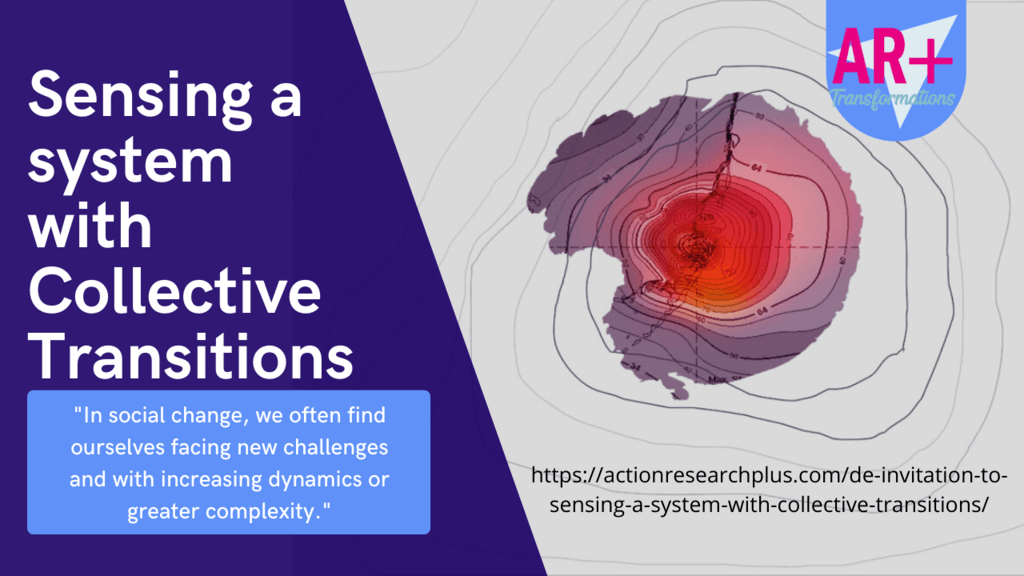
Systems Sensing: Making what’s implicit explicit. Collective Transitions with Hilary Bradbury and AR+

Continues in source:

Systems Sensing: Making what’s implicit explicit. Collective Transitions with Hilary Bradbury and AR+ – AR + Action Research Plus

Only a God Can Save Us – Heidegger’s Spiegel Interview (1966, published 1976)

I got to this from the wonderful Harish Jose thanks to this one reference to cybernetics:

Heidegger: Not in the sense of philosophy — not any more.30 The role of philosophy in the past has been taken ever today by the sciences. For a satisfactory clarification of the “efficacy” of [philosophical] thinking we would have to analyze in greater depth what in this case “efficacy” and “having an effect” can mean. Here we would need fundamental distinctions bctwen”occasion,” “stimulus,” “challenge,” “assistance,” “hinderancc” and “cooperation,” once we have sufficiently analyzed the “principle of ground [‘sufficient reason’].” Philosophy [today] dissolves into individual sciences: psychology, logic, political science.

SPIEGEL: And what now takes the place of philosophy?

Heidegger: Cybernetics.

…However, it is also a nice introduction (for me, who hasn’t read a lot of Heidegger, but has heard a lot of second-hand discourse) to (apart from the Nazism allegations) ‘technicity’ and a lot of other thinking whereby you can see the connections to AI, (counter)accelerationism, etc.

source:

Only a God Can Save Us

Martin Heidegger, “Nur noch ein Gott kann uns retten,” Der Spiegel 30 (Mai, 1976): 193-219. Trans. by W. Richardson as “Only a God Can Save Us” in Heidegger: The Man and the Thinker (1981), ed. T. Sheehan, pp. 45-67.


“Only a God Can Save Us”: The Spiegel Interview (1966)

Martin Heidegger


Although Heidegger was one of the seminal thinkers of the twentieth century, few such men of his time were criticized more severely or resented more bitterly than he. Much of this criticism arose because of an association with the Nazis while Rector of the University of Freiburg, 1933-34, one that publicly he neither reputhated, justified, nor explained. In 1966 the editors of the German news weekly, Der Spiegel, requested of Heidegger an interview to discuss these issues. In granting the interview, which took place on September 23, 1966, Heidegger insisted that it remain unpublished during his lifetime. (It appeared in Der Spiegel on May 31, 1976, five days after his death.) Its substance goes far beyond the personal issues involved and rephrases his entire philosophical experience. He saw this as an opportunity to meditate upon the meaning of Being, particularly under the guise that most profoundly characterizes contemporary culture — labeled by him “technicity” (die Technik). In these terms the interview takes on the quality of a last will and testament.

In the translation which follows I have inserted the pagination of the German publication, Der Spiegel, Nr. 23 (1976), 193-219, directly into the text in brackets. I was assisted in historical matters by the researches of Dr. Kurt Maier of the Leo Baeck Institute, New York City.

— William J. Richardson, S.J.

continues in source:

Only a God Can Save Us

The universe is greebling.

You know that narrative ‘the world is getting faster and more complex and uncertain than ever before’? I’ve always been deeply suspicious of it, not least because it has been being said since *at least* the 1950s, and the pace of complexification in the second world war was something I think it is hard to see even today.

However, I’ve now found my own version of it thanks to a twitter in-joke and Stuart Kauffman – a version I’m happy with, for now.

The universe is greebling.

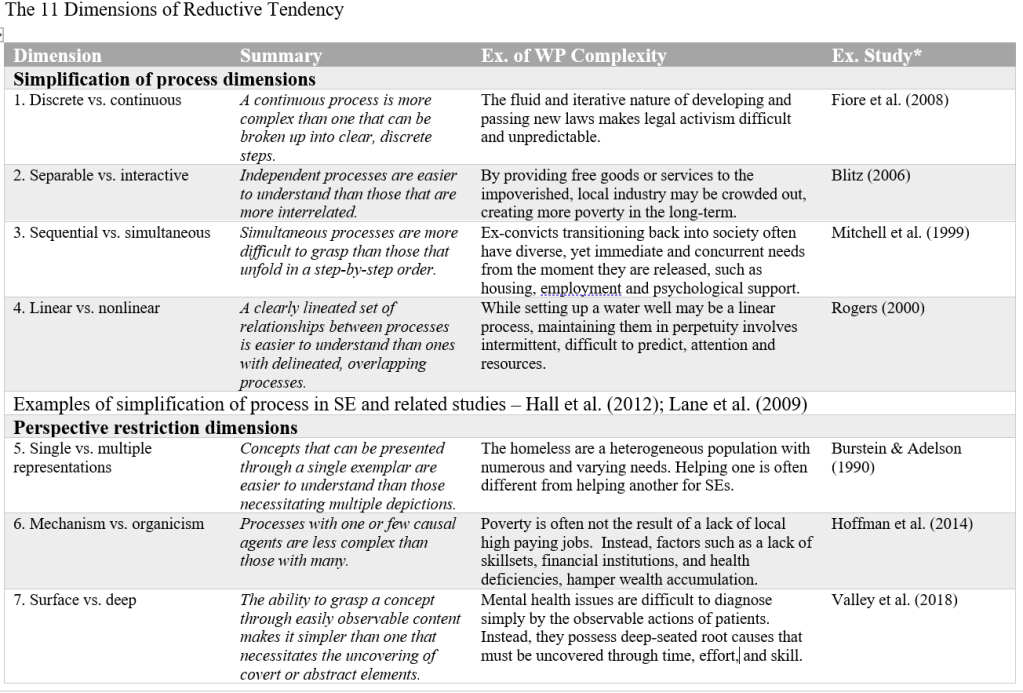
(PDF) Wicked problems, reductive tendency, and the formation of (non-)opportunity beliefs (2019, Gras et al)

Wicked problems, reductive tendency, and the formation of (non-)opportunity beliefs September 2019Journal of Business Venturing 35(3):105966 DOI:10.1016/j.jbusvent.2019.105966 Authors: David Gras Michael Conger Miami University Anna Jenkins The University of Queensland Michael Gras

(PDF) Wicked problems, reductive tendency, and the formation of (non-)opportunity beliefs

Not sure how highly ranked the Journal of Business Venturing is, but an interesting piece.

Wicked problems, reductive tendency, and the formation of (non-)opportunity beliefs

David Gras, Michael Conger, Anna Jenkins, Michael Gras

Systems approach and cybernetics; engaging in the future of mankind | WOSC 2021, planned for the 27-30 September 2021, in Moscow, Russia, On-line

https://wosc2020.ipu.ru/

Systems approach and cybernetics; engaging in the future of mankind.

The significance of systems and cybernetics in the future of societies.
Invitation for active participation

Increasingly, people and institutions are recognizing the systemic nature of our
world and the relevance of systemic thinking as a foundation to deal with the
complexity of technological, social, environmental and economic issues.
With the support of the Russian Academy of Sciences (RAS), the World
Organization of Systems and Cybernetics (WOSC) is organising its 18 th
Congress- WOSC 2021, planned for the 27 th to the 30 th of September 2021, in
Moscow, Russia, On-line.
In this Congress, we are particularly addressing young and creative researchers
who are willing to develop and share cyber-systemic perspectives on how to
understand and manage the future of mankind.
The Congress mission driven by requisite variety (Ashby) and the notion that
transdisciplinary research can only be achieved supporting researchers from all
disciplines to integrate their work in an enabling environment.
For this purpose, WOSC 2021 is focusing on the following four themes:

  1. Philosophical and methodological foundations for the development
    of the systems approach and cybernetics
  2. Interactions in society:
    the cybernetics of society, ecology and governance
  3. On digital technologies and human interactions:
    the co-development of a hybrid reality
  4. Transdisciplinarity of systems sciences and cybernetics:
    developing areas of knowledge

WOSC 2021 Congress site 27-29. Sept 2021 in Moscow, Russia WOSC, RAS
AUTHORS GUIDELINES
In WOSC 2021, we will use a 3 step publishing process will be used, enabling
you to share and discuss your research with peers, aiming to improve it.
Step 1: Submission intention
Please express an intention to submit an abstract before the 1.5.2021 by
creating a WOSC 2021 account.
Step 2. Abstract submission
Researchers, managers, policy-makers, professionals and students across the
globe are invited to submit structured abstracts of about 500 to 800 words
(see abstract/paper template), addressing the Congress themes by the 10. 6.

  1. Authors should receive a response within 14 days of submission (and no
    later than the 30. 6. 2021). All accepted abstracts will be published in the
    Congress book of abstracts.
    Step 3. Full congress paper submission
    Registered authors with an accepted abstract may submit a full congress paper
    by 31. 8. 2021. Full congress papers should not exceed 3500 words (see
    abstract/paper template). In step 2 peers may suggest to authors ideas about
    how to deal with the proposed research issues, before their acceptance for
    presentation to the Congress.
    At the congress, authors will present their contributions.
    There will be a best paper award at the Congress, which will include
    acknowledgments of contributions to final paper’s preparation.
    Basic submission rules
  2. Authors should make sure that the language of their papers meets
    the required standards.
  3. Authors can submit one paper per registration. For submission of a
    second paper, discounted registration rates apply.
  4. Authors are responsible for ensuring that their manuscripts are
    ethically sound and meet the recognised standards, according to the
    author publishing ethics guide.
    Submission
    For the submission please use the abstract/paper template with detailed
    author guidelines.
    You may start the submission process by creating a WOSC 2021 account.

WOSC 2021 Congress site 27-29. Sept 2021 in Moscow, Russia WOSC, RAS
Information for Authors who submitted to WOSC 2020:
COVID-19 made it impossible to run WOSC 2020 last year, however this year
we are running on line the WOSC 2021 event. We apologise to authors who
made a submission to WOSC 2020 because we will not be running it as
originally planned. Regretfully, global and local situations have altered
significantly the circumstances of our research focus and we are running WOSC
2021 with different themes and sessions, something that has significantly
affected the Congress´s focus and structure. These changes are providing us
the opportunity to discuss fresh research results and generate new ideas.
Accordingly, we invite you to send to WOSC 2021 a submission with your more
recent research progress. In any case, should you want to receive back your
originally submission, please, write to info@WOSC2020.org.
Publications
Accepted abstracts will be published in the electronic WOSC2021 Congress
book of abstracts. A selection of congress full papers will be published in a
Springer Nature book. Additionally WOSC congresses are well recognised by
the publishers and, accepted and delivered papers to the Congress, will have
the option to be submitted either as short papers or as fully developed papers
for special issues of a scientific journals. Several international and national,
regular or strictly open access scientific journals, indexed in Thomson JCR,
Scopus RISC, VAK and others are interested in publishing these papers. More
about these possible publications will be discussed on the WOSC2021 web site.
Submissions to journals follow their individual editorial policies. Special issues
of selected journals and papers are expected to be published during 2022.

WOSC 2021 Congress site 27-29. Sept 2021 in Moscow, Russia WOSC, RAS
Participants’ registration to WOSC 2021 will be initiated by their abstract
submission to the website and selection of sections of their choice. This will be
followed by the preparation of papers and discussions during WOSC 2021
Congress.
Registration:
Participant early bird regular
Regular 125,00 € 150,00 €
discounted 50,00 € 80,00 €
If you would like to receive a pro forma invoice or would like to apply for a
discounted registration fee, please create your account at the WOSC 2021
Congress site and write to info@WOSC2020.org,
We shall provide a response with registration details as authors submit their
abstracts by the 10.6.2021. Participants will automatically receive regular
payment details and an invoice after the acceptance of their abstracts.

VENUE:
Due to Covid-19 related circumstances WOSC 2021 Congress will take place
on-line.
IMPORTANT DATES
10 June 2021: Abstract Submission deadline
30 June 2021: Notification of acceptance
31 August 2021: Congress full papers submission deadline and

Early bird registration deadline

15 September 2021: Congress full papers review deadline
27 September 2021: Revised congress full papers submission deadline and

Registration deadline for authors

27-30 September 2021: WOSC 2021 Congress
You may find additional information at WOSC 2021 Congress site
Get in contact at info@WOSC2020.org
your WOSC 2021 team

Update- Complexity and Management Conference 4-6th June 2021

Chris Mowles's avatarComplexity & Management Centre

Whatever happens we still intend to go ahead with The Complexity and Management Conference 2021 4-6thJune -The Complexity of Practice, withProfessor Hari Tsoukasas our key note speaker. So will the introductory workshop on complex responsive processes of relating on Friday 4thJune.

Previously we have been planning either for a face-to-face event, or to go online. However, it seems most likely that some will be able to make it and others will be prevented from coming. So to allow for both modes of participation simulataneously we are now organising for a hybrid event.

If you would still like to attend the conference in person the University booking site is openhere. You will be asked to pay a deposit and then pay a second time to make up the full fee. In the event of our going online we will refund you…

View original post 120 more words

Capitalising on incommensurability – Integration and Implementation Insights – Darryn Reid

source:

Capitalising on incommensurability – Integration and Implementation Insights

Capitalising on incommensurability

March 30, 2021

By Darryn Reid

author_darryn-reid
Darryn Reid (biography)

How can we harness incommensurability as a pivotal enabler of cross-disciplinary collaboration?

Effective cross-disciplinary research across multiple traditional disparate fields of study hinges on logical incommensurability, which occurs because, in general, those ideas will have been constructed using incompatible frameworks to solve distinct problem formulations within dissimilar intellectual traditions.

In other words, the internal logical consistency of a discipline’s way of approaching problems is no guarantee of ability to be integrated with another discipline’s way of approaching problems. Incommensurability should come as no surprise to anyone involved in cross-disciplinary activities. What is pivotal here, however, is the view that incommensurability is not an obstacle to be avoided or feared but an enabler. Moreover, it is the central enabler – worthy of celebration – and the focal point of cross-disciplinary advancement of knowledge.

I support this contention by reviewing the similarities between the philosophies of Thomas Kuhn and Karl Popper. This is followed by a quick dive into the creativity arising from the incommensurability between the theories of general relativity and quantum mechanics.

continues in source:

Capitalising on incommensurability – Integration and Implementation Insights

Marshall MacLuhan’s Tetrad of media effects

source:

Tetrad of media effects – Wikipedia

Tetrad of media effects

From Wikipedia, the free encyclopediaJump to navigationJump to searchA blank tetrad diagram

Marshall McLuhan‘s tetrad of media effects[1] uses a tetrad to examine the effects on society of any technology/medium (put another way: a means of explaining the social processes underlying the adoption of a technology/medium) by dividing its effects into four categories and displaying them simultaneously. The tetrad first appeared in print in McLuhan’s posthumously-published works Laws of Media (1988) and The Global Village (1989).

The tetrad[edit]

The tetrad consists of four questions.

  1. What does the medium enhance?
  2. What does the medium make obsolete?
  3. What does the medium retrieve that had been obsolesced earlier?
  4. What does the medium reverse or flip into when pushed to extremes?

The laws of the tetrad exist simultaneously, not successively or chronologically, and allow the questioner to explore the “grammar and syntax” of the “language” of media. McLuhan departs from the media theory of Harold Innis in suggesting that a medium “overheats”, or reverses into an opposing form, when taken to its extreme.[2]

Visually, a tetrad can be depicted as four diamonds forming an X, with the name of a medium in the center. The two diamonds on the left of a tetrad are the Enhancement and Retrieval qualities of the medium, both Figure qualities. The two diamonds on the right of a tetrad are the Obsolescence and Reversal qualities, both Ground qualities.[3]

  • Enhancement (figure): What the medium amplifies or intensifies. For example, radio amplifies news and music via sound.
  • Obsolescence (ground): What the medium drives out of prominence. Radio reduces the prominence of print and the visual.
  • Retrieval (figure): What the medium recovers which was previously lost. Radio returns the spoken word to the forefront.
  • Reversal (ground): What the medium does when pushed to its limits. Acoustic radio flips into audio-visual TV.

see also:

https://mcluhangalaxy.wordpress.com/2013/03/29/an-essay-on-marshall-mcluhans-tetrads/

Systems Thinking Mini-Course | Systems Thinking Marin

source:

Systems Thinking Mini-Course | Systems Thinking Marin

Systems Thinking Mini-Course

Home/Resources/Systems Thinking Mini-Course

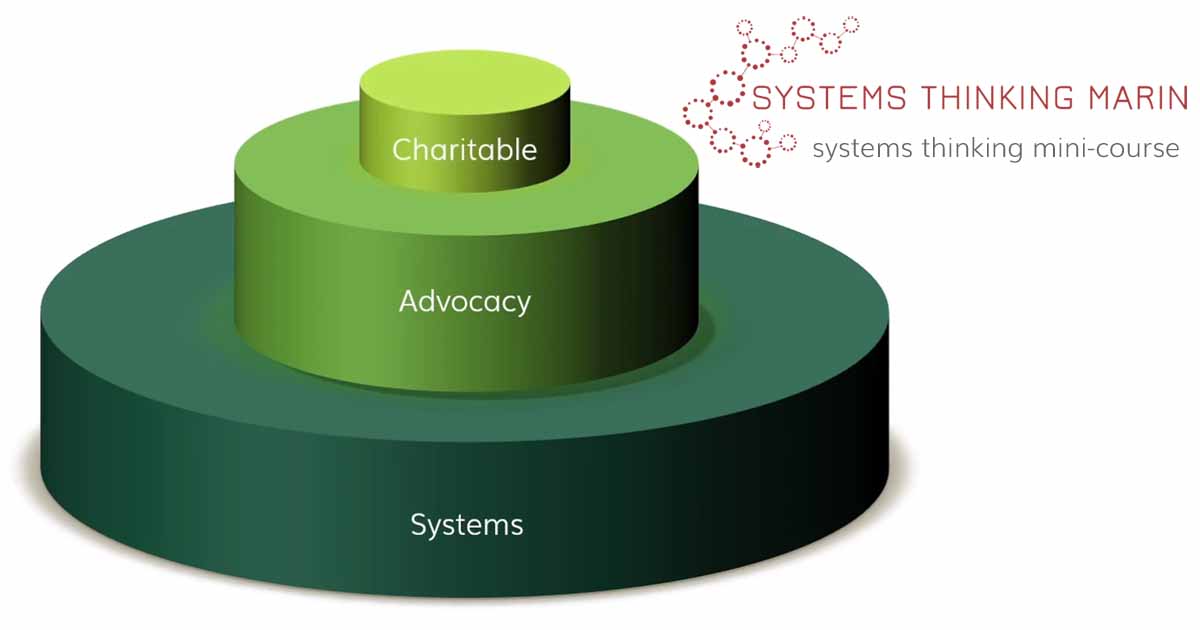
Systems Thinking Mini-Course Image

Systems Thinking Mini-Course

Can we make the world a better place with systems thinking?

Welcome! I believe the answer to this question is not only “yes,” but that without systems thinking, we will continue heading in the wrong direction. Moreover, some of the practices that are working really well are already systems type-approaches. How do you recognize them? Watch the three videos of the Systems Thinking Mini-Course below to find out.

You not only learn about systems thinking, but a bit about how to recognize when a “solution” is addressing the system versus when an intervention is really an emergency action to stop the bleeding.

Put on your thinking cap: there is a lot in these three short videos (the longest is about 11 minutes). If you have any questions or want to learn more, please contact me.

source:

Systems Thinking Mini-Course | Systems Thinking Marin

ISSS conference – online, 8-13 July 2021

source:

Online 2021
Logo

Login | Register

Online 2021

The 65th Meeting of the International Society for the Systems Sciences#ISSS2021 ONLINE, 8-13 July 2021

The Art and Science of the Impossible: The Human Experience

Delia Pembrey MacNamara, President

CALL FOR PAPERS

Please see the Call for Papers and Conference Theme

SPECIAL TRACKS2021 Track Future of Human Social Systems: What Might the Evolution of Complex, Adaptive, and Evolvable Systems Tell Us About Where We Are Going? Download Track Call PDForganized by George Mobus, Tyler Volk, and John Stewart 2021 3 Tracks on Cybernetics – Download 3 Tracks Calls PDF.organized by Ben Sweeting, Tom Scholte, John BeckfordCybernetics at #ISSS2021 #1: In Search of a Critical Cybernetics – A Call for PapersCybernetics at #ISSS2021#2: Practising Cybernetics in Discussion – A Call for QuestionsCybernetics at #ISSS2021#3: Open call 

VENUE: The 2021 Annual Meeting and Conference will be entirely online using the CVENT Virtual Attendee Hub  https://player.vimeo.com/video/535303686?badge=0&autopause=0&player_id=0&app_id=58479 TIME ZONES:  We will have attendees from around the world. The program is being designed to recognize we all need sleep. Every effort is being made to allow for comfortable participation from all time zones. Keynotes and plenaries will be programmed when the majority can attend live. SUBMIT AN ABSTRACTSubmit an abstract for papers and posters at the conference. Use login from previous conferences if you have one (this is different than your login here at isss.org)  Create a new ISSS Journals account if new to ISSS conferences. Authors need to register prior to submitting or, if already registered, can simply login and begin the five-step process to submit an abstract. Submit now: https://journals.isss.org/index.php/jisss/submission/wizard Additional details on submitting abstracts here https://www.isss.org/submitting-abstracts/WORKSHOPSRequests for pre-conference workshops and workshops during the conference should be submitted to Jen Makar VP Admin admin@isss.org STUDENT AWARDSMore details on student awards (each worth $500) https://www.isss.org/student-paper-awards/REGISTRATIONComing soon 

source:

Online 2021

Network Weaving from June Holley – selected readings (Medium)

https://juneholley.medium.com/system-shifting-networks-d43463c70533

https://juneholley.medium.com/what-is-self-organizing-efbe98693a4e

https://juneholley.medium.com/#:~:text=2018-,Network%20Governance,-Network

https://juneholley.medium.com/#:~:text=2018-,Network%20Leadership,-Network

https://juneholley.medium.com/transformative-networks-are-multiscalar-6a86ffa3f2a2

https://blog.kumu.io/the-transformative-power-of-networks-of-networks-a84057c119c0


https://juneholley.medium.com/scaffolding-for-system-shifting-networks-ff972be58067


https://blog.kumu.io/the-importance-of-learning-in-networks-313ef01336f9

Stuart Kauffman | Full Lecture | KLI – YouTube

Stuart Kauffman | Full Lecture | KLI

2 Jun 2016

KLI Klosterneuburg

Pythagoras’ dream was that all is number, hence entailing law. Newton formulated this in classical physics, whose laws entail the becoming of the universe from given initial (and boundary) conditions. Do similar mathematizable laws entail the becoming of the biosphere? I am convinced the answer is “No”. Physics requires the prestatement of the very phase space of the system. In terms of that phase space, the relevant variables are known and dynamical laws can be written and then integrated, much as Newton taught us, to entail the temporal evolution of the system. But we cannot prestate the phase space of biological evolution. Unprestatable new functionalities arise all the time due to Darwinian “preadaptations”, or “exaptation”. No one could have known 3 billion years ago that feathers would evolve for thermoregulation then be co-opted for flight. No one could have known that legs would evolve from the fins of fish, or that fins would arise. Not only do we not know what will happen, we do not even know what can happen. Hence we can write no laws of motion for the evolution of the biosphere, we have no idea what the relavant variables will be. Lacking laws of motion, we cannot integrate the missing laws, so no laws entail the radical emergence of the most complex system in the universe that we know, the biosphere. This evolution is not even mathematizable and the Pythagoran dream here fails. Biographical note: Stuart Kauffman is a theoretical biologist and a pioneer of complex systems research. Kauffman introduced many now-familiar models of complex systems, such as boolean networks to study gene regulatory networks, the NK model to study fitness landscapes, and collectively autocatalytic sets to study the origin of life. He is probably best known for arguing that the complexity of biological systems and organisms might result as much from self-organization and far-from-equilibrium dynamics as from Darwinian adaptation. Kauffman is the author of several books, including his latest, “Humanity in a creative universe”, in which he argues that biological evolution is not entailed by any laws. https://www.youtube.com/watch?v=EWo7-azGHic