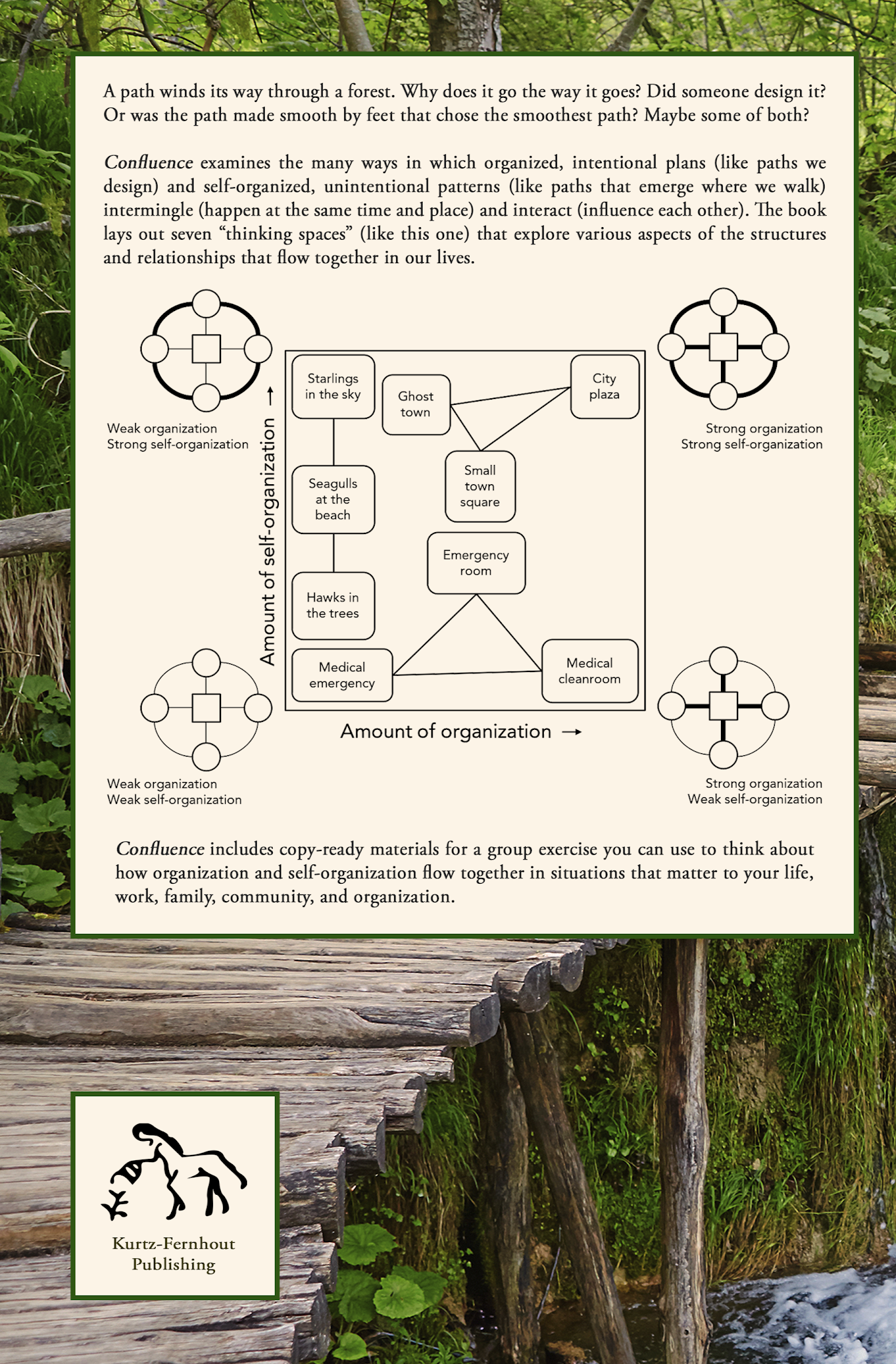
It’s done. The new book is ready for you to read. It has an Amazon page with print and Kindle versions, plus a web site (at cfkurtz.com/confluence) with downloadable exercise materials. You should also be able to order the book at your local book store (ISBN: 978-0-9913694-1-6). Confluence is about the ways in which organized plans (like roads) and self-organized patterns (like traffic) intermingle and interact in our lives, families, communities, and organizations. It’s about complexity, but it’s not just about complexity. It’s about how the structures and procedures we design and the spontaneous patterns that emerge as we interact co-occur, intersect, and press on each other. The book revolves around the use of seven “thinking spaces,” blank canvases you can use to explore organization and self-organization in situations and from perspectives that matter to you. Each space explores a different aspect of confluence. A group exercise helps you use the spaces to make sense of things together. (You can read some of the book by clicking “Look Inside” on the Amazon page.)
Aside from the first chapter (which introduces the book) and the third chapter (which explains the group exercise), most of the book uses the seven thinking spaces to explore a variety of situations, from ghost towns to factories to folk tales to mirages. I wrote these explorations for two reasons. First, I wrote them to use the spaces in front of you, so you can see how you can use the spaces yourself. And second, I wrote the examples to help you practiceusing the spaces as you read and think about my explorations.
Systematics is the name given by John Godolphin Bennett (1897–1974) to a branch of systems science that he developed in the mid-twentieth century. Also referred to as the theory of Multi-Term Systems or Bennettian Systematics, it focuses on types, levels, and degrees of complexity in systems, the qualities emergent at these levels, and the ability to represent and practically deal with (“understand”) complexity using abstract models. Thus to understand the notions of sameness and difference requires a system or universe of discourse with a minimum of two terms or elements. To understand the concept of relatedness requires three, and so on.
Bennettian Systematics evolved through various stages of formulation as described in his major, four-volume work The Dramatic Universe (initially published 1955-1966) and in various articles in Systematics: The Journal of the Institute for the Comparative Study of History, Philosophy and the Sciences, published from 1963 to 1974. Bennettian Systematics has been further refined and advanced by students such as A. G. E. Blake, Anthony Hodgson, Kenneth Pledge, Henri Bortoft, Richard Heath and others.
Bennett has described his discipline of Systematics in quite general terms as “the study of systems and their application to the problem of understanding ourselves and the world.”[1] He notes in this general context 4 branches of Systematics:
Pure Systematics – seeks “to identify and describe the universal properties or attributes common to all systems”.[1]
Formal Systematics – studies “the properties of systems without reference to the nature of the terms. It consists mainly of the investigation of possible modes of connectedness which evidently can be very complex for systems with more than three or four terms”.[1]
Applied Systematics – “the study of systems occurring in our experience and is chiefly directed to the identification of the terms and their characteristics”.[1]
Practical Systematics – focuses on “the application of the understanding gained through the study of systems to the problems that arise in all departments of life”.[1]
Bennett’s use of the term “Systematics” is basically synonymous with what today falls under the terms “systemics“, “systemology“, “systems science“, and “systems theory“. However, his own specific work under the name “Systematics” takes approaches that are still unfamiliar to many current systems specialists, making his work a specialty in a much broader field. In addition, the use of the term “systematics” in biology to refer to the classification of types and forms of organisms creates ambiguity and rather overwhelms the term’s current viability within general systemology. Thus reference can be made simply to “Bennettian Systems” (or Systemics or Systematics), or to “Multi-Term Systems” to describe his work and its continuations.
Formal Bennettian systems are defined around and focus on the idea of logical or qualitative complexity rather than quantitative complexity. There is thus a possible analogy to the philosophical program of logical atomism. (“Quantitative complexity”, as contrasted with “qualitative”, results from the presence in a practical setting of two or more actual components of the same qualitative type. However, in practical Systematics, the quantity or amount of a component also has concrete qualitative effects, and the two categories cannot always be separated.)
Thus in formal Systematics, Bennettian systems are abstract, and each system represents a qualitative or logical “type” or level analogous to the logical levels used by Bertrand Russell in his Theory of Types.
Each formal level consists of qualitatively independent but mutually relevant “terms” that constitute a “universe of discourse” specific to that level, and terminology suitable at one level can cause category confusion when used in other contexts.
Every multi-term system so-defined has its special system-level attribute or characteristic emergent quality, such as “dynamism” for the triad, or “significance” for the pentad. The emergence of these qualities, according to the work of Anthony Blake in what he calls Lattice Systematics, is mysterious but not random and occurs within a process involving both increasing “spiritualization” of will and increasing specification or “materialization” of function.
The logical level of the system depends on the number of the qualitatively different but mutually relevant terms in the system. Bennettian systems thus increase in qualitative complexity, and display new emergent qualities, in a quantized, progressive series as the number of qualitatively distinct terms within the system increases.
Conversely, the “terms” of a given formal system correlate in a general way with the specific degree, type, or level of the system they occur in, so that the terms of a dyad are characterized as “poles”, those of a triad as “impulses”, those of a tetrad as “sources”, those of a pentad as “limits,” and so on.
Each system beyond the first contains subsystems and all systems, theoretically, are embedded in supersystems with a higher number of terms.
In practical Systematics, Bennett carried this process of elaboration up to the 12-term system as best he could within the constraints of the very limited technical vocabulary currently available to make such distinctions. Beyond the 12-term system he spoke of “societies”.
Bennett correlates the logical levels or leaps of qualitative complexity with what he calls the “concrete” or “qualitative” significance of number, perhaps again analogous to what Russell calls “relation number” in Principia Mathematica and in looser reference to Pythagorean traditions, although Bennett was at pains to distinguish what he was doing from various kinds of mere “numerology”.
The series of Bennettian systems includes the monad, dyad, triad, tetrad, and so on, open-endedly. Systems progress in complexity from the monad up, and from vague wholeness to increasingly articulate structure that reaches into society, history and the ontological fabric of the cosmos.
The series of Multi-Term Systems can serve in applications as simplified but progressively complex outer checklists to ascertain the objective diagnostic completeness of a survey and analysis of a system or situation. Conversely, the system models can be used “inwardly” as an aid to subjectively assessing one’s own impartiality, wisdom and adequacy of comprehension. They thus can point toward real structures and processes in the outer world of fact as well as, logically, those structures and processes in the inner world of values and human capacities.
Bennettian Systematics has an integrative programme. Throughout all cultures and throughout all disciplines there are discernible threads of meaning associated with multi-term systems that might otherwise be missed. Bennettian Systematics links with understanding which is connected with structural unity and how insight from one area of experience can be transferred to another without distortion. A journal called Systematics was launched by Bennett’s Institute for the Comparative Study of History, Philosophy and the Sciences in 1963 to publish a diversity of articles relating to this programme. Systematics also led into the development of a new learning system called structural communication, which later became a broad methodology called logovisual thinking (LVT).
Culture is powerful precisely because it is so present and at the same time so very difficult to name or identify.- Tema Okun Dear friends, It’s not too late to reserve your space in our upcoming webinar, “White Supremacy Culture and Systems Change.” The 90-minute session will take place on June 1, 2021 at 10:00 am Pacific/1:00 pm Eastern time.
20 years ago, Tema Okun wrote the article, “White Supremacy Culture Characteristics,” an article deeply informed by her relationships with many genius teachers and colleagues. Please join Tema, CoCreative, the Academy for Systems Change, Illuminate and special guests from around the country to learn more about white supremacy culture, discuss how it’s shifted in the last 20 years, and explore implications for our work in complex systems change.PLEASE NOTE: This is a ticketed event for which all donations will benefit the work of EarthSeed Land Collective whose mission is to remember and reimagine our relationship to ourselves, each other, and the land in pursuit and practice of collective liberation. Everyone is welcome, regardless of ability to pay.Sign me up!
Epistemic status: uncertain yet bold (working things out), and part of my thesis that there are no distinguishing fractures in the systems/cybernetics/complexity field, only many relevant and interesting dimensions of difference which cut across the supposed big distinctions.
Claims are made such as ‘complexity entails a scientific revolution, hence a radical shift in science’.
I believe that what is called complexity science is a continued working-through of ancient insights going back decades and centuries, and claiming a decisive shift leads us down dangerous paths and to miss out on powerful, valuable thinking.
It’s a Rorschach blot
That the world is fundamentally nebulous should not be denied.
It is true that a lot of work in the field (characterised as ‘systems thinking’) is used, naively and with the assumption of systematicity (or by ‘enforcing’ systematicity; reversing science and forcing the world to conform to the model) to sustain top-down, reductive, centralised…
where are our thoughts… caught in reality… or lost in fantasy
RESEARCH & PUBLICATIONS
Blogs:
2021, Feb. How to Organise in Order to Manage Complexity. 19th Feb., 2021. Link 2021, Jan. The Multiple Views of Cybernetics. 30th Jan., 2021. Link
2021, Jan. Making sense of complex situations. 10th Jan., 2021. Link
2020, Jul. View of tourism in Scotland & Edinburgh – insights from nearly two decades of research. 20th July, 2020. Link
2020, Jun. Transforming my university course for a COVID world – but how? 10th June, 2020. Link
2020, May To be tracked or not to be tracked, that is the question. 19th May 2020. Link
2020, Mar. A life beyond Singularity – artificial general intelligence. robots & the rest? 16th March, 2020. Link
Books:
2002 ERP: the implementation cycle. (2003) [formerly Oxford: Butterworth-Heinemann]. NOW Routledge (imprint of Taylor and Francis) [Turkish edition (Bilesim: summer 2005) Chinese edition (Tsinghua University Press: Dec. 2005)
2018 The emergence of makerspaces, hackerspaces and fab labs: Dewey’s democratic communities of the 21st Century? [Eaves, S. & Harwood, S.] In: Ruth Heilbronn, Christine Doddington, Rupert Higham, (Eds), Dewey and Education in the 21st Century: fighting back. London, Emerald Publishing
Journals:
2020 Introducing the VIPLAN Methodology (with VSM) for handling messy situations – nine lessons. Systemic Practice and Action Research. [ABS2] [accepted 10th Sept. 2020; online 27th Oct. 2020 ]
2020 Conceptualising technology, its development and future: The six genres of technology (co-authored with Eaves, S.). Technological Forecasting and Social Change, 160, 1-15[ABS3], [received 25th January 2020, revised 1st May 2020, accepted 19th June 2020, online 30th August 2020.]
2019 VIEWPOINT: Whither is Problem Structuring Methods (PSMs)?Journal of the Operational Research Society, (submitted 16th Jan. 2018,accepted 12th July 2018, online 19th Jan, 2019). [ABS3]
2018 A SHORT COMMUNICATION: A Question of Interpretation: the Viable System Model? European Journal of Operational Research(submitted 19th July 2018,accepted 29th October 2018). [ABS4]
2018 In Search of a (WEF) Nexus Approach. Environmental Science and Policy, 83, 79-85. (submitted 19th Oct. 2017; revise and resubmit, 22nd Jan. 2018; resubmitted 28th Jan. 2017; accepted 29th Jan. 2018; online 26thFeb. 2018) [ABS3]
2012 The Management of Change and the Viplan Methodology in Practice. Journal of the Operational Research Society, 63, 748-761. (submitted 3rd May 2010; revise and resubmit, 24th Aug 2010; resubmitted 13th Feb. 2011; revise and resubmit 18th Apr. 1011; resubmitted 25th Apr. 2011; accepted subject to clarifications 9th Jun, 2011; resubmitted 9th Jun, 2011; accepted 13th June 2011; online 17th Aug. 2011) [ABS3]
2011 The Domestication of Online Technologies by Smaller Businesses and the ‘busy day’. Information and Organization, 21(2), 84-106. (submitted 25th Jan. 2011; ‘conditional’ acceptance by editor ‘subject to some directed revision’, 11th Feb. 2011; accepted 14th Mar.2011; online 22nd Apr. 2011) [ABS3] EDITOR’S CHOICE, June 2015
2011 Can a Cybernetics Lens Contribute to the Business Strategy Domain? Kybernetes, (special issue: Progress in Organisational Cybernetics) 40(3/4), 507-527 (submitted 18th September 2010, accepted 14th December 2010)
2009 The changing structural dynamics of the Scottish tourism industry examined using Stafford Beer’s VSM. Systemic Practice and Action Research, (special issue: Action Research in Organisational Cybernetics), 22(4) 313-334. [ABS2]
1996 Re-thinking the Business. Business Change and Re-engineering, 3(3), 37-46.
1995 A View of Business Process Re-engineering. Systemist, 17(3), 129-132.
1995 Thoughts about the Business. Systemist, 17(4), 201-218.
2019, Apr. The Six Genres of Technology [Harwood, S. & Eaves, S.] 24th UKAIS Annual Conference, St Catherine’s College Oxford, UK, 9th-10th April 2019
2018, Jul. Mind the Gap: But does the gap matter in social science research? [Harwood, S. & Eaves, S.] 17th European Research Methods Conference, ECRM2018. The University of Roma, Rome, Italy, 12-13th July 2018. link
2018, Jul. A Refreshed Pedagogical Agenda for PSMs. [Harwood, S.A.,Tomasella , M.] EURO2018 (Association of European Operational Research Societies): EUROXXIX Conferences, Valencia, Spain 8-11th July, 2018.
2017, Jun. In Search for an Autoethnographic Method. [Harwood, S, & Eaves, S.] 16th European Research Methods Conference, ECRM2017. Dublin Institute of Technology, Dublin, Ireland, 22nd-23rd June 2017
2017, Apr. Homeostasis: from metaphor to mechanism in the tech – human relationship. [Harwood, S. & Eaves, S.] 22nd UKAIS Annual Conference, St Catherine’s College Oxford, UK, 4th-5th April 2017 HIGHLY COMMENDED link
2017, Apr. ‘Affordance’ – what does this mean? [Harwood, S. & Hafezieh. N.] 22nd UKAIS Annual Conference, St Catherine’s College Oxford, UK, 4th-5th April 2017 link
2016, Sep. The emergence of makerspaces, hackerspaces and fab labs: Dewey’s democratic communities of the 21st Century? [Eaves, S. & Harwood, S.] John Dewey’s “Democracy And Education” 100 Years On: Past, Present, And Future Relevance, A conference celebrating the centenary of the publication of John Dewey’s Democracy and Education, University of Cambridge, 28thSep. to 1st Oct. 2016
2016, Jul. VSM and the Quest for Resilience. [Harwood, S.A.,Tomasella , M. & Vancova, Z.] EURO2016 (Association of European Operational Research Societies): EUROXXVIII Conferences, Poznan, Poland 3rd-6th July.
2016, Jun. The VIPLAN Methodology In Management Research. European Research Methods Conference, ECRM2016, Kingston University London, UK, 9th-10th June. In Benson, V. & Filippaios, F. (Eds). Proceedings of the 15th European Conference on Research Methodology for Business and Management Studies.
2016, Apr. The Co-Development of Organisation and Online Technology – ‘Tailoring’ The Local Destination Marketing Organisation (DMO). 21st UKAIS Annual Conference, St Catherine’s College Oxford, UK. 12th-13th April 2016. Proceedings
2015, Sep. Information artefacts in practice: institutional context and self-awareness in enactment of collective affordances. [Hafezieh, N., Eshraghian, F. & Harwood, S.A.]. British Academy of Management (BAM) Conference. University of Portsmouth, England. 8th to 10th Sept. 2015. link
2015, Jul. Information Product: How Information Consumers’ Perception Of ‘Fitness For Use’ Can Be Affected. [Eshraghian, F. & Harwood, S.A.]. The 20th International Conference on Information Quality (ICIQ), Massachusetts Institute of Technology, Cambridge, Massachusetts, USA. 24th July, 2015. link
2015, Jul. Configuring professionalisation: Exploring socio-material arrangements in a voluntary-based sport association. [Eshraghi, A. & Harwood, S.A.]. 31st EGOS Colloquium, Athens, Greece 2nd – 4th July 2015.
2014, Aug. Biography Of Data: A societal level perspective on data quality. [Eshraghian, F., Llyod, A.D., & Harwood, S.A.] The 19th International Conference on Information Quality (ICIQ), Xi’An, China. 1st – 3rd August 2014. link
2013, Jul. Rethinking Affordances: Three Stories about the (Non-)Adoption of Digital Technologies. [Eshraghi, A. & Harwood, S.]Proceedings of the 6th Communities and Technologies Conference 2013, Munich Germany. Wolfgang Prinz, Christine Satchell, Michael Koch, Johann Schlichter (eds). Published by ACM and the European Society for Socially Embedded Technologies (EUSSET). link
2013, Mar. Framing authenticity in Edinburgh’s Royal Mile. na:wh [0728] Conference on World Heritage, 15th Mar, 2013 University of Edinburgh. link
2012, Sep. Is there still life in Stafford Beer’s Viable System Model (VSM)? 54th Conference of the UK OR Society, 4-6th September 2012, University of Edinburgh, Edinburgh, Scotland.
Working Papers:
2018, Jan. The Parrot is Not Dead, Just Resting: The UK Universal Credit System – an empirical narrative. Working Paper, Series, Business School, University of Edinburgh [ISBN: 978-1-9999205-5-5].
2016, Mar. Multi-level research into the social: an old wine in an old forgotten bottle?. Working Paper, Series: 16.01, Business School, University of Edinburgh [ISBN: 978-1-906816-10-0].
2013, Aug. An Audit of a UNESCO World Heritage site – the Royal Mile, Edinburgh: a preliminary search for authenticity – Two years later. Working Paper, Series: 13.01, Business School, University of Edinburgh [ISBN: 978-1-906816-09-4].
2012, Oct. The Performativity Turn in Tourism. Co-authored with Dahlia El-Manstrly. Working Paper, Series: 12.05, Business School, University of Edinburgh [ISBN: 978-1-906816-08-7].
2012, Aug. ‘Authenticity’: a familiar word but what are the implications for a destination if it is a popular tourism destination as well as a UNESCO World Heritage site? Co-authored with Dahlia El-Manstrly. Working Paper, Series: 12.04, Business School, University of Edinburgh [ISBN: 978-1-906816-07-0].
2012, Jul. An Audit of a UNESCO World Heritage site – the Royal Mile, Edinburgh: a preliminary search for authenticity – One year later. Co-authored with Dahlia El-Manstrly, Business School, University of Edinburgh. Working Paper, Series: 12.03, Business School, University of Edinburgh [ISBN: 978-1-906816-06-3]
2012, May An Audit of a UNESCO World Heritage site – the Royal Mile, Edinburgh: a preliminary search for authenticity. Co-authored with Dahlia El-Manstrly. Working Paper, Series: 12.02, Business School, University of Edinburgh [ISBN: 978-1-906816-18-6].
2012, May ‘From the spatial to the digital domain’ : a need for hotelier reconfiguration? Co-authored with Dahlia El-Manstrly. Working Paper, Series: 12.01, Business School, University of Edinburgh [ISBN: 978-1-906816-17-9].
2010, Jun. Business Strategy: thinking, discourse and action through a Cybernetics lens. Working Paper, Series: 10.01, Business School, University of Edinburgh.
2009, Jul. Conceptualising Supply Chain Management: The ‘Sourcing Triangle’. Working Paper, Series: 09.03, Business School, University of Edinburgh.
2009, Feb. Governmental Developments To Support The Uptake Of Online Technologies: EU, UK & Scotland from early 1990s to around 2005.Working Paper, Series: 09.02, Business School, University of Edinburgh.
2009, Jan. A Difference Of Interpretation? A content analysis of the ‘Evidence’ of the Scottish Area Tourism Board Review, 2002-2004. Working Paper, Series: 09.01, Business School, University of Edinburgh.
2008, Nov. A Narrative About Institutional Developments In Scottish Tourism 1969-2008. Working Paper, Series: 08.04, Business School, University of Edinburgh.
2007, Sep. A Quantitative Analysis of Serviced Accommodation Providers in Scotland over the Period 2003 to 2007. Working Paper, Series: 07.01, Business School, University of Edinburgh.
PhD Thesis
2010 The Domestication of ICTs – the case of the online practices of Scottish serviced accommodation providers. Business School, University of Edinburgh.
Other:
2010, Oct. Irresponsible or the victim of a witch-hunt? BP and the 2010 Deepwater Horizon catastrophe. Teaching Case-study.
2007, May submission of evidence (by invitation) to Public Petitions Committee, Scottish Parliament (PETITION: National Tourism Website (Public Ownership) (PE1015)
Dr Stephen Harwood’s ‘V-Space’ where are our thoughts… caught in reality… or lost in fantasy RESEARCH & PUBLICATIONS
JUN
07
ECONOMIC AND SOCIETAL RESTRUCTURING IN A POST-COVID WORLD
by Enlightened Enterprise Academy
Follow
£0 – £10
Actions and Detail Panel
Share this event
Tickets
Event Information
A SYSTEMS THINKING PERSPECTIVE
The impact of the Covid-19 pandemic on developed economies is likely to be comparable to that of the Great Depression and the Second World War; its global reach possibly far greater. It has exposed systemic weaknesses in many of the critical institutions on which society depends, revealing their lack of preparedness and inability to respond to uncertainty.
Following the Great Depression, the response in the US was the New Deal, designed to provide relief to the poor and unemployed, recovery of the economy to normal levels, and reform of the financial system to prevent a repeat event. The responses to the Second World War included the Bretton Woods Agreement and the Marshall Plan, aimed at achieving monetary order and economic redevelopment in Europe.
It is becoming clear that we need a comparable economic and societal restructuring plan for the post-pandemic world. But it needs to be even more ambitious than previous recovery initiatives. It must prepare us for the future, rather than just seeking to get us back to where we were. The pandemic has revealed how many of our key institutions are unfit for purpose in the modern era. We need to be asking questions about what type of society we want to live in, and how to redesign the critical systems society now needs to better serve our purposes.
In this context, the Enlightened Enterprise Academy and Critical Systems Forum will host a series of conferences on the theme ‘Critical Systems Thinking: Economic and Societal Restructuring in a Post-Covid World’. The audience will include politicians, policymakers and economists – people vital to any recovery program. But we will also invite a much wider range of multi-disciplinary experts, including leading systems thinkers with expertise in a wide range of systemic approaches. The aim is to contribute to the redesign, reform, and recovery efforts of leaders of institutions and organisations in all sectors of the economy and in all parts of the world.
Follow-up events to this one will explore some themes in more depth (details below).
Event Host
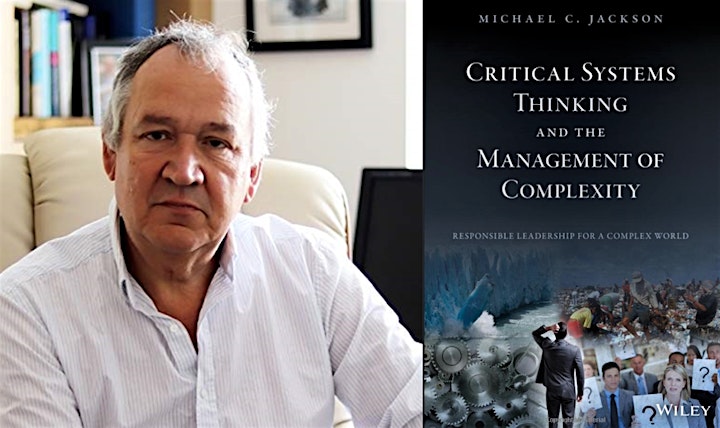
This event is hosted by the Enlightened Enterprise Academy and represents the first conference of our Critical Systems Forum. The forum is an initiative supported by Dr Michael C Jackson OBE, Author of Critical Systems Thinking and the Management of Complexity, founder and former Dean of Hull University Business School, and today a Professor Emeritus at the school.
The Agenda
2-2.10 Welcome and Introductions
2.10-2.30 Provocation 1 (20 mins)
2.30-2.50 Provocation 2 (20 mins)
2.50-3.10 Provocation 3 (20 mins)
3.10-3.20 Introduction of the panellists (10 mins)
3.20-3.45 Individual panellist responses (5 x 5 mins )
3.45-4.15 Moderated discussion amongst the panellists (30 mins)
4.15-4.30 Provocoteaur reflections on the discussion (3 x 5 mins)
4.30-4.55 Moderated Q&A with questions from the audience
4.55-5.00 Closing remarks and announcements
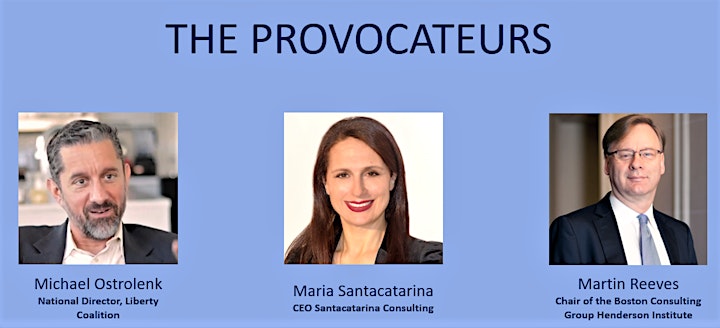
The Provocateurs are:
Michael Ostrolenk, National Director, Liberty Coalition
Maria Santacatarina, CEO Santacatarina Consulting
Martin Reeves, Chair Boston Consulting Group Henderson Institute
Further details to be added soon
The Panellists are:
To be announced soon.
Follow-Up Events
Follow-up events will explore:
How we go about ‘Bridging the Capabilities Gap’ to ensure leaders and other stakeholders have the systems thinking, critical thinking and decision-making capacities to cope with the complexity they encounter in a VUCA world. This is about changing our ways of thinking.
How we go about ‘Getting the Institutions and Organisations we Need’ – government, local government, business, third sector – to meet the challenges we face in the post-Covid world. This is about changing our ways of organising.
How we go about ‘Rethinking and Strengthening the Social Compact’ between the public and private sectors, civil society, and citizens to enable us to ‘build back better’ post-Covid. This is about changing our ways of relating.
Dates for these events will be announced on June 7th at the end of the first coference.
Since Autumn 2019, Collaborate and NPC have been working as learning and evaluation partners to Save the Children’s Early Learning Communities. Our partnership combines Collaborate’s system change knowledge with NPC’s evaluation expertise to develop practice in the emerging field of systems change evaluation.
The Early Learning Communities (ELC) programme aims to make a sustainable difference to the lives of children in four places (Bettws, Feltham, Margate and Sheffield) through a multi-sectoral, multi-agency approach. The programme seeks to better align and connect local activities to identify how to improve the performance of local systems to achieve better early years childhood development outcomes.It also aims to share learning about what is most effective in creating systems change. Since 2018, the ELCs have been bringing together local partners and stakeholders, listening to families, building relationships and collaboratively developing theories of change and local strategies. More recently, they’ve started to test new ways of working, both in terms of direct interventions with children and families, and helping partners work together. Crucially, the work done by the ELCs helped their local systems mobilise effectively in response to the pandemic, enabling them to provide the necessary support for the families in their area.
Evaluating systemic change is difficult for various reasons…
I’ll be honest, I’ve been somewhat wary of platformdesigntoolkit at first; there seemed to be something accelerationist to me (an uninformed opinion, I’ll leave it at that!) – this seems genuinely interesting and I would love to see it analysed in Viable Systems model terms!
What are the organizational elements that connect the organizations above — and many more?
This essay is the first of a series that explores the potential to build a software ecosystem to support an emergent common model of organizing based on small unit, shared services and dynamic contracting. This essay was written by Simone Cicero (Boundaryless) with contributions from Bryan Peters (Sobol.io), Rob Solomon (cone.network), Sascha Kellert (rekursive.org) and Emanuele Quintarelli (Boundaryless).
Have you ever read something, say a novel, a poem, or a quote, and to your surprise you discovered a completely different meaning? It’s a strange experience, and one I’ve been having daily. For example, I once thought I understood the American filmmaker George Lucas when he said:
I was waiting at the crosswalk. Across the street was a building of windows. Behind me was a future building of windows, yet another downtown residential tower under construction. I could see a multitude of reflections of the building behind me in the windows of the building across from me. Then, in a flash, I was bewildered as it seemed that the building I was looking at, or its windows, or something strange inside of it, began to, it seemed, undulate or vibrate or wiggle. Was the building falling? Shaking? Were we having an earthquake that I somehow couldn’t feel, but only see? Was some magic afoot? My confusion ended in a moment as I realized I was seeing a construction elevator ascending in those reflections across the street, it’s image flashing first in one set of window panes, then another, as it rose. The moment of disorientation had lasted but a second, and now, on the other side of perplexity, I’d created comprehension. I don’t remember a time when I didn’t, at least intuitively, comprehend reflections in glass surfaces, but certainly there was that time. I think of my own infant daughter who would sometimes seem startled by her own reflection in the mirrors of our home. That construction elevator, reflected in dozens of windows, had likewise startled me before, as the mind does, I made sense of the nonsense. But, of course, all those reflections were not nonsense and there is no guarantee that what I’d constructed as comprehension had anything to do with reality. I mean, it might seen ludicrous, but it’s quite possible that the entirety of what we perceive is simply a mosaic of infinite reflections, that we each, individually, assemble into “sense.” Scientists assure us that we can never really know what we are “seeing,” the inadequacy of our senses limit what we can really know about the universe, and “comprehension,” as we know it, isn’t a way toward greater truth, but rather a way out of bewilderment. Martin Luther, the original Protestant, wrote, “Bewilderment is the true comprehension. Not to know where you are going it the true knowledge.” When I think of human history, or at least the tiny sliver that I know about, I see a species constantly seeking to overcome its bewilderment, to create sense from the nonsense, to comprehend the incompressible. I also see a species constantly trading one perplexity for another, understanding (or thinking we understand) one thing only to find something beyond it that we don’t understand. We delude ourselves when we believe that we are coming somehow closer to a universal and final understanding. Confusion, bewilderment, perplexity, not knowing: that is the true nature of life. It’s easy to see this in young children who have been entrusted with the freedom to play, children who are not being constantly instructed on how they ought to overcome their bewilderment, but rather left to pursue “true knowledge” on their own. Children move from bewilderment to bewilderment. Sometimes it startles or alarms them. Sometimes it intrigues them, peaking their curiosity. Sometimes children approach their bewilderment with caution, taking their slow, deliberate time, while at other times they throw themselves into it. As adults we too often see their bewilderment as something we must fix, so we tell them how, or show them why, or hurry their process with tips and hints that point them in the “right” direction. When we do that, I wonder if we aren’t robbing them of their true knowledge, which is, their bewilderment. We tend to cast bewilderment in a negative light, as something to be avoided. I’m thinking now of a loved one suffering from dementia. This is a woman who, in her prime, was an intellectual giant, a person gifted in the art of creating sense from nonsense. But it’s not the bewilderment that disturbs her. No, it’s rather that dementia has taken away her ability to construct comprehension the way she once did with such panache. That is, to me, the real tragedy of dementia, not the bewilderment, but the inability to move beyond it. As I watched that construction elevator’s many reflections, each slightly different than the other, create the illusion of movement up the side of the building across the street, I found myself trying to return to that initial moment of bewilderment, to again see what I’d originally seen. I couldn’t do it, of course, but I’ve been thinking about it for weeks now. There was, for me, a moment of sheer delight in my bewilderment, when the world suddenly didn’t make sense to me, when reality gave me a glimpse into its true nature which is to be fully, joyfully, and completely incomprehensible. We are the sense makers, each of us, all of us. We are windows that reflect according to our own, unique angle and perspective, each possessing true, but incomplete knowledge. Tom Hunter sang, “Build it up and knock it down, and build it up again. Knock it down and build it up and knock it down again.” It’s song that goes around and around, infinitely, reflecting the true knowledge that every preschooler knows. From bewilderment we construct comprehension, but being incomplete it cannot lasts, and then we do it again.
Free for All
Published Online:1 Dec 1967https://doi.org/10.1287/mnsc.14.4.B141
Abstract
—Editorial by C. West Churchman, University of California, Berkeley
JUN
30
Soft Systems Networking Meet Up
by RCA Textiles Research
Follow
Free
Actions and Detail Panel
Share this event
Register
Event Information
Our second online networking meeting for researchers exploring all notions of SOFT SYSTEMS in their academic or industrial research practice
About this event
After a highly stimulating and cross disciplinary introductory meeting, we invite past participants and new attendees to join the second meetup. There will be opportunities for more in depth sharing of our research process; successes, struggles and ideas-in-progress. Further details will follow.




 PLEASE NOTE: This is a ticketed event for which all donations will benefit the work of




 Systems Community of Inquiry
You must be logged in to post a comment.