
Resisting or embracing meta-rationality
Resisting or embracing meta-rationality | Meta-rationality
Author Archives: antlerboy - Benjamin P Taylor
How do you change the system three steps at a time? | by noelito | Feb, 2022 | Medium
https://noelito.medium.com/how-do-you-change-the-system-three-steps-at-a-time-60a5f62fe5f1
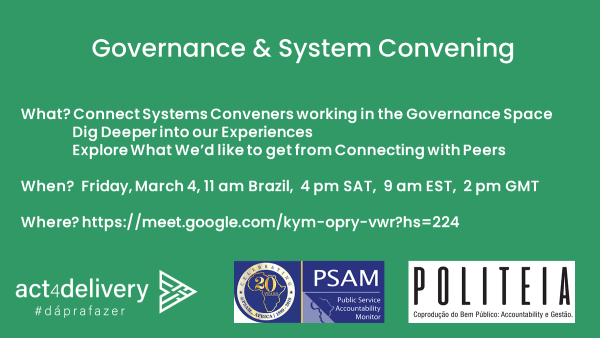
Governance & System Convening webinar – Fri, Mar 4, 2022 at 2pm GMT
Governance & System Convening
Governance & System Convening Tickets, Fri, Mar 4, 2022 at 11:00 AM | Eventbrite
MAR
04
Governance & System Convening
Free
About this event
We are excited to convene an initial conversation on systems convening and governance.
The conversation is an outgrowth of the launch of Bev and Etienne Wenger-Trayner book on Systems Convening, when a number of us expressed interest in exploring the practice of systems convening in the governance space.
Date and time
Fri, March 4, 2022
2:00 PM – 3:30 PM GMT
Five worlds practices for systems transformation with Benjamin P Taylor – YouTube and links – sensemaking.rs
Five worlds practices for systems transformation with Benjamin P Taylor
Five worlds practices for systems transformation with Benjamin P Taylor – YouTube
Slides and other materials via the Meetup:
Learning As You Scale – Social Innovation | Launch Registration Feb 28, 2022 12:00 PM in Dublin
book:
Webinar Registration – Zoom

Learning As You Scale Launch Registration
Topic
Learning as You Scale Launch
One of the most important and challenging aspects of social innovation is scaling. Often innovations which have the potential to transform the lives of people across countries remain confined to small demonstration sites and pilots.
We are inviting you to the launch of Learning as You Scale: A Practical Guide to Navigate Scaling and Complex Systems Change written by a team of European experts. The guide explores how the power of the voices of those involved on the frontline of social challenges can best be harnessed to inform and accelerate change. Valuable guidance for practitioners is included which is rooted in practice, moves beyond simplistic, linear evaluation approaches and addresses the real challenges involved in scaling social innovation, especially within complex systems.
Feb 28, 2022 12:00 PM in Dublin
LinkedIn post:
https://www.linkedin.com/posts/activity-6902292012968865792-rNp3
Webinar | Thinking Like a System and Leading with Humility – Margaret Wheatley and Mayor Lisa Helps of Victoria, BC, 1pm EST March 2, 2022
Thinking Like a System and Leading with HumilityDate: Wednesday, March 2, 2022 | 1:00 p.m.–2:00 p.m. (ET)Speakers: Margaret Wheatley and Mayor Lisa Helps
Webinar | Thinking Like a System and Leading with Humility
CONFERENCE WORKBOOK for “TEXTS IN CYBERNETIC THEORY” An In-Depth Exploration of the Thought of HUMBERTO R. MATURANA WILLIAM T. POWERS ERNST VON GLASERSFELD A Conference of THE AMERICAN SOCIETY FOR CYBERNETICS October 18-23, 1988 Felton, California
https://asc-cybernetics.org/publications/Texts_in_Cybernetic_Theory.pdf
pdf dug up by @Kihbernetics who says:
Found this really interesting document from 1988 with texts from #Powers, #Maturana, and #Glasersfeld, but it is missing two pages (30 and 31) in the “outline of control theory” from Powers. If someone has the full text it would be very much appreciated. https://asc-cybernetics.org/publications/Texts_in_Cybernetic_Theory.pdf
Systems convening across boundaries – hosted by Etienne and Bev Wenger-Trayner, Wed 2 Mar 2022 at 16:00 UK time – Collective Leadership Scotland
MAR02Systems convening across boundaries
Systems convening across boundaries Tickets, Wed 2 Mar 2022 at 16:00 | Eventbrite
MAR
02
Systems convening across boundaries
by Collective Leadership ScotlandFollow
519 followers
Free
Actions and Detail Panel
Register
Event Information
Hosted by Etienne and Bev Wenger-Trayner
About this event
Hosting new types of conversations across complex landscapes requires a certain kind of leadership, which is described as systems convening. A systems convener or systems convening team sets up spaces for new types of conversations between people who often live on different sides of a boundary. For example, a geographic, cultural, disciplinary, political, class, social boundary. They spot opportunities for creating new learning spaces and partnership that will bring different and often unlikely people together, and use their legitimacy to convene people to engage in learning across boundaries.
You may be doing this kind of work without any label, unrecognized, or are not not aware that they are doing it, or perhaps you are interested in learning more…
Join Etienne and Bev Wenger-Trayner in conversation with Janet Whitley and Joan O’Donnell about their recent book on systems convening, where they interviewed 40 systems conveners from around the world, working on diverse issues ranging from improving government transparency to enhancing cancer care.
You can download the book for free here: https://wenger-trayner.com/systems-convening/
About Illuminating Leadership Festival
This event is part of Illuminating Leadership 2022 – a global festival exploring the light and shade of collective leadership. To learn more about this festival and see all other events, have a look here.
Share your event experience using #IlluminatingLeadership and follow Collective Leadership for Scotland @CollectiveScot on Twitter.
Other Event Information
Please note that this event is participatory and has engagement at its heart. Therefore, access to a micro-phone and video-camera is a requirement to participate and get most out of this session.
Our ambition is to host events that are engaging, open and accessible to all. If there is something we can do to enhance your online event experience, please do let us know in advance by contacting collectiveleadership@gov.scot.
Tags
Share with friends
Share on FacebookShare on Facebook MessengerShare on LinkedinShare on TwitterShare by Email
Date and time
Wed, 2 March 2022
16:00 – 16:55 GMT
Enabling Foresightfulness: A Framework for Building a Futures-Oriented Organization – Frenette and Fribance (2020)
Enabling Foresightfulness: A Framework for Building a Futures-Oriented Organization
Enabling Foresightfulness: A Framework for Building a Futures-Oriented Organization – OCAD University Open Research Repository
Enabling Foresightfulness: A Framework for Building a Futures-Oriented Organization
Frenette, Chantal and Fribance, Robin (2020) Enabling Foresightfulness: A Framework for Building a Futures-Oriented Organization. [MRP]
| Item Type: | MRP |
|---|---|
| Creators: | Frenette, Chantal and Fribance, Robin |
| Abstract: | The practice of organizational foresight is known to have significant benefits when utilized as an input into strategic decision-making and strategic planning. There are, however, recognized limitations with organizations’ abilities to integrate and enact insights derived from foresight. This report aims to understand those limitations by seeking to uncover the barriers and enabling conditions associated with integrating foresight within organizations. The research for this report is grounded in human-centred design and follows a problem finding, problem framing, and solutioning process, and is supported by a social constructivist point of view, which emphasizes knowledge building and knowledge transfer through collaboration and active engagement. In addition to background research, industry interviews with expert foresight practitioners, and a survey of organizational strategists were used to determine the barriers and enabling conditions associated with organizational foresight. Key findings include three principles for successful integration of foresight within organizations. Those three principles are: first, the prioritization of the collective over the individual and the recognition that having individual capacity does not translate into having collective capacity; second, foresight is viewed as an organizational activity, meaning that futures-thinking and foresight practicing brings strategic foresight to life in an organization and makes integration achievable; and third, that the organization sees itself as a system, and in that system all the elements and their interrelationships are used to sustain the thinking and the practice of foresight. Stemming from the three principles, this report concludes by making recommendations for both foresight practitioners and organizations that engage with foresight. The report identifies opportunities for further research related to the recommendations. |
| Date: | 2020 |
http://openresearch.ocadu.ca/id/eprint/3159/1/Frenette_Fribance_2020_MDes_SFI_MRP.pdf
Facilitating foresight: where the foresight function is placed in organisations | Hayward (2004) – and other Peter Hayward links
Facilitating foresight: where the foresight function is placed in organisations
Facilitating foresight: where the foresight function is placed in organisations | Semantic Scholar
Facilitating foresight: where the foresight function is placed in organisations
- P. Hayward
- Published 1 February 2004
- Business
- Foresight
This paper introduces the Viable Systems Model and in particular the Meta System component of that model, as a framework within which to consider how foresight can be facilitated in organisations. Shows how the System 4 function within the meta system is in a position to facilitate processes that will produce effectiveness and the development of overall system identity. Also shows how adopting another framework for understanding the paradigms or worldviews that operate in organisations can enhance the likelihood that these processes will be successful.
also via https://www.researchgate.net/publication/235291881_Facilitating_foresight_Where_the_foresight_function_is_placed_in_organisations
FuturePod EP 2: Deep Inquiry and Dealing with Complexity – Peter Hayward
https://www.futurepod.org/podcast/2018/10/22/episode-10-peter-hayward
Teacher Tom: Creating Metaphors: Interpreting The World Through The Prism Of Ourselves
http://teachertomsblog.blogspot.com/2022/02/creating-metaphors-interpreting-world.html
Rafael Kaufmann on Twitter: “In 2012, a literally game-changing economics paper was published. I believe can eventually transform the very structure of civilization. (I don’t make these kinds of statements lightly.) Yet it’s still virtually unknown outside of academia.
In 2012, a literally game-changing economics paper was published. I believe can eventually transform the very structure of civilization. (I don’t make these kinds of statements lightly.) Yet it’s still virtually unknown outside of academia.
The (highly technical) paper, “Iterated Prisoner’s Dilemma contains strategies that dominate any evolutionary opponent”, is by legendary physicist Freeman Dyson (RIP) and William Press of “Numerical Recipes” fame. Hereon “D&P”.
(1) Rafael Kaufmann (🧠,🌎) on Twitter: “In 2012, a literally game-changing economics paper was published. I believe can eventually transform the very structure of civilization. (I don’t make these kinds of statements lightly.) Yet it’s still virtually unknown outside of academia. 🧵” / Twitter
Thread continues:
Metaphorum Webinar Series – Perez-Rios, and Duck and Searles coming up in May
Coming up:
Prof. Jose Perez-Rios
How to make a fast diagnosis of a complex organization with Organizational Cybernetics? Framework and Tools.
May the 4th, 2022, 5:00-6:30 pm (GMT summer time)
Roger Duck and Jane Searles
Designing Freedom Together
May 25th, 2022. 5:00-6:30 pm UK (Summertime)
Metaphorum Webinar Series
Metaphorum Webinar Series – metaphorum
Dr Steve Brewis
y=f(x) … ‘the digital unwrapping of institutional capital’
March 2nd, 2022. 5:00-6:30 pm (UK winter time)
Dr Alan Rayner
Natural inclusion: The receptive simplicity in the heart of complexity and a compassionate, regenerative, and creative community life
April 6th, 2022 5:00-6:30 pm (UK summer time)
The Paradigm of Social Complexity


Volume I: An Alternative Way of Understanding Societies and their Economies
Volume II: Computational Models, Validation, and Applications
Gonzalo Castañeda
With the recent developments in computing technologies and the thriving research scene in Complexity Science, economists and other social scientists have become aware of a more flexible and promising alternative for modelling socioeconomic systems; one that, in contrast with neoclassical economics, advocates for the realism of the assumptions, the importance of context and culture, the heterogeneity of agents (individuals or organisations), and the bounded rationality of individuals who behave and learn in multifaceted ways in uncertain environments. The book synthesises an extensive body of work in the field of social complexity and constructs a unifying framework that allows developing concrete applications to important socioeconomic problems. This one-of-a-kind textbook provides a comprehensive panorama for advanced undergraduates and graduate students who want to become familiar with a wide range of issues related…
View original post 159 more words
Causal emergence is widespread across measures of causation – Comolatti, Hoel (2022)
Causal emergence is widespread across measures of causationRenzo Comolatti, Erik Hoel
[2202.01854] Causal emergence is widespread across measures of causation
Causal emergence is widespread across measures of causation
Causal emergence is the theory that macroscales can reduce the noise in causal relationships, leading to stronger causes at the macroscale. First identified using the effective information and later the integrated information in model systems, causal emergence has been analyzed in real data across the sciences since. But is it simply a quirk of these original measures? To answer this question we examined over a dozen popular measures of causation, all independently developed and widely used, and spanning different fields from philosophy to statistics to psychology to genetics. All showed cases of causal emergence. This is because, we prove, measures of causation are based on a small set of related “causal primitives.” This consilience of independently-developed measures of causation shows that macroscale causation is a general fact about causal relationships, is scientifically detectable, and is not a quirk of any particular measure of causation. This finding sets the science of emergence on firmer ground, opening the door for the detection of intrinsic scales of function in complex systems, as well as assisting with scientific modeling and experimental interventions.
 Systems Community of Inquiry
You must be logged in to post a comment.