
“Norbert Wiener in the 21st Century: The Long Historical View” – Ronald Kline
“Norbert Wiener in the 21st Century: The Long Historical View” – Ronald Kline | Norbert Wiener Learning Center
Author Archives: antlerboy - Benjamin P Taylor
Navigating Uncertainty – Pioneering Habits of Mind by Sonja Blignaut – Wardley Maps BarCamp 2020 – YouTube
Navigating Uncertainty – Pioneering Habits of Mind by Sonja Blignaut – Wardley Maps BarCamp 2020
Navigating Uncertainty – Pioneering Habits of Mind by Sonja Blignaut – Wardley Maps BarCamp 2020 – YouTube
Using Systems Thinking to Make Critical Key Decisions | KnowledgeWorks
Using Systems Thinking to Make Critical Key Decisions Published: September 1, 2021 Topics: Systems Change Education leaders at the district, state and federal levels have all been grappling with systemic disruptions. How can education leaders navigate disruptions and potential disruptions with systems thinking?
Using Systems Thinking to Make Critical Key Decisions | KnowledgeWorks
I was very much expecting to say ‘ho hum, another systems dynamics thing’ – and the heart of this is systems dynamics, but I rather like this – a very good introduction and sensible, practical stuff.
Guidebook on systems thinking for educators (pdf):
http://knowledgeworks.org/resources/education-changemakers-guidebook-systems-thinking/
Handbook on Cities and Complexity – Ed. Portugali, 2021
Handbook on Cities and Complexity
Handbook on Cities and Complexity
Handbook on Cities and Complexity
Research Handbooks in Urban Studies series
Edited by Juval Portugali, Professor of Human Geography, Department of Geography and the Human Environment, Tel Aviv University, Israel
Publication Date: September 2021
ISBN: 978 1 78990 011 8
Extent: 456 pp
Written by some of the founders of complexity theory and complexity theories of cities (CTC), this Handbook expertly guides the reader through over forty years of intertwined developments: the emergence of general theories of complex self-organized systems and the consequent emergence of CTC.
UK NHS Quality Improvement tweet chat on #SystemsThinking 8pm UK time Wednesday 22 September
The next #QIHour tweet chat is on #SystemsThinking joined by @DrAmarShah @NHS_ELFT All welcome To join, type #QIHour into your twitter search bar at 8pm (GMT+1) on Wednesday & select the latest tab. Also see top tips in @LeighAKendall blog https://nhshorizons.passle.net/post/102fl9e/tips-for-taking-part-in-a-tweet-chat… #QITwitter
EGO TO ECO

I’m intrigued and excited by the potential of the ‘ego to eco’ movement.
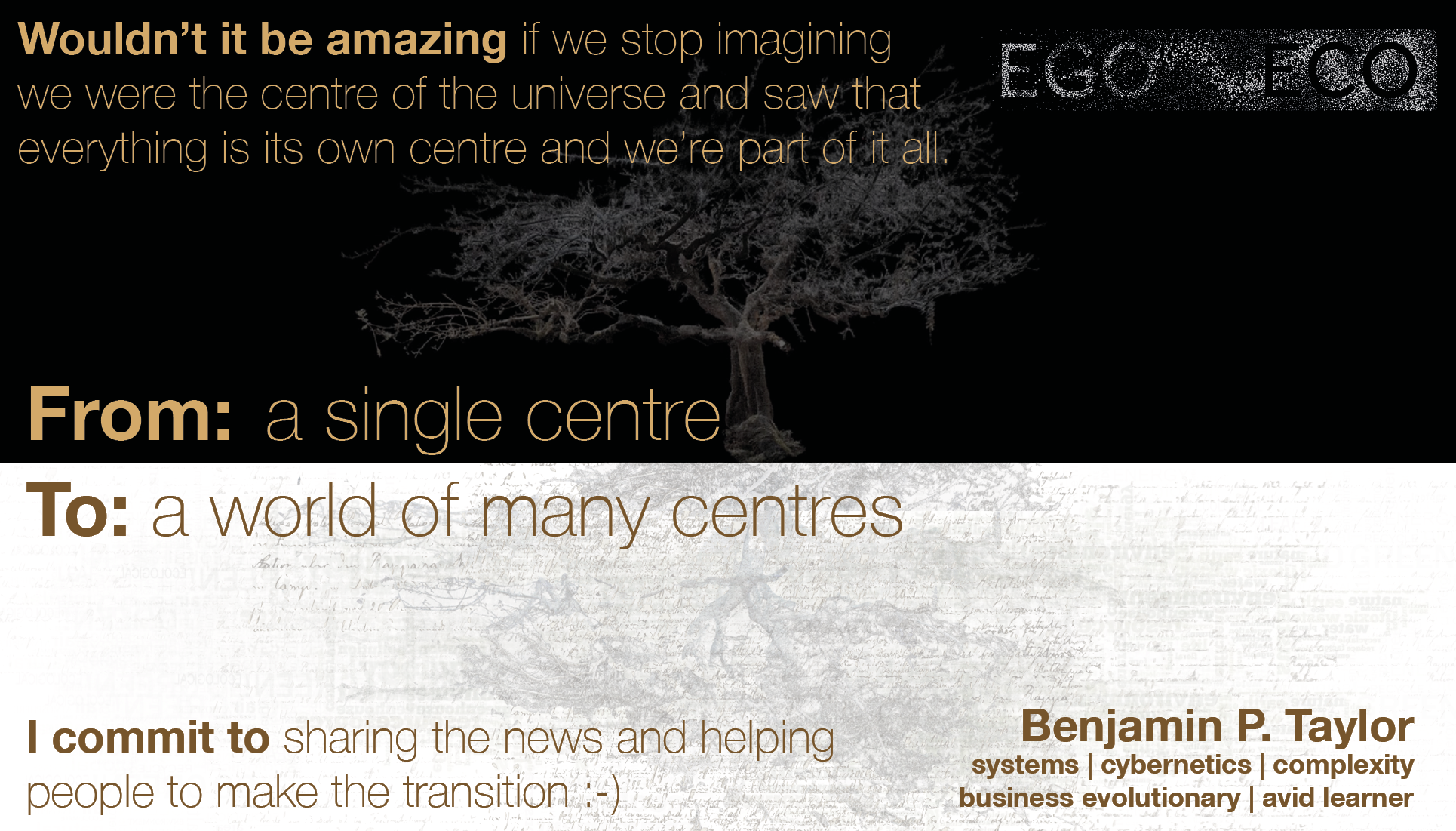
That’s my card – get yours here:
http://www.bit.ly/EgotoEco
More:
Ego to Eco
https://bit.ly/3zrPnec
Pech kucha:
https://bit.ly/3krGjS4
Story:
https://bit.ly/2Z7Y4O7
Facilitating for Emergence: A Conversation with Adam Kahane | Si Network, interviewed by Joanne Dong – October 6, 4:00pm – 5:00pm BST
Facilitating for Emergence: A Conversation with Adam Kahane
Facilitating for Emergence: A Conversation with Adam Kahane | Si Network
Joanne DongToronto Hub RepresentativeEvent
Facilitating for Emergence: A Conversation with Adam Kahane

Wed, October 6, 4:00pm – 5:00pm BST
How to affect change in a complex system where you are part of a process or a discussion and yet without getting directly involved in the process or discussion yourself? How do you know when to listen and observe or engage and intervene, when to seek consensus or live with disagreements, when to stay on course or experiment and explore new paths, and when to command and control or accompany and serve?
Join us to explore these questions in a conversation with Adam Kahane. Adam is the author of five books. In this conversation, we will dive into his latest book, Facilitating Breakthrough: How to Remove Obstacles, Bridge Differences, and Move Forward Together. The conversation will be facilitated by Joanne Dong from Systems Innovation Toronto Hub.
This conversation is for anyone who helps people work together to transform their situation, be it a professional facilitator, manager, consultant, coach, chairperson, organizer, mediator, stakeholder, or friend.
Adam Kahane is a director of Reos Partners, an international social enterprise that helps people move forward together on their most important and intractable issues. He is a leading organizer, designer, and facilitator of processes through which business, government, and civil society leaders can work together to address challenges.
Adam has worked in more than fifty countries and in every part of the world, with executives, politicians, generals, guerrillas, civil servants, trade unionists, community activists, United Nations officials, clergy, and artists.
Learn more about Adam at Reos Partners and find him on Twitter @adamkahane.
Launch: Halogen’s Playbook for Systemic Innovation – YouTube
Launch: Halogen’s Playbook for Systemic Innovation
Launch: Halogen’s Playbook for Systemic Innovation – YouTube
Kittens are Evil II: Six leading systems thinkers pitch their big idea Tickets, Thu, Oct 14, 2021 at 3:00 PM UK time
Kittens are Evil II: Six leading systems thinkers pitch their big idea
Kittens are Evil II: Six leading systems thinkers pitch their big idea Tickets, Thu, Oct 14, 2021 at 3:00 PM | Eventbrite
OCT 14
Kittens are Evil II: Six leading systems thinkers pitch their big idea
by Little Heresies, Northumbria University
Event Information
Kittens are Evil II Book Launch. Six leading systems thinkers pitch their big idea.
About this event
On Zoom
FREE event but registration is essential
Six leading heretics answer the question ‘You bump into Michael Gove in a nightclub. After posing for a selfie he offers to buy you a drink. You tell him what you do and he asks if you have any policy ideas. What is your pitch?
Join us for the launch of Kittens are Evil II and hear from six heretics who have contributed chapters to the Kittens are Evil books.
Six Speakers:
- Kathy Evans, CEO of Children England
- Toby Lowe, Professor in Public Management at the Centre for Public Impact
- Simon Guilfoyle, police inspector and systems thinker
- Cathy Hobbs, time-served devotee of local government and critical systems thinker
- Catherine Needham, Professor of Public Policy and Public Management at the University of Birmingham
- Peter Wright, Convenor, North East Public Health Skunkworks
Two Convenors:
- Rob Wilson, Professor at Northumbria University and Editor of Kittens are Evil II
- Charlotte Pell, Visiting Fellow at Northumbria University, Editor of Kittens are Evil II and Head of Communications at Vanguard Consulting
One Brilliant Book, Kittens are Evil II:
Since our last Little Heresy seminar, much has changed. There have been positives – the unthinkable has become doable in times of crisis. Once insurmountable organisational barriers have disappeared. There have been negatives; a proliferation of dodgy evidence, a focus on targets over the truth, outsourcing to private sector providers with dubious track records, and a top-down approach from government.
Explore alternative ways of designing public services and public policy in this collection of work from nine leading thinkers and practitioners in their fields.
The Book Authors:
- Anton Hemerijck is Professor of Political Science: European University Institute, Florence Centennial Professor of Social Policy: LSE
- Mark Smith is Director of Public Service Reform, Gateshead Council
- Peter Wright is Convenor, North East Public Health SkunkWorks
- Catherine Hobbs has completed her doctoral research at the University of Hull on learning for systemic leadership in local governance networks.
- The late Richard Davis who worked for Vanguard Consulting.
- Catherine Needham is Professor of Public Policy and Public Management, University of Birmingham
- Jake Hayman is CEO, Ten Years’ Time
- Stephen Lock is Head of Business Intelligence, National Institute for Health Research Clinical Research Network
- Vincent Richardson and Alan Peyton are Supporters of Positive Money
Value(s): Taking a Systems/COR Critical Perspective – Weaver and Tan (2021)
Value(s): Taking a Systems/COR Critical Perspective
(PDF) Value(s): Taking a Systems/COR Critical Perspective
Value(s): Taking a Systems/COR Critical Perspective
- September 2021
DOI:10.13140/RG.2.2.21111.14249
- Conference: OR63 63rd Annual UK Operational Research Conference
- Project: Business with Purpose
Authors:

Download file PDFDownload citationCopy link
Abstract
Mark Carney – the former Governor of the Bank of England calls for a new kind of economics and attacks the prevalent neo-liberal paradigm, in his 2021 book, Value(s) Building a Better World for All. Echoing the Financial Times attempts to “reset capitalism”, arguing for stakeholder capitalism and businesses putting “purpose beyond profit”. This narrative is gaining traction as the world seeks to “build back better” following a global pandemic; in light of a climate emergency and recognition that we are in our final decade for action on the Sustainable Development Goals (SDGs). In this session, the authors review Mark Carney’s proposition of Value(s) and suggest the need for clarity to distinguish between the concept of ‘value’ and how this is created by putting ‘values’ into action. Particularly, in light of Midgley, Johnson and Chichirau (2017) clarification that Community Operational Research concerns the meaningful engagement of communities and highlighting of more recent COR applications in a business context. It is also important to note the importance placed by the United Nations on ‘Systems Thinking’ being a core skill to build capacity and accelerate progress towards the SDGs. Recognising competing objectives and multiple different perspectives of differing problem situation(s) from multiple stakeholders. The Sustainability challenge is our ultimate wicked problem. The authors argue to build capacity for sustainability, particularly in supporting business to balance purpose with profit in stakeholder relationships, there is a need to review systems and systemic approaches for attaining the SDGs across partnerships (See Weaver, Tan and Crossan, 2020 for a review of approaches in this context). This includes revisiting Checkland and others ‘underlying systems concept’ and approaches such as boundary critique and Critical Systems Heuristics that can help to distinguish value and boundary judgements, plus methods that can help bring about intervention (e.g. SSM, Systemic Intervention, Theory U).
Feminist system change practice: integrating power and love | by Tatiana Fraser | Refuge for systems leaders | Sep, 2021 | Medium
President’s Series 12 Cybernetics, Cognitive Science and Philosophy Tickets, Wed 13 Oct 2021 at 17:00 UK time
book at:
President’s Series 12 Cybernetics, Cognitive Science and Philosophy Tickets, Wed 13 Oct 2021 at 17:00 | Eventbrite
OCT 13
President’s Series 12 Cybernetics, Cognitive Science and Philosophy
by Cybernetics Society — President’s Series
£0 – £20
Event Information
Joe Dewhurst explores cybernetics and cognitive science while Carl Sachs discusses Wilfred Sellars as Philosopher of Cybernetics
About this event
Hosted by our President, Dr. John Beckford FCybS, the CybSights President’s Series is a new programme that will bring interesting people together to explore the relevance and contribution of cybernetics to addressing important challenges.
Each event will consist of contributions by two different speakers. Each will be followed by individual Q&A. These are then brought together by the President in a lively and engaging plenary discussion. Each will seek areas of convergence and divergence between the ideas explored.
Events will be held via Zoom on the 2nd Wednesday of each month from 1700 to 1900.
Meetings are open to members of the Cybernetics Society and also the general public. Non-members are invited to join or give a donation. Booking is required.
The Cybernetics Society has been hosting conversations and lectures since the late 1960s.
Computers With Bodies: The Contemporary Impact of Cybernetic Approaches in Cognitive Science
The cybernetics movement included many key founding figures of what would eventually become known as cognitive science. Despite this connection, the cybernetic origins of cognitive science are often downplayed in accounts of the discipline’s history, and it is only relatively recently that cybernetic principles have come to be seen as once again relevant to contemporary cognitive science. This paper will consider the contemporary impact of cybernetics in two distinct streams of cognitive scientific research, namely computation and embodiment, and then explore some ways in which these two streams can fruitfully collaborate with one another.
Joe Dewhurst
Joe is currently a Postdoctoral Fellow at the Munich Center for Mathematical Philosophy, where he works on topics to do with computation, mechanistic explanation, and more recently formal approaches to causation and emergence in complex systems. His doctoral research at the University of Edinburgh looked at the relationship between common-sense intuitions and scientific theories in contemporary cognitive science, and he worked at Edinburgh as a Teaching Assistant before moving to Munich in 2018. In his spare time Joe designs and develops simulation boardgames, and is interested in parallels between scientific modelling and the use of boardgames to model real-world situations.
Wilfrid Sellars as Philosopher of Cybernetics
The American philosopher Wilfrid Sellars often uses examples of guided missiles or robots in his speculative scientific metaphysics of mind, but few have noticed that he is implicitly referring to cybernetics when he does so. I shall argue that Sellars’s use of cybernetic examples shows that he was probably familiar with cybernetic ideas from Wiener, Ashby, and Wisdom. In this light we can better understand why Sellars uses the kind of examples that he does. I will also argue that Sellars should have discovered second-order cybernetics and why he failed to do so.
Carl Sachs
Carl is currently associate professor of philosophy at Marymount University (USA), where he works on American pragmatism, the Frankfurt School of critical theory, and philosophy of mind. His first book, Intentionality and the Myths of the Given (Routledge 2014) integrated Sellars’s linguistic account of discursive intentionality with Merleau-Ponty’s phenomenology of embodied intentionality. He is currently writing a second book on Wilfrid Sellars as a philosopher at the intersection of German Idealism, American pragmatism, cybernetics, and philosophy of cognitive science. In his spare time he cooks, bakes, and exercises.
Plenary Discussion
The aim of this session, moderated by John Beckford, is to draw out the complementary and competing ideas emerging from the two sessions.
Dr. John Beckford, FCybS, President of the Cybernetics Society
John Beckford is a board member of WOSC, a partner in Beckford Consulting, Non-Executive Chair of the Board of Rise Mutual CIC, a Non-Executive Director of both Fusion21 and CoreHaus (social enterprises) and Visiting Professor in both the Department of Civil, Environmental and Geomatic Engineering at University College London and the Centre for Information Management, School of Business and Economics, Loughborough University. John holds a PhD in cybernetics from the University of Hull, is a Fellow of the Institution of Engineering and Technology and of the Royal Society for the Arts and a Member of the Institute of Management Services.
book at
President’s Series 12 Cybernetics, Cognitive Science and Philosophy Tickets, Wed 13 Oct 2021 at 17:00 | Eventbrite
The Cybernetics of the Two Wittgensteins:


In today’s post, I am looking at Wittgenstein and parallels between his ideas and Cybernetics. Wittgenstein is often regarded as one of the most influential philosophers of the twentieth century. His famous works include Tractatus Logico-Philosophicus (referred to as TLP in this article) and Philosophical Investigations (referred to as PI in this article). TLP is one of the most intriguing books I have read and reread in philosophy. His style of writing is poetic and the body of the book is split into sections and sub-sections. Wittgenstein is one of the few philosophers who has written two influential books that held opposing views in linguistic philosophy.
The Early Wittgenstein:
Wittgenstein was very much influenced by Bertrand Russel’s logical representation of mathematics. Wittgenstein came to the conclusion that language also resides in a logical space. He realized that the problems in philosophy are due to a lack of understanding how language…
View original post 2,643 more words
W. Brian Arthur on Complexity Economics – Sean Carroll’s Mindscape podcast

Economies in the modern world are incredibly complex systems. But when we sit down to think about them in quantitative ways, it’s natural to keep things simple at first. We look for reliable relations between small numbers of variables, seek equilibrium configurations, and so forth. But those approaches don’t always work in complex systems, and sometimes we have to use methods that are specifically adapted to the challenges of complexity. That’s the perspective of W. Brian Arthur, a pioneer in the field of complexity economics, according to which economies are typically not in equilibrium, not made of homogeneous agents, and are being constantly updated. We talk about the basic ideas of complexity economics, how it differs from more standard approaches, and what it teaches us about the operation of real economies.
Listen at: www.preposterousuniverse.com
Late Great Engineers: Norbert Wiener – father of cybernetics | The Engineer The Engineer
Late Great Engineers: Norbert Wiener – father of cybernetics By The Engineer 15th September 2021 8:00 am
Late Great Engineers: Norbert Wiener – father of cybernetics | The Engineer The Engineer
 Systems Community of Inquiry
You must be logged in to post a comment.