
How can systems thinking be used to build circular cities?
How can systems thinking be used to build circular cities? | by Mikael Seppälä | Systems Change Finland | Nov, 2021 | Medium
Author Archives: antlerboy - Benjamin P Taylor
Magenta Complexity. The UK Treasury adopted new central… | by Bojan Radej | Nov, 2021 | Medium
Magenta Complexity. The UK Treasury adopted new central… | by Bojan Radej | Nov, 2021 | Medium
Magenta Complexity

Bojan Radej1 day ago·4 min read
The UK Treasury adopted new central government guidance on evaluation in 2020, so-called The Magenta Book. The new guidance emphasises particular concerns for evaluation in complex conditions highlighting complex systems thinking implications for policymaking that cuts across many areas of governance. CECAN (The Centre for the Evaluation of Complexity Across the Nexus, 2020) welcomes the adoption of a new guide as evidence of a major shift in an approach to policy challenges, analysis, design, and evaluation.
The Magenta Book is accompanied by a special Annex comprising a supplementary guide on handling complexity in policy evaluation, prepared by CECAN. The guide’s goal is the adoption of a more integrated approach to evaluation. It explains what complexity thinking is, what the features of complex systems are, and how new methodologies and tools can equip policymakers to work with unavoidable complexity. In particular, the guide identifies which complexity-appropriate evaluation strategies can be used in various complex conditions.
Recognition of the fundamental challenges of complexity by a central government is an important milestone in policy impact evaluation. Evaluators in other countries must acknowledge this achievement. As practitioners but also as learners or critical observers.
In short review, I focus on what I perceive as the main problem of the guide — its highly problematic theory of change. The authors understand complexity in a reductionist way, even though complexity is an integrative concept, com-plexus originally means braiding together. Two illustrative examples are addressed. First, they decompose the leading features of complexity, and identify partial solutions for each of them. Second, the authors apply either complicated or chaotic explanations of complexity, as if complexity were not an independent concept, containing part of both but also sublating them.
Magenta Complexity Bojan Radej 1 day ago·4 min read
Magenta Complexity. The UK Treasury adopted new central… | by Bojan Radej | Nov, 2021 | Medium
How do we do feminist systems change? | by Tatiana Fraser & Rachel Sinha | Refuge for systems leaders | Nov, 2021 | Medium
How do we do feminist systems change? | by Tatiana Fraser | Refuge for systems leaders | Nov, 2021 | Medium
How do we do feminist systems change?

Tatiana FraserFollowingNov 10 · 3 min read
Tatiana Fraser & Rachel Sinha
Aligning feminist lens with systems practice
Our new publication launched today, lays out how we combine an intersectional feminist lens with systemic practice.
In summary, we do this by first shifting power and centering lived experience and then, bringing in systems frames to move into strategy
How do we do feminist systems change?
How do we do feminist systems change? | by Tatiana Fraser | Refuge for systems leaders | Nov, 2021 | Medium
updated – The Liminal Web: Mapping An Emergent Subculture Of Sensemakers, Meta-Theorists & Systems Poets – Joe Lightfoot
Updated piece at the bottom fo the same link: https://www.joelightfoot.org/post/the-liminal-web-mapping-an-emergent-subculture-of-sensemakers-meta-theorists-systems-poets
Joe Lightfootsource:
The Liminal Web: Mapping An Emergent Subculture Of Sensemakers, Meta-Theorists & Systems Poets
The Liminal Web: Mapping An Emergent Subculture Of Sensemakers, Meta-Theorists & Systems Poets
Somewhere along the way I seem to have unofficially joined a subculture or memetic ecosystem that I’ve come to think of as The Liminal Web. While there aren’t any hard and fast edges to this international constellation of thinkers and theorists it becomes pretty clear you’ve joined the fray when at least thirty percent of all the intellectual media you consume tends to emerge from this particular noospheric relay.
The Liminal Web: Mapping An Emergent Subculture Of Sensemakers, Meta-Theorists & Systems Poets
The Liminal Web: Mapping An Emergent Subculture Of Sensemakers, Meta-Theorists & Systems Poets
I commented in a rambling way at the twitter thread (comments on the blog, oddly, are turned off?):
What I said (including cross-links to other pages herein:
My little list
and
https://t.co/SXpzbADD6c?amp=1
It’s hard to say this without sounding ‘off’, but/and – liking the reflections and dimensions in your actual piece, I feel there is in this list a lot which is:
- facile/perfomative/pseud-y
- positioning/insincere/shallow
- dangerous
stream.syscoi.com
Who are our fellow travellers?
I very much see that there are a large number of movements aligned with my views on systems/cybernetics/complexity and their application, including but not limited to the list below
I’m not sure that’s *helpful* (sorry) – and it says something about me for sure… but somehow I think it needs to be said.
(And there’s a lot missing – of course – because these are imaginary lines that can only be turnd into history in retrospect).
More and more these days, I find myself referencing and thinking about
@Meaningness’s https://meaningness.com/geeks-mops-sociopaths (and
@vgr’s Be Slightly Evil).
This may be all a reflection of my discomfort with the accommodations necessary for success (or jealousy at success).
For me, there’s a set of retreats in:
- postrat sincere, nonlegible, warmth and whimsy
- grounded practitioners who are doing and living the life they espouse
(and, for the latter, it’s those who are doing so with a consciousness of continuity of history, with their traditions honestly come by – I’m deeply suspicious of those who claim something new, or have dredged up the old)…
sorry – half-formed thoughts – but I think there’s something (important) there.
Relationship Visualizer: Excel to Graphviz | SourceForge.net
Excel to Graphviz
Excel to Graphviz download | SourceForge.net
Creates graph visualizations of Excel data relationships.
Features
- Use Excel worksheets to create Graphviz graphs
- One common macro-enabled spreadsheet which runs on Windows or MacOS
- Displays graphs within Excel, with ability to save graphs to file
- Auto refresh feature updates the graph as you enter values into Excel Cells
- UTF-8 character support for non-Western languages (e.g. Greek)
- Not an Excel Add-In; all features run as VBA macros in the workbook
- All features are easily controlled from Excel’s tab interface
- Style editor for visually defining Node, Edge, and Cluster attributes
- Saves style definitions by name for reuse, and include predefined flowchart shapes
- Create multiple graph views from a single set of data
- View and save the “dot” source code generated from Excel
- Extract and graph data from other Excel workbooks via SQL queries (Win OS only)
- Includes help worksheets for Graphviz shapes, colors, and attributes
- Extensive documentation with simple tutorials
- Sample files included
- Export/Import to JSON for backup, source control, and sharing
Complex Networks: Theory, Methods, and Applications – Lake Como School of Advanced Studies – May 16-20, 2022
Complex Networks: Theory, Methods, and Applications Lake Como School of Advanced Studies – May 16-20, 2022
Complex Networks: Theory, Methods, and Applications – Lake Como School of Advanced Studies – May 16-20, 2022
via Complexity Digest
Complex Networks: Theory, Methods, and Applications – Lake Como School of Advanced Studies – May 16-20, 2022

Many real systems can be modeled as networks, where the elements of the system are nodes and interactions between elements are edges. An even larger set of systems can be modeled using dynamical processes on networks, which are in turn affected by the dynamics. Networks thus represent the backbone of many complex systems, and their theoretical and computational analysis makes it possible to gain insights into numerous applications. Networks permeate almost every conceivable discipline —including sociology, transportation, economics and finance, biology, and myriad others — and the study of “network science” has thus become a crucial component of modern scientific education.
The school “Complex Networks: Theory, Methods, and Applications” offers a succinct education in network science. It is open to all aspiring scholars in any area of science or engineering who wish to study networks of any kind (whether theoretical or applied), and it is especially addressed to doctoral students and young postdoctoral scholars. The aim of the school is to deepen into both theoretical developments and applications in targeted fields.
Read the full article at: ntmf.lakecomoschool.org
part-time research assistant sought: International Federation for Systems Research
Part-time Research Assistance
Open position
A person is sought who has some familiarity or interest in the Systems/cybernetics fields to provide part-time research assistance to the president of IFSR (currently Prof. Ray Ison). The post is for 6 hours per week and would be suited to someone currently undertaking PhD study or might like to become familiar with the systems field as preparation for future PhD study.
Role specification:
Assist the President in drafting and circulating strategic position papers amongst IFSR members and to policy makers and selected journalists;
Undertake relevant literature research and drafting of material on behalf of the president; assist with submissions of IFSR policy publications when relevant
Assist the president in compiling data from IFSR member websites and from one-to-one conversations with individuals in leadership positions in IFSR member organisations as contributions to strategy documents
Help identify potential funding sources for research and/or policy entrepreneurship based on IFSR strategy proposals
Assist in bid preparation for funding
Liaise with other EC members and IFSR Community Curator in relation to other tasks.
For further information, for leads, and applications please contact Prof Ray Ison and Louis Klein at application@ifsr.org.
Constructivist Foundations 17(1)
{ Volume 17, Number 1 November 2021
Constructivist Foundations 17(1)

{
Volume 17, Number 1
November 2021
Cover Art: “Reminiscence” © Esther Barend 2008 · Acrylics on canvas, 150 x 100 cm
With a Voluntary Annual Subscription you can download the entire issue.Share on
Special Offer valid until Monday, 22 November 2021
Get a free print copy by making a donation of at least 49 EuroTarget Article
Euphemisms vs. Dysphemisms, or How we Construct Good and Bad Language
Abstract · Full text in PDF (267 kB)Open Peer Commentaries
Which Cognitive Processes for Which Language Experiences?
Abstract · Full text in PDF (91 kB)
There Are More Euphemisms and Dysphemisms in Heaven and Earth Than One Might Think
Abstract · Full text in PDF (93 kB)
Some Good Words about Curses, and a Few Damning Ones about Bowdlerization
Abstract · Full text in PDF (95 kB)
Accusatives, Deixis, and Pointing Fingers
Abstract · Full text in PDF (101 kB)
Constructing a Constructivist View of Language
Abstract · Full text in PDF (101 kB)
The Distinction of “Good/Evil” and Phenomenal Consciousness
Abstract · Full text in PDF (99 kB)
Meta-Communicative Interactional Dynamics and the Construction of Meaning on Screen
Abstract · Full text in PDF (111 kB)
Author’s Response: X-phemisms and Radical Constructivism: From World-View to Whirled-Views
Abstract · Full text in PDF (110 kB)Target Article
The Construction of Autism: Between Reflective and Background Knowledge
Maciej Wodziński & Paulina Gołaska-Ciesielska
Abstract · Full text in PDF (350 kB)Open Peer Commentaries
Considerations for Changing Concepts Constructively
Abstract · Full text in PDF (78 kB)
From Deficit to Difference in the Discourse on Autism and Mental Health
Abstract · Full text in PDF (104 kB)
The Hardening of the Categories
Abstract · Full text in PDF (96 kB)
Autism as Disordered Sense-Making
Abstract · Full text in PDF (97 kB)
Autism in Extreme Models of Understanding Disability
Abstract · Full text in PDF (100 kB)
Making Sense of Autism or Making Sense of Individuals with Autism?
Abstract · Full text in PDF (87 kB)
Is Heidegger’s Fundamental Ontology an Antidote to Dominant Social Constructions of Autism?
Abstract · Full text in PDF (96 kB)
Author’s Response: Constructivism Strengthens Epistemic Uncertainty – And This is Good News
Abstract · Full text in PDF (125 kB)Target Article
From Liveness to “Lifeness”: Autopoiesis and an Enactive View of Performance
Abstract · Full text in PDF (275 kB)Open Peer Commentaries
The Impact of “Lifeness” in Current Theatre Experiences
Abstract · Full text in PDF (85 kB)
Autopoiesis as Biological Theory and as Theoretical Metaphor
Abstract · Full text in PDF (115 kB)
Enacting the Difference between Liveness and “Lifeness” in Performance
Abstract · Full text in PDF (88 kB)
Orders of Autopoiesis and “Lifeness” as the Biological Spectacle of Control
Abstract · Full text in PDF (102 kB)
Abstract · Full text in PDF (78 kB)
Author’s Response: What Happens in the Spaces in Between
Abstract · Full text in PDF (99 kB)Reviews
The genius of John von Neumann – UnHerd
The genius of John von Neumann First and foremost, he just wanted to solve puzzles BY TOM CHIVERS
The genius of John von Neumann – UnHerd
(also mentions ‘List of things named after John von Neumann’: https://en.wikipedia.org/wiki/List_of_things_named_after_John_von_Neumann )
Introduction to UNDP Sensemaking Method and Approach Tickets, 22 November 2021 1pm UK time
NOV 22 Introduction to UNDP Sensemaking Method and Approach
Introduction to UNDP Sensemaking Method and Approach Tickets, Mon 22/11/2021 at 8:00 PM | Eventbrite
NOV 22
Introduction to UNDP Sensemaking Method and Approach
by UNDP Asia Pacific Innovation Centre
Event Information
An introduction to the UNDP Sensemaking toolkit and then a discussion about how Sensemaking could be used in your organisation.
About this event
The UNDP Asia Pacific Innovation team have developed an approach to Sensemaking which we use to support strategy and impact development across the UNDP Country Offices. There is potential for this methodology to be useful for any organisation who delivers programmes and is looking to find better routes to impact for those programmes. This session is designed to introduce interested people to the Sensemaking Toolkit and to discuss how Sensemaking could be used in organisations outside the UNDP.
A zoom link will be sent to registered participants along with the Toolkit prior to the event.
Date and time
Mon, 22 November 2021
1:00 PM – 2:30 PM GMT
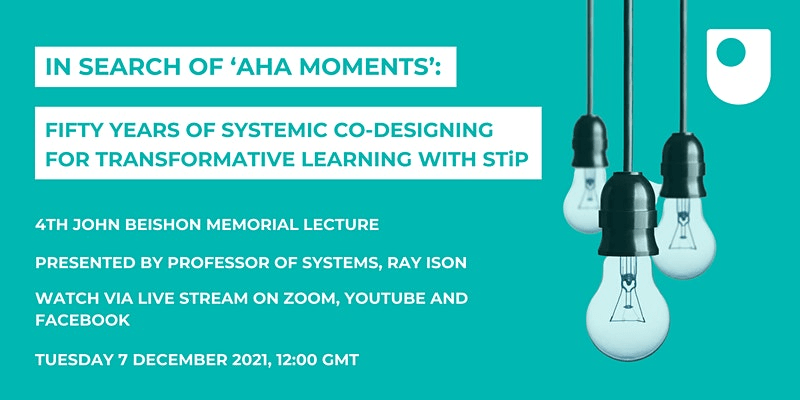
In search of ‘Aha Moments’: 50 Years of transformative learning with STiP Tickets, Tue 7 Dec 2021 at 12:00 UK time (online)
In search of ‘Aha Moments’: 50 Years of transformative learning with STiP
In search of ‘Aha Moments’: 50 Years of transformative learning with STiP Tickets, Tue 7 Dec 2021 at 12:00 | Eventbrite
DEC 07
In search of ‘Aha Moments’: 50 Years of transformative learning with STiP
by The Open University, Faculty of STEM
Event Information
Explore the history and achievements of The Open University’s 50 year-commitment to co-designing and providing Systems education.
About this event

About the event
As part of the STiP@50 event series, Professor Ray Ison employs a STiP (Systems Thinking in Practice) lens to explore the history and achievements of The Open University’s 50 year-commitment to co-designing and providing Systems education, drawing from these experiences lessons for our current circumstances and future action.
Ray will be introduced by Kris Stutchbury, Senior Lecturer in Teacher Education at The Open University and Academic Director for the multi award-winning Teacher Education in sub-Saharan Africa (TESSA) programme – the largest established teacher education network in Africa. Kris is also daughter of the renowned systems thinking practitioner Peter Checkland.
About STiP at The Open University
In 1971, The Open University (OU) in the UK pioneered academic education with the creation of the Department of Systems responsible for presenting a widening range of Systems learning opportunities, now under the aegis of STiP (Systems Thinking in Practice). Since 1971, nearly 50,000 students have studied STiP modules, and many systems resources can be found on the OpenLearn and FutureLearn platforms.
After 50 years, the OU offers a thriving postgraduate suite of qualifications in STiP, supported by internationally acclaimed academics. STiP capabilities are increasingly demanded to make sense, strategise and improve problematical situations in all areas and at all levels, from global human-induced climate change to public health, addressing domestic violence through community health services or business viability. In response to this growing need in 2022 the OU will also become a provider (in England) of masters level Systems Thinking Practitioner Apprenticeships.
Please join us in the 2021 event series that celebrates the STiP Jubilee of The Open University. To receive the live links for the talk, you are invited to register on this page through Eventbrite. Here you will have the option of watching Ray on YouTube or Facebook Live if you prefer not to join through The Open University Zoom platform.
We hope you will join us online for the talk, and/or on social media for the conversation using #OUSTiP and #OUSTiP50. Please feel free to circulate details to friends and colleagues who may not be on this email listing.
A short history of OU systems thinking is available to download here.
We look forward to your participation in fruitful conversations to appreciate the value of STiP for the betterment of all lives in Home Earth.
Privacy Notice – Open University Events booked through Eventbrite, document owned and updated as necessary by the Data Protection team.
About the presenter
Professor Ray Ison joined the Systems Department at The Open University as Professor of Systems in 1994 having moved from the University of Sydney. Since then Ray has been involved in all facets of academic life, including considerable external engagement with STiP alumni, international networks of STiP-oriented scholars and researchers, and in international leadership roles within the Systems and Cybernetics communities. Ray is currently in his second term as President of IFSR (International Federation for Systems Research) a ‘peak body’ of systems, cybernetic and complexity organisations and professional bodies.
In his talk Ray hopes to provide insights into claims made by Diana Laurillard from research which identified “Five distinct ways in which university students describe what they mean by ‘learning’. This research was replicated at many universities with the same result, except at the OU. OU students also saw learning as a way of ‘changing as a person’ – something that students at other universities did not identify.” In the OU STiP experience, learning associated with ‘Aha moments’ extends beyond students.
Ray will claim that the life of a STiP educator/academic and ‘would be improver’ of our world pivots around the emergence of Aha moments. This presentation will explore the nature and scope of Aha moments that have emerged from 50 years of STiP praxis at the OU. In a world facing the need for new ways of thinking and acting in what some now call the Anthropocene, a new framing for human-induced changes in the biosphere, there has never been a greater need for Aha moments! In this regard, the OU STiP experience has much of value to offer: the purposeful design of learning systems; a constant striving to provide an active, situated and embodied pedagogy; a strong ethos of the importance of relationship, multiple perspectives and, thus co-design and co-inquiry processes, to name but a few.
About the John Beishon memorial lecture series
John Beishon (1930-2001) was the first Professor of Systems at The Open University
John Beishon’s life and contribution, and based on his work, the contributions of the Systems Group at the OU, are celebrated in this 4th John Beishon Memorial Lecture.
John Beishon set the essential directions for systems teaching at the OU. Under his chairmanship, T241: Systems Behaviour, the first systems course, ran for 18 years from 1972-1990. The earliest systems-academic staff appointments were made by him. Some of these staff have only recently retired.
SMALL IS BEAUTIFUL Economics as If People Mattered – SCHUMACHER (1973)
SMALL IS BEAUTIFUL
Economics as If People Mattered
E. F. SCHUMACHER
1973
London: Blond & Briggs
Click to access Schumacher%20(1973)%20Small%20is%20Beautiful.pdf
The Next Frontier for Naturalistic Decision Making: A Call to Action – ShadowBox Training – Schmitt (2021)
The Next Frontier for Naturalistic Decision Making: A Call to Action
The Next Frontier for Naturalistic Decision Making: A Call to Action – ShadowBox Training
The Next Frontier for Naturalistic Decision Making: A Call to Action
John Schmitt suggests a new frontier for applying NDM principles and provides a landscape of current NDM tools that may be relevant to this emerging area. We are actively seeking input from the community about tools for addressing wicked problems!
Posted by John Schmitt on November 5, 2021
Social Enterprise Complexity & Systems Change Day in Adelaide, Australia on 15 March 2022
Dear Complexity Friends, we are holding a Social Enterprise Complexity & Systems Change Day in Adelaide, Australia on 15/3/22. Will definitely be worth the trip to Australia as before the event we have our world famous WOMADelaide music festival. #socent https://womadelaide.com.au
Dr Sharon Zivkovic (@SharonZivkovic) / Twitter
Message from Sharon Zivkovic – message or follow her on twitter above or LinkedIn
https://www.linkedin.com/posts/dr-sharon-zivkovic-2587888_dear-complexity-friends-we-are-holding-a-activity-6865456906144763904-2mpz/

Murmurations: Journal of Transformative Systemic Practice
Murmurations: Journal of Transformative Systemic Practice
Murmurations: Journal of Transformative Systemic Practice
Murmurations: Journal of Transformative Systemic Practice
Search

A journal for relationally attuned and systemic social constructionist practitioners and practitioner-researchers with a commitment to social responsibility in community, leadership, therapy, education, organisations, health and social care.
 Systems Community of Inquiry
You must be logged in to post a comment.