Mindwalk (1990) is an unusual film. It is almost entirely a long philosophical conversation rather than a conventional story. The director is Bernt Amadeus Capra, and the ideas come largely from his brother, physicist Fritjof Capra, especially the book The Turning Point (1982). (Wikipedia)
The film runs about 112 minutes and stars Liv Ullmann, Sam Waterston, and John Heard. It was filmed largely on location at Mont-Saint-Michel in Normandy, whose medieval architecture and tides serve as a kind of symbolic backdrop to the discussion. (Wikipedia)
The basic premise Three people wander around the island and talk:
• Sonia Hoffman – a Norwegian physicist who left her research career after realising it was feeding weapons development. • Jack Edwards – an American politician recovering from a failed presidential campaign. • Thomas Harriman – a poet and former political speechwriter who is disillusioned with politics. (Wikipedia)
The entire film is essentially their walk and conversation. They move through cloisters, terraces, and courtyards while arguing about science, politics, ecology, economics, and culture.
The core idea The film’s intellectual centre is systems thinking. Sonia argues that modern society still thinks in a mechanistic, reductionist way inherited from Newtonian science. Instead, she proposes a holistic or systems view, where ecological, social, technological, and economic processes are interconnected networks. (What’s After the Movie?)
So the conversation ranges across things like:
• quantum physics and uncertainty • ecological limits and environmental damage • how political decisions ripple through complex systems • the relationship between science, ethics, and power
Rather than giving solutions, the film tries to shift the frame of thinking—from isolated problems to interacting systems. (What’s After the Movie?)
Style and structure It’s basically a “conversation film”. The drama is intellectual rather than plot-driven. The closest comparisons are films like My Dinner with Andre or, later, Linklater’s dialogue films. Critics often note that the risk with such films is that characters become mouthpieces for ideas. (sensesofcinema.com)
To counter that, the film uses:
• the striking setting of Mont-Saint-Michel • shifting camera compositions of the three characters • poetry (including a reading of Neruda at the end)
These elements keep the film from becoming purely didactic.
Reception Critics often say the same thing: it’s thoughtful but demanding. One review described it as an engaging but dialogue-heavy film that mostly appeals to viewers already sympathetic to its ecological and systems-thinking ideas. (Wikipedia)
Why it still gets talked about Despite being small and somewhat obscure, Mindwalk became a cult favourite in intellectual and ecological circles because it tried to translate systems theory and modern physics into a human conversation about society.
For people interested in systems thinking, complexity, ecology, or the philosophy of science, it’s almost a cinematic essay rather than a typical film.
If you want, I can also explain the key systems ideas in the film (Capra’s worldview, deep ecology, network thinking, etc.). That’s really the heart of it.
We’re excited to bring a new member to our team and network. As Head of Systems Change Practice Partnerships, you will join a team committed to embracing difference and nurturing a systemic, living paradigm, where learning is change.
Salary: £57,500- 61,750 pro rata per annum
Hours: 30 hours per week excluding lunch breaks (0.8 FTE).
Contract: This is a permanent contract. The notice period is three months in writing on either side. There is a probationary period of six months.
Location: London, UK. 22-26 Paul Street, EC2A 4QE, with opportunities for flexible working. Candidates must have a valid right to work in the country.
Benefits: Various opportunities for flexible working, generous time off policies, and other sector-competitive benefits.
hiring a Head of Systems Change Practice Partnerships At a glance Job pack Application process At a glance We’re excited to bring a new member to our team and network. As Head of Systems Change Practice Partnerships, you will join a team committed to embracing difference and nurturing a systemic, living paradigm, where learning is change.
Salary: £57,500- 61,750 pro rata per annum
Hours: 30 hours per week excluding lunch breaks (0.8 FTE).
Contract: This is a permanent contract. The notice period is three months in writing on either side. There is a probationary period of six months.
Location: London, UK. 22-26 Paul Street, EC2A 4QE, with opportunities for flexible working. Candidates must have a valid right to work in the country.
Benefits: Various opportunities for flexible working, generous time off policies, and other sector-competitive benefits.
Volume 20, Number 2, March 2025 Selected papers from the 60th Anniversary Meeting of the American Society for Cybernetics, “Living Cybernetics Playing Language”, edited by Claudia Westermann
Please note that you are welcome to attend any event (allowing for restrictions on members-only events) so long as you speak and understand the language.
COURSES
One new course has been added this month in the Influencing Stakeholders range of intervention skills: Communicating your Systems Interventions by Steve Whitla. This is an extended version of 2h 24m plus exercises and is available for £100.
Please remember that All thirty-one courses now on the SCiO LMS are discounted 10% to members – use the discount code MEMBER10 when booking. The courses currently available are here.
Multi-course discounts: There is a discount of 20% for any four or more courses and 25% for considerably more. The full set of courses (including future additions) can be had with a 30% discount and this includes access to coaching.
Organisational Development Programmes: If your organisation is interested to use any or all of the courses, substantial discounts of around 50% are available and bespoke programmes can be prepared.
2026 CONFERENCE
We hope to see you at the 2026 Conference: Systems Thinking Systems Practice, taking place at Hull University from 24–26 March 2026.
This three-day conference is bringing together practitioners, leaders, academics and system thinkers from across sectors to explore how systems thinking is being applied in practice to address today’s complex organisational, social and policy challenges. The programme will combine thought-provoking keynotes, practical case studies, and opportunities for dialogue, reflection and connection with others working systemically in real-world contexts.
The conference is organised by Hull University’s Centre for Systems Studies in partnership with SCiO, the OR Society and the IFSR, and will be of particular interest to those working in leadership, public services, healthcare, local government, voluntary and community sectors, and organisational development.
The FULL PROVISIONAL PROGRAMME is now available here. The details of the sessions can be seen by clicking on the tiny tabs at the bottom. Alternatively access these through the Conference menu on our website.
Tue, Mar 24th, 2026 – Thu, Mar 26th, 2026 11:30 – 14:30 GMT
For the first time ever, leading institutions representing a broad range of systems thinking methods and approaches are coming together for a landmark conference on Systems Thinking and Systems Practice.
This conference has been shaped with input from a wide-ranging committee, including members of the UK government’s Systems Thinking Interest Group (STIG) and the International Federation for Systems Research (IFSR). It’s a unique chance to connect with others across the field, share different perspectives, and explore the future of systems practice…..
All welcome; £100 – £250; Hull University Business School, Hull HU6 7RX; English BOOK NOW
SCiO’s Development Event offer an opportunity to draw upon the collective expertise of SCiO members in a friendly and supportive atmosphere. By taking Development Events online, using the Zoom meeting platform, we aim to make them accessible to more SCiO members. Development Events are both for members who are just starting out on a journey to explore Systems Thinking approaches, and for those who have many years of exploration and practice. This is a bring your issues of interest Development Event.
Members only; FREE; Online event; English BOOK NOW
In een tijd waarin bedrijven steeds vaker worden aangesproken op hun sociale en ecologische impact, dringt één vraag zich steeds sterker op: Hoe maak je negatieve impact in je productieketen zichtbaar — en hoe neem je daar samen verantwoordelijkheid voor op?
Veel organisaties botsen op dezelfde uitdaging: elke speler vertrekt vanuit zijn eigen noden, rol en beperkingen. Hoe kan je dan tóch systemisch denken en handelen in een complexe ketenomgeving?
Tijdens deze sessie delen Saartje Boutsen en Charlotte Vandierendonck, co-oprichters van Studio D, hun pragmatische aanpak om ketenverantwoordelijkheid werkbaar en gedragen te maken. Vanuit hun ervaring met bedrijven en organisaties reiken ze inzichten, tips en concrete handvaten aan om het gesprek en de samenwerking in de keten op gang te brengen en duurzaam te verankeren….
Members only + guests; 10 euro; Kon. Astridlaan 144, 2800 Mechelen, Belgium; Dutch BOOK NOW
Zwischenergebnisse einer laufenden Dissertation zur Messbarkeit organisationaler Komplexität im industriellen Umfeld. Im Fokus: Wie nehmen operative Führungskräfte steigende Komplexität wahr – und inwieweit lässt sich diese Wahrnehmung datenbasiert im Unternehmen abbilden? Ein praxisnaher Einblick in erste Befunde, methodisches Vorgehen und weiterführende Forschungsfragen.
We are at a critical juncture where traditional, hierarchical governance systems often struggle to navigate the complexities of the climate emergency and mounting social inequalities. You are cordially invited to a special webinar launch event hosted by SCiO Finland to explore the findings of a recent systemic co-inquiry: “Understanding and Achieving Systemic Governance: Lessons from Finland”. Finland is internationally recognised for its innovative “humble governance” and trust-based autonomy, yet these systemic approaches face significant challenges in becoming “sticky” within traditional bureaucratic structures. We will dive into…..
Organisaatiot ovat yhä suorituskykyisempiä. Ne optimoivat prosesseja, asettavat tavoitteita, seuraavat mittareita ja palkitsevat onnistumista. Nämä vahvuudet eivät kuitenkaan välttämättä takaa kestävää menestystä tai organisaation elinkelpoisuutta pitkällä aikavälillä. Esityksessä tarkastellaan suorituskykyä organisoivana logiikkana sekä sen rakenteellisia rajoja. Keskustelemme siitä, miten tavoitteilla johtaminen ja suorituskyvyn optimointi menettävät tehoaan ympäristöissä, joissa epälineaarisuus lisääntyy ja arviointikriteerit muuttuvat epävakaiksi, sekä siitä, kuinka nämä rajat usein tulkitaan toimeenpanon ongelmiksi sen sijaan, että kyseenalaistettaisiin taustalla olevia perusoletuksia. Esityksessä tehdään erottelu suorituskykylogiikan ja adaptiivisen logiikan välillä. Tarkoitus ei ole hylätä suorituskykyä, vaan paikantaa sen rajat – ja avata tilaa toisenlaiselle organisoinnin logiikalle.
SCIO-NL komt elke 1e of 2e vrijdag van de maand live bijeen, meestal in Woerden (Pelmolenlaan 2). Er staan (meestal) geen vaste onderwerpen op de agenda (daarvoor organiseren we specifieke andere meetings), maar de ervaring leert dat er altijd wel een interessant gesprek op gang komt over een systemisch onderwerp. Toegankelijk voor iedereen die de jaarlijkse fee voor de live-bijeenkomsten (€50,-) hiervoor betaald. En voor KNVI-leden. En voor gasten. Neem contact op via ed@doitogether.nl als je interesse hebt, maar nog geen lid van de club bent.
SCIO-NL komt elke 1e of 2e vrijdag van de maand live bijeen, meestal in Woerden (Pelmolenlaan 2). Er staan (meestal) geen vaste onderwerpen op de agenda (daarvoor organiseren we specifieke andere meetings), maar de ervaring leert dat er altijd wel een interessant gesprek op gang komt over een systemisch onderwerp. Toegankelijk voor iedereen die de jaarlijkse fee voor de live-bijeenkomsten (€50,-) hiervoor betaald. En voor KNVI-leden. En voor gasten. Neem contact op via ed@doitogether.nl als je interesse hebt, maar nog geen lid van de club bent.
Sam Lemley samlemley@cmu.edu, Curator of Special Collections, CMU Libraries
OVERVIEW
This document is an evolving definition of the Re-Braiding Cybernetics & Artificial Intelligence Project comprising a series of quarterly online symposia from March 2026 through March 2027, culminating in an exhibit in CMU’s Posner Center→ in Spring 2027, followed by dissemination of documentation of the discourse and outcomes of the project.
Founder Community Capacity Builders (including Centre for Autistic Social Entrepreneurship), Systems Social Entrepreneurship Researcher & Practitioner, Proudly AuDHD (Autistic and ADHD).Founder Community Capacity Builders (including Centre for Autistic Social Entrepreneurship), Systems Social Entrepreneurship Researcher & Practitioner, Proudly AuDHD (Autistic and ADHD).
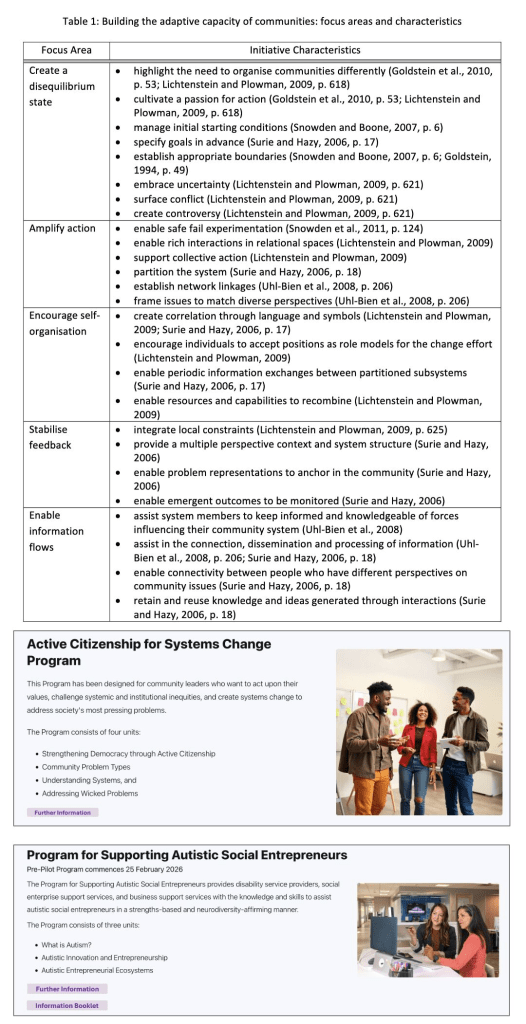
Looking forward to using this system transition framework from my 2014 PhD in two programs that Community Capacity Builders is piloting in the next couple of months. The framework is being used in an Active Citizenship for Systems Change Program that is being piloted with local government, and a Program for Supporting Autistic Social Entrepreneurs that is being piloted with a disability network. Does anyone know of any complex systems conferences being held later in the year? I’m keen to present the learnings from these pilots.
The Spark: Cuts and Constructivism in Cybernetics I was inspired to write this by Harish’s terrific post, An Introduction to Cybernetic Constructivism. It struck a chord with my ongoing interest understanding Biological Constraints or the Cybernetic Cut.

 Systems Community of Inquiry
You must be logged in to post a comment.