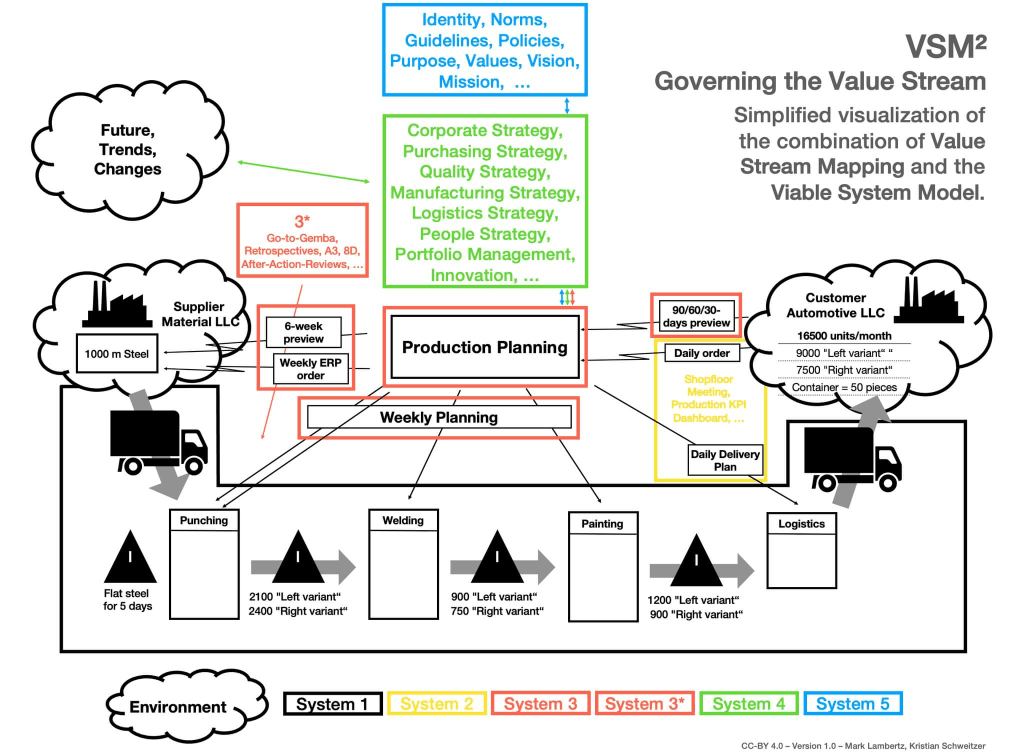
Exciting news! I am thrilled to announce the first version of the combination of Value Stream Mapping and the Viable System Model, known as VSM². This concept originated from a conversation that took place in 2017 between Kristian Schweitzer and me. With VSM², you can understand how to govern a value stream more clearly and precisely.
We believe that VSM² allows a holistic view of a value-creating system by integrating the input-output-logic of the Value Stream Mapping with the steering logic of the Viable System Model.
Kudos to Martin Pfiffner for the methodology to apply the Viable System Model and respective aspects like the coloring system for the model.
We look forward to sharing more updates on VSM² in the near future!
In reviewing the original introduction for Systems Thinking: Selected Readings in the 1969 Penguin paperback, there’s a few threads that I only recognize, many years later.
In the selection of papers for this volume, two problems have arisen, namely what constitutes ‘systems thinking’, and what systems thinking is relevant to the thinking required for organizational management? The first problem is obviously critical. Unless there were a meaningful answer, there would be no sense in producing a volume of readings in systems thinking in any subject. A great many writers have manifestly believed that there is a way of considering phenomena which is sufficiently different from the well-established modes of scientific analysis to deserve the particular title of systems thinking. Reasons for believing that the distinction is of…
[I note that bizarrely they are still stuck in the 19th Century referring to ‘chairmen’, but hey ho]
11th WCSA WORLDWIDE HYBRID GLOBAL CONFERENCE
BRUSSELLS SEPTEMBER 10th to 15th, 2023
CONFERENCE VENUE ON SITE & ONLINE by ZOOM
SECTION ONE (I): PROLOGUE & WCSA PRESIDENTIAL ANNOUNCEMENT
As the current President of the World Complexity Science Academy (WCSA), a European-based policy-modeling think-tank headquartered in Bologna, I am delighted to launch the “2023 WCSA General Call for Papers and Panels” for our 11th Worldwide Conference in Brussels. The conference will take place hybrid, from September 10th to 15th. The conference is hereby titled:
Cybernetics #1, #2 & #3This is just a recap on different “types” of Cybernetics, at a time when there is huge overlap with Systems Thinking, Complexity Sciences and Operations Research. As you may already know, I’m sceptical of definitions being definitive in general – natural language – discourse, beyond logical – formal symbolic – arguments. That matters because most human affairs are complex and their management or governance are the former not the latter.
This is a Survey of work in progress on Inquiry Driven Systems, material I plan to refine toward a more compact and systematic treatment of the subject.
An inquiry driven system is a system having among its state variables some representing its state of information with respect to various questions of interest, for example, its own state and the states of potential object systems. Thus it has a component of state tracing atrajectory though an information state space.
2021/06/16 Keekok Lee | Philosophy of Chinese Medicine 1Posted on April 19, 2023 by daviding — Leave a commentThe philosophy of science underlying Classical Chinese Medicine, in this lecture by Keekok Lee, provides insights into ways in which systems change may be approached, in a process ontology in contrast to the thing ontology underlying Western BioMedicine. This online web video lecture is a complement (and update) to two prior books:
Apr 14 2023
stephenreid321
What is the metacrisis?
The metacrisis, a term popularized by Daniel Schmachtenberger, refers to the systemic and interdependent nature of the various crises facing humanity, which are driven by the misalignment between our technological capabilities, social systems, and underlying value structures. It highlights the interconnectedness of issues such as environmental degradation, socioeconomic inequality, political instability, and technological risks, emphasizing that the resolution of one crisis cannot be truly achieved without addressing the others. The metacrisis underscores the necessity for a comprehensive, cooperative, and paradigm-shifting approach to problem-solving, demanding a transition from a competitive, zero-sum mindset to one that prioritizes collective well-being, long-term resilience, and the flourishing of all life on Earth.
Story of the match funding round
Between Jul 2022 – Jan 2023, Daniel and Kevin Owocki had three conversations on the metacrisis on the Green Pill podcast:
…continues in source
https://forum.metacrisis.xyz/t/metacrisis-match-funding-round-call-for-applications-and-further-sponsors/443/1
The Integral Stage
By Bruce Alderman / Layman Pascal
GAMEIFYING REALITY w/ Bobby Azarian
Cognitive neuroscientist and science writer, Bobby Azarian, returns to the Integral Stage for a deep and wide-ranging discussion of the emerging scientific paradigm — the complexity science paradigm arising out of the intersections of physics, biology, neuroscience, and information theory — that will likely shape self, culture, and society for the next century. If the universe is now known to be self-organizing through levels of developmental emergence, and if we are, as Carl Sagan once said, “a way for the cosmos to know itself,” what really are the implications of such a view for all the domains of life that matter to us? This perspective, of course, is in its general outlines very similar to the one Ken Wilber outlined in Sex, Ecology, Spirituality, but the science has developed since Wilber published SES; so Bobby and Layman explore those developments, and how they further reinforce, and in some cases update, the synthesis Wilber offered several decades ago. Bobby Azarian is a cognitive neuroscientist (PhD, George Mason University), a science journalist, and author of the book The Romance of Reality: How the Universe Organizes Itself to Create Life, Consciousness, and Cosmic Complexity. He has written for The Atlantic, The New York Times, BBC Future, Scientific American, Slate, The Huffington Post, Quartz, The Daily Beast, Aeon, and others. His research has been published in peer-reviewed journals like Human Brain Mapping, Cognition & Emotion, Acta Psychologica, and Philosophical Transactions of the Royal Society. His Psychology Today blog (Mind in the Machine) has received over 8 million views, making it one of the most popular blogs on the website. He has been a guest on The Joe Rogan Experience, the Michael Shermer Show, The David Pakman Show, The Jim Rutt Show, The Young Turks, the Singularity University podcast, and many others. He helped develop multiple episodes for Season 2 of the YouTube Premium series Mind Field, which won the show its first Emmy nomination. He is a pro at audio and music production, and is currently working on an educational podcast based on his new book.
the last evening of the web meeting cycle on biophilia in which, for four Thursday evenings from 21.00, two people talk and discuss the topic of biophilia declined through different perspectives



 Systems Community of Inquiry
You must be logged in to post a comment.