Notas, artículos y reflexiones sobre cuestiones vinculadas a los problemas de la educación y la sociedad destinadas a profesores y estudiantes de filosofía y ciencias sociales
Osvaldo Dallera
lunes, agosto 07, 2023
Los sistemas psíquicos en la teoría de Niklas Luhmann
Systems thinking is this generation’s lifebuoy. It’s the only way to accurately observe our world, assess its complexity, and design and implement sustainable solutions. Our long-term survival depends upon it.
This article is part one of a two-part series that explores some of the world’s greatest systems thinkers of modern times. It highlights what makes them so good and how they continue to inspire us in our work as system analysts and to improve our systems dynamics tools in theSiD omnibus book.
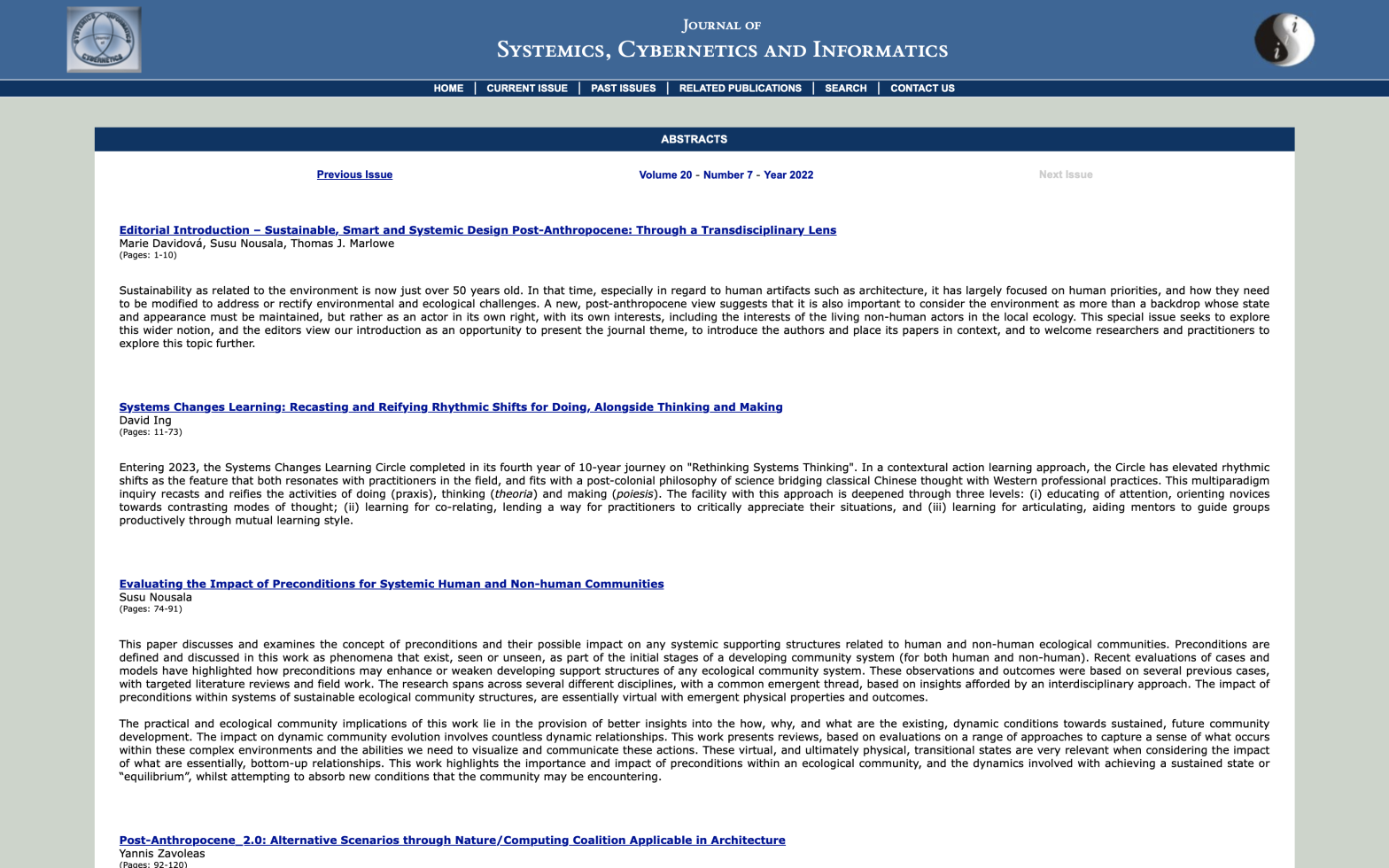
The Special Issue announced in the past years is published and public! The project was carried out by our CSRP Editorial Team: Marie Davidová, Susu Nousala and Thomas J. Marlowe. The contributing Authors are David Ing, Yannis Zavoleas, Xiao (Bella) Hu, Magda Sibley and Ana Zimbarg. The process was warmly supported by Dr Nagib Callaos and Jelena Sucic.
Follows the abstract of the editorial introduction and the full document with the links to the papers.
Abstract: Sustainability as related to the environment is now just over 50 years old. In that time, especially in regard to human artifacts such as architecture, it has largely focused on human priorities, and how they need to be modified to address or rectify environmental and ecological challenges. A new, post-anthropocene view suggests that it is also important to consider the environment as more than a backdrop whose state and appearance must be maintained, but rather as an actor in its own right, with its own interests, including the interests of the living non-human actors in the local ecology. This special issue seeks to explore this wider notion, and the editors view our introduction as an opportunity to present the journal theme, to introduce the authors and place its papers in context, and to welcome researchers and practitioners to explore this topic further.
This document is a case study bank of systems thinking for civil servants. It is one component of a suite of documents that aims to act as a springboard into systems thinking for civil servants unfamiliar with this approach. These documents introduce a small sample of systems thinking concepts and tools, chosen due to their accessibility and alignment to civil service policy development, but which is by no means comprehensive. They are intended to act as a first step towards using systems thinking approaches to solve complex problems and the reader is encourage to explore the wider systems thinking field further.
Hughes, Alan and Ulrichsen, T. (2019) Value Chains, Systems Thinking and Science, Technology and Innovation Policy:Implications for place based policy development in the UK A Critical Assessment. Institute for Manufacturing, University of Cambridge, Cambridge.
A core philosopher deeply aligned with a lot of contextualised systems | cybernetics | complexity, and of course deeply linked to her teacher/mentor and friend, Wittgenstein, whose posthumous work she translated and edited. (Note mostly to self: I hadn’t realised until this show how she connects Wittgenstein and Alasdair MacIntyre, another deeply systems | cybernetics | complexity philosopher).
I sometimes get asked which organizations are doing systems innovation. So here is my very subjective list of the organisations I find most interesting in this area*

 Systems Community of Inquiry
You must be logged in to post a comment.