link at https://twitter.com/Meaningness/status/1672763417948745728
The piece he’s commenting on is in Nautlius, ‘the man who tried to redeem the world with logic’, by Amanda Gefter – I’m sure I can’t find it here but (once again demonstrating that search for syscoi.com is rubbish), I can’t find it.
Our new paper with Masanao Igarashi and @h_shimazaki about the nonequilibrium thermodynamics of large, disordered networks (the asymmetric SK model) was just published in Nature Communications 😀https://t.co/GrIo4RjNTA
about the nonequilibrium thermodynamics of large, disordered networks (the asymmetric SK model) was just published in Nature Communications 😀 https://nature.com/articles/s41467-023-39107-y… Thread about the main ideas of the paper
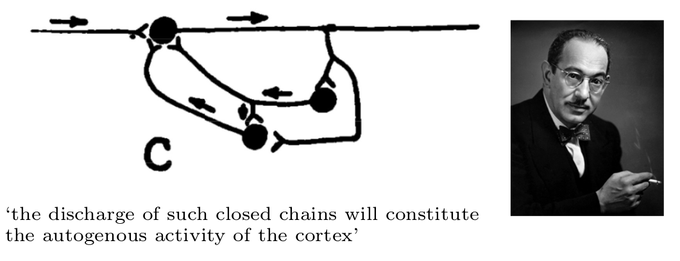
Brain circuits are generally asymmetrically connected, displaying reentrant connectivity and generating self-exciting activity. Perhaps one of the first to study it was Cajal’s student and cybernetic pioneer Lorente de Nó
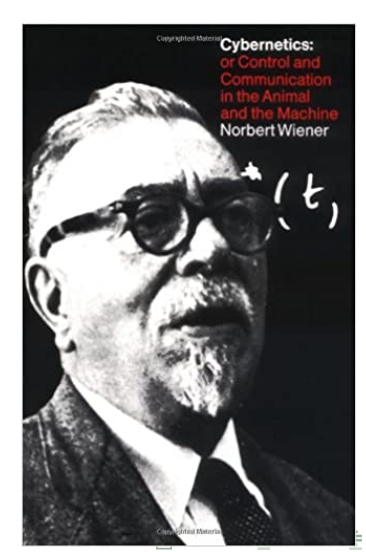
Lorente de Nó participated in the first Cybernetics meetings hosted by Norbert Wiener, who in the first chapter of his seminar book realizes that such asymmetric structures must be governed by the physics of nonequilibrium, irreversible processes
A classic example of an irreversible process is a cup breaking. A movie of a cup breaking feels perfectly natural, but watching the same movie backward is strongly unintuitive. This is because of the emergence of an arrow of time of the entropy dissipated by the cup shattering
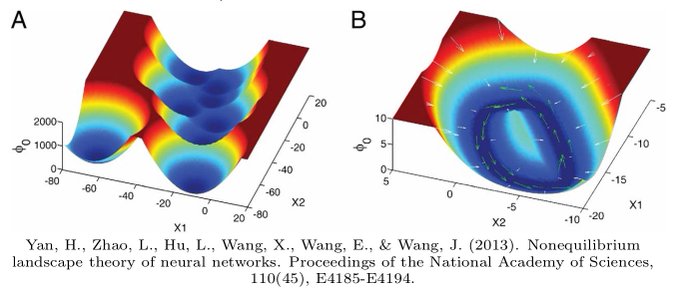
Neural and other networks can display a similar process. Networks in equilibrium (A) have attractors that organize the activity of the network, but behaviour is reversible. Networks out of equilibrium (B) can display interesting irreversible phenomena, like oscillations and chaos
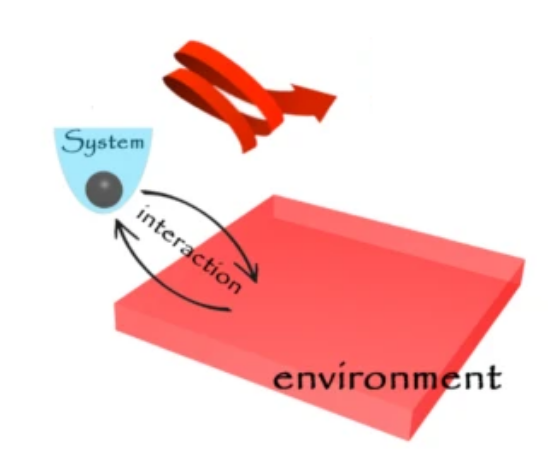
Thermodynamically, out-of-equilibrium dynamics must dissipate entropy to the environment to sustain such irreversible activity. Thus, entropy production is a measure of the emergence of such dynamical dissipative structures
TL:DR — It is impossible for organisations to “demonstrate their impact” if they work in complex environments. Asking them to do so requires them to create a fantasy version of the story of their work. This corruption of data makes doing genuine change work harder because it is difficult to learn and adapt from corrupted data.
The Department for Environment, Food and Rural Affairs (Defra) is the UK government department responsible for improving and protecting the environment, growing the economy, sustain thriving rural communities and support our food, farming, and fishing industries.
The government has set ambitious commitments through the Environment Act, the Net-zero strategy, the food strategy, and the Plan for Water. These commitments will interact with our food system, land-use system, resource and waste flows, rural economies and communities and natural environment. To deliver these commitments our policies need to be coherent with the real-world systems that they affect, and systemic insights are essential for ensuring policy coherence.
Applied systems analysis is in high demand in Defra and we have three exciting opportunities to develop systemic insights in cross cutting and complex areas. You will join the Defra Systems Research Programme (SRP) which was established in 2019 to embed systems research principles in Defra’s policy, evidence, and research activities.
An unusual source and nisam znala ko George Rzevski – who I invited to speak at SCiO many years ago – was Serbian.
More and more founding figures of Artificial Intelligence are making tsunami-scale waves with headlines of imminent doom. Our community can boast one such innovator who is celebrating his 90th year with an open invitation to hear him speak on how our lives will change.
A Workshop in Honour of Emeritus Professor George Rzevski
10:00 – 16:00
Wednesday 21st June 2023
Systems Seminar Room, Walton Hall
For half a century George Rzevski has made many original contribuons to Arficial Intelligence, Complexity Science and Design. What sets George apart from many other researchers in these fields is successful praccal applicaons in areas such as dynamic scheduling of taxis, a fleet of oil tankers, and private jet aircra. George has published widely on his work. His latest book, The Future is Digital: How Complexity and AI will Shape Our Lives and Work, will be published this year by Springer.
09:30 – 10:00 Welcome
10:00 – 11:00 George Rzevski – How Complexity and AI will Shape our Life and Work
11:00 – 11:30 Coffee
11:30 – 13:00 Phil Picton – Deep Learning – What’s New? Soria Psoma – Biosensors for Intelligent Healthcare Systems Vikram Goolaup – Spintronics Neuromorphic Systems Miguel Valdez – AI, Complexity and Starship robots Marian Petre – to be announced Viktoriya Pyeshkova – to be announced Jeff Johnson – AI, Complexity and Designing the Future
13:00 – 14:00 Lunch Break
14:00 – 15:30 Serhan Cosar – Machine Vision and Robocs Alistair Wyllis – to be announced Claudia Eckert – The Data Challenge in Complex Engineering System Design Jon Hall – to be announced Lucia Rapano – to be announced Ihor Sobianin – Harvesng Energy for Bio-implants Anthony Lucas-Smith – to be announced
15:30 – 16:00 Coffee and Discussion: Is Arficial intelligence a subfield of Complexity Science? Everyone is welcome to attend, and everyone is invited to give a 5-minute presentation on their ideas. The more controversial the better !
Nuova edizione 2023-2024Mancano pochi giorni alla presentazione dell’Executive Master in Complexity Management in partenza a settembre. Il Master ha lo scopo di generare nei partecipanti la capacità di comprendere, riconoscere, padroneggiare con consapevolezza ed affrontare con efficacia scenari e situazioni complesse. È indirizzato a tutte quelle persone che desiderano sviluppare nuove capacità per affrontare con efficacia la complessità delle situazioni, per acquisire un nuovo stile di management orientato alla cura delle relazioni interpersonali e di contesto. Quando:15 giugno 202321.00-22.30Web Meeting | Zoom La partecipazione è gratuita con iscrizione obbligatoria tramite EventbritePer registrarti alla serata di presentazione clicca quiCOMPLEXITY LOUNGE #11 Giunge all’11° appuntamento l’incontro riservato alla Community del Complexity InstituteUn appuntamento settimanale, per vivere la nostra community, riservato alle persone associate, per chiacchierare in relax e conoscerci. Questo è il Complexity Lounge. Continuiamo a sperimentarlo insieme! Ogni martedì 18.30 – 19.00 su Zoom
Uno spazio dove generare sinergie inaspettate! Parlando di complessità, arte, filosofia, gite in barca, letture, organizzazioni, intelligenza artificiale e… chissà che altro!Per saperne di più clicca quiIL FASCINO DELLA COMPLESSITÀ
Shockwave traffic jams that appear for no reason have been recreated for the first time. Researchers in Japan applied mathematical theory to cars on a race track to show how drivers breaking can trigger disruptions to traffic flow. Read more about the phenomenon at https://www.newscientist.com/article/…
The 1969 publication of Systems Thinking: Selected Readings, edited by Fred E. Emery as a Penguin Modern Management paperback, can be regarded as a milestone. The articles date from the 1940s to the 1960s, when the first wave of systems thinking was on the rise.
This session covered some basic idea in sections of the book, filled with colour commentary on personal history associated with systems researchers in the 1970s.
link https://coevolving.com/blogs/index.php/archive/systems-thinking-1969-hawk-pourdehnad/
Adam is joined by Dr James Fox to discuss the legacy of cybernetics and organizational theory, its Leftist critics, and the potential for a cybernetics of the commune, one which politicizes the dynamic systems of democracy at play in worker organizing. We discussed public attitudes to cyber-theory, the history of the field from Wiener to Bogdanov and Stafford Beer, and the use of machinic language from Deleuze to the CCRU. You can read all of the pieces from James we discussed today over at https://tektology.substack.com/ Also: Catch James’ talk on his work for the COVER centre at the University of Essex • Dis/agreement in … Support Zer0 Books and Repeater Media on Patreon: https://www.patreon.com/zerobooks Subscribe: http://bit.ly/SubZeroBooks Facebook: https://www.facebook.com/ZeroBooks/ Twitter: https://twitter.com/zer0books
SFI Complexity Interactive (SFI-CI) combines the dynamic interactions of an in-person course with the flexibility to learn from anywhere in the world. This two-week, part-time, online course offers participants a theory- and applications-based overview of complexity science. Complexity Interactive provides a foundation for thinking broadly about complex systems, encouraging participants to explore syntheses across systems in an open dialog with SFI faculty. The program’s size is limited to ensure everyone has ample opportunity to discuss with faculty and with each other.
In 2023, the curriculum will investigate modeling humans and social behavior, focusing on methods and approaches from complex systems science.
Live sessions take place 8:00–10:00AM Santa Fe local time (GMT-6), Monday – Friday. Participants are encouraged to self-schedule time for group discussion and a hackathon project.
The 2023 program registration fee is $300. A limited number of scholarships are available to participants who can articulate a need for support; scholarship application instructions will be provided upon acceptance into the program.
SFI-CI takes place online, using a variety of platforms, all of which are available at no cost but may require registration. Access to YouTube will be required to access recorded content.
As a computational sociologist, Program Director Tamara van der Does studies how individual beliefs and identities are influenced by social and cultural contexts. She is driven by a desire to investigate fundamental theoretical questions using innovative empirical approaches. Through her work at the Santa Fe Institute, she explored how models from physics, economics, and computer science can help us understand the interplay between individual beliefs, group identities, and social networks.
Project Coordinator Santiago Guisasola is a game theorist who specializes in mathematically modeling social and behavioral phenomena, with roles in both the private sector and in academia. Santiago served as the instructor for ComplexityExplorer.org‘s Introduction to Complex Systems course for several years, and he was a Complex Systems Summer School participant in 2016. He holds a PhD in Mathematical Behavioral Sciences from University of California, Irvine, and completed postdoctoral work at Instituto de Matemática Pura e Aplicada (Brazil).
The faculty comprises members of SFI’s research network and includes:
Complexity Interactive is aimed at practicing researchers and leaders from academic, private, non-profit, and government sectors. The curriculum is especially suited to graduate students and postdocs (or those at similar career stages) who wish to develop a trans-disciplinary approach in their work, as well as those who want a deeper look into the approaches of complex systems science as practiced at SFI.
The SFI-CI team is committed to offering inclusive educational programs in which all participants feel valued and supported in their learning journey. We believe that human diversity in all of its dimensions is essential to meaningful scientific progress. We believe that open discourse and respectful sharing of broad perspectives is essential for understanding our world. We work to ensure our educational programs reflect and encourage this diversity and inclusivity, and we welcome you to join us.
In my post today, I am looking at the idea of complexity from an existentialist’s viewpoint. An existentialist believes that we, humans, create meanings for ourselves. There is no meaning out there that we do not create. An existentialist would say, from this viewpoint, that complexity is entirely dependent upon an observer, a meaning maker.
We are meaning makers, and we assign meanings to things or situations in terms of possibilities. In other words, the what-is is defined by an observer in terms of what-it-can-be. For example, a door is described by an observer in terms of what it can be used for, in relation to other things in its environment. The door’s meaning is generated in terms of its possibilities. For example, it is something for me to enter or exit a building. The door makes sense to me when it has possibilities in terms of…






 Newsletter giugno 2023/02
 Questa comunità è un vero e proprio ecosistema che si ispira ai valori del

 As a computational sociologist, Program Director Tamara van der Does studies how individual beliefs and identities are influenced by social and cultural contexts. She is driven by a desire to investigate fundamental theoretical questions using innovative empirical approaches. Through her work at the Santa Fe Institute, she explored how models from physics, economics, and computer science can help us understand the interplay between individual beliefs, group identities, and social networks.
 Project Coordinator Santiago Guisasola is a game theorist who specializes in mathematically modeling social and behavioral phenomena, with roles in both the private sector and in academia. Santiago served as the instructor for


 Systems Community of Inquiry
You must be logged in to post a comment.