
Ashby’s Law of Requisite Variety
Ashby’s Law of Requisite Variety
https://daily.stoa.com/category/systems-thinking
A view or perspective on the world
Ashby’s Law of Requisite Variety
Ashby’s Law of Requisite Variety
https://daily.stoa.com/category/systems-thinking
The Complexity Lounge
New York, NY, USA
The study of complexity helps us to be open to new perspectives, consider non-linear non-causal relationships, and encourages an experimental mindset. We created the NYC Complexity Lounge to discuss Complexity Science, Complex Adaptive Systems, Organizational Change, and Agile / Adaptive approaches to work and everyday life. We share case studies and discuss the latest advances in complexity thinking. We also talk about sense-making principles and tools from the Cynefin Framework.
The Complexity Lounge
https://www.meetup.com/complexity-lounge/
Organizations and Subjectivism Pt. 1Published on September 14, 2022https://en.wikipedia.org/wiki/Tabula_RogerianaNovi MilenkovicNavigating Complexity5 articles FollowingPrefaceOrganization is a human way of dealing with the complexity of the world(1). When I say organization, I don’t mean strictly an enterprise, but any kind of formal or informal organization that brings people together under shared purpose or a promise of an incentive—from book clubs or social activism, to startups or corporations… Organization facilitates creation of order, and order is a low entropy state. It’s how we make our existence more bearable in a universe that otherwise craves disorder. It’s well prepared food, electric cars or skyscrapers that are built by organizing matter into states that could possibly occur, but are highly improbable. It’s the laws, theories or knowledge that we expand to decrease the uncertainty in the world. The entropic concept I’m referring to is not thermodynamic entropy, but statistical entropy, which is a property of a probability distribution, not a real system, and as such is lacking any inherent semantics, it’s a purely syntactic concept(2) If something is ordered it is constrained to the point where future outcomes are predictable as long as the constraints can be sustained(3). It does not matter if we talk about service (an activity) or a product (a physical or a digital object), if the constraints are clear and the causality is linear—it’s order. Consequently, if we understand the causality, we can replicate the outcome.
(1) Organizations and Subjectivism Pt. 1 | LinkedIn
The thermodynamics of life taking shapeby Institute of Industrial Science, The University of Tokyo (UTokyo-IIS)
The thermodynamics of life taking shape
Complexity and LeadershipEdited By Kiran Chauhan, Emma Crewe, Chris MowlesCopyright Year 2023Paperback£34.99Hardback£120.00eBook£31.49ISBN 9780367551599Published September 12, 2022 by Routledge266 Pages
Complexity and Leadership – 1st Edition – Kiran Chauhan – Emma Crewe
#NewMacy Studios @RSD11
#NewMacy Studios @RSD11 · #NewMacy
by NewMacy 22/8/2022
Pille Bunnell, Carlos Castellanos, Damian Chapman, Kate Doyle, Xiao Zoe Fang, Mikal Giancola, Michael Lieber, TJ McLeish, Paul Pangaro, Eve Pinsker, Eryk Salvaggio, Larry Richards, Fred Steier, Mark Sullivan, Claudia Westermann
#NewMacy emerged in March 2020 as the pandemic of COVID became the newest global wicked challenge. Since then little has changed in the fights against pandemics of biology and technology, racism and structural inequities, environment and economics. We embrace the timespan of RSD11 as “the long now” in recognition that these systemic challenges require new scales of effort and expectation across generations. We invoke the original Macy Meetings, which arose from a recognition that understanding purposive systems would be essential for addressing the failures of WWII. In the 21st-century, #NewMacy catalyzes conversations for action across disciplines, geographies, and generations through systemic principles, processes, and communities. #NewMacy creates conditions for enacting productive responses among individuals and communities that bring about change in the near-term, while planning for and committing to the time-span required to effect lasting change.
Our current focus is a new framing for “ontogenesis,” specifically, that of developing new ways of becoming. To survive in a changing world, we must embrace resilience in lieu of security interpreted as constancy. Hence we substitute ontogenetic resilience as our framing intention — and Cybernetics as key.
How might we practice ontogenetic resilience? We begin by embracing the human as the basic unit of change. Conversation is the unifying process. We adopt a structure of themed and design-led “Studios” that are explorations of ontogenetic principles. These Studios identify cultural sites where ontogenetic resilience is needed and where we may pursue inclusive and recursive modes of experimentation. The purpose of the #NewMacy Studio construct is to enable deep participation through activities such as prototyping, play, exploration, enactment, and improvisation. The following Studios at RSD11 will enact conversations for action across the middle days of the symposium:
After the Studios we will all gather for a final conversation to consider: What’s next? How do we grow into an increasingly inclusive ecosystem of Studios? What new, vital activities will we design? The dialogue, collaboration, and matchmaking performed in this session serve as the means for a recursive process of integration and synthesis, one directed toward ongoing, empathetic, intelligent, and sustainable action.
Keywords: Pandemics, wicked challenges, second-order Cybernetics, systemic change, ontological security, conversation, ontogenetic resilience, recursive feedback.
Stanislaw Ulam Memorial Lecture Series — The Story of Sync (Lecture II of II)Steven StrogatzCommunity Event7:30 pm US Mountain TimeSeptember 21, 2022Speaker: Steven Strogatz
Events: Stanislaw Ulam Memorial Lecture Series — The Story of Sync (Lecture II of II) | Santa Fe Institute
Thorbjørn Mann: The ‘Great Reseat’? (A slightly revised version of an earlier FB post.)
Another new, evil bugaboo if not just one more disguise or reincarnation of ‘socialist’, ‘neoliberalist’, but essentially authoritarian tyranny schemes?
I happened lo listen to a lecture urging resistance against the WEF-driven ‘Great Reset’ that is using humanitarian crises like the Covid-pandemic as levers for unprecedented transitions toward capitalist-state-controlled Big Brother tyranny. Using well-intentioned benevolent mass protection directives (or means that can be presented as necessary mass protection tools, like wearing facemasks, social distancing, vaccination) as opportuntities for getting people used to more freedom-destroying oppression. Getting strong impressions that these warnings and concerns are either perhaps well-intentioned but based on thoroughly misunderstood misrepresented nature and causes of the attacked evils, or just political ‘propaganda’ messages against the current administration — the very thing they accuse them of.
Assuming for a moment the interpretation of well-intentioned misunderstanding, but getting the direction of forces wrong: Some key considerations. (Numbered for convenience in responding, not to indicate any order of importance)
1. Must not ANY initiative for improvement — well-intentioned or equally just power-hungry for the sake of power — pursue some degree of POWER (‘empowerment’) to spread its ideas and get them adopted? Which also applies to any initiatives for resisting such initatives?
2. Must not ANY adoption of ‘new’, ‘innovative’ or ‘restoring’ (repairing, returning to previous good states) initiatives and provisions at governance level (requiring adherence by all members of a community) run up against some degree of RESISTANCE by ‘opposition’ groups perceiving loss of status, power, well-being, profit from the change?
3. Must not such opposition be expected, the more DECISIONS for adoption have been reached by decision methods that inadvertently or deliberately ignore or override the concerns of such segments of society, now feeling disadvantaged? Decision modes such as ‘leadership’ dictates or even majority voting, no matter how well accepted as the very essence of democracy?
4. Are not most if not all current governance tools aiming at ensuring common ADHERENCE to agreements (‘laws’), even by disavantaged parties, based on the notion of ‘ENFORCEMENT’ —that is, punishing violations by force or threat of force? Implied in the very term ‘enforcement’?
5. Will opposition resistance not have to seek and adopt reciprocal force against ‘law enforcement’ means — the more so, the more the very decision modes for law adoption prevent or distort or ignore other means of expressions of concerns by the disadvantaged parties? (Does this not include the ‘propaganda’ means of reckless mutual disputing / misrepresenting the intelligence, honesty, civil-mindedness, ethics, patriotism etc.?) (Isn’t the fact that the very groups insisting on ‘law and order’ (ensured by government) but also insisting on the second amendment interpretation of citizens right to own and carry — as protection against the very government they elected — orcefully if inadvertently making this point?)
6. Will such reliance on force and counter-force not lead to a continuing escalation of the tools (weaponry) of ‘enforcement’ and ‘resistance’? Escalation that can lead to internal civil war and revolution, and, on the larger, international level, given the increasing destructiveness of modern weaponry, utterly ‘MAD’ outcomes?
7. Do these mechanisms not, potentially, apply to ALL historical and current forms of governance — not just to ‘socialist’ or ‘facist’, ‘chinese communist’ or ‘chinese capitalist’ but also to the ‘democratic’ regimes that are increasingly bought by the big corporations and oligarchs, or taken over by the military? The common denominator being the LACK OF EFFECTIVE CONTROLS OF POWER?
Note that this conclusion does not imply nor justify the wholesale rejection of power: there are many situations in which effective public decisions will have to be made ‘fast’, by individuals properly empwered to make such decisions, without the benefit of thorough public discourse: On a ship encounering an iceberg in the ocean, a decision must be made ‘fast’ — pass the iceberg on the port or starboard side, with all necessary intemediate means for adopting the new course being followed by all affected members of the crew?
8. Regardless of the answers to these questions, does criticism of current ways of doing things not imply some responsibility of engaging in and encouraging development of a better PUBLIC DISCOURSE, supporting, even requiring, efforts of developing and discussing alternative, better ways? Should mere complaints and attacks on ongoing or proposed change, without concrete suggestions of better ways to deal with the problems, just be seen as political ‘propaganda’ in the interest of gaining political power but under the same basic conditions that generated the problems?
9. Would it not be presumptuous and preposterous for any single person to claim to have all the answers.? And that instead, as a collective species, the global humanity as much as smaller local communities, WE DO NOT HAVE A CONVINCING, UNIVERSALLY ACCEPTABLE MODEL FOR SURVIVAL – YET. Could it not even be argued that humans are a designing, planning species with every generation wanting to develop its own ‘NEW’ definition, vision, design, plan for what it means to be human, and that it should be ‘empowered’ to do so, and that any ultimate ‘RESET’ model would be the wrong answer?
So attempts (Including my own musings) to offer some thoughts for improvement should be seen as efforts to respond to that responsibility of #8 above, as encouragements to develop, engage in, and offering initial contributions and proposals to the necessary public discourse, not as some ultimate panacea. Some urgently needed considerations and efforts may ibclude the following:
10. There are many efforts, theories, initiatives, experiments and proposed ‘models’ already being developed and implemented all over the world. They are diverse, not all agreeing on the same principles and assumptions, and arguably not communicating well either with similar initiatives or a wider public. But should they not be encouraged and supported, by the global community? Perhaps on some conditions: for dample, of:
10.1 Remaining ‘local’ (in the sense of respecting, tolerating neighboring and existing systems — until common larger, even global agreements have been reached by satisfactory and peaceful means;
10.2 Comprehensibly sharing their ideas and experiences (sucesses, obstacles, and failures) as well as proposals for wider adoption in a global repository for mutual learning, discussion and evaluation;
10.3 Refraining from any form of violent, deceitful, or otherwise coercive attempts to impose their provisions on other parties.
11 Encouraging the development of a ‘PUBLIC PLANNING DISCOURSE SUPPORT PLATFORM’ both to facilitate access to the respository of innovation / restoration initiatives, and the support discussion of necessary ‘global’ agreements (common ‘road rules’ akin to the decision to drive on the right or left side of the road…)
12 The PUBLIC DISCOURSE sjould aim at common decisions based on the quality and MERIT of information and contributions to the discourse, and contain:
12.1 INCENTIVES for wide open and speedy public participation;
12.2 Standard INFORMATION SUPPORT (Similar incentives, research etc.)
12.3 TECHNIQUES AND PROCEDURES for structured discourse without excessive repetition, disruptive and flawed contributions but concise, effective overview of the whole spectrum of contributions;
12.4 Optional provisions for SYSTEMATIC EVALUATION of contribution MERIT (e.g. the merit or proposals or proposal improvement ideas, or of arguments pro or con proposals);
12.5 Development and provisions for DECISION-MAKING (Recommendations, agreements) based on contribution merit (rather than on shortcuts such as majority voting which systematically disregards minority concerns, and in itself is inapplicable to projects and problems transgressing traditional the boundaries of governance entities where the numbers of voters can be meaningfully defined…)
13 Efforts should be increased to the development of NEW tools for ENSURING ADHERENCE of decisions and agreements, as much as possible based on automatic prevention of violations (triggered by the very attempt of violation) rather than violent or coercive ‘enforcement’.
14 High priority should be given to the development of better provisions for the CONTROL OF POWER, aiming at preventing the escalation of power and power tools and the corresponding intesity of opposition.
Tentative ideas for innovative techniques and tools related to the above items 10, 11, 12, 13, and 14 have been proposed for discussion in my papers on Academia.edu, FB, LI, books, and Abbeboulah.com blog; pfd files can be sent by email to interested people upon request (by FB message or email: abbeboulah@yahoo.com). None of these platforms are yet suitable venues for the structured discourse needed even for discussing these suggestions.

‘Wrong Question?
RIP Richard Cook.
Velocity 2012: Richard Cook, “How Complex Systems Fail”
Velocity 2012: Richard Cook, “How Complex Systems Fail” – YouTube
See also
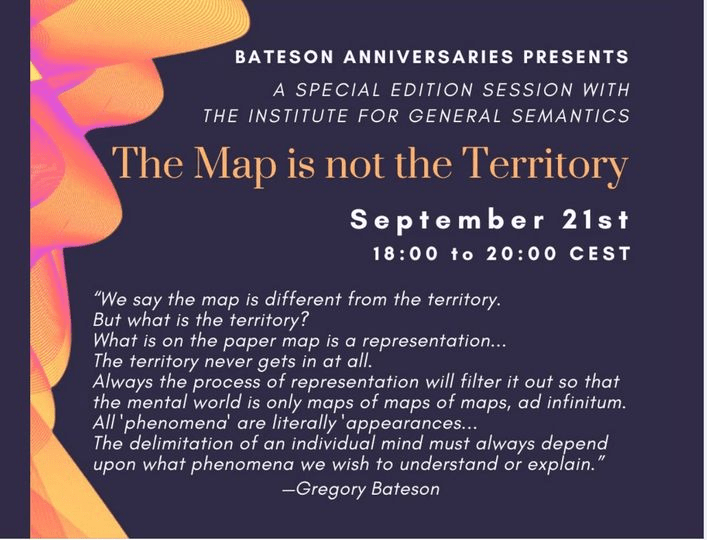
BATESON ANNIVERSARIES WITH THE INSTITUTE FOR GENERAL SEMANTICS
“The Map is not the Territory”
WEDNESDAY—September 21st
REGISTER HERE TO GET THE LINK
Zoom Link to register: https://us06web.zoom.us/…/tZEtcOyvrDktEtIz83D28ghubNCQu…
We are excited to invite you to the Bateson Anniversaries special two-hour session with The Institute for General Semantics titled—The Map is not the Territory—a term famously coined by Alfred Korzybski. We share the following essay before our session, taken from the text of Gregory Bateson’s talk at the Alfred Korzybski Memorial Lecture in 1970—Form, Substance and Difference.
Bateson reminds us that the differences are what make it on the map and that differences have differences. What differences do you perceive?
“We say the map is different from the territory. But what is the territory? What is on the paper map is a representation…The territory never gets in at all. Always the process of representation will filter it out so that the mental world is only maps of maps of maps, ad infinitum . All ‘phenomena’ are literally ‘appearances’… the delimitation of an individual mind must always depend upon what phenomena we wish to understand or explain.” (Gregory Bateson, 1970)
In 1933, decades before the Memorial Lecture, Korzybski writes,
“Two important characteristics of maps should be noticed. A map is not the territory it represents, but, if correct, it has a similar structure to the territory, which accounts for its usefulness. If the map could be ideally correct, it would include, in a reduced scale, the map of the map; the map of the map of the map; and so on, endlessly… If we reflect upon our languages, we find that at best they must be considered only as maps. A word is not the object it represents; and languages exhibit also this peculiar self-reflexiveness, that we can analyze languages by linguistic means. This self-reflexiveness of language introduces serious complexities… The disregard of these complexities is tragically disastrous in daily life and science. (Alfred Korzybski, Science and Sanity: An Introduction to Non-Aristotelian Systems and General Semantics, 1933, p. 58).
We look forward to digging into the territory together with you.
Please register below to receive the link:
THE BATESON ANNIVERSARIES SPECIAL SESSION—THE MAP IS NOT THE TERRITORY
Registration link
FINANCIAL AND MONETARY SYSTEMS
Everything from technology to living organisms is becoming more complex. This is why
Aug 30, 2022
This article is published in collaboration withThe Conversation.
Complexity can develop the ability to manage, control and navigate the complexity it has constructed.
Ragnar van der Merwe
PhD Candidate, Department of Philosophy, University of Johannesburg
Alex Broadbent
Professor of Philosophy of Science, Durham University
How to navigate an increasingly complex world | World Economic Forum
20 Systems (over) Thinker Tips
Download a high-resolution PDF or PNG of my infographic of John Cutlers “20 Things I’ve Learned as a Systems (over) Thinker”
It’s based on his blogplost that you can read here.
https://cutlefish.substack.com/p/20-things-ive-learned-as-a-systems
Download the infographic in English here: PDF / PNG
20 Systems (over) Thinker Tips – Context specific agile, product, and systems coaching
This is the end-August monthly events mailing from SCiO. Click on the group titles below to go to the events that interest you. Please remember that you can attend online events organised by any of the SCiO groups if they are held in a language you speak/understand. Further details of events may be available by clicking on the event titles below and you can also book each event directly from the Book now text. See also directly below for the first AGM notification for members.
The SCiO UK Open Event in September will be live and held in Manchester. Some groups post events quite late, so it is always worth checking the website – also for changes to dates and times. Please click here to see all the events in a browser.
The Cherith Simmons/SCiO Apprenticeship now has a revised start date of 22nd September and is still taking registrations and expressions of interest. For more information click here.
Steve
SCiO – Systems & Complexity in Organisation
Mobile 07712 140422
e-mail steve.hales@systemspractice.org
website www.systemspractice.org
This message is confidential to the intended recipient. It does not constitute a legally binding document on the part of either the sender or the recipient. If this message has been received by you in error please reply to: steve.hales@systemspractice.org with UNSUBSCRIBE as the title
Systems and Complexity in Organisation Ltd is a company registered in England with Company Number: 3499590 Registered address: Unit 14 Tower Street, Brunswick Business Park, Liverpool, Merseyside, England, L3 4BJ
______________________________________________________________
SCiO Open Meeting – 12th September 2022
Mon 12 September 2022 09:30–17:00 GMT+1
Face-to-Face Open Meeting: A new series of speaker presentations of interest to Systems & Complexity in Organisation’s members and others. This session will be held in the Alliance Manchester Business School, high up in the Penthouse, and is the first post-Covid face-to-face event to be held by SCiO in the UK. We’re looking forward to seeing you!
A case study of warping and weaving systems methods – Niki Jobson (Dr)
Mechanisms of Self-Creation in Living Beings and Organizations – Clemens Dachs (Dr)
Designing Democracy – Robin Asby (Dr)
Critical Social Learning Systems: an inquiry, case study and some learning – Tony Korycki
Penthouse Room, Manchester Business School, Booth Street West, MANCHESTER M15 6PB UK,
All welcome; £30; English; Book now
SCiO UK Virtual Development Event – October 2022
Tue 18 October 2022 19:00–21:00 GMT+1
SCiO’s Development Days offer an opportunity to draw upon the collective expertise of SCiO members in a friendly and supportive atmosphere. By taking Development Events online, using the Zoom meeting platform, we aim to make them accessible to more SCiO members Development Events are both for members who are just starting out on a journey to explore Systems Thinking approaches, and for those who have many years of exploration and practice…. Read more
Members only; FREE; Online event; English; Book now
______________________________________________________________
Tue 13 September 2022 18:00–20:00 CET+1
Een veranderproces start meestal met het uitkristaliseren van het ‘waarom’, de ‘verwachte opbrengsten’ en een ‘transformatie hypothese’. De ‘transformatie hypothese’ is meestal het onderdeel in de verhaallijn die duidelijkheid verschaft over hoe de transities concreet gerealiseerd kunnen worden, rekening houdend met cultuur, processen en ecosystemen. Althans, dat is de theorie. In praktijk merk je dat de veranderkundige verhaalllijnen vaak uitblinken in eenvoud en gefragmenteerde actiestappen; en zelden rekening houden met de verschillen in perspectief-inname van betrokken partijen. Het systemische perspectief blijft ook heel vaak beperkt tot een klein aantal betrokkenen die gefrustreerd zijn dat collega’s onvoldoende integratief en holistisch kunnen denken. De eenvoudige verhaallijnen leiden tot weerstand en het over het hoofd zien van kritische interafhankelijkheden, wat op haar beurt vertragingen en herwerk creëert. Hoe je hiermee omgaat, en welke condities je kan creëren om transformatie in goede banen te leiden vormt het onderwerp van deze bijdrage die gebaseerd is op het boek ‘Geen samenwerken zonder samendenken’.Belgium
All welcome; FREE; Online event; Dutch; Book now
SCiO Belgium – VSM deep dive sessie 1 – Strategisch management: twee VSM ontwerppincipes uitgelicht.
Tue 11 October 2022 18:00–20:00 CET+1
In de deep dive cylcus nemen we het Viable System Model in-depth onder de loep en toetsen we dit aan de praktijk.
De cyclus zoomt in op het praktisch maken van het werk van Stafford Beer, aan de hand van de publicaties van één van zijn belangrijkste leerlingen, nl. Fredmund Malik.Strategisch managment wordt door Stafford Beer beschreven als een meta-ststemisch controlemechanisme voor complexe systemen. Eén van de cybernetische uitgangspunten hierbij is dat je nooit het volledige detail kan beschrijven van hoe complexe systemen werken. Vanuit deze hypothese maakt het dan ook geen zin om een zekere authoriteit de verantwoordelijkheid te geven voor het management van informatiestromen en kennisprocessen. Effectieve controle bereik je door in te zetten op een hoger niveau, namelijk via principes die zelfsturing en zelfregulatie mogelijk maken. De principes laten een indirecte sturing van complexe systemen toe. We bespreken er twee, namelijk (1) het principe van compleetheid van structuren, en (2) het principe van relatieve autonomie. Vervolgens bespreken we hoe deze in eigen cases een rol spelen.
Members only; FREE; Online event; Dutch; Book now
______________________________________________________________
SCiO DACH (Deutschland, Österreich, Schweiz)
SCiO DACH – Einführung in das Viable System Model
Thu 15 September 2022 19:00–20:00 CET+1
Einführung in das Viable System Model durch Carola Roll. Der Termin richtet sich an „VSM-Neulinge“, aber auch an alle Interessierten, welche sich eingehend mit den Basics des Models beschäftigen wollen. Nach der Präsentation und einigen Beispielen aus der Praxis besteht die Möglichkeit, Fragen zu stellen und zur allgemeinen Diskussion.
All welcome; FREE; Online event; German; Book now
______________________________________________________________
SCiO Espana – La dinámica del diálogo trabajando con el Modelo de Sistema Viable
Tue 4 October 2022 19:00–21:00 CET
In English: Ponente: Jan De Visch. Executive Professor Human Capital Management at Flanders Business School, and Managing Director at Connect & Transform.
En esta conferencia, Jan revisará el proceso por el que los empleados dan sentido a los sistemas en los que trabajan y cómo este influye el diálogo entre ellos. La pregunta central es si los empleados, trabajando como un equipo, serán capaces de integrar las distintas perspectivas para una mejor toma de decisiones.
El trabajo de Staford Beer ilustra la naturaleza fractal de los sistemas organizados (como las organizaciones), esto significa que la estratificación del trabajo puede ser distinguida desde los niveles más sencillos hasta los más complejos. Sin embargo, nadie trabaja a un solo nivel, y suelen sentirse más o menos cómodos dependiendo del nivel en el que están, generando tensión en las personas y los equipos. Jan nos mostrará que la consciencia y la gestión de esta tensión es el centro del proceso de desarrollo organizacional que ilustrará con un caso de estudio. Así mismo, nos mostrará una serie de herramientas para el proceso de co-diseño de la nueva organización.
La dinámica del diálogo trabajando con el Modelo de Sistema Viable – Jan De Visch
All welcome; FREE; Online event; English / Spanish; Book now
______________________________________________________________
SCIO-NL monthly meeting (live in Vianen and in Dutch)
Fri 9 September 2022 11:00–15:00 CET+1
SCIO-NL komt elke 2e vrijdag van de maand live bijeen in Vianen (Hagenweg 3c). Er staan geen vaste onderwerpen op de agenda (daarvoor organiseren we specifieke andere meetings), maar de ervaring leert dat er altijd wel een interessant gesprek op gang komt over een systemisch onderwerp.
Hagenweg 3c, Vianen, Netherlands
All welcome; FREE; Dutch; Book now
SCIO-NL monthly meeting (live in Vianen and in Dutch)
Fri 14 October 2022 11:00–15:00 CET+1
SCIO-NL komt elke 2e vrijdag van de maand live bijeen in Vianen (Hagenweg 3c). Er staan geen vaste onderwerpen op de agenda (daarvoor organiseren we specifieke andere meetings), maar de ervaring leert dat er altijd wel een interessant gesprek op gang komt over een systemisch onderwerp.
Hagenweg 3c, Vianen, Netherlands
All welcome; FREE; Dutch; Book now
Integrating a systems approach into Defra
Published 23 May 2022
Integrating a systems approach into Defra – GOV.UK
Document references:
Defra appoints six new Academic Fellows to lead Systems Research Programme (3 May 2019)
https://www.gov.uk/government/news/science-research-programme-launched-to-inform-defra-policy-making
This is my bag of tricks — patterns, rules-of-thumb, tools, cheatsheets, gimmicks, leverage points, questions, risks, and unknowns.
Patterns — Gordon Brander
See also ‘library’ page at
https://gordonbrander.com/lib

 Systems Community of Inquiry
You must be logged in to post a comment.