
Viable Systems Model: More Support Tools Needed
Marite Kirikova
Department of Artificial Intelligence and Systems Engineering, Riga Technical University, Riga, Latvia
Marite.Kirikova@rtu.lv
Abstract. Stafford Beer proposed a Viable Systems Model, which was supposed to support successful management of enterprises. Since then numerous research works have referred to that model in management, information systems, and computer sciences. However, in the area of enterprise modeling there is a shortage of tools that would give an opportunity to create detailed enterprise models that would adhere to the VSM and would also be applicable for advanced model visualization and analysis. If available, appropriate modeling tools could help to utilize such features of VSM as fractality, distributed control, and variety handling mechanisms; and provide the possibility of overall adherence to those principles of cybernetics that become increasingly important in modeling enterprises in a socio-cyber-physical context.
Keywords: VSM, fractal systems, service systems, variety management, distributed control
Category Archives: Discussion
A view or perspective on the world
THE EVOLUTION OF ORGANIZATIONAL CYBERNETICS – SCHWANINGER (2006)
Scientiae Mathematicae Japonicae Online, e-2006, 865-880
THE EVOLUTION OF ORGANIZATIONAL CYBERNETICS – MARKUS SCHWANINGER
Received April 24, 2006
ABSTRACT. The purpose of this contribution is to give an overview of the origins and further developments of Organizational Cybernetics, its transdisciplinary nature and its links to different areas of science, i.e., both natural sciences and the humanities.
Changing the system: Brian Eno and James Thornton in conversation | Science and Industry Museum
source:
Changing the system: Brian Eno and James Thornton in conversation | Science and Industry Museum
CHANGING THE SYSTEM: BRIAN ENO AND JAMES THORNTON IN CONVERSATION
TOGGLE BUTTON TO PLAY OR PAUSE THE VIDEO
Join Brian Eno in conversation with James Thornton, CEO and founder of ClientEarth, a pioneering environmental organisation, and discuss how we can use the power of the law to protect the planet. This special event will be chaired by science, natural history and environmental broadcaster Liz Bonnin.
Discover how we can use the power of the law to fight against climate change, protect the environment and build a future in which people and the planet thrive together.
Liz Bonnin will lead the conversation with Brian Eno, who is a dedicated climate campaigner and Trustee of ClientEarth as well as a renowned musician, record producer and visual artist, and James Thornton as they talk about their pioneering work using the law to bring about systemic change that protects life on Earth.
ClientEarth’s team of lawyers, scientists and policy experts have used their environmental expertise to achieve powerful change, from winning court cases over illegal air pollution, to writing laws to ensure that there will still be fish in the sea in the future.
Hear more about the landmark changes in law and policy which have been made possible by their work and discuss their predictions for the future and ideas for what we can all do to play our part.
Please note: This virtual event will not be available to watch again, so book a ticket to make sure you don’t miss out.
Book now to watch this event online.
This event is part of the Science Museum Group’s series of Climate Talks
Join Brian Eno in conversation with James Thornton, CEO and founder of ClientEarth, a pioneering environmental organisation, and discuss how we can use the power of the law to protect the planet. This special event will be chaired by science, natural history and environmental broadcaster Liz Bonnin.
Discover how we can use the power of the law to fight against climate change, protect the environment and build a future in which people and the planet thrive together.
Liz Bonnin will lead the conversation with Brian Eno, who is a dedicated climate campaigner and Trustee of ClientEarth as well as a renowned musician, record producer and visual artist, and James Thornton as they talk about their pioneering work using the law to bring about systemic change that protects life on Earth.
ClientEarth’s team of lawyers, scientists and policy experts have used their environmental expertise to achieve powerful change, from winning court cases over illegal air pollution, to writing laws to ensure that there will still be fish in the sea in the future.
Hear more about the landmark changes in law and policy which have been made possible by their work and discuss their predictions for the future and ideas for what we can all do to play our part.
Please note: This virtual event will not be available to watch again, so book a ticket to make sure you don’t miss out.
Book now to watch this event online.
This event is part of the Science Museum Group’s series of Climate Talks.
INFORMATION
- FREE FESTIVAL TALK
- DATE: Monday 15 February 2021
- TIME: 19.30
- PRICE: Free (booking essential)
- LOCATION: Online
- AGE: Suitable for ages 14 and older
book at source: FREE FESTIVAL TALK DATE: Monday 15 February 2021 TIME: 19.30 PRICE: Free (booking essential) LOCATION: Online AGE: Suitable for ages 14 and older BOOK TICKETS NOW
Changing the system: Brian Eno and James Thornton in conversation | Science and Industry Museum
A systems thinker thinks in systems about systems | Massimo Curatella
source
A systems thinker thinks in systems about systems | Massimo Curatella
by Massimo Curatella / 0 Comment
A systems thinker thinks in systems about systems
Thanks to the participants of this online discussion group, I had the opportunity to reflect upon the role and the identity of a system thinker.
A systems thinker is not a person who thinks about systems, a systems thinker is a person who thinks in systems, first, and then, maybe, about systems. Or, even better, a systems thinker is a person who thinks in systems about systems.
Systems Thinking is an outcome. You get to it if you consider all components of a system defined by an arbitrary boundary. You are part of the system you are considering. The thinking is demanded of your brain, the systemic outcome depends on if and how you are considering the relationships and the interactions between all components of the observed system. And this is just a starting point. I see no religion, no dogma, no convictions if you go through the approach of Critical Thinking and mitigating biases when you are observing, pondering, and intervening. I see Systems Thinking as a huge amount of work, requiring discipline, focus, concentration, and collaboration much needed to be more effective and efficient in letting the thinking be of elevated quality. That’s also why I think the best Systems Thinking thinking can happen in the context of facilitating collective intelligence composed of diverse, integer, generous people (and machines).
source:
A systems thinker thinks in systems about systems | Massimo Curatella
Metaphorum webinar series fornightly in the first half of 2021 – and appeal for future webinars
Weednesdays 5-6:30pm uk time, fortnightly from February 24th-May 26th
Following the first webinar in 2021 from Prof. Mike Jackson, we are pleased to announce the next webinar series which will run until the end of May. You can find the recordings of previous webinars on our webpage.
http://metaphorum.org/metaphorum-webinar-series
The program for the next three months is detailed below. See more details of each webinar on the link above.
We will be using the recurrent Zoom link for this webinar series:
Metaphorum Webinar Series
Join Zoom Meeting
https://us02web.zoom.us/j/81943981395?pwd=UldHZ0RESGVPQTE2RDNoSWU2UWt2Zz09
Meeting ID: 819 4398 1395
Passcode: 758276
For anyone interested in offering a webinar for the next series (Jun 2021 to Dec 2021), please contact us at Metaphorum.org@gmail.com, sending us the following information:
- name, title, description of the webinar, brief cvs with your picture
- dates on which you are NOT available (we run the webinar series on Wednesdays 5:00-6:30 pm UK)
We will review the proposals and will accept the most innovative and high- quality proposals (hopefully on new topics not presented before in other Metaphorum events). We shall let you know shortly after receipt of your proposal if it has been accepted and discuss your availability.
Best regards,
Angela, Allenna and Jon
METAPHORUM WEBINAR SERIES
AGENDA FEBRUARY – MAY 2021
| Date | Speaker | Title |
| February the 24th | Prof. Raul Espejo | “The Enterprise Complexity Model: An Extension of the Viable System Model for Emerging Organisational Forms” |
| March the 3rd | Dr. Martin Pfiffner | The third dimension of organizing |
| March 17th | Dr Igor Perko | Invoking AI technology in organisations – a systemic examination |
| March 31st, | Dr. Raghav Rajagopalan | Meta Rational Ways of Knowing |
| April the 14th | Dr Angela Espinosa | Sustainable Self Governance: Early alarms from the COVID19 Pandemic |
| April 28th | Dr. Alfredo del Valle | The Participatory Workspace (PWS): An online, complexity management and communications tool |
| May the 12th | Dr Allenna Leonard | A VSM reflection on US politics and democracy |
| May 26th | Dr. Bernhard Sterchi | Alignment and autonomy on the last mile of execution – in defense of the wriggly lines |
CybSights Insights: Putting on CyBeer Goggles( in public administration) Tickets, Tue 23 Mar 2021 at 18:00 UK time | £20 for CybSoc membership for the year
source:
CybSights Insights: Putting on CyBeer Goggles( in public administration) Tickets, Tue 23 Mar 2021 at 18:00 | Eventbrite
MAR 23
CybSights Insights: Putting on CyBeer Goggles( in public administration)
by CybSights: The Insights Series Following£0 – £20
Event Information
View the world as a cybernetician. Tim Falkiner explores POSIWID, isomorphism, & variety balance rooted in town planning & law.
About this Event
The Insights Series is an eclectic and learned collection of monthly events on the 4th Tuesday of each month hosted by Cybernetics Society. There will be lectures, seminars, conversations, debates, participation, all advancing our knowledge of cybernetics and related disciplines and their applications to real world needs.
Cybernetics is the science of achievement, the great meta-discipline of our time.
The CybSights Insights series is normally curated and hosted by the Secretary, Angus Jenkinson, FCybS. Attendance is free. Non-members are invited to make an optional donation or to Join.
In this session we welcome an Australian.
We are particularly delighted to be able to welcome Tim Falkiner with his experience in town planning, law, and legilstion with ‘homeskooled’ cybernetics.
Putting on our CyBeer Goggles
The underlying object of this discussion is to have the participants exercise their ability to think in cybernetic terms. To put on “cybeer” goggles and view the world as a cyberneticist. Cybernetics is a large field, but Tim has selected three cybernetic topics to explore. In three 25 minute segments, Tim will (i) explain what he understands of each topic; (ii) give some applications of that law or technique and (iii) invite the participants to give examples of how they apply the laws and techniques in their own professions or lives.
POSIWID The purpose of a system is what it does. Our purpose often defines the extent of the system or systems. It is helpful, in considering the purpose of a system from an objective, scientific, cybernetic viewpoint; to use Stafford Beer’s concept of POSIWID.
Isomorphism – The control system is isomorphic with the system under control. The town planner, J. Brian McLoughlin, writing about urban and regional planning systems, makes the point that control systems must have the same form and operation as the systems which they control —an application of the Conant-Ashby theorem:
“… the control devices for any system have to be isomorphic with the system to be controlled, that is, they have to be of similar form. This enables us to say that the planning process must have a similar ‘shape’ to the human ecosystem.”
Balancing variety – Given the control system must be isomorphic with the system under control, and given the infinite variety involved in real-world systems, a regulator must balance the resources available to it with the system to be controlled. Problems of increasing, decreasing, and balancing variety in time are considered.
Tim Falkiner – Crown solicitor, town planner, barrister, legislator
Tim lives in Melbourne, Australia with a career blending law and town planning. This gives experience in law as a regulator, system design and the science of cybernetics. As town planner, legal officer in the Victorian Ministry for Planning and Environment and the Crown Solicitor’s Office of Victoria in the Constitution, Legislation and Advisings section, he gained wide experience of land use planning and environmental legislation. He wrote the specification for the first computerised tribunal registry system in Victoria. Tim has practised as a barrister and is a life member of the Victorian Planning and Environmental Law Association. He learned cybernetic controls systems theory in 1976 and found other parallels (e.g. between Garth Thornton’s book “Legislative Drafting” and Frederick Brook’s book on the development of the IBM System 360 and OS/360, its operating system). He is the author (1982) of “Scientific Legislation – The Use of Cybernetics and Software Engineering Knowledge to Explain What Legislation Is, How it Behaves and How It should be Designed, Maintained and Replaced” influenced by Stafford Beer’s cybernetics. He is now revisiting it to reconcile Beer’s definition of planning as a continuous process of making and discarding plans, with the difficulties, so clearly outlined by software engineers of maintaining legislation in the face of continuous change towards a future more dynamically adaptive legislative style based on cybernetic principles.
Join us, and engage in the dynamics of these key concepts
The sessions are designed for audience participation!
book at source:
CybSights Insights: Putting on CyBeer Goggles( in public administration) Tickets, Tue 23 Mar 2021 at 18:00 | Eventbrite
Second Order Science: Logic, Strategies, Methods Tickets, Tue 23 Feb 2021 at 18:00 UK time | £20 CybSoc membership for the year
source:
Second Order Science: Logic, Strategies, Methods Tickets, Tue 23 Feb 2021 at 18:00 | Eventbrite
FEB 23
Second Order Science: Logic, Strategies, Methods
by CybSights: The Insights Series Following£0 – £20
Science is headed for a turn, waking up to another level of logic that recognises the observer’s in both the world and the making of science
Cybernetics is the science of achievement, the great meta-discipline of our time.
The CybSights Insights series is normally curated and hosted by the Secretary, Angus Jenkinson, FCybS. Attendance is free. Non-members are invited to make an optional donation or to Join. Follow us for news of future events.
We are particularly delighted to be able to welcome an eminent member of the cybernetic discipline discussing the very future of science.
The initial generation of cybernetics was keen to develop smart technology and to show the parallels between machine and human, after all people implanted human designs into their machine organization. Later cybernetics was more concerned about the processes of the living, as well as the ways in which the ‘observation process’ (whether done by a robot, frog, or person of some cultural background) shaped knowledge and behaviour. This was also part of an evolving shift in the understanding of the world . A next step is a shift in the understanding of science itself. Dr Stuart Umpleby is a leading thinker in this movement and this session should be a treat.” — Angus Jenkinson, Secretary of CybSoc
Second Order Science: Logic, Strategies, Methods —Colloquy
book in source:
Second Order Science: Logic, Strategies, Methods Tickets, Tue 23 Feb 2021 at 18:00 | Eventbrite
Insights Series: Humberto Maturana on Autopoiesis and Cybernetics Tickets, Tue 25 May 2021 at 18:00 | £20 for Cybernetics Society membership for the year
Insights Series: Humberto Maturana on Autopoiesis and Cybernetics Tickets, Tue 25 May 2021 at 18:00 | Eventbrite
- MAY 25
Insights Series: Humberto Maturana on Autopoiesis and Cybernetics
by CybSights: The Insights Series Follow£0 – £20Tickets
About this Event
The Insights Series is an eclectic and learned collection of monthly events on the 4th Tuesday of each month. There will be lectures, seminars, conversations, debates, participation, all advancing our knowledge of cybernetics and its applications to real world needs.
It is the science of achievement, the great meta-discipline of our time.
Events are normally curated and hosted by the Secretary, Angus Jenkinson, FCybS. Get in touch of you have an idea. Attendance is free. Non-members are invited to make a donation or Join.
The Cybernetics Society has been hosting conversations and lectures since the late 1960s. We also have an Annual Conference. Videos are shared on our YouTube Channel.
Humberto Maturana on Autopoiesis and Cybernetics
Dr Humberto Maturana Romesin HonFCybS
Assisted by
Sebastián Gaggero, operational leader of Matritizica, Chile.
Angus Jenkinson: “I am delighted to let you know that Humberto Maturana, one of our Hon Fellows, will provide an overview of the main elements composing the understanding of the living within autopoiesis, a ley cybernetic paradigm. Be prepared to listen slowly to the mature understanding of one of the great scientists of our time. As you probably know, Dr. Maturana was a co-founder of Autopoiesis with Dr Francisco Varela. Associated with the Macy conference generation, he came to prominence in one of the most influential papers in the history of science co-authored with Lettvin, McCulloch, and Pitts: “What the Frog’s Eye Tells the Frog’s Brain.”
(Proceedings of the IRE 47, no. 11 (1959): 1940-1951).
In 1974, he and Varela published their first major paper on autopoiesis with R Uribe: “Autopoiesis: The Organization of Living Systems, Its Characterization and a Model.” In 1978, he published Autopoiesis and cognition: The realization of the living with Varela. In recent decades, Humberto Maturana has collaborated extensively with others.
I remember reading with huge excitement Maturana and Varela’s 1987 landmark text, The Tree Of Knowledge: the Biological Roots of Human Understanding. The original edition was developed and published in a closed edition in 1985 by Maturana, Varela, and Rolf Behnke, a member of the Chilean government, who had conceived and funded a project to provide an alternative view of life to the Organisation of American States (OAS). As Varela explains, they wanted to put an alternative epistemology into the world of biological science and did so by what could be called the ‘cheeky method’ of pretending that it was a basic textbook. The naive reader could read it as such while the professional would see a stark contrast to the standard textbooks. Why was it so exciting? It proposed another view of life, of intelligence, and an inversion of the standard model of competition. For many like myself who are profoundly uncomfortable with the Darwinian struggle for existence model and the neo-Darwinian selfish gene, it was a wonderful, provocative, and profoundly thoughtful presentation of another way of understanding life itself and life’s understanding of itself.
The fundamental concept — a complete self-referential architecture of thought — that he initiated was “autopoiesis” of course, a fully interactional analysis of the co-dynamic of cognition and life of any kind. Organisms maintain their own identity (by what I have called active causation) through circular organization, which
constitutes a homeostatic system whose function is to produce and maintain this very same circular organization by determining that the components that specify it be those whose synthesis or maintenance it secures.
While to an observer, this is “structurally coupled” to their environment, each living organism lives life within its own cognitive world — the “Leibnizian Gap” of disconnect between mentality, nervous system, and world. It is a position that benefited from his reading of von Euxküll. Along with and embedded in this are other key ideas: the co-evoluton of species and their ecosystems; the biology of love, constructivism; fundamental relativity (a notion that upsets many scientific apple carts); and the biological basis of cognition, and the work he is engaging on now that he will speak of. Cognition and learning are then a fundamental input into evolution.
He is then a precisely creative mind and a giant of cybernetics whose ideas controversial or mainstream must be engaged with. In particular they have great responsance for understanding not merely living organisms but social forms.
In Maturana’s early fundamental paper of 1975, The Organization of the Living: A Theory of the Living Organization (International journal of man-machine studies 7, no. 3 (1975): 313-33), he proposed: The fundamental feature that characterizes living systems is autonomy, and any account of their organization as systems that can exist as individual unities must show what autonomy is as a phenomenon proper to them, and how it arises in their operation as such unities. Accordingly the following is proposed.
(1) That autonomy in living systems is a feature of self-production (autopoiesis), and that a living system is properly characterized only as a network of processes of production of components that is continuously, and recursively, generated and realized as a concrete entity (unity) in the physical space, by the interactions of the same components that it produces as such a network. This organization I call the autopoietic organization, and any system that exhibits it is an autopoietic system in the space in which its components exist; in this sense living systems are autopoietic systems in the physical space.
(2) That the basic consequence of the autopoietic organization is that everything that takes place in an autopoietic system is subordinated to the realization of its autopoiesis, otherwise it disintegrates.
(3) That the fundamental feature that characterizes the nervous system is that it is a closed network of interacting neurons in which every state of neuronal activity generates other states of neuronal activity. Since the nervous system is a component subsystem in an autopoietic unity, it operates by generating states of relative neuronal activity that participate in the realization of the autopoiesis of the organism which it integrates.
(4) That the autopoietic states that an organism adopts are determined by its structure (the structure of the nervous system included), and that the structure of the organism (including its nervous system) is at any instant the result of its evolutionary and ontogenic structural coupling with the medium in which it is autopoietic, obtained while the autopoiesis is realized.
(5) That language arises as phenomenon proper to living systems from the reciprocal structural coupling of at least two organisms with nervous systems, and that self-consciousness arises as an individual phenomenon from the recursive structural coupling of an organism with language with its own structure through recursive self-description.
Humberto Maturana Romesin HonFCybS
Born September 14, 1928, Dr Maturana is a Chilean biologist and philosopher, co-developer of autopoiesis as the biology of cognition and life, with affiliations to second-order cybernetics. He has collaborated with many, including particularly Francisco Varela, Ricardo B. Uribe, Ximena Dávilahis, Rolf Behnke, Gregory Bateson, Gerda Verden-Zöller (on the Biology of Love), Walter Pitts, and Oliver Lettvin. In 1954, after his first qualifications at the University of Chile, he was awarded a scholarship by the Rockefeller Foundation to study anatomy and neurophysiology at University College, London. He obtained a PhD in biology from Harvard University in 1958. In 1994 he received Chile’s National Prize for Natural Sciences. His work influenced Niklas Luhmann, Fernando Flores and Julio Olalla, and many others, not all of whom Maturana has agreed with. Gregory Bateson, asked who would continue his work, replied, “A man by the name of Humberto Maturana out of Santiago, Chile. He has been doing some very interesting research that compliments my work.” (Ruiz, 1997)
Biologist Jakob von Uexküll’s Umwelt was one of Maturana’s own inspirations. During a period of illness, he reflected and realized:
“…that what was peculiar to living systems was that they were discrete autonomous entities such that all the processes that they lived, they lived in reference to themselves … whether a dog bites me or doesn’t bite me, it is doing something that has to do with itself.”
—Ramage, Magnus, and Karen Shipp. Systems Thinkers. Milton Keynes, UK: Springer, 2009.
We are very grateful to Sebastián Gaggero for joining this meeting as a co-presenter also supporting any translation requirements. He is the present operational leader of Matritizica, which was co-founded by Humberto Maturana and Ximena Dávilahis to humanize organization in Chilean corporations. Matríztica is also interested in developing the phenomenon of learning. This involves experiencing what moves us emotionally, what triggers curiosity, in processes of self-transformation while engaging with others. It aims to provide programmes of inspiration and learning with a reflexive attitude, with awareness of our observing and acting in our co-existence… within organizations, family, schools, etc.
book at source:
Insights Series: Humberto Maturana on Autopoiesis and Cybernetics Tickets, Tue 25 May 2021 at 18:00 | Eventbrite
JRC Publications Repository: Managing complexity (and chaos) in times of crisis. A field guide for decision makers inspired by the Cynefin framework – Snowden and Alessandro (2021)
I’m pleased to say that the JRC of the EU Commission has just published a new fieldguide to managing in Complexity (and Chaos). Will be organising webinars to brief people on this next week and happy to handle any group or other requests for similar. You may agree or disagree with the underlying theory but this is significant for the wider complexity community in terms of acknowledgement
(As Dave Snowden said in the Complexity Explorers group on Facebook)
source:
JRC Publications Repository: Managing complexity (and chaos) in times of crisis. A field guide for decision makers inspired by the Cynefin framework
Managing complexity (and chaos) in times of crisis. A field guide for decision makers inspired by the Cynefin framework | |
| Authors: | SNOWDEN DAVE; RANCATI ALESSANDRO |
| Publisher: | Publications Office of the European Union |
| Publication Year: | 2021 |
| JRC N°: | JRC123629 |
| ISBN: | 978-92-76-28844-2 (online),978-92-76-28843-5 (print) |
| ISSN: | 1831-9424 (online),1018-5593 (print) |
| Other Identifiers: | EUR 30569 EN OP KJ-NA-30569-EN-N (online),KJ-NA-30569-EN-C (print) |
| URI: | https://publications.jrc.ec.europa.eu/repository/handle/JRC123629 |
| DOI: | 10.2760/353 10.2760/164392 |
| Type: | Books |
| Abstract: | This field guide helps to navigate crises using the Cynefin framework as a compass. It proposes a four-stage approach through which we can: – assess the type of crisis and initiate a response; – adapt to the new pace and start building sensing networks to inform decisions; – repurpose existing structures and working methods to generate radical innovation; – transcend the crisis, formalise lessons learnt and increase resilience. The guide stresses the importance of setting and managing boundaries, building informal structures, keeping options open, distributing engagement and keeping an ongoing assessment of the evolving landscape. Action items, real life examples and demonstrations complement the references to the developing theoretical framework. |
| JRC Directorate: | Joint Research Centre Corporate Activities |
full document in source:
JRC Publications Repository: Managing complexity (and chaos) in times of crisis. A field guide for decision makers inspired by the Cynefin framework
Legendary Physicist David Bohm on the Paradox of Communication, the Crucial Difference Between Discussion and Dialogue, and What Is Keeping Us from Listening to One Another – Brain Pickings
Another one I’m squeezing in because, although it’s probably not possible to formally call this ‘systems thinking’, it has come up so many times for me in the last week alone that I feel a need to document this very significant source of inspiratoin for so many int the community.
Brainpickings: https://www.brainpickings.org/2016/12/05/david-bohm-on-dialogue/
Dialogue – a proposal (1991) pdf https://www.humiliationstudies.org/documents/BohmDialogue.pdf
Bohmian Dialogue: A Promising Pedagogy for Transformation Learning? McBride et al (2003) pdf https://core.ac.uk/download/pdf/37774232.pdf
The Art of Dialogue according to David Bohm
On the foundations of meaningful communication (2019)
https://organicstrategies.de/en/the-art-of-dialogue-according-to-david-bohm/
Wikpedia:
https://en.wikipedia.org/wiki/Bohm_Dialogue
Stafford Beer masterclass Q and A – Cybernetics, VSM (Viable System Model), Chile, Allende etc – YouTube
STAFFORD BEER masterclass Q and A – Cybernetics, VSM (Viable System Model), Chile, Allende etc – YouTube
STAFFORD BEER masterclass Q and A – Cybernetics, VSM (Viable System Model), Chile, Allende etc
Professor Stafford Beer responding to questions submitted after a masterclass in Liverpool. Unfortunately I do not know the date. This was recorded by Roger Harnden at Stafford’s cottage in Wales. I added the picture because I like it – taken at Aberaeron around 1976. “The purpose of a system is what it does.”
source:
STAFFORD BEER masterclass Q and A – Cybernetics, VSM (Viable System Model), Chile, Allende etc – YouTube
visualcomplexity.com
source:
visualcomplexity.com | About
“Functional visualizations are more than innovative statistical analyses and computational algorithms. They must make sense to the user and require a visual language system that uses colour, shape, line, hierarchy and composition to communicate clearly and appropriately, much like the alphabetic and character-based languages used worldwide between humans.”Matt Woolman Digital Information GraphicsGoalVisualComplexity.com intends to be a unified resource space for anyone interested in the visualization of complex networks. The project’s main goal is to leverage a critical understanding of different visualization methods, across a series of disciplines, as diverse as Biology, Social Networks or the World Wide Web. I truly hope this space can inspire, motivate and enlighten any person doing research on this field.Not all projects shown here are genuine complex networks, in the sense that they aren’t necessarily at the edge of chaos, or show an irregular and systematic degree of connectivity. However, the projects that apparently skip this class were chosen for two important reasons. They either provide advancement in terms of visual depiction techniques/methods or show conceptual uniqueness and originality in the choice of a subject. Nevertheless, all projects have one trait in common: the whole is always more than the sum of its parts. |
source:
visualcomplexity.com | About
Cybernetics, Computer Design, and a Meeting of the Minds – IEEE Spectrum
source:
Cybernetics, Computer Design, and a Meeting of the Minds – IEEE Spectrum
09 Feb 2021 | 14:00 GMT
Cybernetics, Computer Design, and a Meeting of the Minds
An influential 1951 conference in Paris considered the computer as a model of—and for—the human mind
By David C. Brock
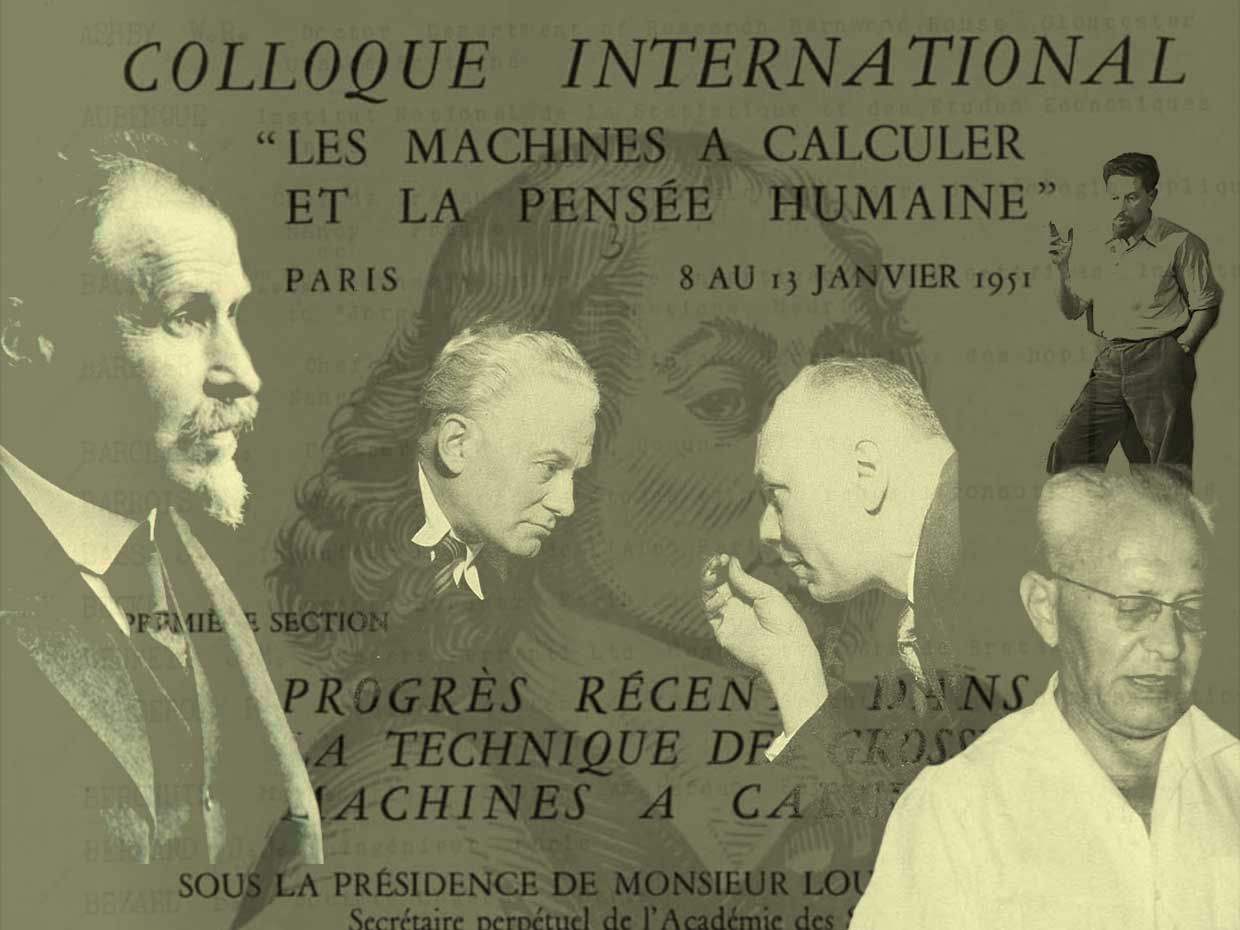
AdvertisementEditor’s PicksThe Brain as Computer: Bad at Math, Good at Everything ElseFirst Programmable Memristor ComputerUntold History of AI: The DARPA Dreamer Who Aimed for Cyborg Intelligence
Suggested Wiley-IEEE Reading
Dynamic Spectrum Access Decisions: Local, Distributed, Centralized, and Hybrid Designs
In Paris. Exactly seventy years ago.
continues in source:
Cybernetics, Computer Design, and a Meeting of the Minds – IEEE Spectrum
The Fractal Geometry of Nature – Benoit Mandelbrot (full book)
CybSights Insights: “What’s my Motivation?” A cybernetic question and its dramatic enactment – YouTube
CybSights Insights: “What’s my Motivation?” A cybernetic question and its dramatic enactment – Prof Tom Scholt, Percetual Control Theory, Method of Levels
The Insights Series is an eclectic and learned collection of monthly events on the 4th Tuesday of each month hosted by the Secretary of the Cybernetics Society, Angus Jenkinson. Cybernetics is the science of design and achievement, the great fusion discipline of our time. In this session, Prof Tom Scholte, an acclaimed film and theatre director, Vice-President of the American Society for Cybernetics, and a Professor of Acting and Directing at the University of British where his centre deals with social challenges and conflicts in organisations. This business-savvy and human-centred immersive experience was a fine exploration of motivation and human behaviour through the media of drama, conversation and reflection. It also introduced the discipline of perceptual control theory (PCT), a discipline with affinities and connections to cybernetics. Discover the real nature of behaviour and how it is self- managed. Relevance to business and social practice is evident. The session was also held in association with IASCYS, the PCT network.
source:
CybSights Insights: “What’s my Motivation?” A cybernetic question and its dramatic enactment. – YouTube
 Systems Community of Inquiry
You must be logged in to post a comment.