Riding Dynamics – Kerry Turner (online book)

[Application of systems dynamics models to horseriding]

In this book Kerry Turner has challenged the rider – not just to improve but to really “think” about what they are doing.   It is clear throughout that the author believes that the good rider should be a lifelong student of this absorbing art and it is because I wholeheartedly agree with her that I am delighted to write this Foreword.   Riding is an art that involves another living being, the horse, who is as unique and individual as us. The difference between the rider and the horse is that the horse is not a volunteer. As a result we owe it to him to constantly strive to improve our skills and “connection” with him if his welfare is to be uppermost in our hearts and minds, which should be the case for all good horsemen.   All too often good horsemanship is sadly measured by how many competitions have been won or difficult horses conquered, when in reality it should be measured by a state of peaceful agreement and co-operation between horse and rider – in other words HARMONY.   Good harmony can only be achieved by understanding oneself first and then the horse, along with a sound grasp of technical skills. When the rider is truly aware of this and is committed to constantly strive to improve, only then can he or she reap the rewards this lifelong journey will bring.   I know that by reading this book your own and your individual horse’s journey can only be enhanced.     Patrick Print FBHS Chairman The British Horse Society July 2007

Foreword

http://dynamics.ward.asia.wiki.org/view/welcome-visitors/view/riding-dynamics/view/foreword

Save the date: Metaphorum 2024, Creativity and Viability, 16-17 September, Berlin,Germany

The Metaphorum 2024 Conference is set to take place in Berlin, Germany, at the mid of September. This two-day event will span from Monday, September 16th, to Tuesday, September 17th. This year’s conference theme centers around the role of creativity in sustaining viability. The primary conference activities are scheduled for Monday and Tuesday, to be held at The Change Hub, an innovative space dedicated to creating sustainable transformation and social impact.Additionally, the Annual General Meeting (AGM) will take place on Wednesday, September 18th. Optional pre/post-conference events and/or VSM trainings are under consideration. Nevertheless, one thing is already clear: It will be a highly interactive event!

We encourage our community to save the date and are eager to announce more details about the Metaphorum 2024 conference as soon as possible. Please note for your planning that the WOSC 2024 is scheduled to take place the week before, in case you are interested in attending both events.

Looking forward to seeing you,

Angela Espinosa, Allenna Leonard, Jon Walker, Marcus Wetzler and Mark Lambertz

Why Emergence and Self-Organization are Conceptually Simple, Common and Natural – Heylighen (2024)

Heylighen F. (2024): Why Emergence and Self-Organization are Conceptually Simple, Common and Natural, in: Proceedings of the Science Week on Complexity, (UM6P, Ben Guerir)

Click to access Heylighen_Emergence_Self_organization.pdf

The original talk on which this is based (less in-depth) can be watched here: 
https://www.youtube.com/watch?v=2fZKodNHi_g&list=PLw1sW0Y_wQcoYuedC3YslGWsmf_KkixNd&index=35

Why Emergence and Self-Organization are Conceptually Simple, Common and Natural

Abstract: Emergent properties are properties of a whole that cannot be reduced to the properties of its parts. Properties of a system are defined as relations between a particular input given to a system and its corresponding output. From this perspective, whole systems formed by coupling component systems have properties different from the properties of their components. Wholes tend to arise spontaneously through a process of self-organization, in which components randomly interact until they settle in a stable configuration that in general cannot be predicted from the properties of the components. That configuration constrains the relations between the components, thus defining emergent “laws” that downwardly cause the further behavior of the components. Thus, emergent wholes and their properties arise in a simple and natural manner.

Aspects of Cybernetics – website section – Jenkinson (2021)

LINK: https://cybsoc.org/?page_id=1668

Covers:

Fundamentals

This is the core of cybernetic theory and practice, the essentially transdiciplinary from which all the specialist fields grow and feed back.

This is an essential field of enquiry and learning.

Think of context and feedback and variety, of markers and cues and signs, of navigation and outcome…

Design

Almost all cybernetic activity that is not pure theory is also design work, incldujgn the design of scientific method, of theory, of its communication.

But there are also core fields recognised as belonging to design such as…

Architecture and interior design

Business design

Apps, products, services and materials design — R&D, innovation

Designing social futures and what is needed for them

Methods design, such as Agile and Lean

Social planning and social architecture

Ethical aspects of design.

For the specialist there is a long and nuanced list. Tags can be used to mark these.

Knowing

This includes

Philosophy and history of science, and scientific paradigms and cybernetics as revolutionary or stable social processes

Core tools and concepts of cybernetics and their implications, including Ternary Theory, Directiveness, Context, Feedback, Cues and Signals, and more

Scientific Method & Philosophy of Science

Cross Discipline/Trans-Discipline/Integration as practice

Second, recursive, reflexive, and observer-dependent orders of science and cybernetics; observation and interpretation, constructivism

Noetic Sciences — a very long list related to what and how we know, how we understand mind, and how we work with it… Consider just these…

Appearances

Artificial intelligence as a concept and paradigm

Autonomy and freedom, agency

Brain, nervous system, and brain sciences

Cognition and sensory perception

Cognition

Cognitive biases, frames, and paradigms

Communication — in nature, humans, machines

Concepts and ideas and what they are or do

Consciousness studies

Constructivism, idealism

Context theory

Cross discipline/trans discipline/integration as practice

Cybernetic influence on scientific paradigms

Determinism

Directiveness and autonomy

Double bind and other pathologies

Embodied intelligence

Emotion (affect, feelings) and its effects and intelligence

Epistemology and Ontology

Neuroscience and Psychological Theories…

And more

Matter

Physics and chemistry especially work with material substances and the forces and organization of these, but they play a role in many fields. But from the design of research to the construction of things out of these materials and substances for a purpose, cybernetics can and does play a useful role. It dances with

Physical and Chemical Organization

Catalysis and Autocatalysis

Organic products, eg protein.

Physico-Chemical Self Organization

Anatomy and the physiome

Global Warming

Gaia

 and so on...

Life

All Life Sciences

Formative principles of life and ecology, eg Context and Feedback, Persistence and Change, Individuation and Speciation.

Systems Biology & Morphology, inc genome and physionome studies

Autopoiesis

Ethology

Perceptual Control Theory (PCT)

Veterinary Science

Ecology and Ecosystems

Evolution

and so on

Machine

Machine Cybernetics and a few more…

Robotics

AI software

Autonomous vehicles, autopilots…

Assistive tech, eg for surgery

Designing machine systems, e.g. AI, IoT, software, and other smart technologies

Ethical and functional consequences

Homeostatic devices and signal systems

Smart software systems (feedback and controls)

Software systems and coding practices

The internet

Semantic web and advanced coding

People

Sociology and Anthropology

Sociology and social structuration, and its concepts, eg recursive situations, context, reflexive monitoring of the flux of encounters, speech acts, Erving Goffman face-to-face social interaction as a PCT theorist…

Social Ecology/social autopoiesis

Economics, macro and micro, Nudge, behavioural economics

Integrated Sociology: General theory, Political Theory; Economic Theory, Cultural Theory

Social anthropology

History 

Human Synthesis & Meta Levels, eg

Domain Analysis & Transdisciplinary Methods

Therapeutics (inc Psychotherapy, PCT Theory of Levels, Medical Science)

Social Planning

Aid and development

Crisis Solutions ( Global Warming, Degradation, Political Breakdown, Etc)

Change Design

Governance and the law

Education & training

Design thinking and practices

Architecture

Social planning and social architecture

Product design

Systems

How important has systemic thinking become!

Cybernetics is routinely equated with the systems sciences, but despite its affinities with all of them, it has a particular orientation that marks a distinction. Yet many problems are resolved when a systems discipline is united with a cybernetic.

Systems science disciplines

See the introduction to consider this further and perhaps write an article.

Management

Management is cybernetic. So is Government and its political practices. Cybernetics dances with all the following…

Management Theory, Identity, Culture, Business Models

Organization theory, structure and design

Policy formation and control, Governance, steering tools

 Strategy, research, planning, decision making, adaptation

Innovation, problem solving, design and execution of change

Administration and unit/team organization

Marketing, Sales, Brand, Pricing, value propositions and offerings

Financial systems

Production systems

Value streams, processes, circular economy, ecosystem

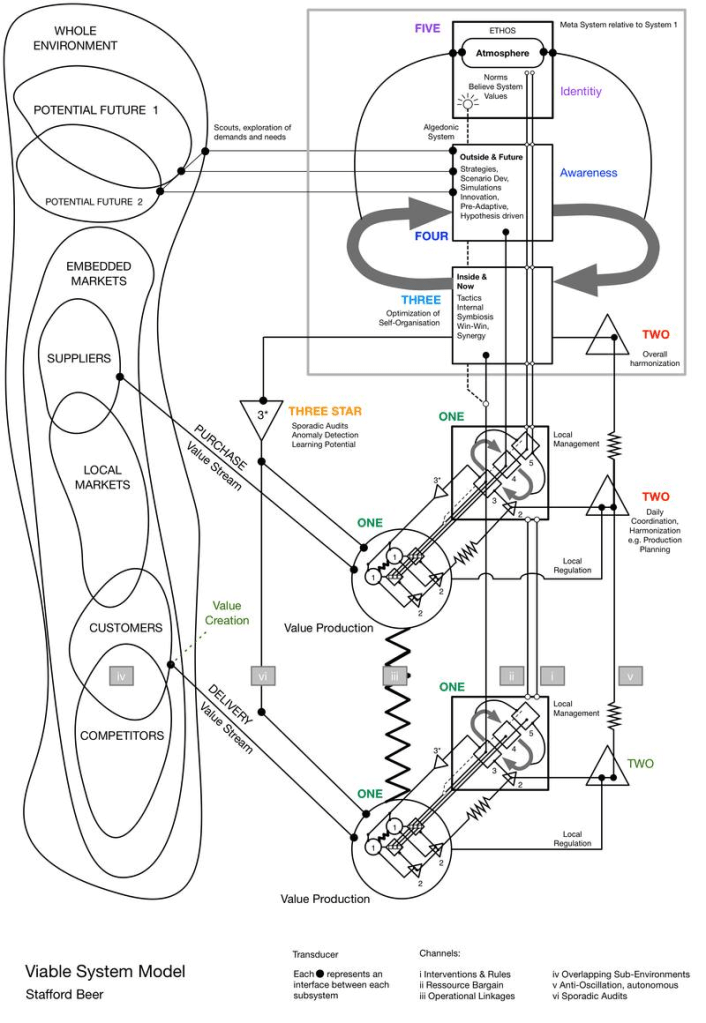
Cybernetic tools, including VSM

Extended corporate machine intelligences.

See also https://cybsoc.org/?page_id=1539

and https://cybsoc.org/?page_id=1551

The Evolution of Organizational Cybernetics (Schwaninger, 2006)

Journal Scientiae Mathematicae Japonicae

ISSN 1346-0862

ISSN-Digital 1346-0447

Date Issued 2006-09-28

Author(s)

Schwaninger, Markus 

Abstract

The purpose of this contribution is to give an overview of the origins and further developments of Organizational Cybernetics, its transdisciplinary nature and its links to different areas of science, i.e., both natural sciences and the humanities.

The Evolution of Organizational CyberneticsJournalScientiae Mathematicae JaponicaeISSN1346-0862ISSN-Digital1346-0447Typejournal articleDate Issued2006-09-28Author(s)Schwaninger, Markus AbstractThe purpose of this contribution is to give an overview of the origins and further developments of Organizational Cybernetics, its transdisciplinary nature and its links to different areas of science, i.e., both natural sciences and the humanities.

The Evolution of Organizational Cybernetics

https://www.alexandria.unisg.ch/entities/publication/ab1a813e-ed06-4267-9a18-13f5bb93fb2f/details

also at

https://www.researchgate.net/publication/36381704_The_Evolution_of_Organizational_Cybernetics

The EMK Complexity Group

[Only just come across this though it’s not very active in recent years – found it because the titular Eve Mittleton-Kelly spoke at a Systems Innovation even https://www.youtube.com/watch?v=RPa_hNN5cGk]

The EMK Complexity Group has been working for over 20 years, with organisations in the private and public sectors to address practical complex problems. In the process it has developed a theory of complex social systems and an integrated methodology using both qualitative and quantitative tools and methods.

About | EMK Complexity Group

http://emk-complexity.org/about/

Projects (appear to be quite outdated) http://emk-complexity.org/projects/

Publications http://emk-complexity.org/publications/

YouTube channel – nothing new for six years but / and a great selection of absolutely core complexity people including most of the big names: https://www.youtube.com/channel/UCaY7I2J4X_0dMyndQSqma2g

Biography, complexity guide, complexity links http://emk-complexity.org/guide/

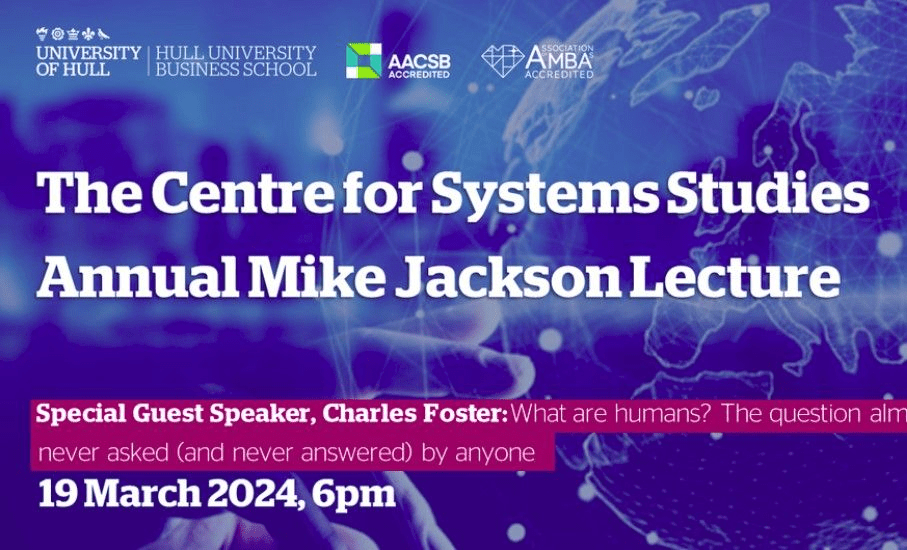
The Centre for Systems Studies Annual Mike Jackson Lecture 2024 -‘What are humans?’ Charles Foster. 19 March 2024, 6pm – Hull and online

 Middleton Hall, Hull, HU6 7RX

 Tue 19th March 2024 6:00PM

What are humans? The question almost never asked (and never answered) by anyone

Anthropologists and sociologists (at least) might be expected to have attempted an answer to the question ‘What are humans?’. But they have not. It is a vaunting, daunting question, but it is worth exploring, even if the exploration is frustrating. This lecture looks at the question through a number of lenses, suggests the least unsatisfactory answer, and goes on to ask what this answer means for the way that we should live as individuals and the way we should structure our societies. 

Event Details

Starts at 6:00PM

Location

Middleton Hall, Hull, HU6 7RXC

https://www.ticketsource.co.uk/whats-on/hull/middleton-hall/the-centre-for-systems-studies-annual-mike-jackson-lecture/2024-03-19/18:00/t-earqqam

[

For anyone who like me was ignorant of Charles Foster, but too ashamed to ask, Dr Mike C Jackson OBE wrote about him here:

https://www.linkedin.com/pulse/systems-thinking-david-attenboroughs-life-our-planet-jackson-obe/

and here

https://www.researchgate.net/publication/358467627_Systems_Thinking_’The_Imagination_Machine’_’Sandtalk’_and_’Being_a_Human’

And here’s a podcast: https://www.youtube.com/watch?v=AYASK-3_zBg

Sounds fascinating!

]

Evolution “On Purpose”: Teleonomy in Living Systems – Eds Corning, Kauffman et al (2023)

Evolution “On Purpose”: Teleonomy in Living Systems

Edited by

Peter A. Corning,

Stuart A. Kauffman,

Denis Noble,

James A. Shapiro,

Richard I. Vane-Wright,

Addy Pross

The MIT Press

DOI:

https://doi.org/10.7551/mitpress/14642.001.0001

ISBN electronic:

9780262376013

Publication date:

2023

Evolution On PurposeTeleonomy in Living Systems | Books Gateway | MIT Press

https://direct.mit.edu/books/oa-edited-volume/5634/Evolution-On-Purpose-Teleonomy-in-Living-Systems

Systems Thinking – Rap4Skills

From Hong T.M. Bui https://www.linkedin.com/posts/hong-t-m-bui-b027633a_systems-thinking-activity-7136682131254075392-_gPh/ and shared by Fred Robinson in the Systems Thinking Network LinkedIn group.

Rap4Skills 

Hip-hop & Rap

Follow Rap4Skills and others on SoundCloud.Sign inCreate a SoundCloud account

www.rap4skills.org/
We are a passionate team, dedicated to transforming how young generations acquire vital skills for the digital age, e.g., time management, critical thinking, design thinking, empathy, digital citizenship, budgeting, etc. We believe in the power of music, particularly rap, as an educational tool. The lyrics of these skills are in the book “Rap4Skills” published on Amazon in 2023 (www.amazon.com/Rap4Skills-Prof-H…Bui/dp/B0BYR5F9MT). We have also produced a demo on YouTube and received well-warm feedback from our students and friends (Prof Hong Bui -YouTube channel).

Our project, Rap4Skills, aims to produce songs that convey vital work and life skills and engage multiple communities to spread its impacts. Your support is paramount. By contributing, you are enabling a creative education for social inclusion and social transformation. The impact of this edutainment project will go globally.

Let’s change education together, one rap at a time!

Systems ThinkingRap4Skills 1 month ago1 month agoHip-hop & RapLikeRepostShareCopy LinkAdd to Next upMore 79 plays79 View all likes4 View all reposts2Rap4Skills 1 track1FollowReportFollow Rap4Skills and others on SoundCloud.Sign inCreate a SoundCloud accountwww.rap4skills.org/We are a passionate team, dedicated to transforming how young generations acquire vital skills for the digital age, e.g., time management, critical thinking, design thinking, empathy, digital citizenship, budgeting, etc. We believe in the power of music, particularly rap, as an educational tool. The lyrics of these skills are in the book “Rap4Skills” published on Amazon in 2023 (www.amazon.com/Rap4Skills-Prof-H…Bui/dp/B0BYR5F9MT). We have also produced a demo on YouTube and received well-warm feedback from our students and friends (Prof Hong Bui -YouTube channel).Our project, Rap4Skills, aims to produce songs that convey vital work and life skills and engage multiple communities to spread its impacts. Your support is paramount. By contributing, you are enabling a creative education for social inclusion and social transformation. The impact of this edutainment project will go globally.Let’s change education together, one rap at a time!

Stream Systems Thinking by Rap4Skills | Listen online for free on SoundCloud

Design Learning – Journeys of Growth & Belonging 2024

Meeting banner

Description

Journeys of Growth and Belonging is a gathering series co-facilitated with storytellers who are affecting a shift to an alternative narrative in their communities and organizations. These stories give us a place to redirect our attention. They can teach us how to become relational activists, which means we are putting our experience with each other first. It invites us all to reclaim control of our collective well-being. As we have been connecting and exchanging ideas around ideas in Peter Block’s books Activating the Common Good and Community, what has become evident is the value in gathering and collectively identifying ways that we can put the Six Conversations and other common good protocols into practice. Our intention is to continue to share, learn together with, and inspire others throughout 2024 by hosting a diverse and multidisciplinary community of those who are actively co-creating communities, organizations, and a world that works for the common good of all. In addition to learning from the story, we will connect in small groups as a model of the very convening style we wish to see more of in the world. Join us to connect and witness the common good.

Date & TimeYou can choose to attend one or more of the following sessions.

Jan 26, 2024 03:30 PM

Feb 23, 2024 03:30 PM

Mar 29, 2024 02:30 PM

Apr 26, 2024 03:30 PM

May 31, 2024 03:30 PM

Jun 28, 2024 03:30 PM

Jul 26, 2024 03:30 PM

Aug 30, 2024 03:30 PM

Sep 27, 2024 03:30 PM

Oct 25, 2024 03:30 PM

Time shows in London

Meeting Registration – Zoom

https://us06web.zoom.us/meeting/register/tZModeuuqD0qGNQxi8KAfO9_KUDNW_iP6eBl#/registration

MIT Systems Awareness Lab Research Design (virtual) Seminar Series – 23-25 January 2024

Research Design Seminar Series

We invite you to join us in a new virtual seminar series to collaboratively explore diverse research approaches and methodologies in our study of compassionate systems and systems awareness more broadly. The aim of this series from the MIT Systems Awareness Lab is to inspire communities of practitioners and researchers to work together in considering the role of research in their own systems change work. 

From this series of research design seminars, we will iterate on research designs that our community can then build upon, refine, implement, and learn from with our partners. 

For More Information, contact systemsawareness@mit.edu

antlerboyben@gmail.com Switch accounts

Not shared

  • Indicates required question

Upcoming Sessions

Tuesday, January 23, 2024, 10:00 – 11:30 am EST “Systems Awareness Methodologies”

An exploration of how we understand and map the nested layers of the education ecosystem with Dr. Mette Miriam Boell along with Dr. Lukas Herrmann, and Dr. Lana Cook of the MIT Systems Awareness Lab.

  • * *

Wednesday, January 24, 2024, 10:00 – 11:30 am EST

“Simulations and Game-based Learning for Youth Engagement”

A design session with Dr. Eric Klopfer, Dan Roy (MIT Scheller Teacher Education Program, Education Arcade) with Gustav Boell and Youth Ambassadors (Center for Systems Awareness)

  • * *

Thursday, January 25, 2024, 9:00 – 10:30 am EST

“Systems Intelligence of Children”

A conversation with Dr. Jean Clinton (McMaster University), Dr. Peter Senge (MIT), Jacob Martin (Dulwich College Singapore), and Charlotte Ruddy (Dulwich College Singapore)

Research Design Seminar Series

https://docs.google.com/forms/d/e/1FAIpQLSdiDvCBSe-Toz9OhiKw6EkUpX1cUXxoWmBwVYGvhCSpIzCsbg/viewform

Working in complexity inside and out – paid course with Chris Corrigan and Caitlin Frost, April 11 – June 20, 2024

Interactive Online Program 2024

April 11th – June 20th for North America & Europe

8 engaging online learning and practice sessions
3 small group discussion sessions and 2 partner exercise practice sessions
Participatory Narrative Inquiry
Online classroom with recordings, resources, discussion space and more.

For more information please contact Caitlin Frost caitin.frost@gmail.com
Check out your time zone compatibility here: https://www.worldtimebuddy.com/

REGISTRATION NOW OPEN!

SIGN UP FOR EVENT UPDATES NEWSLETTER

We hope to offer dates for Australasia in the future.
Please join our waitlist if you are interested HERE.

https://www.harvestmoonconsultants.com/complexity-inside-out.html

working in complexity – Harvest Moon Consultants

Systemic Design Association update January 2, 2024 – online sessions with SD12 keynote talks by Shermon Cruz and Peter Jones.

Systemic Design Association | January 2, 2024
Cruz & Jones: Back in the saddle
Technical difficulties meant that we missed recording RSD12 keynote talks by Shermon Cruz and Peter Jones. Futures to the rescue! The JFS Futures Community is hosting these two RSD12 talks.
January 10: Shermon Cruz, Dreams & Disruptions (register now)February: Peter Jones, Ecologising the Future (TBA)
The JFS Futures Community,* founded by Anisah Abdullah and Lavonne Leong, is a space for practitioners, educators, and the future-curious to connect, share, and develop teaching and learning materials. Meetings are held every month on Zoom. *The Journal of Futures Studies is a globally oriented, transdisciplinary referred journal. Its mission is to develop high-quality, futures-oriented research and thinking based on the evolving knowledge base of futures studies.
Shermon Cruz shares his experience as an inventor and co-designer with Radical Futures Unleashed: Igniting your imagination with Dreams and DisruptionsREGISTERPeter Jones presents Summer: Ecologizing the Future situated within the extraordinary future potentials for Mexico in this dynamic centuryGET NOTIFIED
Studios: Mapping Mondays
Mondays, beginning February 26, 2024. The response to the RSD12 (2023) call for maps and exhibits exceeded our capacity to programme sessions during the symposium, and contributors agreed to present maps in this series of studios presenting about four maps each. The series will consists of at least ten gatherings. Details on presenters and exhibits will be posted here for each studio as commitments are firmed up.
If you are a master mapper or mapping-curious, these talks are an opportunity to discuss maps and related exhibits with the researchers.
REGISTER
Stuck? Diagrams helpVIDEO NOW AVAILABLE
RSD12-Washington keynote Abby Covert
Like digital tow trucks, diagrams have been helping people feeling stuck for thousands of years. But why? Because diagrams give us superpowers. The ability to render our ideas visually helps us move through some pretty gnarly human situations. In this keynote Abby Covert, an author and information architect, takes us on a tour of five of the superpowers that make diagrams the helpful superhero of many sensemaking stories. 
Abby Covert is an information architect, writer and community organizer with two decades of experience helping people make sense of messes. Abby has written two popular books, How to Make Sense of Any Mess and Stuck? Diagrams Help. She currently spends her time making things that help you to make the unclear clear, many of which she makes available for free on her website, www.abbycovert.com or at accessible price points in her popular Etsy shop, AbbytheIA. In 2022, she started The Sensemakers Club where she brings together sensemakers from different walks of life to learn from one another. Abby currently lives and writes from Melbourne, Florida, where her most important job title is “Mom.”
prepared by Cheryl May | cheryl@systemic-design.org | inspired by cowboy futurism
whoa rsd12 | systemic design talks and studios

ANU School of Cybernetics newsletter – 2023: the year in review

As we approach the third anniversary of the School of Cybernetics, we reflect on the incredible milestones achieved during 2023. We’re thrilled to share our journey in this celebratory overview.JanuaryHappy new year and welcome to 2023!We commenced 2023 on a high note after our School’s remarkable official launch in 2022. The new year promises numerous opportunities for our students, partners and industry professionals as we continue to create, experiment and collaborate on safe, sustainable and responsible approaches to new technological systems.FebruaryWe welcomed our fifth cohort of Master students.Our 16 students come from diverse and impressive backgrounds. As mid-career professionals, they bring a wealth of experience from various fields including teaching, army logistics, non-profits, big tech, festival direction, data analysis, Indigenous affairs, cybersecurity and business management.We co-hosted an interactive breakfast discussion along with the Paul Ramsay Foundation on the role of collective intelligence and cybernetics in changing how we think about social policy. Read >>MarchWe launched our first public-facing micro-learning full-day course.This course took a deep dive into new ways to talk productively about AI, without being beholden to existing technological narratives. It helped participants to acquire skills to think in system and gain a deep understanding of how AI fits into not just our current social order but future iterations.Maia Gould, Cybernetic Engagements Lead, Hannah Simpson, Educational Developer, and Jackie Randles, Partnerships Lead, hosted a networking lunch and workshop in Melbourne as part of the Data Informed Design (DID) Conference. Read >>AprilWe launched Cybernetic Imagination Residency program.“The Cybernetic Imagination Residency Program is a collaboration to create stories about the future that are hopeful,” Associate Professor and Cybernetic Futures Lead Andrew Meares said.On April 28, we hosted five residents who form the first two cohorts of Cybernetic Imagination Residents and officially launched the program. Read >>In light of the federal government’s announcement for long-term Trove funding, the School produced a series of vignettes, ‘AI and libraries’, which explores the role of libraries as a trusted curator, custodian of knowledge and a midwife of new ideas.The School contributed to the Australian Universities Accord Discussion Paper reviewing Australia’s ambitions, aspirations and potential in the higher education sector.The Cybernetic Imagination Residents. (L-R) Lynette Wallworth, Caroline Pegram, Angie Abdilla, Kate Crawford and Mark Thomson. Photo: Lauren SuttonMayThe School was featured on The Australian.The article authored by The Australian’s higher education editor Tim Dodd covered the School’s official launch, the exhibition ‘Australian Cybernetic: a point through time’ and the School’s mission into the future. Read >>Some other coverages of the School and school members this year:In a conversation with Brunswick’s Alice Gibb, Genevieve Bell discusses the field of cybernetics and its relevance to the 21st century. She highlights the need to embrace diverse perspectives in problem-solving and the importance of making an optimistic future through active participation. Read »During the interview with Brad Howarth for The Mandarin’s special report on AI in the public sector, Matthew Holt highlights the importance of comprehending AI in its entirety and seeing generative AI as part of the computing revolution. Read »In an interview by APAC Network, Professor Katherine Daniell explains how Cybernetics principles can help current and emerging leaders to shape our fast, smart and interconnected world. Watch here.Our School Director Genevieve Bell delivered the esteemed Ann Moyal Lecture 2023 at the National Library of Australia. She shared a new set of stories about the Overland Telegraph Line with the audience, stories that examine it as a complex cybernetic system, and the questions we must ask of any large system and its unintended consequences, regulations, impact, power, control and inequity.JuneWe launched a series of learning experiences.We launched an array of full-day non-award learning experiences to prepare organisations, workplaces and individuals for the increasingly fast-paced technological world.Student Demo Day Semester one was on, and that meant 2023 cohort was halfway through their Master program study. 16 individual projects were displayed on the day.JulyLucie in the Sky unveiled at Uncharted Territory Festival.Lucie in the Sky, a world-first dance performance blending artistry with drone technology, was unveiled at the Uncharted Territory Festival, a result of a multi-year research collaboration between the Australasian Dance Collective (ADC) and Professor Alex Zafiroglu from the School.We responded to the inquiry into the use of generative AI in the Australian Education system and to the ‘Safe and responsible AI in Australia’ Discussion Paper, Department of Industry, Science & Resources.Cybernetic Snacks made its return this year! We talked to more leading voices in the field of Cybernetics. We also celebrated the graduation of our 2022 Master students!2022 graduates. (L-R), Graeme Wallace, David Auricht, Ross Tieman, Distinguished Professor Genevieve Bell, Lawrence Du, Daniela Fernandez, Evan Skinner, Michelle Jasper, Amy Wardrop. Photo: Sherice Kazzi.AugustWe benefited from a series of enlightening talks.August was packed with learning and sharing. We welcomed Professor Gerald Midgley from the University of Hull to deliver a series of talks regarding his work in systems analysis and systems thinking. Read here.Professor Bill Reckmeyer delivered a captivating talk on the “Cybernetics Systems Program at San José State University: 1962-1992 – 30 Years of Innovation Education”.Staff are doing remarkable things in the world! Here are some of them:Louisa Shen, a researcher at the School, joined other ANU scholars for a fantastic film screening and discussion of Blade Runner on 18 August at the National Film and Sound Archive of Australia.Associate Professor Matthew Holt and Dr Safiya Okai-Ugbaje joined Tracey Spicer for a panel discussion on the basics and impacts of AI and delivered a workshop – Let’s demystify Artificial Intelligence – at the ALP fringe conference in Brisbane.Dr Safiya Okai-Ugbaje was speaking at the “See It to Be It” conference – a platform for empowerment and a celebration of diversity and inclusion in the tech world.And some of the featured pieces contributed by school members:Alex Zafiroglu – Long-term government funding for Trove at the National Library of Australia a win for all.Chris Mesiku – Enhancing Human Flourishing: The Synergy between Data and a Systems Approach.Alex Fischer – How should a robot explore the Moon? A simple question shows the limits of current AI systems.Julian Vido – No idea what it’s talking about.SeptemberGenevieve Bell announced new VC and Top 100 Innovator.Wow! This was a month with big news. Our director was announced to be the next Vice-Chancellor and President of the ANU. In addition to this celebratory news, Genevieve was also recognised on The Australian Top 100 Innovators List, which celebrates and highlights future-focused leaders and companies helping to put Australia on the map as an innovative nation.First AI and leadership learning experiences were delivered in Canberra, garnering positive feedback.OctoberMetaverse report launched at SXSW Sydney.This groundbreaking report delves into the fascinating realm of the metaverse. It dissects the metaverse’s roots and its journey to the present day and offers a cybernetic perspective on the metaverse’s potential and the pathways to shape its development. Read the reportAnother impactful research report published this month was “Designing for change”.We got exciting news within the alumni community – Mikaela Jade (2020 Master cohort) was announced 2023 Australian Academy of Technology and Engineering (ATSE) new fellow, along with our Vice-Chancellor, Professor Brian Schmidt.The School has been shortlisted for the Developing Emerging Skills and Competencies Award by QS Reimagine Education through our New practitioners to shape safe, sustainable and responsible futures submission.NovemberLearning experiences on tour!We continued to deliver our learning experiences, and this time we’re taking it to Sydney and Melbourne!Master students showcased their group cyber-physical projects during the semester-two Demo Day, and this marked a wrap-up in their learning journey.We welcomed our alumni back for the inaugural Alumni Professional Development Day – a jam-packed two days of networking, learning, sharing and collaborating.Find out some of our alumni’s achievements:Jacob Sheung-Kay Choi (Master of Cybernetics, 2020 cohort) was awarded as one of Australia’s Top 40 Under 40 most influential Asian-Australians in the country! He was awarded Winner of the Asian-Australian Leadership Awards, Public Sector & Government.Glen Berman (2019 Master cohort, current PhD candidate at ANU School of Engineering) published a new paper in Big Data & Society, a preeminent journal for interdisciplinary social science research. The paper, titled Investigating hybridity in artificial intelligence research was co-authored by Glen and Dr Kate Williams at University of Melbourne and Sandra Michalska.Erika Ly (2021 Master cohort), Policy Manager at the Tech Council Australia, was interviewed by the National AI Centre about her thoughts on the future of AI. Watch here.Jake Blight (2021 cohort, and current PhD candidate at the School of Cybernetics) was appointed as the next Independent National Security Legislation Monitor. Read more.Evan Skinner (2022 cohort and PhD candidate at the School of Cybernetics) co-presented Hopeful Futures via Cybernetics and Generative AI at SXSW Sydney.Student projects on Demo Day.DecemberQS Reimagine Education Award Bronze WinnerWe are the Bronze Winner for the Developing Emerging Skills and Competencies Award by QS Reimagine Education! The QS Reimagine Education Awards celebrate and reward the world’s most successful educational innovations enhancing student learning outcomes and employability. Read more.

We are going on holiday from 18 December to rest, rejuvenate and gear up for our return on 10 January 2024. We look forward to the adventures and future possibilities together in 2024!

Top ten most read posts on the Systems Community of Inquiry in 2023 (rather surprising!)

I thought this would be an interesting exercise – having done similar on my own blog.

Top ten:

  1. Tables of Soyga: the first cellular automaton? Anders Sandberg – an oddly popular post, blogged here in 2019 from a 2014 post
  2. Marshall McLuhan – extensions and amputations – inspired by Aidan Ward and Philip Hellyer – super interesting stuff! (From 2019)
  3. Our Theory of Change « The Berkana Institute – the two loops model: useful and mythopoetic stuff
  4. Conscious Purpose versus Nature – Gregory Bateson – which I described back in 2018 as ‘very big and important’ – accurately, I think!
  5. Is there an actual source for the Kurt Lewin quote “You cannot understand a system until you try to change it”? – a post which pretty much fulfils Betteridge’s Law of Headlines
  6. Marshall MacLuhan’s Tetrad of media effects – second impactful visitation of MacLuhan, undoubtedly a systems | cybernetics | complexity thinker, but not in the usual canon!
  7. Biocentrism – Robert Lanza – biology as the central driving science in the universe. I’m sure I thought twice whether to weblog this one or not (in 2018)
  8. A schema for better understanding systems leadership and systems change – it me
  9. Hospicing The Old – TheFarewellFund – Cassie Robinson – the two loops model again
  10. Gregory Bateson and the Counter-Culture – Bateson again but a pretty weird take, and including an image the original bloggers had stolen from someone who stole it from Howard Silverman, so – much as I find the connections from both cybernetics and organisational development to ‘the dark side’ of cults, MK Ultra etc fascinating (and parallel to some of the military origins of some systems approaches, and then use in e.g. RAND Corp and Vietnam war ‘planning’), not a piece I would actually recommend for anyone serious – check the comments on the original blog.

I’m fascinated and intrigued, and assume that a lot of this is just accidental googlewhacks etc – there’s a clear exponetial curve with the top four running at 1,210, 1,029, 636 and 444 respectively, and the tenth at 277 visits – then another 30ish posts before the hit count drops to under 100. And I know a number of people read these posts by email.