The “Mind Projection Fallacy” in Systems Thinking:

Harish's avatarHarish's Notebook - My notes... Lean, Cybernetics, Quality & Data Science.

In today’s post, I am writing about the wonderful Bayesian E. T. Jaynes’ idea of “Mind Projection Fallacy” (MPF) with respect to Systems Thinking. He explained MPF as asserting one’s own private thoughts and sensations as realities existing externally in nature. Jaynes noted – One asserts that the creations of his own imagination are real properties of Nature, and thus in effect projects his own thoughts out onto Nature.

Jaynes used the English language to delve into this further. In Logic, we say that If A is B, then B is A. However, when we apply this in our language, we will have issues. He used the old adage of “knowledge is power” as an example. If we then say “power is knowledge”, then we have said something that is fantastically absurd. The trouble here is with the verb “is”. As Jaynes pointed out:

These examples remind us that the…

View original post 996 more words

Application of Open Systems Theory to establish Active Adaptive Organisations, Fri, Dec 2, 2022, 9PM AEDT

Application of Open Systems Theory to establish Active Adaptive Organisations

Hosted By Systems At Play

Systems At Play

Application of Open Systems Theory to establish Active Adaptive Organisations, Fri, Dec 2, 2022, 3:00 PM | Meetup

New England Complex Systems Institute – Introduction to Complexity Science Concepts and Applications – online course ($750)

Introduction to Complexity Science Concepts and Applications

Gain new insights that reframe your thinking, specific tools to advance current projects, and perspectives to set new directions.

October 18 – November 18

Course access begins October 18

New England Complex Systems Institute

The Authentic Cybernetician:

Harish's avatarHarish's Notebook - My notes... Lean, Cybernetics, Quality & Data Science.

In today’s post, I am looking at the idea of “authenticity” in relation to existentialism. I am inspired by the ideas of Kierkegaard, Heidegger, Sartre and De Beauvoir. The title of this post may be misleading. From an existentialist standpoint, to talk about an authentic person is contradicting the very ideas it stands for. An existentialist believes that existence precedes essence. This means that our essence is not pregiven. Our meaning is something that we create. It is an ongoing construction. I do admit that I find the idea of an authentic cybernetician quite fascinating. I am exploring the idea of “authenticity” in existentialism with relation to cybernetics. As Varga and Guignon note:

The most familiar conception of “authenticity” comes to us mainly from Heidegger’sBeing and Timeof 1927. The word we translate as ‘authenticity’ is actually a neologism invented by Heidegger, the wordEigentlichkeit, which…

View original post 902 more words

Systems Thinking Ontario – 2022-10-17 – Reifying Systems Thinking towards Changes

October 17 (the third Monday of the month, dodging Thanksgiving) is the 104th meeting for Systems Thinking Ontario. The registration is at https://reifying-systems-thinking.eventbrite.ca .

Reifying Systems Thinking towards Changes

In 2012, at the 56th Annual Meeting of the International Society of the Systems Sciences, an aspiration of “Rethinking Systems Thinking” was proposed. In 2019, the rise in interest in “systems change” led to the formation of the Systems Changes Learning Circle, centered in Toronto, Canada. Now 4 years into a 10-year journey, research publications and presentations are being released.

In 2022, the Systems Changes Learning approach features three concepts: (i) rhythmic shifts; (ii) texture (leading to contexture); and (iii) propensity. Practices developed are depicted as hub of “knowing from within” appreciated through a cycle of learning along four spoke. Theory-building through multiparadigm inquiry includes philosophies of science underlying Classical Chinese Medicine and ecological anthropology.

This presentation was originally created for an in-person meeting at the Universitat de Barcelona Business School Graduate Programme in Business on October 10, 2022. The slides have been published, and will be reused for an online presentation at Systems Thinking Ontario on October 17, and recorded.

Venue:

  • The link for a Zoom conference will be sent upon preregistration.
SEE MORE AT SOURCE: Systems Thinking Ontario – 2022-10-17

Using systems thinking to inform management of imperiled species: A case study with sea turtles – Silver-Gorges et al (2021)

Biological Conservation

Volume 260, August 2021, 109201

Biological Conservation

Policy analysisUsing systems thinking to inform management of imperiled species: A case study with sea turtles

Author links open overlay panelIanSilver-GorgesaSimona A.CerianibMatthewWareaMeganLambcMargaretLamontdJaniceBeckercRaymond R.CarthyeChrisMatechikfJosephMitchellgRayaPrunerhMikeReynoldsiBradleySmithjCaitlinSnydercMariana M.P.B.Fuentesa

Using systems thinking to inform management of imperiled species: A case study with sea turtles – ScienceDirect

Ralph Stacey Memorial Lecture video

Chris Mowles's avatarComplexity & Management Centre

Here is the video recording the Ralph Stacey Memorial Lecture on Weds 5th October, where I talked about Ralph’s legacy and Patricia Shaw responded.

We reflected on Ralph’s unique ability to take his experience seriously and make it available to others.

View original post

Scientific Observation Is Socio-Materially Augmented Perception: Toward a Participatory Realism – Froese (2022)

Scientific Observation Is Socio-Materially Augmented Perception: Toward a Participatory Realism

by 

Tom Froese

Embodied Cognitive Science Unit, Okinawa Institute of Science and Technology Graduate University, 1919-1 Tancha, Onna 904-0495, Okinawa, Japan

Academic Editors: Gordana Dodig-Crnkovic and Marcin J. Schroeder

Philosophies 20227(2), 37; https://doi.org/10.3390/philosophies7020037

Received: 28 February 2022 / Revised: 29 March 2022 / Accepted: 29 March 2022 / Published: 30 March 2022

(This article belongs to the Special Issue Contemporary Natural Philosophy and Philosophies – Part 3)

View Full-Text Download PDF 

Browse Figure

Citation Export

Abstract

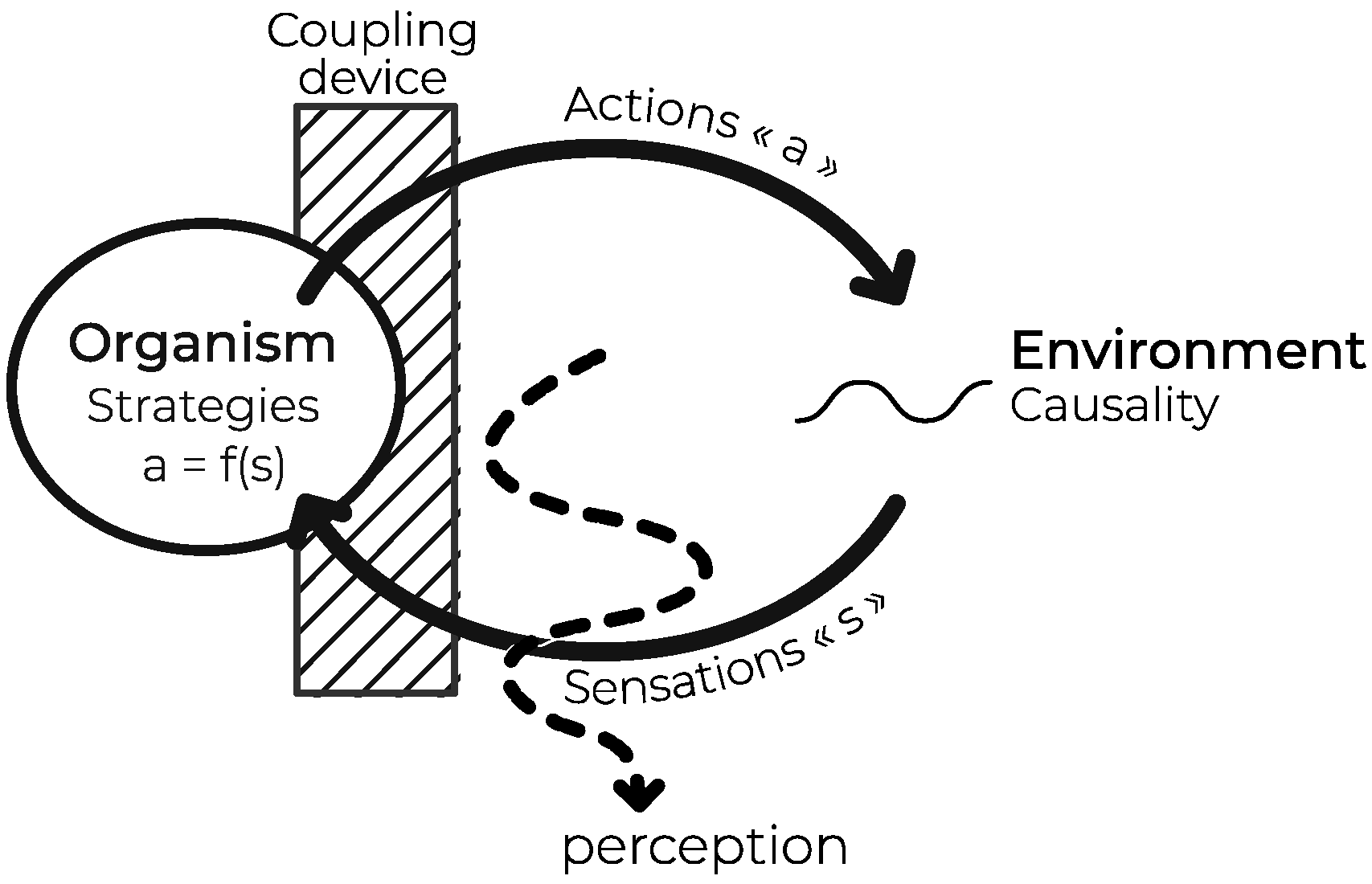
There is an overlooked similarity between three classic accounts of the conditions of object experience from three distinct disciplines. (1) Sociology: the “inversion” that accompanies discovery in the natural sciences, as local causes of effects are reattributed to an observed object. (2) Psychology: the “externalization” that accompanies mastery of a visual–tactile sensory substitution interface, as tactile sensations of the proximal interface are transformed into vision-like experience of a distal object. (3) Biology: the “projection” that brings forth an animal’s Umwelt, as impressions on its body’s sensory surfaces are reconfigured into perception of an external object. This similarity between the effects of scientific practice and interface-use on the one hand, and of sensorimotor interaction on the other, becomes intelligible once we accept that skillful engagement with instruments and interfaces constitutes a socio-material augmentation of our basic perceptual capacity. This enactive interpretation stands in contrast to anti-realism about science associated with constructivist interpretations of these three phenomena, which are motivated by viewing them as the internal mental construction of the experienced object. Instead, it favors a participatory realism: the sensorimotor basis of perceptual experience loops not only through our body, but also through the external world. This allows us to conceive of object experience in relational terms, i.e., as one or more subjects directly engaging with the world. Consequently, we can appreciate scientific observation in its full complexity: it is a socio-materially augmented process of becoming acquainted with the observed object that—like tool-use and perceiving more generally—is irreducibly self, other-, and world-involving. View Full-Text

Keywords: mind–body problemsensory substitutiondirect perceptionenactive cognitiontool-usefact–value gapphilosophy of mindcognitive sciencephilosophy of scienceconsciousness

Philosophies | Free Full-Text | Scientific Observation Is Socio-Materially Augmented Perception: Toward a Participatory Realism

Cybernetics of anticolonial war: Organisation, control and communication in nineteenth century Chechnya | by JJ Ruffell | Oct, 2022 | Medium

JJ Ruffell

Oct 2022

Cybernetics of anticolonial war: Organisation, control and communication in nineteenth century Chechnya

Cybernetics of anticolonial war: Organisation, control and communication in nineteenth century Chechnya | by JJ Ruffell | Oct, 2022 | Medium

Leadership and Systems Thinking – Zane Scott

Leadership and Systems ThinkingBy Zane ScottPosted on October 3, 2022

Leadership and Systems Thinking – Community.Vitechcorp.com

Metaphorum Webinars to May 2023, including Jan de Visch on October 5, 2022 and Paul Pangaro on November 4, 2022

Next Wednesday the 5th October, from 5:00 to 6:30 pm (UK summer time), we have our next webinar by Jan De Visch, on ‘Coherent Action: Linking Role and Work Contributions to Each other Through Real-Time Dialogue’. See below details of this webinar. The webinar will be at our usual zoom link:

Topic: Metaphorum’s Webinar Series
https://us02web.zoom.us/j/81943981395

See also below, more details of the forthcoming webinars in 2022.

Looking forward to having you with us in this webinar series.

Also . . . . we have been working on the Metaphorum web site and have uploaded several new resources including: links to the Falcondale collection ( both videos and transcripts); the complete recordings of Designing Freedom; a complete bibliography; and access to various ways to draw the VSM.

We hope this will build continuously, so if you have any ideas on the how the web site should develop please get in touch.

Angela Espinosa, Allenna Leonard , Peter Tuddenham, John Waters and Jon Walker

Jan De Visch
Coherent Action: Linking Role and Work Contributions
to Each other Through Real-Time Dialogue.
October the 5th 2022 (5:00- 6:30 pm UK summertime)

“The session focuses on the dialogical dimension of collaborative action. It is argued that within each of the five systems of Stafford Beer, collaborative coherence is characterised by asymmetry. Every team experience downward momentum, which pushes destabilisation away to the familiar and unambiguous, while upward momentum develops further, tests, and supplements new ideas. An oscillation toward and away from important focal ideas is seen as a constituent of how coherent action arises: there is a continuous dance between upward and downward dynamics. Finally, the session proposes ways to facilitate and enhance dialogue processes to develop real co-intelligence.

The ideas build on the best scientific research on individual, team, and organisational development. The findings reveal the relationship between system design complexity (which differs depending on the stratification level) and how individuals interpret those challenges. Perspective-taking determines how Stafford Beer’s five systems unfold in practice. Differences in perspective-taking determine how collaborative thinking in the designed systems occurs practically and with or without breadth and depth. Jan will illustrate the dynamics with two examples from actual recent organisational development projects.”

Jan is an Exec. Professor Organizational and Human Capital Management at the Entrepreneurial MBA at Flanders Business School (by Catholic University Leuven), since 2004. He does applied research on the relationship between dialogical practices, collaborative structures, and collaborative intelligence in organisations.

His recent publications (books based on research, full overview of 115 articles and 11 books available on demand) include several recent books on Dynamic Collaboration, Self-organisation, and Collaborative Intelligence (2018 -2022).

He is the founder and managing director of Connect & Transform BVBA (Belgium), since 2000 (www.connecttransform.be); Co-founder and managing partner of Making Strategy Deliver (USA, Florida), since 2011 (www.makingstrategydeliver.com); Co-Founder & Chief Ecosystem Officer Dynamic Collaboration App (since 2018) (http://dynamiccollaboration.app/) .

Jan is the President of the Belgian Chapter of the “Systems & Complexity in Organisations” network (since 2019), and Board Member of several international research groups (Canada, USA). He was President of the Board for ‘De Beitel’, social economy company, (2003-2010); Board member of the Flemish Employers Association (region Antwerp-Mechelen) (www.etion.be) (2000-2010); and Honorary Board Member of Metena (Think thank of entrepreneurs in Flanders) (www.etion.be) (2005-2009)

Jan holds a master’s in psychology from the Catholic University in Leuven and other postgraduate degrees in management, corporate governance and Corporate social responsibility (CSR), Executive remuneration (Vlerick Management School, 2002)

  • Several certifications in process & change facilitation tools.

Jan De Visch built his career in Human Resources, as Human Resources Director of De Vaderlandsche, the Group Franki-Van Roey and Sanoma Magazines. In each case he developed a Human Resources strategy that supported and reinforced the growth strategy of the company. He was involved in several integrations and restructuring processes from a corporate role. He has focused recently on Organisational development and complex transition coaching are the main themes through which Jan helps companies to realize their full potential. In particular, in facilitating Business Model transitions, Organisational culture and change, Co-creation, City Transition Projects, Organisation Design, cross cultural issues and diversity, business strategy and education, and coaching complexity.

E-mail : Jan@connecttransform.be

Dr Paul Pangaro
Designing Conversations for Variety
November 4th 2022, noon EST, 4 pm UK (wintertime)

There are countless challenges to managing complex organizations, including the need to design its processes with variety explicitly in mind. Of course, one approach is the VSM.

In this session a complementary approach is proposed, and critique invited. This approach distinguishes the classes of conversation that must reach agreement to coordinate the action of an organization. Of course, these conversations must pay attention to variety.

Pangaro will present this model of “designing conversations for variety” and propose how it maps to the VSM, where it may offer additional resilience. The goal of the presentation is to engage the participation of the attendees and to draw connections between the VSM and this conversation model, in hopes of illuminating both.

Paul Pangaro is president of the American Society for Cybernetics. His career spans research, consulting, startups, and education. Before his current role as Visiting Scholar in the School of Architecture and the School of Design at Carnegie Mellon University, he was Professor of the Practice in the Human-Computer Interaction Institute on the same campus. He has worked with and within startups in New York and Silicon Valley, in product and technology roles. His past consulting clients include Du Pont, Nokia, Samsung, Instituto Itaú Cultural (São Paulo), Ogilvy & Mather, and PoetryFoundation.org. His writing explicates “designing for conversation” from his research and implementations of software and organizational processes. His B.S. in Humanities/Computer Science is from MIT and his Ph.D. in Cybernetics with Gordon Pask is from Brunel University. His work can be found at http://pangaro.com/.

Olaf Brugman
Ten Synergetic Ideas for the VSM and Management Cybernetics Community
Dec 1st, 2022, 5:00- 6:30 pm (UK wintertime)

The leading question for this webinar is: “What can we do to enhance the applicability of the Viable System Model and Management Cybernetics?” Ten ideas will be presented to explore opportunities to take research, education, and application in practice of the VSM and Management Cybernetics a step further. The ideas are inspired by agile software development, pattern language architecture approaches, and from management practice in cooperative organisations. It will address the VSM as a tool, dissemination of knowledge and know-how, and its practical application. The webinar aims to share notions around the VSM and Management Cybernetics that participants can connect to their academic and professional activities.

Dr. Olaf Brugman has been a systems practitioner ever since he first got to know the Viable System Model in 1985. In the systems sciences community, he currently acts as the Vice President Conference on the board of the International Society for the Systems Sciences. His main professional engagement is with Rabobank, at which he serves as the head of sustainability policy & risk. He holds a master’s degree in public administration from Twente University and a doctorate from Radboud University Nijmegen, both in the Netherlands. He currently lives in and works from The Hague.

www.olafbrugman.com

Metaphorum Webinar Series 2022-2023 –
Agenda
September 2022- May 2023
(5:00 -6:30 pm UK unless stated differently)

Sept 7th, 2022, L Lavanderos, A. Malpartida. ‘Ecotomo, Ecopoiesis and No Required Variety’.
October 5th, 2022, Jan De Visch. ‘Coherent Action: Linking Role and Work Contributions to Each other Through Real-Time Dialogue’.
November 4th, 2022, Paul Pangaro. ‘Designing Conversations for Variety’. noon EST, 4 pm UK (wintertime)
December 1st 2022 Olaf Brugman. ‘Ten Synergetic Ideas for the VSM and Management Cybernetics Community’
January 4th, 2023, Vanilla Beer. ‘Interview with Vanilla Beer on her personal learning with Stafford ‘
February 1st, 2023, Katharine Farrell. ‘Holarchies, heterarchies, and hermeneutics: exploring relationships, between Beer and Bateson’
March 1st, 2023, Jose-Carlos Mariategui. ‘CENTRO and the construction of a mathematical model for atin -America’
April 5th, 2023, Raul Gonzalez. ‘How to enhance business platforms using the Viable System Model (VSM) to face the current and future complexity business challenges’
May 3rd, 2023, Joe Truss. ‘The Meta architecture of Team Syntegrity for participatory democracy’

We will announce sooner than later final details of the webinars for the 1st semester 2023.

Affording What’s In Your Head:

Harish's avatarHarish's Notebook - My notes... Lean, Cybernetics, Quality & Data Science.

In today’s post I am looking at the idea of “affordances”. This term is attributed to the famous American psychologist, James J Gibson. A loose explanation of affordances is something that offers ‘action possibilities’ or ‘information possibilities’. For example, a seat with its solid and flat surface affords sitting. It also affords standing on it. Gibson explains:

The affordances of the environment are what it offers the animal, what it provides or furnishes, either for good or ill. The verb to afford is found in the dictionary, but the noun affordance is not. I have made it up. I mean by it something that refers to both the environment and the animal in a way that no existing term does. It implies the complementarity of the animal and the environment.

Gibson was making it very clear that affordances are not exclusively the properties of something. They are the possibilities…

View original post 1,277 more words

How We Understand “Complexity” Makes a Difference: Lessons from Critical Systems Thinking and the Covid-19 Pandemic in the UK – Jackson (2020)

How We Understand “Complexity” Makes a Difference: Lessons from Critical Systems Thinking and the Covid-19 Pandemic in the UK

by 

Michael C. Jackson

Centre for Systems Studies, University of Hull, Hull HU6 7TS, UK

Systems 2020

Systems | Free Full-Text | How We Understand “Complexity” Makes a Difference: Lessons from Critical Systems Thinking and the Covid-19 Pandemic in the UK

An exchange of letters on the role of noise in collective intelligence – Daniel Kahneman, David C Krakauer, Olivier Sibony, Cass Sunstein, David Wolpert

cxdig's avatarComplexity Digest

A key but neglected issue in the search for collective intelligence principles is the role of noise. Does noise inhibit collective intelligence or can it amplify the discovery of intelligent solutions? In this exchange of letters, the authors explore the pros and cons of noise.

Collective Intelligence, 1(1)

Read the full article at: journals.sagepub.com

View original post

Systems Thinking – The OR Society

Systems ThinkingThe Systems Thinking Special Interest Group (ST-SIG) is for Systems/OR practitioners who are using, or want to learn about, systems theories, methodologies and methods to prevent or address highly complex organizational, social and environmental problems.We have an inclusive understanding of systems thinking, and value contributions from all the theoretical and methodological traditions using that term. We also welcome insights from the closely-related fields of cybernetics, systems science and complexity.The SIG has a broad aim of fostering interest in, and increasing knowledge of, systems thinking. We provide a forum for practitioners to share their experiences and learn from one another, and also to support academics in their applied research and teaching. We are particularly keen to enable collaborations between practitioners and academics, in the belief that significant, synergistic innovations can arise from open-minded learning between people working in different contexts.We aim to host quarterly sessions with guest speakers, and the production of a newsletter is under discussion. We will also continue to host the Systems Thinking stream at the annual conference of the OR Society. For several years, this has been the largest stream at the conference, with 60+ paper presentations and thriving dialogue and debate. We will make sure these annual get-togethers continue.As this is a new SIG, we are still developing what we want to offer the Systems/OR community, and we welcome ideas for things that you yourself would like to organize (preferably online, as the membership is geographically dispersed). Feel free to contact our Chair, Sadaf Salavati  sadaf.salavati@lnu.se with proposals.Please join us and contribute to the growing community of systems thinkers who are building the necessary capabilities to make our organizations, communities and ecosystems better places to live for current and future generations.

Systems Thinking – The OR Society