
https://www.peopleneedpeople.online/people-need-people-online
Warm Data labs: https://batesoninstitute.org/warm-data-labs/
https://www.peopleneedpeople.online/people-need-people-online
Warm Data labs: https://batesoninstitute.org/warm-data-labs/
Source: https://www.squawkpoint.com/2020/05/managing-complexity/
In the late 00’s Michelle Barton and Kathleen Sutcliffe carried out a study of wildfires in the US. They wanted to understand why some fires were well controlled and brought to a swift and happy conclusion, whilst others ran out of control causing millions of dollars of damage to thousands of acres of land.
They interviewed 28 firefighters from the north and south western states. This gave them insights into 62 different incidents.
The researchers categorised the outcome of the incidents as good or bad by how well the firefighters managed to control the blaze. At one extreme, fires were quickly extinguished whilst at the other they caused significant damage to property and on occasion firefighters had to run for their lives — literally.
They found patterns in the behaviour of those teams that controlled fires, and also those that didn’t.
Continues in source: https://www.squawkpoint.com/2020/05/managing-complexity/
https://docs.google.com/document/d/17YkH4kc63t7JI7JJZR6i3-iebJd7kfRAzAK_ssl8bt4/edit#
Travel demand modelling: What is it, what are its uses and what challenges has COVID-19 caused?
The Operational Research Society – Webinar – 24 June 2020 at 1pm UK time
Travel demand modelling: What is it, what are its uses and what challenges has COVID-19 caused?
Tim Gent, Atkins
Free, Online, 24 June 2020 at 1pm UK, The OR Society
https://us02web.zoom.us/webinar/register/7215897906706/WN_cQnj3dEnSYicfS80ueUMPQ
In this webinar, Tim will distil his years of experience and learnings to offer an excellent introduction to the principles of transport modelling and its uses. You will develop a newfound interest in, and appreciation of this area of operational research. In particular, he will share insights on the challenges caused by the COVID-19 pandemic, and how transport modellers and operational researchers may respond. This will ensure your grasp of transport modelling is up-to-date and cutting-edge.
https://us02web.zoom.us/webinar/register/7215897906706/WN_cQnj3dEnSYicfS80ueUMPQ?fbclid=IwAR1xBH2cbjY_KNoBjNdTBt85geiCGneZtZg9insQ2GkLN8256Mg-3bid-Bo

https://ccs2020.org/
We have been following the evolution of the COVID-19 pandemic, and it is unlikely that a successful, broadly attended, face-to-face meeting can be safely held in October. Therefore, the organizing committee and the Complex Systems Society (CSS) have agreed to transform CCS2020 to an online event organized by the CSS during this year. Further details will be provided soon in this and in the Complex Systems Society webpage [https://cssociety.org/].
Although from @IFISC_mallorca we are going to dearly miss you this year, we are happy to announce that Mallorca will be the venue for CCS2022. With renewed energy, we expect to see you all in Mallorca from 17 to 23 October 2022 for a vibrant CCS2022 edition. We also have the honor to announce that the next presencial edition of CCS will be held in October 2021 in Lyon, France! Keep these dates in your agenda!

In the early 60s, Robert Axelrod was a math major messing around with refrigerator-sized computers. Then a dramatic global crisis made him wonder about the space between a rock and a hard place, and whether being good may be a good strategy. With help from Andrew Zolli and Steve Strogatz, we tackle the prisoner’s dilemma, a classic thought experiment, and learn about a simple strategy to navigate the waters of cooperation and betrayal. Then Axelrod, along with Stanley Weintraub, takes us back to the trenches of World War I, to the winter of 1914, and an unlikely Christmas party along the Western Front.
https://overcast.fm/+Lfujhc
https://www.wnycstudios.org/podcasts/radiolab/segments/104010-one-good-deed-deserves-another
https://www.forbes.com/sites/rogerkay/2011/12/19/generous-tit-for-tat-a-winning-strategy/#b58f02866eb0
**
Prof. Ray Ison (http://www.open.ac.uk/people/rli2) has been a resilient voice advocating for systems approaches in both Australia and the UK for many years, as well as a deeply committed systems practitioner and teacher. In this last session, we heard from Ray about his practice, and his new book (with Ed Straw) The Hidden Power of Systems Thinking: Governance in a Climate Emergency. (https://www.routledge.com/The-Hidden-Power-of-Systems-Thinking-Governance-in-a-Climate-Emergency/Ison-Straw/p/book/9781138493995)
taken from their website – www.thesystemsschool.org
join our community of practice https://thesystemsschool.us20.list-manage.com/subscribe
Next Session: Examining power, lived experience and co-design
Thursday June 4th from 1:00-2:30pm Melbourne time
*members of the community of practice will receive a
calendar invitation with connection details separately*
We are pleased to share that in conjunction with our Power in the System course ( https://www.the-systems-school.org/copy-of-webinar-series ) , we will be hosting a virtual fireside chat with a few special guest practitioners. These folks are working in the field and engaging with issues of power, co-design, lived experience and systems. We’ll be hearing from them about how they are navigating these topics in their own practice.
Special Guests:
https://www.createspaceconsultancy.com/ in the areas of intersectional whole of system and community change for enabling gender equality, preventing family violence, respectful relationships and anti-racism
————————————————————
**
Systems Practice Self-Assessment
————————————————————
Back in December we wrapped up the inaugural ‘introduction to systems thinking’ webinar learning series. During one of the sessions, I introduced this brief survey tool to help you assess where you might begin building your systems practice (http://bit.ly/systemspractices) !
You may like to return to this survey over time and see how your progress is developing and see new areas for you to explore.
taken
By Sara Sumner
Posted on August 20, 2015
Throughout my professional career, I have worked at three different companies, each specializing in systems engineering. Ironically, I have found that even though systems has been the focus of each company, I didn’t find a true “systems” emphasis until I joined Vitech. As the VP of Professional Services (and my boss), Zane Scott, likes to put it, that requires a “focus on understanding systems and working from the perspective of that understanding.” A company true to the “systems” in “systems engineering” will manage the organization as a system itself, being deliberate and tactical regarding the management of the organization, and applying systems engineering principles ensuring organizational success. Below are five of the many systems engineering practices key to successfully engineering an organizational system:
1)Identify Your Mission
2)Keep the Systems Perspective
3)Manage Your Interfaces
4)Design for Redundancy
5)Verify and Validate
and
By Mark Simons
Posted on November 21, 2019
In model-based systems engineering, we tend to focus on requirements and design, but how many MBSE implementations consider aligning design with verification and validation (V&V)? The Vitech systems metamodel is especially capable of supporting V&V activities throughout the development lifecycle on either side of the “V.” Let’s take a look.
The typical “V,” illustrated in the following figure, depicts verification planning activities on the left side of the V, and verification execution activities on the right side of the “V.” In reality, verification and validation activities are also conducted on the left side of the “V” in conjunction with system development activities. Left side verification and validation typically consists of verification by analysis using simulation to validate the evolving system design, while right side V&V consists of the traditional unit, integration, system, and operational testing of the system as it is integrated and field tested.
Figure 1. The Engineering Model
If V&V is in reality aligned with system development, what metamodel can be defined to guide these activities? The world of verification and validation tends to vary more from organization to organization than typical systems engineering. Typically, systems engineers speak about requirements, behavior, and system design. V&V, on the other hand, is implemented in many different ways depending on your engineering domain, organization, or field. Despite this variability, the Vitech systems metamodel provides a means to formalize V&V methodologies and connect V&V with systems engineering. An excerpt of the Vitech systems metamodel, included in the following figure, depicts four unique classes specific to V&V, and describes the relationships among these classes, and with other classes in the systems metamodel.


The Covid 19 pandemic has given me an opportunity to observe, meditate and learn about complexity in action. In today’s post, I am looking at “truths” in complexity. Humans, more than any other species, have the ability to change their environment at a faster pace. They are also able to maintain belief systems over time and act on them autonomously. These are good reasons to call all “human systems” complex systems.
The Theories of Truth:
Generally, there are three theories of truth in philosophy. They are as follows:
View original post 1,948 more words
Another enthusiastic systems learner, August has a few projects set out below – and, in particular, another nascent community, the Project [+] Community Learning Discover server: https://discord.gg/9EN8TQU
Check out our initiatives and sites here: https://LinkTr.ee/AugustJames Let
Follow us on Twitter: https://twitter.com/brain_swap + https://twitter.com/augustjamesd
Share your idea here! https://brainswap.weebly.com/contact or visit directly: https://forms.gle/oBwUeZVhPPMQSJdT6
https://www.dlsweb.rmit.edu.au/bus/public/ADG_showcase/manage_change/content/sigmoid_curve.htm
According to Handy, the best time to start a new ‘curve’ is before you reach the peak of your existing one! That way, you will be starting something new when you still have the resources, and the spirit, to take it to new heights. In contrast, most people think of doing something new only when they have reached the bottom of what they are presently involved in.
Background to the sigmoid curve:
Successful industries are constantly re-inventing themselves, even when things are going well. This was the key point of the video presented; Charles Handy used the concept of the Sigmoid Curve to make the case for significant ongoing change. The sigmoid, or S-shaped, curve charts the trajectory of every successful human system. There is always a first period of experimentation and learning which is followed by a time of growth and development. Ultimately, however, every curve turns downward. The only thing that varies is the length and duration of each part of the curve.

Reference: Chapter Three in Charles Handy (1995) The Empty Raincoat – Making Sense of the Future Random House Australia ISBN 0 09 930125 3
Today, the speed of every curve seems to be increasing. To keep on growing, the successful industry, organisation and individual, must develop a second curve out of the first. The new curve, however, must start before the first one peaks, at Point A, when all the evidence is that there is no need for change.
Most organisations do not change until they get frightened, at Point B. This is often too late. By then the leaders have lost credibility, resources are depleted and the energy for creative thinking is low. Forty per cent of the Fortune 500 companies of seven years ago no longer exist as independent entities.
Change at Point A, however, results in a period of great confusion, represented by the shaded area in the drawing. At this time there are two contrasting and often competing cultures. The old ways, products and people must continue their efforts to maintain the first curve’s momentum.
At the same time, however, the industry must experiment with new ways and new ideas; and not all of them work. The challenge of the second curve is to find a way to start that curve while still building upon the success, learning and maturity gained from the first curve. When standing at Point A, one is presented with two confusing and opposing vistas. When one looks back along the sigmoid curve, they see success, growth and satisfaction. But at Point A, one can also look the other direction and see over the horizon of the curve and see the fall towards Point B. The opportunity is to openly look at what Point B tells you, to see the trends that can lead from A to B, but then to use this information to design a pathway from the current Point A, to the Point A on the next sigmoid curve – a pathway of uninterrupted success.
https://www.academia.edu/36268563/Gregory_Batesons_cybernetic_methodology_The_ecosystem_approach_in_empirical_research?email_work_card=title
Published 2017220
Pasikowski S. (2017). Gregory Bateson’s cybernetic methodology: The ecosystem approach in empirical research.
In N. Bateson, M. Jaworska-Witkowska (Eds.), Towards an ecology of mind: Batesonian legacy continued (63-84). Dąbrowa Górnicza: Scientific Publishing University of Dąbrowa Górnicza.
Page Numbers: 63-84
Publication Date: 2017
Proponents of #SystemsThinking often espouse holism to counter over-emphasis on reductionism. Reading some definitions from an encyclopedia positions one in the context of the other (François 2004).
–begin paste —
1560
HOLISM 1) – 3)
“A descriptive and investigative strategy which seeks to find the smallest number of explanatory principles by paying careful attention to the emergent properties of the whole, as opposed to the behavior of the isolated parts, as chosen by the observer in a reductionist strategy” (T.F.H. ALLEN & T.B. STARR, 1982, p.270).
The term and the concept were introduced in 1926 by the South African general and statesman Jan SMUTS. The term was derived from the Greek: “holos” = whole.
SMUTS wrote: “The idea of wholes and wholeness should… not be confined to the biological domain: it covers both inorganic substances and the highest manifestations of the human spirit. Taking a plant…
View original post 2,033 more words
source: https://www.ismtool.org/
A practical tool for designing effective policy interventions
There are many different theories which help us understand behaviour and change, drawn from many different disciplines. But there are fewer practical tools which allow practitioners to mobilise that theory, and apply it in developing and delivering behaviour change interventions on the ground.
ISM (standing for ‘Individual, Social, Material’) has been described as the most comprehensive of the available tools.
ISM is a multi-disciplinary tool for designing effective policy interventions, originally developed in the context of sustainability challenges. It was created by Andrew Darnton with colleagues at the University of Manchester, and launched by the Scottish Government in 2013.
ISM brings together into a single figure the main factors from the three disciplines most concerned with understanding behaviour: behavioural economics, social psychology, and sociology. The factors are arranged into three contexts, symbolised by a head (the Individual) in a circle (the Social) in a square (the Material). Evidence from reviews of international behaviour change interventions suggests that lasting change requires action in all three contexts (Southerton et al, 2011).
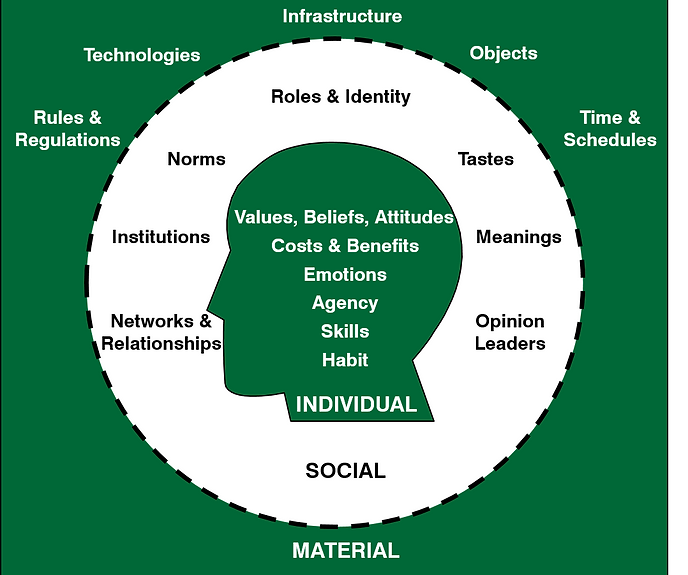
ISM was developed as a practical approach for intervening in complex systems, grounded in a deep understanding of behaviour. ISM offers a shortcut to the task of drawing on multiple models and theories, resulting in a tool which policymakers, analysts and practitioners of all stripes can pick up and run with – including in self-facilitated sessions. Used in this way, ISM supports approaches to policy development based on co-design and co-production, which in turn are vital for effective action in complex systems like obesity, biodiversity, or social inclusion, where no one organisation or actor holds all the levers over a given behaviour.
The process of using ISM is as important in producing results as the content of the model itself.
source: https://www.ismtool.org/


You must be logged in to post a comment.