Systemic Governing – Applied systems thinking in practice – Observatory of Public Sector Innovation Observatory of Public Sector Innovation

source: https://oecd-opsi.org/systemic-governing-applied-systems-thinking-in-practice/


Observatory of Public Sector Innovation

Systemic Governing – Applied systems thinking in practice

Written by Ed Straw and Professor Ray Ison on 26 May 2020

Guest blog from the Applied Systems Thinking in Practice Group, School of Engineering & Innovation, The Open University (UK)

Systems thinking in times of complex challenges

The Covid-19 pandemic has shown what governments can do when faced with an existential threat:
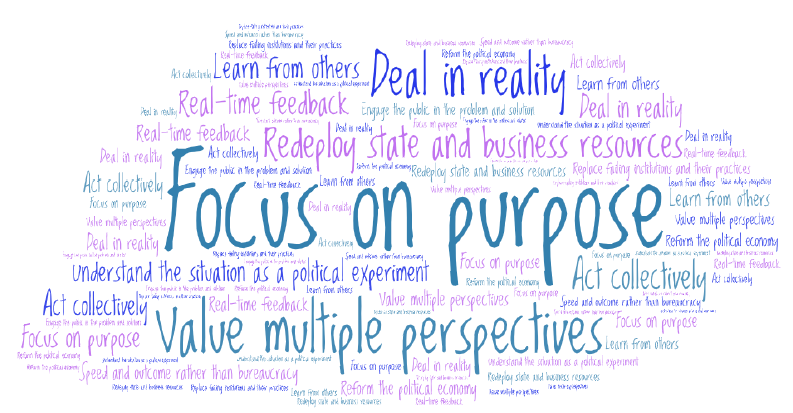
The above figure describes systemic responses that our book concludes are essential in modern government: Focus on purpose, Deal in reality, Real-time feedback, Learn from others, Value multiple perspectives, Speed and outcome rather than bureaucracy, Act collectively, Replace failing institutions and their practices, Redeploy state and business resources, Reform the political economy, Engage the public in the problem and solution, and Understand the situation as a political experiment.

The climate and associated emergencies are existential threats. These will require even more of governments and of governance. Further, these new ways of governing are what is needed to enable governments to achieve real and lasting beneficial change, consistently, across the board. Our thesis is that it is only through new systems of governance and new ways of thinking and acting can the human world manage the climate and associated emergencies, reduce inequality and reestablish widespread confidence in government. This is termed ‘second order change’. A young Algerian woman interviewed recently by the BBC said:

‘I have decided not to leave the country. The system has to leave.’

Our book is an invitation to us all to think about, and change, what we do when we do what we do.

Continues in source: https://oecd-opsi.org/systemic-governing-applied-systems-thinking-in-practice/

Systems Thinking Ontario – 2020-06-08, 18:30-20:30 Toronto time

booking via eventbrite: https://www.eventbrite.com/e/synthesis-mapping-2020-sfi-1-systems-thinking-ontario-tickets-107509886966?aff=ebemoffollowpublishemail&utm_term=Synthesis+Mapping+2020+SFI+%231+–+Systems+Thinking+Ontario&utm_medium=email&utm_content=follow_notification&utm_source=eventbrite&utm_campaign=following_published_event

2020-06-08

June 8 (the second Monday of the month) is the 80th meeting for Systems Thinking Ontario. The registration is at https://synthesis-mapping-2020-1.eventbrite.com.

Synthesis Mapping (#1), 2020 Strategic Foresight and Innovation program

Every year Systems Thinking Ontario hosts a series of summer evening events for presentations of synthesis maps (complex systems maps) created in systemic design courses in OCAD University graduate programs.

  • This first evening, June 8, we’re looking to have about three presentations.
  • The second evening, July 12, we’re considering to have another three presentations.
  • The third evening, August 10, we’re holding if there is more interest

Synthesis maps are rich visualizations that illustrate the real-world complexity of systemic challenges, and typically used to not only “map system problems” but to propose design recommendations for systems change and policies (from health to public policy, from service experiences to social change) from evidence gathered in stakeholder research. Policymakers and organizational stakeholders use synthesis maps for strategic advising, long-term planning, and considering interventions for social and systemic challenges (wicked problems).

While we are still sorting out the final slate of presenters, we have confirmed:

  • “Instagram & Mental Health: An exploration of users trapped by systemic pressures”, with Eugene Peng, Caitlin Pannell-Evans, Keith Burt, and Nélia Teixeira.
  • [more to come]

Venue:

  • The link for a Zoom conference will be sent upon registration on Eventbrite.
    • It’s really too bad that we can’t use the OCADU Visual Analytics Lab to meet in person!

Suggested pre-reading:

What are Synthesis Maps and Gigamaps? at https://slab.ocadu.ca/project/synthesis-maps-gigamaps

Agenda

https://www.gstatic.com/atari/embeds/913211048dfa67f4be7864f4505a4b63/intermediate-frame-minified.html?jsh=m%3B%2F_%2Fscs%2Fapps-static%2F_%2Fjs%2Fk%3Doz.gapi.en_GB.eR3MfYRCxOg.O%2Fam%3DwQE%2Fd%3D1%2Fct%3Dzgms%2Frs%3DAGLTcCOngjmPthjBHQKrX_RVBttSalO88w%2Fm%3D__features__&r=921664826

Warm Data and Iced Lemonade

source: https://thesideview.co/articles/warm-data-and-iced-lemonade/

Warm Data and Iced Lemonade

A deeply human response to complexity is possible.
Nora Bateson & Explorers of Liminality
Photo by Rodion Kutsaev 
Author: Nora Bateson & Explorers of Liminality
Affiliation: The International Bateson Institute
Twitter: @NoraBateson
Date: May 20, 2020

What is Warm Data?

Warm Data is that other kind of information: the emulsifier at the unspoken levels of why anyone does what they do. To make sense of our world we need all of our senses in relation to each other. Warm Data is the messy stuff, the multi-contexted, non-measureable relations between those senses. It is the movement within a complex living system. Warm Data is information that is alive. Warm Data itches when it is confined. Warm Data is the kind of information that let’s you know when to tell someone you love them. Warm Data gives credence to the notion that a deeply human response to complexity is possible. We all have it. Warm Data is why setting up multiple committees to solve the world’s problems of ecological and economic disaster will never work. The issues can never be separated. Warm Data is not located in one spot, or definable from one context—it changes, it is paradoxical, it matters who is observing.

Warm Data is the relational information; it’s not about the family members, but the relationship between them; it’s not about the organisms in a forest, but the relations between them; it’s not about the institutions of a society, but the relations between them.

There are different ways of generating Warm Data. One is research on complex issues. This form of research generates inquiry that does not get caught in either time-frozen or decontextualized research projects. Another form of participation is the Warm Data Lab. But, since the Warm Data Lab is an in-person process, it is currently on hold for the time it takes before travel and group gatherings are allowed again. In the meantime, a community-based project, called People Need People (PNP) has begun. It was originally designated for helping communities begin to perceive and articulate the possible projects that would form responses to the complexity of the issues they are facing, as opposed to silo-ed solutions. In a hurry, this process had to go online. I was against it. I fought hard. I was worried that the tech would flatten the richness of the in-person labs. What would happen to the shared experience of the room, to the subtle cues of a group laughing loudly, to the nuance of body language? But I eventually found a design for the process, and with a few different teams around the world, we prototyped it in a rush. That process is now known as PNP Online, and it’s running in about 40 different places around the world now, aided by around 100 certified PNP hosts.

continues in source: https://thesideview.co/articles/warm-data-and-iced-lemonade/

SCiO (Systems and Complexity in Organisation) Virtual Networking Event – 20 July 2020 18:30–20:15

source: https://systemspractice.org/events/scio-virtual-networking-event-july-2020

SCiO Virtual Networking Event – July 2020

20 July 2020 18:30–20:15

Organiser(s): SCiO UK

Event access:All welcome

Book now

SCiO Virtual Networking Event – July 2020

Open events and development days, in addition to the core content, provide valuable opportunities for systems practitioners to network and mingle. Since our events are now going online, this will be hard – or certainly different.

Therefore we’re running the first virtual networking event. Hosted by SCiO director Benjamin Taylor, with deep experience of online facilitation from five to over a hundred people, this will combine some initial small group work, Open Space-style discussions, and completely open opportunities to mingle as individuals.

Please note that you will need to attend using a desktop computer (not a tablet or phone) to get the best experience.

source: https://systemspractice.org/events/scio-virtual-networking-event-july-2020

A Conversation with Eric Trist – YouTube

Eric Trist discusses his discovery of social/technical systems in coal mines in post war England.

Sandra Janoff, Marv Weisbord, and roots into the history of human relations

Dr. Sandra Janoff from the USA and Co-Founder of the Future Search Methodology, talks to Prof. Dr. Hüseyin Özdemir (oezpa Institute) about the Future Search, Tavistock, Eric Trist, Future Search Network and Marvin Weisbord.

An interview with Marvin Weisbord and Sandra Janoff, founders of Future Search Network, whose members practice one of the first and most successful participative methods for whole system interactive planning and organizational development. Learn about a unique philosophy and method that enables communities and organizations to transform their capability for action.

Integrating Chaos: Building Resilient Organizations with Chaos Theory

source: https://think-boundless.com/chaos-theory/

Integrating Chaos: Building Resilient Organizations with Chaos Theory

Chaos Theory in Modern Organizations

Our imagination about what happens in the business world has become disconnected with reality and it all starts with an accepted narrative about the unstoppable power of Fredrick Taylor’s ideas

The narrative goes like this: Fredrick Taylor introduced managers to analytical methods and tools that helped them to dramatically improve productivity; however these efforts also kick-started a non-stop line of efforts that led to the inevitable over-optimization of human labor.

This over-simplification of Taylor is part of a narrative that has become entrenched and feeds a broad movement that says organizations are broken. The story says that organizations might be efficient, but at enormous cost – they destroy autonomy, stifle creativity and at worst, are systems that enable widespread verbal and physical abuse. All starting with Taylor of course.

Yet, as I’ll show you, this story is wrong, misses the context of Taylor’s time and ignores that a hyper-optimized mindset towards work did not take hold until the emergence of the “career path” in the 1960s. This coincided with the risk of “knowledge work” and this shift turned work into a performance, distracting many from the real mission of any organization: survival.

Instead of seeing organizations as broken, a more accurate starting point is to think of them as complex systems and instead of broken, as fragile. As the scale of business gets bigger, the hidden fragility of many organizations puts employees, customers and society at risk.

To address this fragility, I want to look at organizations as “complex adaptive systems”, an idea that emerged from a field called Chaos Theory in the 1970s and 1980s. I want to push for a broader adoption of these principles and encourage a new generation of “chaos managers” to become interested in the survival and success of our institutions.  

I first learned about chaos theory 13 years ago and have been thinking about it ever since.  During the ten years I spent in the corporate world and as a management consultant, I couldn’t escape the feeling that something was missing.  This is my first attempt to fill that gap and to give many other frustrated managers and leaders an additional lens to help them think about helping their organizations thrive.  

This essay will explore the following:

  • What we got wrong about Taylor
  • How the idea of the “career path” turned workers into performers
  • How organizations subsequently became complicated, not complex
  • Why chaos theory does not lead to anarchy
  • The implications of chaos theory on leadership
  • An actionable five-part guide for the modern “chaos manager”

Continues in source: https://think-boundless.com/chaos-theory/

SCiO Virtual Open Meeting – Mon 13 July 2020 | 18:30-20:30 BST

source: https://systemspractice.org/events/scio-virtual-open-meeting-july-2020

  • SCiO Virtual Open Meeting – July 2020
openmeeting

SCiO Virtual Open Meeting – July 2020

13 July 2020 18:30–20:30Event type:
Open MeetingOrganiser(s):
SCiO UKEvent access:All welcomeBook now

SCiO Virtual Open Meeting – July 2020

SCiO organises Open Meetings to provide opportunities for practitioners to learn and develop new practice, to build relationships, network, hear about skills, tools, practice and experiences. In the current period of social distancing we are pleased to provide a virtual version of these popular events. Inevitabley this will be shorter but will also be more frequent. Although these events will be free, it is important that you do book – through eventbrite (click book now). You will be emailed a Zoom link close to the meeting. The programme for 13th July is as follows:

18:30 – Welcome, SCiO notices, virtual housekeeping etc
18:40 – Virtual community exercise
18:50 – Session 1 (presentation followed by Q & A ) – Marie Davidova
19:40 – Session 2 (presentation followed by Q & A) – Malcolm Cawood
20:25 – Summary and close

Event Resources

Systemic Approach to Architectural Performance: The Hyperobjective Media and Agency in Co-creative Design Processes

The session by Marie Davidova will focus on Systemic Approach to Architectural Performance (SAAP) design field and hyperobjectivity of its prototypes. The field discusses the question of cities’ adaptation to climate change and biodiversity loss. Current environmental ecology research shows that spe… Read moreAuthorsMarie Davidova

Shakespeare & Systems Thinking – the high and low co-operate in the general system of unavoidable concatenation

People I talk to often seem a little wary of the term “systems thinking” – a bit abstract, perhaps, and far too intellectual. On other hand, anyone who can appreciate complex drama, from Shakespeare to modern TV shows like The Wire, is arguably already doing it, that is thinking, to some degree, sys… Read moreAuthorsMalcolm Cawood

source: https://systemspractice.org/events/scio-virtual-open-meeting-july-2020

Rewilding Theory Is Making Me a Better Leader

https://builtin.com/founders-entrepreneurship/rewilding-theory-better-leader

REWILDING THEORY IS MAKING ME A BETTER LEADER

Apply these lessons from the rewilding theory of conservation to revolutionize your approach to leadership.

Headshot of Hypergiant CEO Ben Lamm

Ben Lamm

Expert Contributor

Serial technology entrepreneur making the impossible possible. Currently, Founder/CEO of Hypergiant. Previously, Founder/CEO of Conversable, acquired by LivePerson; Chaotic Moon Studios, acquired by Accenture; and Team Chaos, acquired by Zynga.

May 12, 2020 Updated: May 20, 2020

I don’t know how many days I have spent inside my house. For a while, I counted them, but I gave up somewhere around day 20. I began to acknowledge that things were going to blur together, and that I was going to become intimately familiar with my home office. While trapped inside, I began studying new theories and ideas for how to move our world forward. In particular, I’ve been drawn to the theory of rewilding.

Continues in source: https://builtin.com/founders-entrepreneurship/rewilding-theory-better-leader

Steady State Economics: We’ve Got Some (Systems) Thinking To Do | Scoop News

source: https://www.scoop.co.nz/stories/HL2005/S00181/steady-state-economics-weve-got-some-systems-thinking-to-do.htm

Steady State Economics: We’ve Got Some (Systems) Thinking To Do

Friday, 22 May 2020, 9:50 am
Article: Murray Grimwood

Terreform One’s vision of New York as a smart city. Photograph- Mitchell Joachim/Terreform One

In this time of impending economic and ecological crises, we urgently need to aim for a sustainable or ‘steady state’ economy. In order to get there, we will need to adopt a ‘systems-thinking’ outlook taking into account the interconnections of our complex world. We will also need to consider the issue of de-growth, and re-prioritise kindness and the commons. We have a choice as to whether we act now to make this transition voluntarily and with fairness, or have it forced upon us by times of economic, resource and ecological collapse.

In short, we’ve got some systems thinking to do.

source: https://www.scoop.co.nz/stories/HL2005/S00181/steady-state-economics-weve-got-some-systems-thinking-to-do.htm

Simplicity is at the root of policy failures – Polly Mackenzie in UnHerd

source: https://unherd.com/2020/05/why-simplicity-is-at-the-root-of-policy-failures/

Simplicity is at the root of policy failures

Whether it’s lockdown regulations or welfare payments, one-size-fits-all is not the answer

BY POLLY MACKENZIE

An uprising against the hated elite by the people of [checks notes] Islington (Photo by Tolga AKMEN / AFP) (Photo by TOLGA AKMEN/AFP via Getty Images)

Polly Mackenzie is Director of Demos, a leading cross-party think tank. She served as Director of Policy to the Deputy Prime Minister from 2010-2015.Add to Favourites Add to favourites

pollymackenzie

May 28, 2020

At school, I always loved the moment in language lessons when you had to learn how to list your siblings. Thanks to my parents’ divorce and remarriages, I have a brother, a sister, a half-sister and three step sisters, which meant I got to show off my mastery of complicated words like stiefschwestern and hermanastras. I pitied the children with boring families and boring things to say like “je suis enfant unique.” What surprised me, though, was that even my best friends could never quite remember which of my sisters belonged to which step parent. We have infinite ability to understand the complexity of our own lives. But when we think about other people? The details get blurred, like the background in a Zoom video.

I was reminded of this very human weakness as I listened to Dominic Cummings exhaustively describe the “complicated, tricky situation” that had led him to drive his family to Durham at the end of March. He seemed to think that “complicated” and “tricky” were evidence that his circumstances were exceptional. Because, like my school friends, he was blind to the complexity of others’ lives — the thousands upon thousands of other parents who also had little children, sick spouses and important jobs.

The government wrote a lockdown policy that was radically different to the norm in our common law system. Under common law, everything is legal unless prohibited by law. During the lockdown the default was the opposite: it was illegal to leave your home unless you had a good excuse. That shift puts an impossible burden on those who draft the law, to think of every single good reason that could arise, in the infinite variety of human experience.

Continues in source: https://unherd.com/2020/05/why-simplicity-is-at-the-root-of-policy-failures/

Ackoff’s lift and Rory Sutherland’s fantasy…

Ian Mitroff reminds me of this classic story (evidently repeated in several publications by Ackoff):

There is a classic case in which the tenants of a large office building complained about the increasingly poor elevator service.  A consulting firm specializing in elevator-related problems was employed to deal with the situation.  It first established that average waiting time for elevators was too long. It then evaluated the possibilities of adding elevators, replacing existing elevators with faster ones, and introducing computer controls to improve utilization of elevators. For various reasons, none of these turned out to be satisfactory.  The engineers declared the problem to be unsolvable.

        When exposed to the problem, a young psychologist employed in the building’s personnel department made a simple suggestion that dissolved the problem. Unlike the engineers who saw the service as too slow, he saw the problem as one deriving from the boredom of those waiting for an elevator. So he decided they should be given something to do.  He suggested putting mirrors in the elevator lobbies to occupy those waiting by enabling them to look at themselves and others without appearing to do so. The mirrors were put up and complaints stopped.  In fact, some of the previously complaining tenants congratulated management on improvement of the elevator service.

                                                                Ackoff, R. L.,  1999

                                                                Re-creating the Corporation

                                                                Oxford Univ. Press, NY p15-16

http://classes.bus.oregonstate.edu/ba465H/Stories/Ackoff’s%20elevator%20story.htm

https://signalvnoise.com/posts/1244-defining-the-problem-of-elevator-waiting-times

To me, this seems to tie in with Rory Sutherland’s more recent ‘Perspective is Everything’ TED Talk:

​https://www.ted.com/talks/rory_sutherland_perspective_is_everything?language=en

Speaking to Ian Mitroff (for a forthcoming podcast) has certainly validated and cemented my own ‘systems thinking identity’ as being focused on this kind of story – the importance of framing, the priority of actual outcomes and of making things better!

Benjamin

[Continued in first comment]

Tour Cybernétique (Cybernetic Tower) – Liège, Belgium – Atlas Obscura

https://www.atlasobscura.com/places/tour-cybernetique-cybernetic-tower

Tour Cybernétique (Cybernetic Tower)

Parc de la BoverieLiège, Belgium

Nicolas Schöffer’s massive interactive sculpture was assembled in 1961 and brought back online in 2016. 

AHVENAS (ATLAS OBSCURA USER)

A STRUCTURE OF STEEL TUBES and blades towers 52 meters (170 feet) over the Parc de la Boverie in Liège, Belgium. Known as Tour Cybernétique (the Cybernetic Tower), the monumental structure was designed by the artist Nicolas Schöffer and assembled in 1961.

Nicolas Schöffer is known as the father of cybernetic art, which priotizes feedback over traditional aesthetics. Cybernetic art uses audio and visual feedback, computer-generated compositions, and other technological elements to create pieces of striking modernist art.

Tour Cybernétique interacts with environment through an electronic brain located in a nearby convention center, the Palais des Congrès. It is equipped with microphones, light sensors, a hygrometer, and an anemometer. This way the tower receives data about noise, light intensity, humidity and wind. Depending on this input, the electronic brain can set in motion the different pads or start one of the 12 musical sequences or light up the area with one of its 120 multi-color projectors.

Due to lack of proper maintenance, the tower was deactivated in 1970. The tower however stayed and as a testimony of a scientific process it was later classified as an exceptional heritage. In 2002, a project to restore of the tower began. In 2015 it was dismantled for a complete renovation. The control and electrical systems and lights were updated and modernized. In 2016, after more than 40 years of inactivity, the tower was operational once again.

2014/02/25 18:00 Terence Deacon, “Emergence: Why self-organization is not enough”, U. of Toronto

daviding's avatarIn brief. David Ing.

Abstract for Terence Deacon talk:

How can living and mental “selves” exhibit properties that are so unlike the properties of the inanimate, insentient material processes that constitute them? Can an account of how order spontaneously arises from chaotic beginnings in so-called “self-organizing” processes solve these mysteries?  this talk will demonstrate how self-organizing processes work, explain why they alone cannot solve these mysteries, but hen show how certain higher order relationships between self-organizing processes do create selves.

Wiegand Memorial Foundation Lecture Series, Vivian & David Campbell Conference Facility, Munk School of Global Affairs

Welcome by Jay Pratt, vp of dean and infrastructure

Weigand interest:  in larger questions, science and faith

This digest was created in real-time during the meeting, based on the speaker’s presentation(s) and comments from the audience. The content should not be viewed as an official transcript of the meeting, but only as an interpretation by a single…

View original post 1,964 more words

Human Thermodynamics pioneers – Hmolpedia

source: http://www.eoht.info/page/HT+pioneers

HT pioneersThis is a featured page

____HT pioneer (new)
The subject of human thermodynamics is akin to mountain climbing: we know thermodynamics governs us as it does the universe, the question is not if, the question is how? Only through study of the pioneers (below) shall we reach the summit.

In hmol science, HT pioneers, or pioneers of human thermodynamics, are those (505+) scientists and writers, as listed below, who over the years have contributed theory and logic to the understanding of the thermodynamics of human existence. 

“I’m sorry Lord Kelvin (1824-1907) is dead. I would travel a few thousand-million miles to discuss with him the thermodynamics of socialistic society.” (Henry Adams, Letter to English lawyer Charles Gaskell, 1909)

“The fascination of a growing science lies in the work of the pioneers at the very borderland of the unknown, but to reach this frontier one must pass over well traveled roads; of these one of the safest and surest is the broad highway of thermodynamics.” (Gilbert Lewis and Merle Randall, Thermodynamics, 1923)Each person’s photo-size is indicative of a combination of originality, contribution density, impact, and deepness of thought and theory penetration. Ranks of pioneers within a given year, are listed in descending order. Small quick-mark clickable icons, as described in the following table, are used to facilitate topics and theories associated with the work of each person. Those thinkers with equations, shown in upper right hand corner (of their description), each equation representative of that person’s work, signifies a deeper thinker who goes beyond simple verbal arguments and employs the language of differential equations, rather than simple verbal arguments, otherwise known as entropology, which are a dime-a-dozen; most-often becoming empty excursions into nonsense. Thinkers are grouped into four year-range categories: past-1799 (8+), 1800-1899 (51+), 1900-1999 (334+), and 2000-present (110+):