Differential Logic • 5

Differential Expansions of Propositions

Worm’s Eye View

Let’s run through the initial example again, keeping an eye on the meanings of the formulas which develop along the way.  We begin with a proposition or a boolean function f(p, q) = pq whose venn diagram and cactus graph are shown below.

Venn Diagram f = pq

Cactus Graph f = pq

A function like f has an abstract type and a concrete type.  The abstract type is what we invoke when we write things like f : \mathbb{B} \times \mathbb{B} \to \mathbb{B} or f : \mathbb{B}^2 \to \mathbb{B}.  The concrete type takes into account the qualitative dimensions or “units” of the case, which can be explained as follows.

Let P be the set of values \{ \texttt{(} p \texttt{)},~ p \} ~=~ \{ \mathrm{not}~ p,~ p \} ~\cong~ \mathbb{B}.
Let Q be the set of values \{ \texttt{(} q \texttt{)},~ q \} ~=~ \{ \mathrm{not}~ q,~ q \} ~\cong~ \mathbb{B}.

Then interpret the usual propositions about p, q as functions of the concrete type f : P \times Q \to \mathbb{B}.

We are going to consider various operators on these functions.  An operator \mathrm{F} is a function which takes one function f into another function \mathrm{F}f.

The first couple of operators we need are logical analogues of two which play a founding role in the classical finite difference calculus, namely, the following.

The difference operator \Delta, written here as \mathrm{D}.
The enlargement operator, written here as \mathrm{E}.

These days, \mathrm{E} is more often called the shift operator.

In order to describe the universe in which these operators operate, it is necessary to enlarge the original universe of discourse.  Starting from the initial space X = P \times Q, its (first order) differential extension \mathrm{E}X is constructed according to the following specifications.

\begin{array}{rcc}  \mathrm{E}X & = & X \times \mathrm{d}X  \end{array}

where:

\begin{array}{rcc}  X & = & P \times Q  \\[4pt]  \mathrm{d}X & = & \mathrm{d}P \times \mathrm{d}Q  \\[4pt]  \mathrm{d}P & = & \{ \texttt{(} \mathrm{d}p \texttt{)}, ~ \mathrm{d}p \}  \\[4pt]  \mathrm{d}Q & = & \{ \texttt{(} \mathrm{d}q \texttt{)}, ~ \mathrm{d}q \}  \end{array}

The interpretations of these new symbols can be diverse, but the easiest option for now is just to say \mathrm{d}p means “change p” and \mathrm{d}q means “change q”.

Drawing a venn diagram for the differential extension \mathrm{E}X = X \times \mathrm{d}X requires four logical dimensions, P, Q, \mathrm{d}P, \mathrm{d}Q, but it is possible to project a suggestion of what the differential features \mathrm{d}p and \mathrm{d}q are about on the 2‑dimensional base space X = P \times Q by drawing arrows crossing the boundaries of the basic circles in the venn diagram for X, reading an arrow as \mathrm{d}p if it crosses the boundary between p and \texttt{(} p \texttt{)} in either direction and reading an arrow as \mathrm{d}q if it crosses the boundary between q and \texttt{(} q \texttt{)} in either direction, as indicated in the following figure.

Venn Diagram p q dp dq

Propositions are formed on differential variables, or any combination of ordinary logical variables and differential logical variables, in the same ways propositions are formed on ordinary logical variables alone.  For example, the proposition \texttt{(} \mathrm{d}p \texttt{(} \mathrm{d}q \texttt{))} says the same thing as \mathrm{d}p \Rightarrow \mathrm{d}q, in other words, there is no change in p without a change in q.

Given the proposition f(p, q) over the space X = P \times Q, the (first order) enlargement of f is the proposition \mathrm{E}f over the differential extension \mathrm{E}X defined by the following formula.

\begin{matrix}  \mathrm{E}f(p, q, \mathrm{d}p, \mathrm{d}q)  & = &   f(p + \mathrm{d}p,~ q + \mathrm{d}q)  & = &  f( \texttt{(} p, \mathrm{d}p \texttt{)},~ \texttt{(} q, \mathrm{d}q \texttt{)} )  \end{matrix}

In the example f(p, q) = pq, the enlargement \mathrm{E}f is computed as follows.

\begin{matrix}  \mathrm{E}f(p, q, \mathrm{d}p, \mathrm{d}q)  & = &   (p + \mathrm{d}p)(q + \mathrm{d}q)  & = &  \texttt{(} p, \mathrm{d}p \texttt{)(} q, \mathrm{d}q \texttt{)}  \end{matrix}

Cactus Graph Ef = (p,dp)(q,dq)

Given the proposition f(p, q) over X = P \times Q, the (first order) difference of f is the proposition \mathrm{D}f over \mathrm{E}X defined by the formula \mathrm{D}f = \mathrm{E}f - f, or, written out in full:

\begin{matrix}  \mathrm{D}f(p, q, \mathrm{d}p, \mathrm{d}q)  & = &   f(p + \mathrm{d}p,~ q + \mathrm{d}q) - f(p, q)  & = &  \texttt{(} f( \texttt{(} p, \mathrm{d}p \texttt{)},~ \texttt{(} q, \mathrm{d}q \texttt{)} ),~ f(p, q) \texttt{)}  \end{matrix}

In the example f(p, q) = pq, the difference \mathrm{D}f is computed as follows.

\begin{matrix}  \mathrm{D}f(p, q, \mathrm{d}p, \mathrm{d}q)  & = &   (p + \mathrm{d}p)(q + \mathrm{d}q) - pq  & = &  \texttt{((} p, \mathrm{d}p \texttt{)(} q, \mathrm{d}q \texttt{)}, pq \texttt{)}  \end{matrix}

Cactus Graph Df = ((p,dp)(q,dq),pq)

This brings us by the road meticulous to the point we reached at the end of the previous post.  There we evaluated the above proposition, the first order difference of conjunction \mathrm{D}f, at a single location in the universe of discourse, namely, at the point picked out by the singular proposition pq, in terms of coordinates, at the place where p = 1 and q = 1.  That evaluation is written in the form \mathrm{D}f|_{pq} or \mathrm{D}f|_{(1, 1)}, and we arrived at the locally applicable law which may be stated and illustrated as follows.

f(p, q) ~=~ pq ~=~ p ~\mathrm{and}~ q \quad \Rightarrow \quad \mathrm{D}f|_{pq} ~=~ \texttt{((} \mathrm{dp} \texttt{)(} \mathrm{d}q \texttt{))} ~=~ \mathrm{d}p ~\mathrm{or}~ \mathrm{d}q

Venn Diagram Difference pq @ pq

Cactus Graph Difference pq @ pq

The venn diagram shows the analysis of the inclusive disjunction \texttt{((} \mathrm{d}p \texttt{)(} \mathrm{d}q \texttt{))} into the following exclusive disjunction.

\begin{matrix}  \mathrm{d}p ~\texttt{(} \mathrm{d}q \texttt{)}  & + &  \texttt{(} \mathrm{d}p \texttt{)}~ \mathrm{d}q  & + &  \mathrm{d}p ~\mathrm{d}q  \end{matrix}

The differential proposition \texttt{((} \mathrm{d}p \texttt{)(} \mathrm{d}q \texttt{))} may be read as saying “change p or change q or both”.  And this can be recognized as just what you need to do if you happen to find yourself in the center cell and require a complete and detailed description of ways to escape it.

Resources

cc: Academia.eduCyberneticsLaws of Form • Mathstodon (1) (2)
cc: Research GateStructural ModelingSystems ScienceSyscoi

#amphecks, #animata, #boolean-algebra, #boolean-functions, #c-s-peirce, #cactus-graphs, #change, #cybernetics, #differential-calculus, #differential-logic, #discrete-dynamics, #equational-inference, #functional-logic, #gradient-descent, #graph-theory, #inquiry-driven-systems, #logic, #logical-graphs, #mathematics, #minimal-negation-operators, #propositional-calculus, #time, #visualization

Differential Logic • 4

Differential Expansions of Propositions

Bird’s Eye View

An efficient calculus for the realm of logic represented by boolean functions and elementary propositions makes it feasible to compute the finite differences and the differentials of those functions and propositions.

For example, consider a proposition of the form ``p ~\mathrm{and}~ q" graphed as two letters attached to a root node, as shown below.

Cactus Graph Existential p and q

Written as a string, this is just the concatenation p~q.

The proposition pq may be taken as a boolean function f(p, q) having the abstract type f : \mathbb{B} \times \mathbb{B} \to \mathbb{B}, where \mathbb{B} = \{ 0, 1 \} is read in such a way that 0 means \mathrm{false} and 1 means \mathrm{true}.

Imagine yourself standing in a fixed cell of the corresponding venn diagram, say, the cell where the proposition pq is true, as shown in the following Figure.

Venn Diagram p and q

Now ask yourself:  What is the value of the proposition pq at a distance of \mathrm{d}p and \mathrm{d}q from the cell pq where you are standing?

Don’t think about it — just compute:

Cactus Graph (p,dp)(q,dq)

The cactus formula \texttt{(} p \texttt{,} \mathrm{d}p \texttt{)(} q \texttt{,} \mathrm{d}q \texttt{)} and its corresponding graph arise by replacing p with p + \mathrm{d}p and q with q + \mathrm{d}q in the boolean product or logical conjunction pq and writing the result in the two dialects of cactus syntax.  This follows because the boolean sum p + \mathrm{d}p is equivalent to the logical operation of exclusive disjunction, which parses to a cactus graph of the following form.

Cactus Graph (p,dp)

Next question:  What is the difference between the value of the proposition pq over there, at a distance of \mathrm{d}p and \mathrm{d}q from where you are standing, and the value of the proposition pq where you are, all expressed in the form of a general formula, of course?  The answer takes the following form.

Cactus Graph ((p,dp)(q,dq),pq)

There is one thing I ought to mention at this point:  Computed over \mathbb{B}, plus and minus are identical operations.  This will make the relation between the differential and the integral parts of the appropriate calculus slightly stranger than usual, but we will get into that later.

Last question, for now:  What is the value of this expression from your current standpoint, that is, evaluated at the point where pq is true?  Well, replacing p with 1 and q with 1 in the cactus graph amounts to erasing the labels p and q, as shown below.

Cactus Graph (( ,dp)( ,dq), )

And this is equivalent to the following graph.

Cactus Graph ((dp)(dq))

We have just met with the fact that the differential of the and is the or of the differentials.

\begin{matrix}  p ~\mathrm{and}~ q  & \quad &  \xrightarrow{\quad\mathrm{Diff}\quad}  & \quad &  \mathrm{d}p ~\mathrm{or}~ \mathrm{d}q  \end{matrix}

Cactus Graph pq → Diff → ((dp)(dq))

It will be necessary to develop a more refined analysis of that statement directly, but that is roughly the nub of it.

If the form of the above statement reminds you of De Morgan’s rule, it is no accident, as differentiation and negation turn out to be closely related operations.  Indeed, one can find discussion of logical difference calculus in the personal correspondence between Boole and De Morgan and Peirce, too, made use of differential operators in a logical context, but the exploration of those ideas has been hampered by a number of factors, not the least of which has been the lack of a syntax adequate to handle the complexity of expressions evolving in the process.

Resources

cc: Academia.eduCyberneticsLaws of Form • Mathstodon (1) (2)
cc: Research GateStructural ModelingSystems ScienceSyscoi

#amphecks, #animata, #boolean-algebra, #boolean-functions, #c-s-peirce, #cactus-graphs, #change, #cybernetics, #differential-calculus, #differential-logic, #discrete-dynamics, #equational-inference, #functional-logic, #gradient-descent, #graph-theory, #inquiry-driven-systems, #logic, #logical-graphs, #mathematics, #minimal-negation-operators, #propositional-calculus, #time, #visualization

Differential Logic • 3

Cactus Language for Propositional Logic (cont.)

Table 1 shows the cactus graphs, the corresponding cactus expressions, their logical meanings under the so‑called existential interpretation, and their translations into conventional notations for a sample of basic propositional forms.

Table 1. Syntax and Semantics of a Calculus for Propositional Logic

Table 1. Syntax and Semantics of a Calculus for Propositional Logic

The simplest expression for logical truth is the empty word, typically denoted by \boldsymbol\varepsilon or \lambda in formal languages, where it is the identity element for concatenation.  To make it visible in context, it may be denoted by the equivalent expression ``\texttt{(())}" or, especially if operating in an algebraic context, by a simple ``1".  Also when working in an algebraic mode, the plus sign ``+" may be used for exclusive disjunction.  Thus we have the following translations of algebraic expressions into cactus expressions.

\begin{matrix}  a + b \quad = \quad \texttt{(} a \texttt{,} b \texttt{)}  \\[8pt]  a + b + c  \quad = \quad \texttt{(} a \texttt{,(} b \texttt{,} c \texttt{))}  \quad = \quad \texttt{((} a \texttt{,} b \texttt{),} c \texttt{)}  \end{matrix}

It is important to note the last expressions are not equivalent to the 3‑place form \texttt{(} a \texttt{,} b \texttt{,} c \texttt{)}.

Resources

cc: Academia.eduCyberneticsLaws of Form • Mathstodon (1) (2)
cc: Research GateStructural ModelingSystems ScienceSyscoi

#amphecks, #animata, #boolean-algebra, #boolean-functions, #c-s-peirce, #cactus-graphs, #change, #cybernetics, #differential-calculus, #differential-logic, #discrete-dynamics, #equational-inference, #functional-logic, #gradient-descent, #graph-theory, #inquiry-driven-systems, #logic, #logical-graphs, #mathematics, #minimal-negation-operators, #propositional-calculus, #time, #visualization

Differential Logic • 2

Cactus Language for Propositional Logic

The development of differential logic is facilitated by having a moderately efficient calculus in place at the level of boolean‑valued functions and elementary logical propositions.  One very efficient calculus on both conceptual and computational grounds is based on just two types of logical connectives, both of variable k-ary scope.  The syntactic formulas of that calculus map into a family of graph-theoretic structures called “painted and rooted cacti” which lend visual representation to the functional structures of propositions and smooth the path to efficient computation.

The first kind of connective is a parenthesized sequence of propositional expressions, written \texttt{(} e_1 \texttt{,} e_2 \texttt{,} \ldots \texttt{,} e_{k-1} \texttt{,} e_k \texttt{)} to mean exactly one of the propositions e_1, e_2, \ldots, e_{k-1}, e_k is false, in short, their minimal negation is true.  An expression of that form is associated with a cactus structure called a lobe and is “painted” with the colors e_1, e_2, \ldots, e_{k-1}, e_k as shown below.

Lobe Connective

The second kind of connective is a concatenated sequence of propositional expressions, written e_1 ~ e_2 ~ \ldots ~ e_{k-1} ~ e_k to mean all the propositions e_1, e_2, \ldots, e_{k-1}, e_k are true, in short, their logical conjunction is true.  An expression of that form is associated with a cactus structure called a node and is “painted” with the colors e_1, e_2, \ldots, e_{k-1}, e_k as shown below.

Node Connective

All other propositional connectives can be obtained through combinations of the above two forms.  As it happens, the parenthesized form is sufficient to define the concatenated form, making the latter formally dispensable, but it’s convenient to maintain it as a concise way of expressing more complicated combinations of parenthesized forms.  While working with expressions solely in propositional calculus, it’s easiest to use plain parentheses for logical connectives.  In contexts where ordinary parentheses are needed for other purposes an alternate typeface \texttt{(} \ldots \texttt{)} may be used for the logical operators.

Resources

cc: Academia.eduCyberneticsLaws of Form • Mathstodon (1) (2)
cc: Research GateStructural ModelingSystems ScienceSyscoi

#amphecks, #animata, #boolean-algebra, #boolean-functions, #c-s-peirce, #cactus-graphs, #change, #cybernetics, #differential-calculus, #differential-logic, #discrete-dynamics, #equational-inference, #functional-logic, #gradient-descent, #graph-theory, #inquiry-driven-systems, #logic, #logical-graphs, #mathematics, #minimal-negation-operators, #propositional-calculus, #time, #visualization

Differential Logic • 1

Introduction

Differential logic is the component of logic whose object is the description of variation — focusing on the aspects of change, difference, distribution, and diversity — in universes of discourse subject to logical description.  A definition that broad naturally incorporates any study of variation by way of mathematical models, but differential logic is especially charged with the qualitative aspects of variation pervading or preceding quantitative models.

To the extent a logical inquiry makes use of a formal system, its differential component governs the use of a differential logical calculus, that is, a formal system with the expressive capacity to describe change and diversity in logical universes of discourse.

Simple examples of differential logical calculi are furnished by differential propositional calculi.  A differential propositional calculus is a propositional calculus extended by a set of terms for describing aspects of change and difference, for example, processes taking place in a universe of discourse or transformations mapping a source universe to a target universe.  Such a calculus augments ordinary propositional calculus in the same way the differential calculus of Leibniz and Newton augments the analytic geometry of Descartes.

Resources

cc: Academia.eduCyberneticsLaws of FormMathstodon
cc: Research GateStructural ModelingSystems ScienceSyscoi

#amphecks, #animata, #boolean-algebra, #boolean-functions, #c-s-peirce, #cactus-graphs, #change, #cybernetics, #differential-calculus, #differential-logic, #discrete-dynamics, #equational-inference, #functional-logic, #gradient-descent, #graph-theory, #inquiry-driven-systems, #logic, #logical-graphs, #mathematics, #minimal-negation-operators, #propositional-calculus, #time, #visualization

Differential Logic • Overview

A reader once told me “venn diagrams are obsolete” and of course we all know how unwieldy they become as our universes of discourse expand beyond four or five dimensions.  Indeed, one of the first lessons I learned when I set about implementing Peirce’s graphs and Spencer Brown’s forms on the computer is that 2‑dimensional representations of logic quickly become death traps on numerous conceptual and computational counts.

Still, venn diagrams do us good service at the outset in visualizing the relationships among extensional, functional, and intensional aspects of logic.  A facility with those connections is critical to the computational applications and statistical generalizations of propositional logic commonly used in mathematical and empirical practice.

All things considered, then, it is useful to make the links between various styles of imagery in logical representation as visible as possible.  The first few steps in that direction are set out in the sketch of Differential Logic to follow.

Part 1

Introduction

Cactus Language for Propositional Logic

Differential Expansions of Propositions

Bird’s Eye View

Worm’s Eye View

Panoptic View • Difference Maps

Panoptic View • Enlargement Maps

Part 2

Propositional Forms on Two Variables

Transforms Expanded over Ordinary and Differential Variables

Enlargement Map Expanded over Ordinary Variables

Enlargement Map Expanded over Differential Variables

Difference Map Expanded over Ordinary Variables

Difference Map Expanded over Differential Variables

Operational Representation

Part 3

Field Picture

Differential Fields

Propositions and Tacit Extensions

Enlargement and Difference Maps

Tangent and Remainder Maps

Least Action Operators

Goal-Oriented Systems

Further Reading

Document History

Document History

Differential Logic • Ontology List 2002

Dynamics And Logic • Inquiry List 2004

Dynamics And Logic • NKS Forum 2004

Resources

cc: Academia.eduCyberneticsLaws of FormMathstodon
cc: Research GateStructural ModelingSystems ScienceSyscoi

#amphecks, #animata, #boolean-algebra, #boolean-functions, #c-s-peirce, #cactus-graphs, #category-theory, #change, #cybernetics, #differential-analytic-turing-automata, #differential-calculus, #differential-logic, #discrete-dynamics, #equational-inference, #functional-logic, #graph-theory, #hologrammautomaton, #indicator-functions, #inquiry-driven-systems, #leibniz, #logic, #logical-graphs, #mathematics, #minimal-negation-operators, #propositional-calculus, #time, #topology, #visualization

Survey of Pragmatic Semiotic Information • 9

This is a Survey of blog and wiki posts on a theory of information which grows out of pragmatic semiotic ideas.  All my projects are exploratory in character but this line of inquiry is more open‑ended than most.  The question is —

What is information and how does it impact the spectrum of activities answering to the name of inquiry?

Setting out on what would become his lifelong quest to explore and explain the “Logic of Science”, C.S. Peirce pierced the veil of historical confusions obscuring the issue and fixed on what he called the “laws of information” as the key to solving the puzzle.

The first hints of the Information Revolution in our understanding of scientific inquiry may be traced to Peirce’s lectures of 1865–1866 at Harvard University and the Lowell Institute.  There Peirce took up “the puzzle of the validity of scientific inference” and claimed it was “entirely removed by a consideration of the laws of information”.

Fast forward to the present and I see the Big Question as follows.  Having gone through the exercise of comparing and contrasting Peirce’s theory of information, however much it yet remains in a rough‑hewn state, with Shannon’s paradigm so pervasively informing the ongoing revolution in our understanding and use of information, I have reason to believe Peirce’s idea is root and branch more general and has the potential, with due development, to resolve many mysteries still bedeviling our grasp of inference, information, and inquiry.

Inference, Information, Inquiry

Pragmatic Semiotic Information

Semiotics, Semiosis, Sign Relations

Sign Relations, Triadic Relations, Relation Theory

  • Blog Series • (1)
    • Discusssions • (1)(2)

Excursions

Blog Dialogs

References

  • Peirce, C.S. (1867), “Upon Logical Comprehension and Extension”.  Online.
  • Awbrey, J.L., and Awbrey, S.M. (1995), “Interpretation as Action : The Risk of Inquiry”, Inquiry : Critical Thinking Across the Disciplines 15(1), 40–52.  ArchiveJournal.  Online (doc) (pdf).

cc: FB | SemeioticsLaws of FormMathstodonOntologAcademia.edu
cc: Conceptual GraphsCyberneticsStructural ModelingSystems Science

#abduction, #c-s-peirce, #communication, #control, #cybernetics, #deduction, #determination, #discovery, #doubt, #epistemology, #fixation-of-belief, #induction, #information, #information-comprehension-x-extension, #information-theory, #inquiry, #inquiry-driven-systems, #inquiry-into-inquiry, #interpretation, #invention, #knowledge, #learning-theory, #logic, #logic-of-relatives, #logic-of-science, #mathematics, #philosophy-of-science, #pragmatic-information, #probable-reasoning, #process-thinking, #relation-theory, #scientific-inquiry, #scientific-method, #semeiosis, #semiosis, #semiotic-information, #semiotics, #sign-relational-manifolds, #sign-relations, #surveys, #triadic-relations, #uncertainty, #visualization

Survey of Differential Logic • 8

This is a Survey of work in progress on Differential Logic, resources under development toward a more systematic treatment.

Differential logic is the component of logic whose object is the description of variation — the aspects of change, difference, distribution, and diversity — in universes of discourse subject to logical description.  A definition as broad as that naturally incorporates any study of variation by way of mathematical models, but differential logic is especially charged with the qualitative aspects of variation pervading or preceding quantitative models.  To the extent a logical inquiry makes use of a formal system, its differential component treats the use of a differential logical calculus — a formal system with the expressive capacity to describe change and diversity in logical universes of discourse.

Elements

Blog Series

Architectonics

Applications

Blog Dialogs

Explorations

cc: FB | Differential LogicLaws of FormMathstodonOntologAcademia.edu
cc: Conceptual GraphsCyberneticsStructural ModelingSystems Science

#amphecks, #animata, #boolean-algebra, #boolean-functions, #c-s-peirce, #cactus-graphs, #category-theory, #change, #cybernetics, #differential-analytic-turing-automata, #differential-calculus, #differential-logic, #discrete-dynamics, #equational-inference, #frankl-conjecture, #functional-logic, #gradient-descent, #graph-theory, #hologrammautomaton, #inquiry-driven-systems, #leibniz, #logic, #logical-graphs, #mathematics, #minimal-negation-operators, #propositional-calculus, #visualization

Survey of Cybernetics • 5

Again, in a ship, if a man were at liberty to do what he chose, but were devoid of mind and excellence in navigation (αρετης κυβερνητικης), do you perceive what must happen to him and his fellow sailors?

— Plato • Alcibiades • 135 A

This is a Survey of blog posts relating to Cybernetics.  It includes the selections from Ashby’s Introduction and the comment on them I’ve posted so far, plus two series of reflections on the governance of social systems in light of cybernetic and semiotic principles.

Anthem

Ashby’s Introduction to Cybernetics

  • Chapter 11 • Requisite Variety

Blog Series

  • Theory and Therapy of Representations • (1)(2)(3)(4)(5)

cc: FB | Inquiry Driven SystemsLaws of FormMathstodonAcademia.edu
cc: Conceptual GraphsCyberneticsStructural ModelingSystems Science

#abduction, #c-s-peirce, #communication, #control, #cybernetics, #deduction, #determination, #discovery, #doubt, #epistemology, #fixation-of-belief, #induction, #information, #information-comprehension-x-extension, #information-theory, #inquiry, #inquiry-driven-systems, #inquiry-into-inquiry, #interpretation, #invention, #knowledge, #learning-theory, #logic, #logic-of-relatives, #logic-of-science, #mathematics, #peirce, #philosophy, #philosophy-of-science, #pragmatic-information, #probable-reasoning, #process-thinking, #relation-theory, #scientific-inquiry, #scientific-method, #semeiosis, #semiosis, #semiotic-information, #semiotics, #sign-relational-manifolds, #sign-relations, #surveys, #triadic-relations, #uncertainty

Survey of Inquiry Driven Systems • 7

This is a Survey of work in progress on Inquiry Driven Systems, material I plan to refine toward a more compact and systematic treatment of the subject.

An inquiry driven system is a system having among its state variables some representing its state of information with respect to various questions of interest, for example, its own state and the states of potential object systems.  Thus it has a component of state tracing a trajectory though an information state space.

Anthem

Elements

Background

Blog Series

  • Pragmatic Cosmos • (1)

Blog Dialogs

  • Architectonics of Inquiry • (1)

Developments

Applications

  • Conceptual Barriers to Creating Integrative Universities
    (Abstract) (Online)
  • Interpretation as Action • The Risk of Inquiry
    (Journal) (doc) (pdf)
  • An Architecture for Inquiry • Building Computer Platforms for Discovery
    (Online)
  • Exploring Research Data Interactively • Theme One : A Program of Inquiry
    (Online)

cc: FB | Inquiry Driven SystemsLaws of FormMathstodonAcademia.edu
cc: Conceptual GraphsCyberneticsStructural ModelingSystems Science

#abduction, #adaptive-systems, #analogy, #animata, #artificial-intelligence, #automated-research-tools, #c-s-peirce, #cognitive-science, #cybernetics, #deduction, #educational-systems-design, #educational-technology, #fixation-of-belief, #induction, #information-theory, #inquiry, #inquiry-driven-systems, #inquiry-into-inquiry, #intelligent-systems, #interpretation, #logic, #logic-of-science, #mathematics, #mental-models, #pragmatic-maxim, #semiotics, #sign-relations, #triadic-relations, #visualization

Heideggerian AI, Xerox PARC, and Metarationality with David Chapman – Max Langenkamp (substack)

Nov 23, 2024

link

Heideggerian AI, Xerox PARC, and Metarationality with David Chapman
https://substack.com/home/post/p-152022351?selection=62abbc6e-f8dd-4723-8818-b119f322e932

#cybernetics

How can we change the world? Exactly – join us and we’ll see!

‘to understand is to know what to do’ Wittgenstein

‘I can only know what I should do if I can first answer the question: of what story, or stories, do I find myself a part?’ MacIntyre

If you follow me, you might have heard this thing called ‘systems thinking’ or ‘complexity’ or ‘cybernetics’. It’s about:

-> knowing that to do anything, we create a frame and make sense of the picture inside – how the patterns form and connect. And knowing that redrawing that frame will allow us to see differently

-> a set of core, often counterintuitive ‘laws’ which seem to illuminate aspects of *how the world really is*

This is *humbling* stuff – because it makes you realise that the world is infinitely complex and that everyone has their own unique perspective.

And it’s powerful, practical knowledge of how to work to achieve shared outcomes in complexity.

**An invitation**

If you’d like to hang out with me and explore this, there are loads of opportunities over the next few weeks – details in the reply.

‘A cybernetician is a man who thinks about what could have happened, but did not’ Ashby

–>> what is one insight that changed the way *you* saw the world?

#complexity #systemsthinking #cybernetics #sensemaking

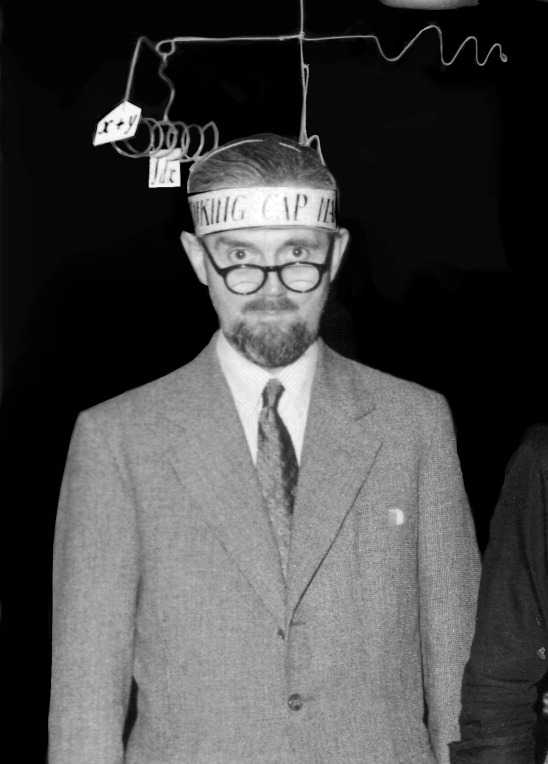
ross ashby thinking cap

FIVE chances to hang out with me cybernetically in the next few weeks – I’d be honoured if you’d join!

1)
NEXT WEEK – The systemic leadership summit 2021 is a pretty amazing opportunity to hear a fantastic group of speakers (and me). Attendance is FREE on the day and you can listen back for 48 hours.
SIGN UP HERE: https://bit.ly/2LmRflf (affiliate link if you decide to get the upgraded package) hashtag#sls2021

For more background, see: https://linkedin.com/feed/update/urn%3Ali%3Aactivity%3A6752493345236500481

2)
MONDAY – I’m presenting at the SCiO open meeting (free) on the ‘four quadrants of thinking threats’ you face if you enter into a powerful field link this: https://systemspractice.org/events/scio-uk-virtual-open-meeting-january-2021

For more background on the four quadrants, see https://www.linkedin.com/feed/update/urn%3Ali%3Aactivity%3A6749960470872100864/

3)
Monday 25 January – our informal online systems networking, hosted by me
https://systemspractice.org/events/afterwards-bar-scio-uk-january-2021

4)
The SERVANT LEADERSHIP SUMMIT in May – not me – but other amazing speakers
https://www.servantleadershipconference.com/ – quote AntlerBoy10 to get 5% discount to you, and 5% donation to Medecins sans Frontieres.

5)
Monday 1 February – Systems Practice development day (£20 annual membership required)
https://systemspractice.org/events/scio-uk-virtual-development-event-february-2021

And look out for me chatting to @Dov Tsal in February too!

Join the SCiO – systems and complexity in organisation – informal Slack channel, and informal networking event Jul 20, 2020 6:30-8:30PM London time

Join the SCiO – systems and complexity in organisation – informal Slack group at https://bit.ly/SCIOSLACK

#systems #complexity #cybernetics #organisation
(Note that this is informal, open to everyone, will not be archiving any messages other than 10,000 most recent, and as it’s open, should not be used for confidential or sensitive information.

And there’s an informal networking event – open to all:

Jul 20, 2020 6:30-8:30PM London time

Register in advance for this meeting:
https://zoom.us/meeting/register/tJIqfuCppjkiGdebyWE-ZcvygILU9Ls8sJ2b
After registering, you will receive a confirmation email containing information about joining the meeting.

Bringing together some recent and old threads on #systemsthinking is #complexity is #cybernetics

Mahoo, @SystemsNinja, asked me (possibly michievously):

Hey @antlerboy tell us why complexity thinking is systems thinking, is cybernetics? Nerd face

Here’s my reply:

You tryna stop me working, or what??

I have some of this prepped, off of facebook, so here goes…

Complexity, cybernetics, and systems thinking are an extended family recognisable by a whole set of similarities (and some controversies) which draw from the same roots and influences, and share the same governing intent – understanding.

My ‘acid test’ is that I believe you cannot make a distinction between systems thinking and complexity which will not ‘sweep in’ to each ‘discipline’ something avowedly part of the ‘other’, and ‘sweep’ out from each something which claims it belongs.

some of the roots are demonstrated here:
some quotes on the theme #complexitythinking is #systemsthinking (is #cybernetics)

Look at the Macy conferences, for a start. Look at the overlaps between the early thinkers, the shared thinking, the shared learning societies.
The field is transdisciplinary (and indeed meta-disciplinary), so naturally it has diverse expression and form.

So, why do people believe there is a difference? There are indeed tribes wearing each of the three badges (and some who wear more than one) – and if you squint, you can see some differences between them. But it relies on squinting – narrowing down to what you want to focus on.

Well, there are many reasons why it suits people to say ‘my work is *this* and not *this*’ (it’s the rule of tables – if someone has a table saying ‘left side old, bad, right side new, good’ – they are trying to sell you something).

We might call it ‘wrecking synergy to stake out territory. A nice piece on that concept is here: https://model.report/s/xacytg/wrecking_synergy_to_stake_out_territory (formatting not good as exhumed from the internet graveyard)

A good example of that is Castellani’s ‘complexity map’, which is to me a piece of fundamentally poor scholarship for this reason https://stream.syscoi.com/2019/12/21/why-i-hope-we-could-do-better-than-the-castellani-complexity-map/

There are others who I won’t name either because they’re nice people out to learn, or so argumentative as to not allow me to get to bed. (But if you search the model.report archives for ‘curmudgeons’ and ‘popularisers’ you will find some materiel).

What tends to happen (other than simply eliding or ignoring bits of the history which show the overlap across the family resemblance) is that you pick a somewhat populist, simplistic version of the thing you want to do down, you straw-man it a bit further, and thereby produce a strangulated version of the ‘other’ (and announce This Is Wot Everyone Kno as The Thing). Then you post five or seven or 13 points showing why your brand overcomes and surpasses (usually not encompasses) the weaker, wrong part of the family. And that way we are all a little the poorer. Note that there are, in fact, many members of our extended family we potentially aren’t *that* proud of, bless their hearts… but we tolerate them and recognise they don’t represent any particular chunk of the family tree in full.

The risk of this sort of thing (‘down with this sort of thing!’) is what caused me to create the ‘four quadrants of thinking threats’ https://www.dropbox.com/s/1ritpobdoexr5qy/four%20quadrants%20of%20thinking%20threats.pdf?dl=0 – systems / complexity / cybernetics thinkers are prone to move into one of the four corners – it’s imperative we try to full ourselves towards the middle…

(this has a modicum of discussion about the quadrants: https://stream.syscoi.com/2019/05/12/four-quadrants-of-systems-thinking-threats-revisited-and-complexity/ )

See also for a magisterial take on the topic, the first comment in this link , Gerald Midgely’s excellent facebook comment at https://www.facebook.com/groups/774241602654986/permalink/2067256553353478/

…The constraints on that topic make a huge difference to the possible outcomes that could be concluded – so much so that diametrically opposite findings would arise from different ways of bounding the understandings of Systems and Complexity. In my view, a great PhD on this would have to start by acknowledging the diversity of paradigms (and perspectives within the paradigms) in both fields, so this is not a simplistic question of “theory A says X and theory B says Y”. So, for example, there are systems methodologies that are strong on exploring multiple perspectives, and others that are weak on this. Likewise, there are complexity approaches that are both strong and weak on perspective-taking. So a really strong analysis would, I think, look at the diversity; the various aims that the diversity of approaches are trying to achieve; the various critiques of the different approaches; and then map each approach onto that territory of aims and critiques. Once that has been done, it should be possible to look for patterns – identify how the two research fields differ in terms of number and diversity of approaches, aims that are unique in one field compared to the other, aims that are common across both fields, aims that are very strongly featured in one field, etc. If you’re serious about doing a PhD on this (or a related topic), we could talk by skype. I should flag straight away though that we don’t have funded scholarships. I have a bunch of PhD students, but most are studying part-time and paying for themselves.

For some practical examples, have a look at these two papers and tell me what you learn about the difference or not:
https://stream.syscoi.com/2020/04/13/guiding-the-self-organization-of-cyber-physical-systems-gershenon-2020-cf-beyond-hierarchy-a-complexity-management-perspective-espinosa-harnden-and-walker-2007/

A good chapter IIRC: https://stream.syscoi.com/2019/11/13/complexity-and-systems-thinking-january-2011-merali-and-allen/

A good series of papers IIRC:
https://stream.syscoi.com/2019/06/04/systems-theory-and-complexity-emergence-complexity-and-organization-richardson-2004/

And an enquiry:
https://stream.syscoi.com/2019/02/02/are-there-any-developed-methods-specific-to-complexitytheory-other-than-agent-based-modelling/

So. All three labels are multiply defined and probably ‘essentially contested’. And, at the end of the day, it doesn’t matter – there are a bunch of good ideas, which can also steer you wrong – let’s use them.

Where it hurts (us all) is when people feel a need to define their work by doing ‘systems thinking’ down – explicitly or implicitly, subtly or not – in comparing themselves to the model they hold of some crap form of systems thinking. So in fighting against this nonsense, I’m partly creating the pain which I think we should all avoid by doing our work and not putting down other disciplines. But it’s a double bind – you let the mud stick as if you deserve it, or you get down in the mud and wrastle…

I would that I have nothing ‘against’ any person who chooses to label themselves as complexity; I love to hear about and explore and share their work (and will critique it or not based on what my limited understanding suggests it deserves – lord knows there are some poor, limited, self-limiting attempts at systems thinking too – I try to help nudge them to deeper awareness always). I *believe this is all part of the same learning and exploration*, and it turns out to be much harder to make an argument for overlap across and distinctions within-not-between, than it is to straw-man something and define your thing as different. Every time I get into this argument, I discover that my antagonist has picked one view of one set of practices, and held this up as *being* the whole.

And there *are*, of course, some more or less unsatisfactory ways you could try to make a distinction (subject to the arguments above) – at a SCiO group presentation, the only true distinction people form all three ‘camps’ could divine was a set of emotional biases of practitioners. But any definition of ‘complexity’ will fall short by some standards – as I’m arguing – so I won’t go into that here. (SCiO is the systems practitioner organisation – www.systemspractice.org – formerly Systems and Cybernetics in Organisation, now Systems and Complexity in Organisation cos it is undeniably trendier and why not?)

I’ll end with McCulloch on the Macy conferences:
“Even then, working in our shirt sleeves for days on end, at every meeting …. we were unable to behave in a familiar friendly or even civil manner. The first five meetings were intolerable. Some participants left in tears never to return. Margaret Mead records that in the heat of battle she broke a tooth and did not even notice it until after the meeting.”
There has never been an agreed definition, and there probably never will be.

A thousand years ago, you asked ‘Hey @antlerboy, tell us why complexity thinking is systems thinking, is cybernetics?’. The answer is there is no ‘is’ of identity (I’m borrowing Wittgestein’s ‘family resemblances’ concept), but the overlaps are so many and varied, as are the distinctions within the field, that meaningful distinctions can really only be made of small subsets across the space – or for polemical reasons.

Er, so why did you ask?


I can’t I’m being a public intellectual

What is cybernetics?

Someone asked me this.

Cybernetics is…
The official definition from Wiener is ‘the scientific study of control and communication in the animal and the machine.” (This gets us into a lot of trouble with people for whom ‘control’ is a bogeyman).

Or
…the study of purposeful (or goal directed) behaviour
(Sometimes adding ‘in complex situations’ though in fact it’s in any situation)
…’the art of steering’ or ‘steersmanship’ from the Greek root in kubernetes (it’s still the best metaphor, I think)
…this links to various definitions around ‘governance’ or governing etc
…the study of circular causality (also sometimes self-directed control)
..the study of recursion
…the study of what might have happened, but didn’t
…or versions using regulation or self-regulation as the key…
Self-correction is also central, as is explorative creation and maintenance of meaning.

Wikipedia has Umpleby’s list of definitions which is good:
https://en.m.wikipedia.org/wiki/Cybernetics

Pangaro’s is good too: https://www.pangaro.com/definition-cybernetics.html

Britannica cites unusual ‘key people’ but is good https://www.britannica.com/science/cybernetics

Principia Cybernetica offers a good one: ‘organization independent of the substrate in which it is embodied.’
(Principia Cybernetica describes itself as philosophy, seeking to answer the big questions of life; I think thereby it might fall foul of not seeing the circular, embodied and self-referential nature of language – which usually means these are not meaningful ‘questions’ – this is why I think Wittgenstein was a cybernetician and why I get such a big kick out of https://meaningness.com/metablog/bongard-meta-rationality which I think is on the same tracks)

And Clemson’s ‘What is management cybernetics’ (www.barryclemson.net/what-is-management-cybernetics/) cites Beer: “the science of effective organization”. Effective, of course, relates to viability, to ‘independent of the substrate’, to steering, governing, and to *intentional* behaviour (which I’d prefer to goal-directed or ‘purposeful’).

For ‘what is science’, I get “the intellectual and practical activity encompassing the systematic study of the structure and behaviour of the physical and natural world through observation and experiment.”
So science can only be achieved through cybernetic means, of course, being purposeful, but I’d say that cybernetics is a particular type of science focused on effective behaviour (using the above), and here effective includes the second-order cybernetic concept of seeing the observer as an intervener in the system, and the potential of self-reflection.

#cybernetics