Anokhin Petr Kuzmich PRINCIPAL ISSUES OF THE GENERAL THEORY OF FUNCTIONAL SYSTEMS 1973
FIRST PART-
GENERAL BACKGROUND It is difficult to find a moment in the history of civilization that could be said that it was then that the idea of integrity, of the unity of the world, arose. Probably, already at the first attempt to understand the world, a thinking person was faced with an amazing harmony between the whole, the “universe”, and separate details, parts.
In essence, this problem is relevant not only for biologists, but also for physicists, economists, and other specialists. It is enough to follow the extremely interesting discussion between Niels Bohr and Albert Einstein to understand what a burning problem is the development of these new principles of a holistic approach to the object under study. In this discussion, two approaches to the question of how to ensure the level of a specific whole in scientific research, for example, an organism, collided, and at the same time not lose the huge advantages of the level of the finest analysis.
As you know, Niels Bohr expressed his point of view in a concept known as the “principle of complementarity.” According to this concept, a whole and holistic approach should give the researcher the opportunity to find additional characteristics of the studied object, more or less expressing the specific features of the whole. He believes that the observation conditions, i.e. the perspective in which we observe the object under study can change in the course of research and this provides additional support points for a comprehensive knowledge of the object. At its core, this approach, expanding the possibilities of studying a holistic object, puts the researcher in the position of an observer who determines how the observed phenomena develop.
Albert Einstein, on the contrary, sought to find an approach that would replace Bohr’s phenomenological approach with a dynamic approach that allows one to penetrate into the nature of internal interaction in some complex integral phenomenon.
While with the help of the phenomenological approach to the whole process it is possible to determine how the objects under study are arranged, Enshtein’s approach is to present the empirically found regularity as a logical necessity.
It is now important for us to emphasize that the discussion between the two greatest scientists of our time takes as something definite and obligatory the search for the transitional principle of a holistic approach to phenomena. The point is only in what form this principle could be most effective for a specific research work, since a holistic approach in general, while remaining a researcher’s dream, did not provide any constructive solutions at the same time for formulating the tasks of everyday research. “Whole” and analytical experimentation still coexisted in two parallel planes, without enriching each other.
The emergence of a systems approach gave scientists some hope that, finally, the “whole” from a diffuse and non-constructive form will take on a clear outline of an operational research principle. However, before analyzing the reasons why this principle was not found, we want to give a brief assessment of the development of a systems approach in various physiological schools.
The term “system” has a very ancient origin, and there is hardly any scientific direction that did not use it. It is enough to recall the “circulatory system”, “digestive system”, etc., which are still accepted by some researchers as expressing a systematic approach. For the most part, the term “system” is used when it is about something brought together, ordered, organized, but, as a rule, the criterion by which the components are assembled, ordered, organized is not mentioned.
These common disadvantages are natural. We must not forget that the consistent application of the systemic principle to phenomena of various classes (organism, machines, society) is not a simple change of terminology, a rearrangement of only the order of research methods. The systematic approach to research is a direct consequence of the change in the theoretical approach to understanding the objects under study, i.e. to some extent, a consequence of a change in the very form of thinking of the experimenter. Naturally, such a process cannot be instantaneous.
As will be shown below, the most characteristic feature of the systems approach is that in research work there cannot be an analytical study of some partial object without an accurate identification of this particular in a large system. Thus, from a strategic and practical point of view, the researcher should first of all have a specific concept of the system, which should satisfy the basic requirements of the very concept of the system, and only then formulate the point of the system that is subject to specific research.
In the field of physiological research, I.P. Pavlov was perhaps the first to use the expression “system” for some special cases of his experimental work. It is primarily about the formation of a dynamic stereotype. As you know, this system is created by the fact that the stereotyped order of the same conditioned stimuli is repeated from day to day. As a result of a long training session, this order of stimuli, detected by the amount of saliva specific for a given stimulus, manifests itself even when the same stimulus is used.
Direct electroencephalographic studies of the brain at the time of creating such a dynamic stereotype, carried out in our laboratory by A.D. Semenenko, showed very interesting properties of the brain as a whole. Thus, for example, it turned out that to each forthcoming stimulus in the case of a strengthened dynamic stereotype, the brain automatically, i.e. only on the basis of previous training and regardless of a real external stimulus, prepares a state that qualitatively reflects exactly the stimulus that was used in this place many times in previous trainings. Of course, the stereotypical states of the brain created in this way, reflecting the complex of conditioned stimuli of a given experimental day, are far from their physiological sense from that systematic approach, which is booming recently. Nevertheless, these experiments showed that the brain, on the basis of the acquired experience, can create some integral states that combine the stimuli of a whole experimental day and open up independently of the actual experimental situation.
continues in source:
Anokhin Petr Kuzmich PRINCIPAL ISSUES OF THE GENERAL THEORY OF FUNCTIONAL SYSTEMS 1973
Stafford Beer achieved the hardest of all pedagogic tasks: he changed the way people think. His protean influence stretches from generations of inspired students, through Salvador Allende’s Chile, to the collective brain of openDemocracy. A huge, life-affirming figure has passed, but his work will long survive, says our international editor.
Stafford Beer, scientist, poet, painter, founder of Management Cybernetics and world leader in operational research, who has died at the age of 75, was much larger than life. The handsome photograph that one accompanied the Guardian obituary is entitled ‘Subversive Showman’. If he fitted neatly into neither the British establishment, nor the academic nor indeed the business world, it was partly because of the sheer impact of the man – but also because of what he had to say.
His self-appointed task was to bring an often unwelcome message to whoever would listen, including the twenty-two governments who hired him as a consultant over the years, about the need for ‘effective organisation’ in companies, social services, great institutions, whole countries, and international communities, if they were not to be left behind by technological advance, threats to economic survival, and loss of faith in established authority – by, in short, complexity and change.
Some people ‘got it’: they joined the band of friends and followers from around the world, and were rewarded by Stafford’s patient and loyal interest in their own efforts to apply what they had learnt. They were inspired by his various favourite dicta, such as ‘Don’t bite my finger: look where it’s pointing’, or ‘You accuse me of using big words that you find hard to understand. But you need big words for big ideas. And you should find it hard to understand.’
Many more, who were nevertheless profoundly influenced by his work, found these admonitions unfashionable and irritating, and his many books unreadable. They often failed to see the indefatigable energy which he devoted to trying to make himself better understood: Stafford’s ideas in Latin, in thirteen languages, in poetry, in a summary for business schools, as applied to car engines, hospitals, prisoners or stars.
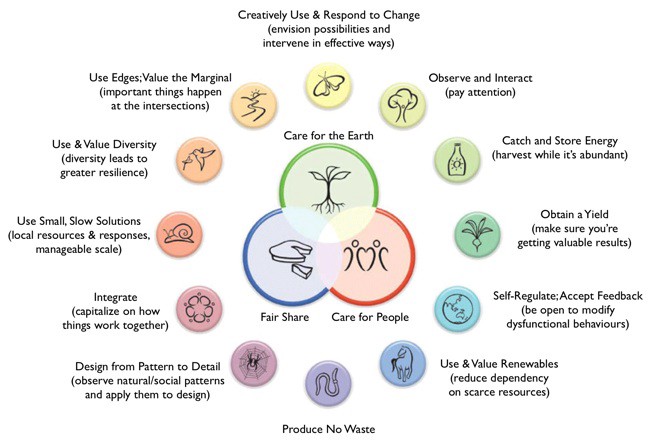
There are 12 design principles in permaculture. I think they can be applied to daily life, work and play which will allow us to live happier and healthier, to work more effectively and to create a more sustainable world.
Here are the 12 principles:
Observe and interact.
Catch and store energy.
Obtain a yield.
Apply self-regulation and accept feedback.
Use and value renewable resources and services.
Produce no waste.
Design from patterns to details.
Integrate rather than segregate.
Use small and slow solutions.
Use and value diversity.
Use edges and value the marginal.
Creatively use and respond to change.
How can we use these principles to guide our life or our work?
COVID‐19 – how a pandemic reveals that everything is connected to everything else
Joachim P. Sturmberg MBBS, MFM, PhD, DORACOG, FRACGP Carmel M. Martin MBBS, MSc, PhD, MRCGP, FRACGP, FAFPHM
First published: 06 July 2020 https://doi.org/10.1111/jep.13419
Shannon, father of information theory + titan of 20th c. science combined rigor, playfulness + insatiable curiosity (to?) invent a powerful but simple formalism linking thermodynamic entropy to information content. Jaynes' 1957 paper on that connection https://t.co/I23qjDlXOPpic.twitter.com/FuLbRZlZBQ
I’m a systems engineer at heart but also passionate about design. Systems thinking has grown on me over many years of practice and research and I now do all that I can to promote it.
I’m often asked to define a ‘systems approach’ and where to get started with systems thinking.
Forget the textbooks. Don’t worry too much about the theory. I’m not saying these things aren’t valuable. I’m simply saying that they can wait.
This website is deeply grounded in the work of Humberto Maturana, with further elements from the work of others in Matriztica and elsewhere, and of course my own ideas. I would like to be clear that what I have presented, and indeed all that I can present to you, is only what I know, I have to claim responsibility for that. Further the world I live and understand has arisen through all of the many encounters I have experienced. Over my lifetime I have encountered many people, some as individuals, others known only through some of their works. I can and do thank them all for their intentional or unintentional contribution to me. Hence this website, although based on the biological, epistemological, ethical and daily life-based understanding that I have gained from Maturana’s deep work, I will be also present many other sources throughout this site.
Seized by Agreement, Swamped by Understandingedited by L. Fell, D. Russell & A.StewartA collection of papers to celebrate the visit to Australia in August 1994 by Humberto MaturanaISBN 0-646-20084-4 Hawkesbury Printing, University of Western Sydney.This book is now out of print, though it is available in major Australian libraries.
A search for ‘the classic structural coupling diagrams (which inspired the logo for my forthcoming podcast series, Transduction: systems, cybernetics and complexity I have come to sing songs to your cat, featured below), led me to two lovely pieces from two lovely websites, which I will list separately.
How do we know what the niche of a living being is?
We can only know to the extent that we are able to observe what aspects of the environment the living system responds to. The living system determines its own niche according to its connection with its medium. Whatever it does not connect with (respond to) is essentially “not there” for the being, it does not see the environment, ie. the “surround” of its niche.
Of course we may not see what the living being is interacting with. We may not see its niche, fully, as it may exist outside our ken. We can sometimes impute that there is “more” from behaviour, as for example when a dog is obviously smelling something we cannot sense.
Prominent scholars in the field accept that the history and development of systems thinking has occurred in “waves” as originated by Flood, Jackson, and Keyes[1][2] and built on by Midgley, et. al.[3][4][5] This metaphor was extended in the late ’90s early ’00s with Cabrera[6][7] and Midgley [8] and the suggestion of a 4th Wave. The “waves” have proven to be a useful and powerful conceptual, historical, and pedagogical model (as long as we are aware of periodization bias and what’s-nextism bias). For a more in-depth review of the “waves” see Cabrera[6].
Building Complex Organizations through Simple Constraints: Zappos — with John Bunch
John Bunch explains why Zappos uses research on cities to inform its internal structure, and the ambition to create an anti-fragile company that can be around for 1000 years and more. That puts pressure on evolving the company quickly to respond to new market demands and opportunities, while ensuring that people in the organisation are fully aligned with its core values and can move swiftly within its enabling constraints.
Marginality: In Nationality, Religion, Profession, and Race
1.While reading Can We Truly See the Other, it struck one reader that she is two “others.” Born in America with Mexican heritage, the family then moved to Mexico; and she now lives and moves back and forth between the two cultures. In Mexico, she is seen as American, and in America she is seen as Mexican. Never fully one or the other. Always marginal. At first, marginality feels like a deficit, but is there also a positive side, a unique contribution marginality can make to both cultures?
2. We were doing an “identity” exercise as part of a residential When Cultures Meet Workshop. All participants would be working on their identities, and the staff pressured me to work on my White identity. I resisted. Others would be working on deep emotionally-charged identities – racial, sexual, aging. Whiteness wasn’t that for me. In the end, I did it for the team. And I got into it, although with a headache.
White identity: WE Whites created civilization; WE brought civilization to peoples across the world; WE created great and lasting literature, philosophies, music, scientific breakthroughs; WE created magnificent cities with awe-inspiring architecture; and more… (Please don’t tell me about all the other gifts WE brought – slavery, oppression, genocide, cultural extinction…That wasn’t my mandate.)
What was painful to me was this: I am a first generation American; my parent came to America as children from Russia, poor and speaking no English. As heritage goes, in Russia they were not known as White. They were Yids, kikes, vermin, and such. Definitely, not White. That was my deep emotionally charged identity.
3.Jewish Marginality. One of the many things Hitler had against the Jews was that they weren’t real Germans regardless of how long they lived in the country, the wars they fought on behalf of the country, or the contributions they made to the country. They were internationalists, citizens of the world, therefore either actually or potentially disloyal. He was partly right, but the point he missed was that as “citizens of the world” they were not full citizens anywhere. Wherever they lived, they were marginal.
That got me to wonder: What if marginality itself is an identity? Marginals are part of the culture, yet never fully inside it. Marginality brings to a culture some not always appreciated gifts. Marginals are potentially free of blind loyalty, groupthink, unquestioned patriotism. My country/organization right or wrong is not the Marginal’s motto. We may love and be proud of our country/organization, yet, in our marginality, we are freer of blind attachment and, as a consequence, we are more able to see and accept its faults as well as its virtues.
4. By now, I assume that some of you organizational specialists and consultants are beginning to recognize marginality as significant part of your identity. That is your gift (again not always appreciated) to the systems you serve. You help insiders see what their chauvinism and patriotism keep them from seeing. However, this gift can come in empathy-free packaging.
5. Marginals may see themselves as bearers of truth, as forces not for destroying systems – organizations, countries – but for helping them live up to their full potential. Some insiders may appreciate the gift, while others might see Marginals as disloyal, ever critical, not true patriots or team players, as disruptive forces, and as problems to be eliminated. And, with some accuracy, they may feel that Marginals don’t really understand or appreciate the inside experience. Our organization exercises (Top, Middle, Bottom, Customer interactions) are often humbling experiences for experienced consultants (Marginals) who become Top Executives or Middle Managers in the exercises only to find that what seemed so simple from the margins was considerably more complex on the inside. The humility that comes from living on the inside might well temper the righteousness of one’s evaluations from the margins.
6. And how does marginality relate to otherness- for example, to the Black and Brown experience? Isn’t marginality an additional layer to that experience, one that brings with it the unique marginal perspective – making visible what was invisible, the blatant aggressions and the not-so-obvious yet painful microaggressions that pass for business as usual on the inside. That perspective can make for painful, yet useful, listening. And there is a challenge (questionable, I suppose): Can that painful and useful gift from the margins come with understanding or even empathy for the inside experience?




 Systems Community of Inquiry
You must be logged in to post a comment.