Shared on LinkedIn – https://www.linkedin.com/posts/dr-mike-c-jackson-obe-b27b7a12_systems-thinking-activity-6714878172573380608-lsSN/
For those interested in critical systems thinking and practice, some new material:
First, in the ‘systems stream’ at the 2020 ORS online conference. This was with Luis Sambo and was called ‘CST: Lessons from the 2014 Ebola Epidemic for the UK’s Response to the Covid-19 Pandemic’ https://lnkd.in/gMFWr7j With Q & A, it lasts an hour.
The second and third were for the World Organization of Systems and Cybernetics (WOSC) online conference. They can be accessed from the site www.wosc2020.org – go to WOSC2020 Online
There is a 20 minute standalone presentation on CST. There is also a 15 minute contribution to ‘WOSC 2020 Online discussions day 1’. my contribution starts at 36 minutes.
Also, the first of a series of papers I am writing on the 4 stages of critical systems thinking has now been published in Systems Research and Behavioral Science and is available on ResearchGate: https://lnkd.in/ghTXX8T
As a way of integrating emerging knowledge of biological systems, developmental process, and therapeutic process, we identify principles in the process of exchange between organism and its context of life support that are present at all levels of complexity in living systems, from the cellular to the organization of consciousness. These principles range from specificity, rhythmicity, recurrence, and pattern to coherence, wholeness, and a relative unity in the organization of component parts. By proposing that these principles are also governing the exchange between mother and infant as they negotiate a sequence of essential tasks of adaptation, or “fitting-together” between them over the first years of life, the author suggests that the biological level becomes integrated with the developmental. A sequence of adaptive tasks extends from specificity of recognition in the newborn state, to recognition of inner awareness, purpose, and intention—shaping conscious organization. The bridge to the therapeutic level is constructed as therapist and patient build increasingly inclusive and coherent moments of recognition between themselves at the level of conscious organization, which act as corrective experiences, bringing the patient’s own senses of “true self” and of “agency-to-initiate” to new levels of validity and competence.
Matthew T. Ballew, Matthew H. Goldberg, Seth A. Rosenthal, Abel Gustafson, and Anthony LeiserowitzPNAS April 23, 2019 116 (17) 8214-8219; first published April 8, 2019 https://doi.org/10.1073/pnas.1819310116
Edited by Arild Underdal, University of Oslo, Oslo, Norway, and approved March 8, 2019 (received for review November 26, 2018)
Significance
Systems thinking is recognized as vital to understanding climate science and addressing climate change. Understanding how systems thinking influences the public’s beliefs and attitudes about climate change has important implications for climate change education and communication. Our findings indicate that across the political spectrum, systems thinking may facilitate an ecological ethic or value system that humans should preserve and protect the natural world rather than exploit it. This, in turn, may strengthen proclimate views and understanding of climate change (e.g., that global warming is happening, is human-caused, etc.). The findings contribute to systems thinking theory and indicate the importance of promoting systems thinking to support proclimate science beliefs, attitudes, and behaviors across political lines.
Published online by Cambridge University Press: 14 August 2018
Abstract
This paper is a response to Sanders, Snijders and Hallsworth (2018). The challenges and opportunities of behavioural public policy Sanders, Snijders and Hallsworth discuss highlight a conundrum for the field: the impact of behavioural interventions is difficult to measure accurately in complex situations, and yet complexity is inherent in the very areas in most need of impact. Behavioural interventions will be only one tool of many to work towards broader organisational, systems and social change. As a field, we should be looking to other disciplines, inviting them into the fold of discussions on how to achieve these changes. Finally, while the mantra of nudge for good is a useful beacon, intentions are only part of the equation, and a number of questions should be asked when considering a behavioural policy intervention.
Bounded interdisciplinarity: critical interdisciplinary perspectives on context and evidence in behavioural public policies – Feitsma and Whitehead, 2019
The Center for Mind and Culture, Inc. (CMAC) is a non-profit organization in Boston, Massachusetts dedicated to non-partisan research. CMAC’s network of expert researchers tackles complex social problems such as social integration of immigrants and refugees, religious self-radicalization, spiraling suicide rates, illegal child trafficking, ethical risks of digital data and computer algorithms, and many other critical issues arising within what we refer to as the “mind-culture nexus.”
Many aspects of human life come together in the mind-culture nexus: thinking and emotion in brains, personality and identity, entanglement in environments, distinctive cultures, socio-economic conditions, and historic processes of change. Many fields of research generate insights into the mind-culture nexus, from neuroscience to sociology, biochemistry to public health, and engineering to philosophy. At CMAC, we gather experts from all these fields into problem-focused teams, discovering how to make headway on the previously intractable, extraordinarily complex, and deeply frustrating problems we face today.
These teams employ computational models, data analytics, historical interpretation, philosophical analysis of concepts and other methods to generate practical answers to the host of challenges confronting us. CMAC researchers rely on extensive collaboration to implement this leading-edge research, training, and public education.
A shouting match is often perversely compelling in the same way that a road accident is: it’s ugly, but it commands your attention. Very occasionally, however, a viciously heated conversation manages to achieve aching tedium at the same time. For an example of this paradox, ask some religious studies scholars what religion is. The ensuing debate will be a painstaking, often bitter exchange of views that ultimately boils down to the deflationary proposition that there is, in fact, no such thing as religion at all. But my mentor and collaborator Rich Sosis and I have a different perspective. While there’s no one-size-fits-all definition of religion, we think that looking at religions as a complex adaptive systems helps make sense of both their persistent cross-cultural similarities and their widely varying differences. Recently, we published a chapter on a computer model exploring this vision in an edited volume, Human Simulation.
have discovered a neural correlate of sensory consciousness in a corvid bird (the carrion crow). The authors use an elegant set up involving barely perceptible visual stimuli to distinguish the delivery of a stimulus and the subjective percept that it engenders. The experiment clearly demonstrates that crows can maintain an internal representation for a period of time before taking an action based on a rule that is subsequently presented to them. This kind of task has been used in primates to distinguish what happens in the brain when an animal consciously detects a stimulus versus when it doesn’t. But is this really a correlate of conscious subjective experience or simply a marker of ongoing neural activity that mediates working memory? What do we even mean by conscious subjective experience? Does maintaining an active neural state necessarily entail a mental state?
by Daniel Papero 1,*,Randall Frost 2,Laura Havstad 3 andRobert Noone 41The Bowen Center for the Study of the Family, Washington, DC 20007, USA2Living Systems, 209-1500 Marine Drive, North Vancouver, BC V7P 1T7, Canada3Programs in Bowen Theory, 120 Pleasant Hill Ave N., Sebastopol, CA 95472, USA4Center for Family Consultation, 820 Davis Street, Suite 504, Evanston, IL 60201, USA*Author to whom correspondence should be addressed.Systems2018, 6(2), 19; https://doi.org/10.3390/systems6020019Received: 2 April 2018 / Revised: 28 May 2018 / Accepted: 30 May 2018 / Published: 1 June 2018(This article belongs to the Special Issue Systems Thinking)View Full-TextDownload PDFCite This Paper
Abstract
Broadly speaking, natural systems thinking is defined as a way of thinking that endeavors to conceptualize the functioning of living organisms as dependent on predictable forces at work within and around them. Systems concepts help to bring the function of those variables and life forces into better view. Psychiatrist Murray Bowen over the course of several years and a major research project at the National Institute of Mental Health (NIMH) developed a theory of the family as a system. He considered his theory a natural systems theory, “… designed to fit precisely with the principles of evolution and the human as an evolutionary being” The human family system, a network of relationships, linking each family member to every other, responds dynamically to its environment and the conditions to which all members must adapt. Each family member’s behavior influences that of every other to some degree. Although ideas of a general system theory and cybernetics were developing at the same time, Bowen reported that he knew nothing about those ideas at the time he developed his thinking. He believed that his systems orientation derived from his study of systems in nature and not from the “systems thinking” of the period. An emerging systems paradigm in biology and evolutionary thinking focuses on collective behavior and appears consistent in principle with Bowen’s thinking about the family. The collective behavior of the family unit cannot be understood by looking at the characteristics of the individuals who comprise it. The human family presents a highly integrated, interactive system of adaptation. Its roots extend along the path of hominid evolution and share common elements with other evolved collectivities. The complex development of the human brain appears to have co-evolved with the interactional processes of the family. The Bowen theory provides the potential for an integrative theory of human behavior reaching beyond the focus on the physiology and psychology of the individual to the operation and influence of the family system. Such an integrative theory can offer broader explanatory and investigative pathways for understanding physical, emotional, and social problems as they emerge in human activity. View Full-TextKeywords: family; family system; natural systems thinking; Murray Bowen; integrative theory
This paper aims to expose the inadequacy of social marketing to tackle complex social problems, while proposing an expansion in the discipline’ conceptual repertoire. The goal is to incorporate complexity tools, in particular from the system dynamics field, and the promotion of mindware within a true transdisciplinary paradigm.
Design/methodology/approach
This paper uses literature review to support the proposed theoretical development. It also presents a short case study.
Findings
Most problems that plague our modern societies have a distinctive complex nature that is not amenable to traditional social marketing interventions. Social marketing has simplified the problem of bringing about societal change by thinking that upstream social actors can be influenced in the same way as downstream individuals. This paper shows that this is not the case while proposing a framework to close this gap.
Research limitations/implications
The proposed framework is a theoretical one. It depends on further refinements and actual application to wicked problems.
Practical implications
Complex social problems – or wicked problems – remain widespread in modern societies. Moreover, they are getting worse over time. The paper presents a proposal to redefine the limits of the social marketing discipline so it can be more useful to tackle such problems. Practical approaches such as measuring the success of mindware in the marketplace of ideas are implied in the proposed framework.
Social implications
The increase in complexity of social problems has not been accompanied by an evolution in the discipline of social marketing. The lack of proper conceptual tools has prevented the discipline from contributing to tackling these problems effectively. Some interventions may actually worsen the underlying problems, as illustrated in the paper.
Originality/value
This paper identifies two major gaps associated with the social marketing discipline, in particular the lack of complexity and systems thinking and the forsaking of ideas (mindware) as a legitimate goal of the discipline. This realization corroborates the claim that boundaries among disciplines are often artificial, hindering the proper understanding of complex social problems. In turn, only the use of adequate conceptual lenses makes it possible to devise interventions and programs that tackle actual causes (instead of symptoms) of complex social problems.
“This book is like a magnificent suspension bridge, linking the science of the human brain to the practical craft of applying it in everyday life. I loved it.” – Rory Sutherland, Ogilvy’s Vice Chairman
“A SUPERB book […] by one of the profound thinkers in our field [behavioral economics].” – Michal G. Bartlett
“Luca’s book was so helpful to my work. Opened my eyes up to some more reasons why change is so hard.” – Chris Murman on the first edition
Reviews of Luca Dellanna’s previous books
“Absolutely brilliant.” – Alberto Pisanello
“A very thoughtful piece of writing, deep and wiring!” – David Krejca
“A thoughtfully written book in very straightforward language.” – A.L. Peevey
“Very good book. Read it in in two evenings. Great insights straight to the point (not the usual self-help babble). Highly recommended.”
“One of the best works I have read in that matter (I have read a few) and it’s surprising how realistically he depicts the condition.” – Manel Vilar (on Luca’s book on autism)
“So insightful with common sense applications of complexity and the ability to communicate clearly!!” – Bob Klapetzky
“A profound, useful and insightful book” – Lorenzo Dragani
The book
Why do you sometimes do things which are bad for you? Why are there some items on your to-do list that you keep procrastinating over and over? And what can you do about it?
Luca answers these questions and then some more, in what is probably the most comprehensive and densely-packed book you’ll ever read on human behavior. More importantly, Luca does not only provide answers, but also practical tips to get you to do what you set your mind to.
The book starts with observations of daily-life behavior. Then, it dissects our behavior from many lenses – neurology, risk management, evolution, complex systems – and distills the principles that guide human behavior, including the overarching one that gives the name to the book, “The Control Heuristic.” Luca then converts these principles into practical steps that he applied to his life, and that will help you fight resistance to change.
This is not your typical book telling stories about human behavior. Instead, it is a densely-packed analysis of human behavior from the perspectives that matter the most, and a set of practical, actionable rules guiding human behavior
The outline
Please click on the arrows at the sides of the cover image (at the top of this page) to explore the table of contents.
This post first appeared as Who controls public policy? on the UK in a Changing Europe website. There is also a 1-minute video, but you would need to be a completist to want to watch it.
Our #AcademicintheSpotlight series highlights social scientists doing innovative & dynamic research that you really ought to be aware of.
This week, it’s the turn of @CairneyPaul. Paul works on understanding the mechanics of public policy and policymaking. Interested? Read on… pic.twitter.com/bMs8RoQi2a
Most coverage of British politics focuses on the powers of a small group of people at the heart of government. In contrast, my research on public policy highlights two major limits to those powers, related to the enormous number of problems that policymakers face, and to the sheer size of the government machine.
This article is written by Hodan Abdullahi, Head of Exploration UNDP Somalia Accelerator Lab and Najoua Soudi, Head of Solutions Mapping UNDP Morocco Accelerator Lab
It doesn’t take a system thinker to point out that the pandemic has impacted every aspect of people’s lives, but it does take a system thinker to make sense of the underlying complexity of these connections, that too often go unnoticed, misrepresented, or unconsidered.
As the pandemic wears on, we are fast approaching the wickedest global economic recession. In the span of weeks, countries had to make hard decisions and many complex tradeoffs. Tradeoffs between citizen’s health and their data privacy, between the pace of medical innovation and its safety and, perhaps even more poignant, between Covid and non-Covid-19 deaths.
In our view, these choices made by policymakers everywhere often fall short of drawing upon a shared understanding of the new post-pandemic realities, let alone the new unintended effects and outcomes.
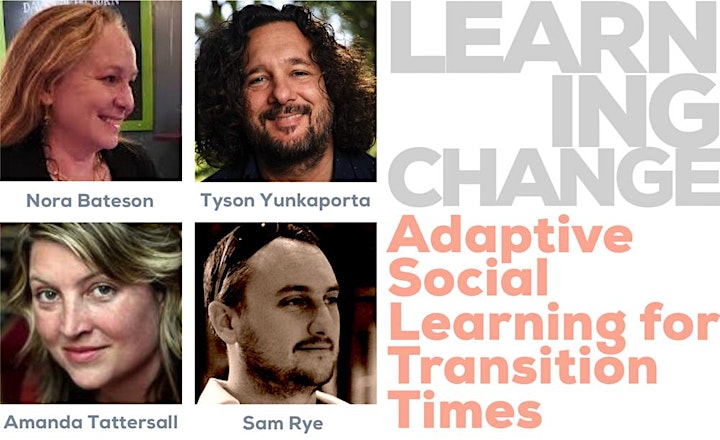
Join free-flowing in-depth conversations between four leading change-makers Wednesdays: SEP 23 / OCT 21 / NOV 18 / DEC 16 •• 6-8 PM *
About this Event
How do we embed collective learning as an essential part of whatever change processes we are involved with?
How do we harvest that learning in ways that make it useful to other communities and movements?
And how do we share those learnings across distributed networks?
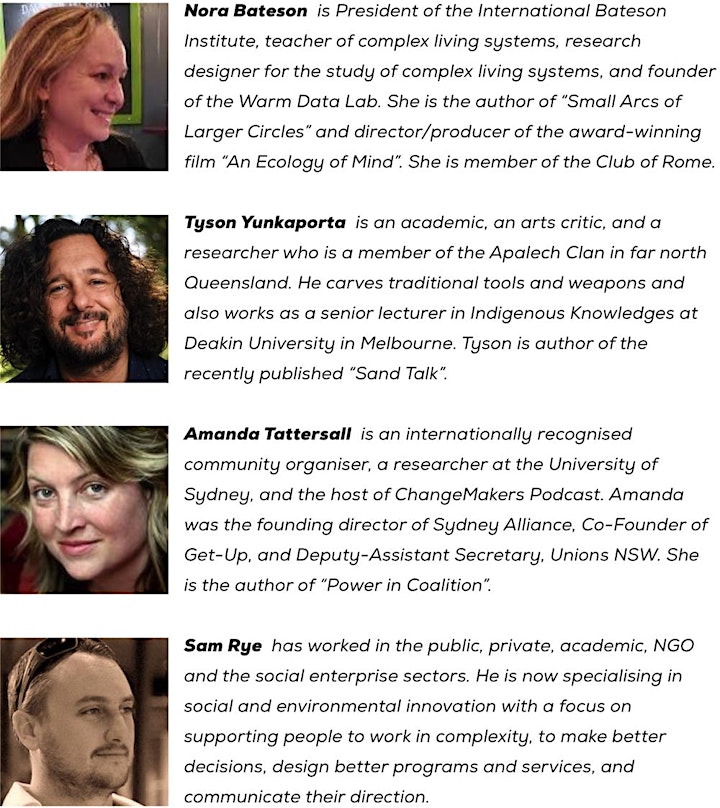
Nora, Tyson, Amanda and Sam will participate in all sessions. They bring a wealth of knowledge and experience across diverse arenas of systemic change-making and collaborative learning in action. Yet each has a very distinct praxis. Together they will take a deep dive into some of the most challenging questions of a time of uncertainty and cascading environmental and social upheaval.
This series of online conversations offer a unique co-learning opportunity for those who understand the urgency of systemic change and want to deepen and refresh their own practice.
Each session will conclude with time for Q&A.
* NOTE: Times are shown in AEST (UTC+10) for September 23 and Australian Daylight Saving Time (UTC+11) for October 21, November 18 and December 16.
Our guests for all four sessions:
Registration is essential to received the Zoom login link the day before each session
••• IF YOU PLAN TO PARTICIPATE IN ALL FOUR SESSIONS YOU NEED ONLY REGISTER FOR THE FIRST ONE AND YOU WILL BE SENT THE LOGIN INFO EACH MONTH •••
ATN donations policy • Please read carefully
Anthropocene Transition Network Inc is a self-funded volunteer-run incorporated association. We depend on the generosity of our program participants, supporters and friends to cover our costs, develop new programs, and cross-subsidise the involvement of people who can only afford a modest contribution.
Our policy is to invite participants in all our programs to make the most generous donation they can afford within a recommended range. Our practice is guided by the principle of ‘Dana’, a Sanskrit word that connotes the merit of generosity, one of the most basic human virtues.
This is an entirely voluntary expression of your support proportional to your means. No one is ever turned away from ATN programs because of inability to contribute.
For this on-line series we recommend a donation in the range $40-$400 FOR THE WHOLE SERIES, but this is entirely your choice. It is also possible to register for individual sessions. No one will be turned away while places are available.
Webinar – Elinor Ostrom’s Governing the Commons: 30 Years Later
The Ostrom Workshop at Indiana University Bloomington presents an online symposium:
Elinor Ostrom’s Governing the Commons: 30 Years Later Friday, October 2, 2020 9:00 – 12:30 (US, Indiana, Eastern Time Zone)
Join us in celebrating and reflecting on the impact and continuing relevance of Elinor Ostrom’s seminal and influential Governing the Commons (CUP). An opening panel with three short keynotes followed by four dynamic panels covering the impact of Governing the Commons on social-ecological systems thinking and practice, polycentric governance, the ‘new commons’, and environmental justice and policing studies.





 Systems Community of Inquiry
You must be logged in to post a comment.