Subscendence – Journal #85 October 2017 – e-flux – Timothy Morton

Subscendence – Journal #85 October 2017 – e-flux

Very good, this. h/t Michael Garfield

SubscendenceTimothy MortonA record of a positive discharge of electricity, also known as a Lichtenberg figure, in the text Walter E. Woobury,‟Photographing Electrical Discharges” in Popular Science Monthly, Volume 49, (July 1896). Photo: Wikimedia CommonsIssue #85October 2017

Subscendence – Journal #85 October 2017 – e-flux

From first-order to second-order evaluation practice: time to shift the ground – EES

From first-order to second-order evaluation practice: time to shift the groundby Sharon Scotcher | Aug 30, 2022 | Blog

From first-order to second-order evaluation practice: time to shift the ground – EES

A Systemic Perspective on National Preparedness | John Beckford |National Preparedness Commission

A Systemic Perspective on National Preparedness01 September 2022In this article John Beckford articulates a set of themes on applying systemic thinking to the notion of national preparedness. These themes will be explored in a set of subsequent papers commissio

A Systemic Perspective on National Preparedness | National Preparedness Commission

ISSS Mini-symposia will start again on Saturday 3 Sept at 7 AM Pacific time – The first session is open to non-members!

(This is the International Society for the Systems Sciences)

You are invited to join us on a journey to rediscover and appreciate the richness of our discipline during my presidential term. Grouped in monthly themes, we will explore traditional and emerging systems perspectives, with an added emphasis on reflection on interrelatedness of these different perspectives. Every fourth week, the session will be dedicated to intuitive reflection on the connections of the perspectives discussed during the month. I hope to create a rich library of material to be used by everyone entering the discipline or wishing to widen their own systems perspective.

Based on our experience of the past year, we decided not to have a weekly repeat of a main session, but rather alternate monthly between the two time slots used before. This means that during September, there will be one weekly session at 7 AM Pacific Daylight Time without any repeat, and October the sessions will be on Wednesdays at 7am in the Australian Eastern Standard Time (Sydney) without repeat. All sessions will be posted on ISSS shortly after completion. November will be on Saturdays, followed by December on Wednesdays, and so forth. Sessions will be announced in the Calendar on ISSS.org.

The Zoom Link will be in the ISSS calendar on ISSS.org on Thursday – [that should be here: https://www.isss.org/calendar/?cat=&view=day&month=9&day=3&year=2022]

Roelien Goede
ISSS President

Sustainability from ecological anthropology: the second life of trees – Coevolving Innovations

Sustainability from ecological anthropology: the second life of trees

Sustainability from ecological anthropology: the second life of trees – Coevolving Innovations

Failing Productively in Systems Change: Key Mindsets & Practices – CoCreative on NetworkWeaver

FAILING PRODUCTIVELY IN SYSTEMS CHANGE: KEY MINDSETS & PRACTICESBy CoCreative  23 Aug 2022

Failing Productively in Systems Change: Key Mindsets & Practices – NetworkWeaver

The Illusion of Complexity by James Wilk

The Illusion of ComplexityJames Wilk

Introduction from the Editor

Complexity is not a feature of the world that can be modelled, or managed. Complexity is, rather, a function of our lack of understanding, or the way we have attempted to understand something—something which, once understood, can be seen to be fundamentally simple. Complexity needs to be filtered. The illusion of complexity, which continually renders our actions ineffective, results from the application of simplistic, sweeping midlevel abstractions to the idiosyncratic details of real-world situations. The radical implications for management and decision-making are the focus of this brief introduction to our contrarian view of complexity.—The Editors

CONTINUES IN SOURCE The Illusion of Complexity – by James Wilk – Change

Towards the full recovery of Alexander Bogdanov’s work and ideas

Örsan Şenalp's avatarAlexander Bogdanov (1873-1928)

This blog project is meant to be a personal contribution to the collective process of the recovery of Alexander Bogdanov’s fascinating life work and ideas.

The project follows up and builds on two events I co-organized on 2 and 3 June 2021. I was very lucky to be the principal organizer of these events, which were the outcome of my ongoing research on Bogdanov’s Tektology, and I received great support from precious people like Fabian Tompsett, John Biggart, Gerald Midgley, Amanda Gregory, and Mike Jackson in realising them. The institutional hosts and supporters of the events were the Centre for Systems Studies at the University of Hull, the British Cybernetics Society, and the Financial University of Moscow.

The first of these events was the 2021 Annual Mike Jackson Lecture given online by renowned theoretical physicist Carlo Rovelli. The lecture was entitled ‘The Relational Interpretation of Quantum Mechanics and Alexander Bogdanov’s…

View original post 205 more words

Heinz Von Foerster Papers (Digital Surrogates) | Digital Collections at the University of Illinois at Urbana-Champaign Library

Heinz Von Foerster Papers (Digital Surrogates)

Heinz Von Foerster Papers (Digital Surrogates) | Digital Collections at the University of Illinois at Urbana-Champaign Library

via Mark Johnson, from Thomas Fischer:


Mark Johnson
@mwjtweet

Thank you to @TH0MASF1SCHER – this is an exciting collection of videos on cybernetics with Heinz von Foerster and Humberto Maturana “In cybernetics [] ethics becomes a central part of scientific activity” https://digital.library.illinois.edu/items/ac64fb20-f570-0134-23e3-0050569601ca-0… @rupertwegerif @GubernatorHomo @carlgomb @antlerboy

This link includes two hosted plenary ASC conference recordings with von Foerster and Maturana.

Transcripts

Part one https://otter.ai/u/vVcSttm_NvigVkkVcKARL7ZyL_o

Part two https://otter.ai/u/GEG-hkUrvcawt9XpMPhwempCbd8

This Great Network of Interbeing, with Vince F Horn – Buddhist Geeks podcast

A really nice talk by Vince Horn on holism, networks, interbeing and so on.

This Great Network of Interbeing, with Vince F HornBuddhist GeeksRELIGION & SPIRITUALITYBUDDHISMbuddhismMeditationMindfulnessSocietyTechnologytibetan buddhismvajrayanavipassanazen© https://creativecommons.org/licenses/by/4.0/ Website“‘To be’ is to inter-be.” – Thích Nhất HạnhIn this episode–taken from a Dharma Talk at the Garrison Institute in 2022–Vince Fakhoury Horn teaches on the complexity of Interbeing, looking at “it” from 3 distinct perspectives:Interbeing within OurselvesInterbeing with OthersInterbeing inside NatureTaken together, these three form a great network of Interbeing, one which opens us to the self-similar & fractal nature of interdependence. At every scale, we inter-are.

This Great Network of Interbeing, with Vince F Horn

Video

Overcast

https://overcast.fm/+Fgr-fuRg

Design Foundations For Systems Capital | by Griffith University Yunus Centre | Y Impact | Aug, 2022 | Medium

Griffith University Yunus CentreAug 17·5 min read·ListenLayering portfolios in context. Developed by The Yunus Centre Griffith University & Hatched for Design Foundations for Systems CapitalDesign Foundations For Systems CapitalDesigning an investment approach that fosters systems innovation and transformation

Design Foundations For Systems Capital | by Griffith University Yunus Centre | Y Impact | Aug, 2022 | Medium

h/t Mikael Seppala

Disentangling the evolutionary drivers of social complexity: A comprehensive test of hypotheses – Turchin et al (2022)

Disentangling the evolutionary drivers of social complexity: A comprehensive test of hypotheses | Science Advances

h/t Michael Garfield

PETER TURCHIN HTTPS://ORCID.ORG/0000-0002-1292-8100HARVEY WHITEHOUSE HTTPS://ORCID.ORG/0000-0001-6935-6724 SERGEY GAVRILETSDANIEL HOYER HTTPS://ORCID.ORG/0000-0003-2675-257XPIETER FRANÇOISJAMES S. BENNETT HTTPS://ORCID.ORG/0000-0003-3051-1672KEVIN C. FEENEYPETER PEREGRINE HTTPS://ORCID.ORG/0000-0001-9185-3348GARY FEINMAN HTTPS://ORCID.ORG/0000-0002-4787-2733[…]MAJID BENAM +8 authors Authors Info & Affiliations

SCIENCE ADVANCES

24 Jun 2022

Vol 8, Issue 25

DOI: 10.1126/sciadv.abn3517

Abstract

During the Holocene, the scale and complexity of human societies increased markedly. Generations of scholars have proposed different theories explaining this expansion, which range from broadly functionalist explanations, focusing on the provision of public goods, to conflict theories, emphasizing the role of class struggle or warfare. To quantitatively test these theories, we develop a general dynamical model based on the theoretical framework of cultural macroevolution. Using this model and Seshat: Global History Databank, we test 17 potential predictor variables proxying mechanisms suggested by major theories of sociopolitical complexity (and >100,000 combinations of these predictors). The best-supported model indicates a strong causal role played by a combination of increasing agricultural productivity and invention/adoption of military technologies (most notably, iron weapons and cavalry in the first millennium BCE).

Disentangling the evolutionary drivers of social complexity: A comprehensive test of hypotheses

Disentangling the evolutionary drivers of social complexity: A comprehensive test of hypotheses | Science Advances

Using neuroscience & cybernetics to transform social organisations | Bobby Azarian & Arash Arabi – YouTube

Bobby Azarian has apparently been on the Joe Rogan thing. This was advertised on linkedin (https://www.linkedin.com/posts/arasharabi_using-neuroscience-cybernetics-to-transform-activity-6962555285450211329-U3Wk?utm_source=linkedin_share&utm_medium=member_desktop_web) by Arash Arabi where I said:

“Congrats on a really professional and interesting podcast / video interview…. I must admit I thought it seems like he knows his stuff and was giving a wide overview, but because it was *such* a wide overview, without real reference points to which theory (and which versions) he was referencing, I lost track bit and was unable to see what the ‘new perspective’ was that he was bringing. Perhaps I’m not at my best this evening, or perhaps I’m not the target audience 🙂
Anyway, I’ve subscribed and will share!”

“PS I have a real prejudice against neuroscience (sorry!) so I was quite pleased to see it didn’t seem to really feature – but I don’t think cybernetics (which I am prejudiced in favour of!) really featured either?”

I would value perspectives on this!

Using neuroscience & cybernetics to transform social organisations | Bobby Azarian & Arash Arabi – YouTube

The risks of ‘seeing the whole’

antlerboy - Benjamin P Taylor's avatarchosen path

Join the discussion on LinkedIn https://www.linkedin.com/posts/antlerboy_8-things-to-think-about-systems-complexity-activity-6964845434942959616-R3We/

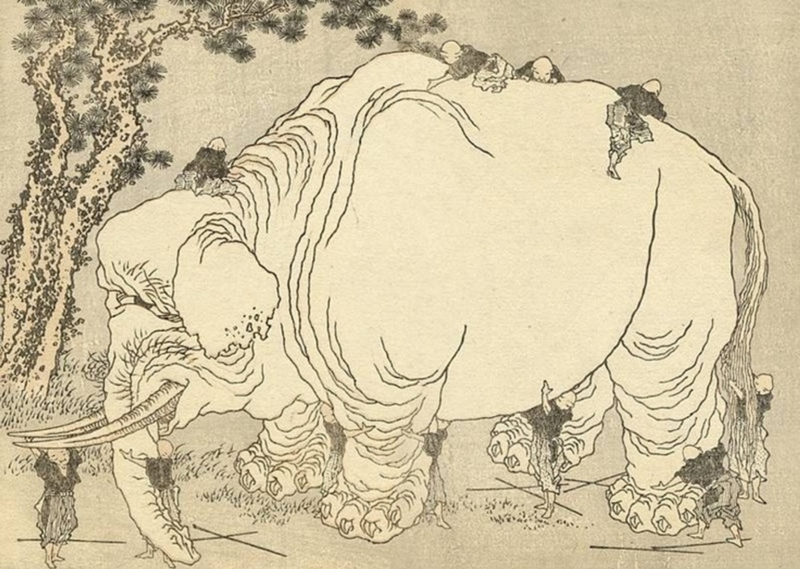
Have you ever been encouraged to ‘see the whole’, or ‘think holistically’?

Have you read that it is critical for our #future that we ‘see the whole of the elephant’?

It’s true — but it’s not the whole story.


And because it’s a one-sided argument trying to rebalance a polarised, competitive world — arguments for ‘holism’ can undermine themselves by missing out the reality of people’s lives.


Here are eight things to think about re complexity | systemsthinking | cybernetics. They apply for management, innovation, society, ecology.

1 denying that we are part of a whole

It’s true: we are all connected. You can’t throw anything ‘away’ because there’s no ‘away’.

This insight can change lives — deeply, fundamentally. It can change organisations, and society — usually for the better.

But despite our best wishes and intentions, it somehow doesn’t change the world! Why?

2 believing we have seen the whole when…

View original post 316 more words

Systems thinking is old hat.. Don’t be mistaken. It was there before… | by Philippe Vandenbroeck | Aug, 2022 | Medium

Systems thinking is old hat.. Don’t be mistaken. It was there before… | by Philippe Vandenbroeck | Aug, 2022 | Medium