
Design Needs Complexity Theory
Kasey Klimes
Aug 13, 2021131
Despite Christopher Alexander’s notable application of complexity theory in design during the 60’s and 70’s, the two fields have mysteriously grown apart. The contemporary design world demonstrates little interest in complexity theory, and design is generally absent in the world of complexity theory. I think this separation is not only a missed opportunity, but also a tragic error for humanity on a larger scale.
Continues in source: Design Needs Complexity Theory – by Kasey Klimes
Author Archives: antlerboy - Benjamin P Taylor
On intentionality • Marcus Jenal
On intentionality | Gaining Systemic Insight
I recently said: Everything we do with intention is not systemic. I can’t really remember in what context I said it but I remember that I was surprised myself when hearing me say that. So here a bit of an exploration of this statement.
Continues in source: On intentionality • Buttondown
Intro video to the history and ideas of complexity science and networks

I needed a video presenting the historical development of ideas behind the complexity and network science in 20 minutes—an impossible task of course (especially since I couldn’t spend too much time on prepping it). Anyway, someone out there would be interested, so here it is:
Some credits not stated in the video: The starling murmuration video comes from NYT (travel section April 4, 2022), the Boids-like simulation from Complexity Explorables. All photos except the book covers, come from Wikipedia. The network picture comes from Helen H Jennings (1959), Sociometry of group relations. The Odum & Odum book is really called The Energy Basis for Man and Nature.
Climate, covid, conflict – Food, Farming and Countryside Commission – Sue Pritchard
Climate, Covid, Conflict? Community…Sue Pritchard assesses risks and opportunities for a resilient food system26th May 2022
Climate, covid, conflict – Food, Farming and Countryside Commission
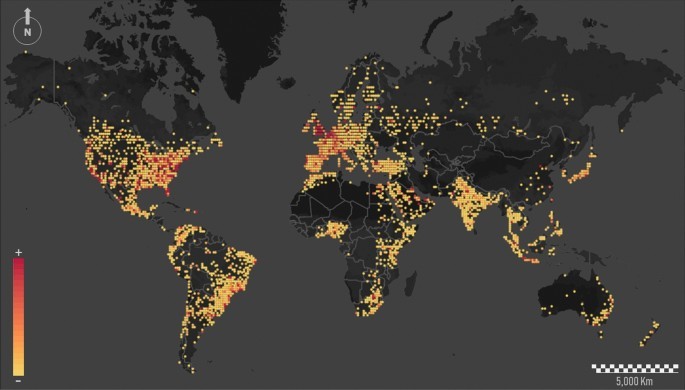
Scale, context, and heterogeneity: the complexity of the social space

 José Balsa-Barreiro, Mónica Menendez & Alfredo J. Morales
Scientific Reports volume12, Articlenumber:9037 (2022)
The social space refers to physical or virtual places where people interact with one another. It decisively influences the emergence of human behaviors. However, little is known about the nature and complexity of the social space, nor its relationship to context and spatial scale. Recently, the science of complex systems has bridged between fields of knowledge to provide quantitative responses to fundamental sociological questions. In this paper, we analyze the shifting behavior of social space in terms of human interactions and wealth distribution across multiple scales using fine-grained data collected from both official (US Census Bureau) and unofficial data sources (social media). We use these data to unveil how patterns strongly depend upon the observation scale. Therefore, it is crucial for any analysis to be framed within the appropriate context to avoid biased results and/or misleading conclusions…
View original post 43 more words
Moral character in human systems (Geoffrey Vickers) | Adams, Catron, Cook (1995)

While Geoffrey Vickers and Gregory Bateson both worked with human systems, the background philosophies on ethics were different.
— begin paste —
Beginning with The Art of Judgment and culminating in 1983 with Human Systems Are Different, Vickers was concerned to avoid the narrowing of scope that had become a remarkably powerful force in both the theoretical and empirical study of organized human activity. His concept of appreciation was a pivotal element of this effort. Gregory Bateson (1972) also wished to keep the sense of “system” more open than was the norm. Yet while Vickers and Bateson admired one another’s work, they parted intellectual company on the origin and role of ethics.
- For Bateson, since all systems are identical, morality enters, if at all, in systemic processes that would be found in all systems.
- Vickers, by contrast, saw a moral character within human systems that distinguished them from both…
View original post 661 more words
Chickens’ eyes function differently (Interconnected – Matt Webb)
11.09, Thursday 9 Jun 2022 Link to this postIt turns out that chickens use their eyes quite differently. (I’ve been skimming paper abstracts.)The left eye distinguishes between strangers and friends – and more generally is a novelty detector.The right eye categorises and figures out what action to take.(So a chicken looking only with its right eye is poor at telling novelty.)Chickens, having eyes on the sides of their heads, look with only one eye at a time.If I wasn’t sitting here baking in the heat I would be thinking about the general lesson here – that these two ways of seeing make up the totality of how to see the world. One a process that looks for metaphors and stereotypes; the second a novelty switch. Organisations and bureaucracies need these two ways of seeing. Machines and software too.Anyway. The avian brain. Did dinosaurs specialise their eyes too?Here’s the abstract.Vallortigara, G., & Andrew, R. J. (1994). Differential involvement of right and left hemisphere in individual recognition in the domestic chick. Behavioural processes, 33(1-2), 41–57. https://doi.org/10.1016/0376-6357(94)90059-0
Idle thoughts sitting by the pool in the hot sun (Interconnected)
Growing Workforce Capacity & Capabilities for System Leadership , Tue 12 Jul 2022 at 12:00 noon BST
Growing Workforce Capacity & Capabilities for System Leadership
Growing Workforce Capacity & Capabilities for System Leadership Tickets, Tue 12 Jul 2022 at 12:00 | Eventbrite
Message received by email:
Growing workforce capacity and capabilities for system leadership
A webinar with our ImpACT research group.
12pm – 1pm (BST)
Tuesday 12 July
In this final in the series, we will draw on examples from organisation and system transformation working with National, Regional and System partners.
Hosted by Jonathan Webster, Professor of Practice Development & Co-Director ImpACT Research Group, UEA.
Featuring speakers and contributors:
- Beverly Chilson, Integrated Therapies Clinical Lead, James Paget NHS Foundation Trust
- Anna Morgan, Independent Consultant
- Saffron Rolp-Willis, Workforce Transformation Manger, HEE East of England
- Emma Wakelin, Associate Director of Workforce Transformation, Norfolk and Waveney Health and Care Partnership
- Claire Whitehouse, Senior Nurse for NMAHP Research, James Paget NHS Foundation Trust
- Maurina Barron, Caribbean Nurses & Midwives Association (UK)
- Paulette Lewis, Caribbean Nurses & Midwives Association (UK)
This event is hosted by UEA Health and Social Care Partners’ ImpACT research group, which looks at sharing best practice to reinvigorate health and social care settings, seeking to enable flourishing systems, workforce and communities.
Subscribe to the ImpACT research group’s YouTube channel, where you can catch up on the previous webinars hosted by ImpACT.
Numbers are limited, so please register here.
This event will be recorded and circulated for those unable to join.
Conversations that Challenge: Failure: Does fear hold us back from changing systems? – New System Alliance
Conversations that Challenge: Failure: Does fear hold us back from changing systems?Thursday, July 712pm – 1pm
Conversations that Challenge: Failure: Does fear hold us back from changing systems? – New System Alliance
A Time for Heretics, orginal for 1996, rejected by IIB | David Hawk
A Time for Heretics, orginal for 1996, rejected by IIBDavid Hawk1996, Transcript of Annual Meeting of EIBA
(23) A Time for Heretics, orginal for 1996, rejected by IIB | David Hawk – Academia.edu
SYSTAC Europe looking for *volunteers* to support a forum for systems thinking for health systems
| Are you a junior researcher? Are you interested in supporting others in systems thinking? |
 |
| We are looking for you!SYSTAC Europe is looking for a team of driven junior and early-stage researchers to create and design a support forum for systems thinking for health systems. The forum is expected to be place for young researchers to build confidence in their systems thinking practice by developing soft skills and technical skills through peer support. The design and activities of the forum will be decided by the team. The team is expected to jointly develop a short plan for the forum by the end of October 2022. Team members will have the opportunity to lead the forum after its launch. The SYSTAC Coordination team will provide input on as needed and the team will have the option to be part of other SYSTAC activities. During 2022, SYSTAC Europe will fund the development of the forum and travel and activity costs.If you have any experience with systems thinking and health systems research and are enthusiastic about supporting other junior researchers, send us a cover letter explaining why you are interested in being part of the team and how you would envision the support forum. Individuals and groups are welcome to apply!Duration: July – December 2022 Pay: Volunteer basisApply by sending your letter to dell.saulnier@med.lu.se by June 30th. |
Twelve potluck principles for social design | Nold et al
Twelve potluck principles for social design
Twelve potluck principles for social design | DISCERN: International Journal of Design for Social Change, Sustainable Innovation and Entrepreneurship
Twelve potluck principles for social design
Authors
- Christian NoldThe Open University
- Patrycja KaszynskaUniversity of the Arts London
- Jocelyn BaileyUniversity of the Arts London
- Lucy KimbellUniversity of the Arts London
Keywords:
social design, design principles, manifesto, boundary objects, design research
Abstract
The term ‘social design’ is used in a variety of contexts, but—or maybe because of this—it is far from clear what it means. The starting point for this paper is that there is a need for stronger and more critical community discourse to understand and clarify what social design is and what it does. By analyzing key texts, the paper identifies commonalities, disagreements and unresolved questions in relation to social design. Drawing on the example of citizen science, the paper argues for a need to develop principles for social design for further inquiry and discipline-building for social design. The paper offers twelve principles that focus on the notion of the social in social design, its methods and practices and its normative intent, as well as its critical reflexivity. These principles are intended as a ‘potluck’ boundary object to kickstart a stronger social design community. The paper reports feedback from two workshops where these principles were discussed and tested with design academics suggesting how the principles can be applied.
The Memory of Systems – Censemaking
The Memory of Systems April 26, 2021 Cameron D. Norman 619 Viewscense, complexity, decision making, design, developmental evaluation, evaluation, Living History, path dependence, reflective practice, systems change, systems thinking, W. Edwards DemingSystems change is so difficult because is the link between the past, present and future is tight and often invisible.The term “system(s) change” is often used without a clear sense of what it means.What is the system that needs to be changed and how is that system defined? These are two important questions that will shape the answers.Systems are also affected by history and this ‘memory’ within a system is an important, yet often neglected part of understanding change.Remembering where systems started is an important signal for where they can go.
The Memory of Systems – Censemaking
RSD11 Focus: Confronting legacies of oppression in systemic design
FOCUS: CONFRONTING LEGACIES OF OPPRESSIONRSD UPDATES | RSD11 PROGRAMBookmark0Confronting legacies of oppression in systemic designSystemic design is often complicit in the reproduction of oppression, contributing to structural inequities being designed into our systems. A growing group of scholars and practitioners are confronting legacies of oppression in this domain, such as through explorations into decolonizing systems thinking (Goodchild, 2021), and abolitionist design (Fathallah & Lewis, 2021), and design justice (Costanza-Chock, 2020). To grapple with the systemic nature of oppression, a greater commitment to equity, self-determination and liberation in, through and beyond systemic design is needed.
Focus: Confronting legacies of oppression
The riddle of emergence – where do novel things come from? Mitchell (2022)
The riddle of emergence – where do novel things come from?By Kevin Mitchell – May 23, 2022It’s not true, that there’s nothing new under the sun. The universe is producing novelty all the time. Galaxies, stars, and planets, where none existed before. New elements, new molecules – life itself, with the explosion of new species, and eventually new minds, capable of new thoughts. New types of things at new levels of existence – discrete entities composed of smaller entities, arranged in specific ways. New systems with new properties and new causal powers, governed by new principles. So where does all this novelty come from?
The riddle of emergence – where do novel things come from?
 Systems Community of Inquiry
You must be logged in to post a comment.