Thea Snow on Twitter: “Has anyone ever seen/created a tool or canvas using Donella Meadows leverage points, which is designed to help people think about different places to intervene in a system?”

Has anyone ever seen/created a tool or canvas using Donella Meadows leverage points, which is designed to help people think about different places to intervene in a system?

(1) Thea Snow on Twitter: “Has anyone ever seen/created a tool or canvas using Donella Meadows leverage points, which is designed to help people think about different places to intervene in a system?” / Twitter

Replies include links to such

Resources — Radical Childcare Systems Lab

Open Resources

Resources — Radical Childcare Systems Lab

Openness has always been a key principle of our ecosystem, from 00 ventures through to Impact Hub Birmingham and #RadicalChildcare because it is vital for work to become stronger and spread, shorten the feedback cycle. It enables many to test implementations and creates opportunities beyond what we could even imagine. We try to be as open as we possibly can at every stage, and we don’t want our work to be binary, but a start point.

We feel it’s better to have a vision to hack, iterate and critique and build better than to complain about the system without re-imagining together what it could too, so this is an open invitation to use and download the resources to make your work stronger, better and broader. We hope these values will be reciprocal, and where you feel we might be able to support your work, or if it’s appropriate to credit, please do. We all stand on the shoulders of many people’s work, and no one person, organisation or solution sill tackle these complex challenges alone.

To receive a link to all our #RadicalChildcare bank of resources, including maps, infographics, research tools and references, please fill in your your details below.

Nau mai | Welcome – MDes, Sam Rye

Nau mai | WelcomeThis is the write up from Sam Rye’s Masters of Design (2016-2018) which bridges the worlds of environmental conservation, systems thinking and strategic design. Welcome, it’s free and open to explore.

Nau mai | Welcome – MDes, Sam Rye

Introduction Collaborative Innovation, Virtual Course, 2022

Virtual Course:Introduction to Collaborative Innovation​Hawaii ST: May 16, 18 & 23, 8:00 am – 11:00 am Pacific US: May 16, 18 & 23, 11:00 pm – 2:00 pmEastern US: May 16, 18 & 23, 2:00 pm – 5:00 pm

Introduction Collaborative Innovation, Virtual Course, 2022

see also (from Russ Gaskin):
I wanted to let you know that we’re offering our introductory course in May for folks wanting to advance collaborative systems change work.

If you know of anyone who might be interested, we’re happy to answer any questions and provide discounts for your close allies or partners. Melissa, who’s copied here, can help with that.

In the meantime, I’m happy to share some new or updated free resources from CoCreative:

The Mind Made Matter | David Krakauer (2022)

DAVID KRAKAUER7 Mar 2022

The Mind Made Matter

Analog tools are collaborators in cognition, not mere mechanical servants.

The Mind Made Matter | David Krakauer

Coexistence in diverse communities with higher-order interactions

cxdig's avatarComplexity Digest

Theo Gibbs, Simon A. Levin, Jonathan M. Levine

A central assumption in most ecological models is that the interactions in a community operate only between pairs of species. However, the interaction between two species may be fundamentally changed by the presence of others. Although interactions among three or more species, called higher-order interactions, have the potential to modify our theoretical understanding of coexistence, ecologists lack clear expectations for how these interactions shape community structure. Here, we analytically predict and numerically confirm how the variability and strength of higher-order interactions affect species coexistence. We found that, as higher-order interaction strengths become more variable across species, fewer species coexist, echoing the behavior of pairwise models. If inter-specific higher-order interactions become too harmful relative to self-regulation, coexistence was destabilized, but coexistence was also lost when these interactions were too weak and mutualistic effects became prevalent. Last, we showed that more species rich communities…

View original post 41 more words

Advances in Systems Science: 66th Annual Meeting of the International Society for the Systems Sciences, July 7-11, 2022

Advances in Systems Science: 66th Annual Meeting of the International Society for the Systems Sciences

July 7, 2022—July 11, 2022

July 7: Pre-conference session and Tech Troubleshooting 

July 8, 9 & 10: Main Conference Sessions

July 11: Concluding remarks and ISSS Administration Meetings 

Main conference program- July 8, 2021-July 10, 2022

Summary – Advances in Systems Science: 66th Annual Meeting of the International Society for the Systems Sciences

The International Society for the Systems Sciences is pleased to announce our 66th Annual Meeting and Conference to be held online July 7-11, 2022 on a 24-hour schedule. ISSS President George Mobus invites you to submit papers and workshops for the event, and the Call for Papers is attached for your reference. The conference website will be updated as events are scheduled and registration is open now. Be sure to register before the early bird deadline for the best rates.

Call for Papers

Conference Website and Registration

More details on submitting abstracts here https://www.isss.org/submitting-abstracts/

More details on student awards (each worth $500) https://www.isss.org/student-paper-awards/

Economics of Mutuality

Completing Capitalism

Transforming the Economic System by Creating a Mutuality of Benefits Among All Stakeholders

Economics of Mutuality

Also Economics of Mutuality Lab at Said Business School, Oxford University

https://www.sbs.ox.ac.uk/research/centres-and-initiatives/responsible-business/economics-mutuality-lab

EFFECTIVENESS OF SYSTEMIC COACHING AND CONSULTING IN THE CONTEXT OF WORK AND ORGANIZATIONS | Thomas Bachmann | Research Project

Effectiveness of systemic coaching and consulting in the context of work and organizationsThomas BachmannJohannes LoermannGoal: In the course of the legal recognition of systemic therapy in Germany in 2019, the question of the effectiveness of systemic interventions in the context of work and organizations also arises. Systemic coaching and consulting already looks back on a long tradition and an extensive body of theory and methods. Systemic organizational consulting, constellation work, systemic coaching, and team development, among others, are established formats. Nevertheless, the state of research on their effectiveness is insufficiently ¬elaborated.The Systemic Society (“Systemische Gesellschaft”- SG) and in cooperation with German Society for Systemic Therapy, Counseling and Family Therapy ¬(“Deutsche Gesellschaft für Systemische Therapie, Beratung und Familientherapie”- DGSF) commissioned artop – Institute at the Humboldt University of Berlin – to conduct a pilot study on the effectiveness of systemic formats in work and organizational contexts. In this study, the current state of effectiveness research is to be documented and reviewed, and perspectives and possibilities for further research projects are to be identified.

EFFECTIVENESS OF SYSTEMIC COACHING AND CONSULTING IN THE CONTEXT OF WORK AND ORGANIZATIONS | Thomas Bachmann | 1 updates | Research Project

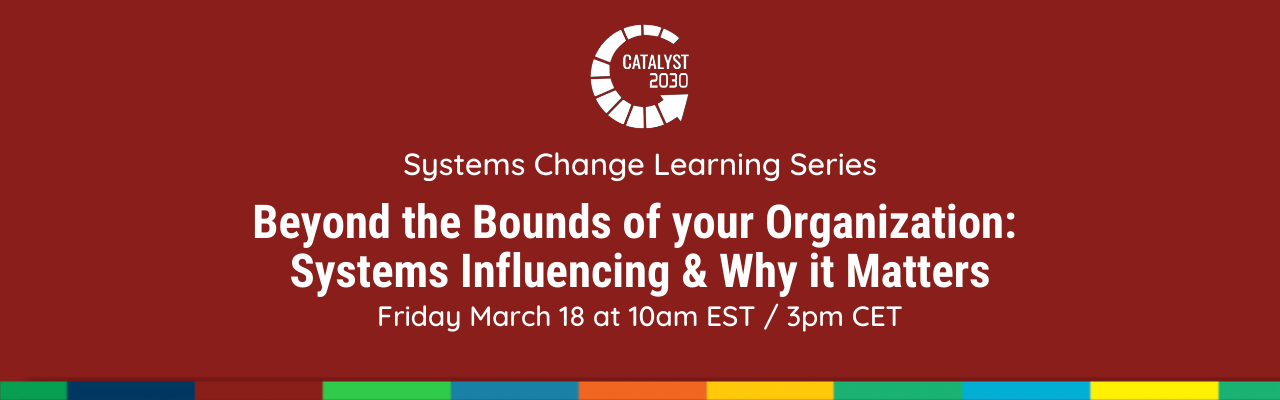
Beyond the Bounds of your Organization: Systems Influencing & Why it Matters Mar 18, 2022 3pm in Amsterdam

TopicBeyond the Bounds of your Organization: Systems Influencing & Why it MattersDescriptionJoin Jeroo Billimoria (Catalyst2030), Vera Cordeiro (Instituto Dara) and Daniela Papi Thornton (Systems Led Leadership) for a robust conversation on leveraging systems change within your organization and beyond.TimeMar 18, 2022 03:00 PM in Amsterdam

Meeting Registration – Zoom
Meeting banner

Meeting Registration

Beyond the Bounds of your Organization: Systems Influencing & Why it Matters

Join Jeroo Billimoria (Catalyst2030), Vera Cordeiro (Instituto Dara) and Daniela Papi Thornton (Systems Led Leadership) for a robust conversation on leveraging systems change within your organization and beyond.Time

Mar 18, 2022 03:00 PM in Amsterdam

Teacher Tom: The Consequence Of All Learning: We Can No Longer See The Chicken

The Consequence Of All Learning: We Can No Longer See The Chicken

Teacher Tom: The Consequence Of All Learning: We Can No Longer See The Chicken

The Seeing Systems Blog: Challenge the Oppressor, Integrate with the “Other.” – Barry Oshry

Written on the occasion of his 90th birthday. Happy birthday, Barry!

Challenge the Oppressor, Integrate with the “Other.”

The Seeing Systems Blog: Challenge the Oppressor, Integrate with the “Other.”

Systems Thinking Ontario – 2022-03-14

source

Systems Thinking Ontario – 2022-03-14

2022-03-14

March 14 (the second Monday of the month, besides being Commonwealth Day in Canada that isn’t a statutory holiday!) is the 98th meeting for Systems Thinking Ontario. The registration is at https://entropy-systems-thinking.eventbrite.ca .

Entropy: How does the Second Law of Thermodynamics change our thinking?

Entropy, the second law of thermodynamics, is foundational to the systems sciences. Since the field aims for isomorphies (i.e. patterns that apply across many disciiplines), a variety of interpretations of entropy can create a lot of confusion!

David L. Hawk, in his 2019 book, remarks:

“Entropy, something I had no idea about when first told, then began to understand it on second encounter, then knew I would never understand it when I met it the third time. Then, not being able to ever get over it on fourth encounter.” [….]

“For Einstein, then Steven Hawking, the 2nd Law of Thermodynamics was sacrosanct. [,,,,] Many leading scientists have gone deeper in arguing why they agree with Einstein, then Hawking, and feel so strongly about entropy is a supreme law of nature and must be factored into what humans do.”

With this caution, David Hawk has agreed to guide us towards some understanding of entropy, and how it shapes (or misshapes!) the human condition.

The pre-reading list, below, has been annotated, to encourage participants to gain some familiarity in advance of the interactive discussion.

2022-03-14March 14 (the second Monday of the month, besides being Commonwealth Day in Canada that isn’t a statutory holiday!) is the 98th meeting for Systems Thinking Ontario. The registration is at https://entropy-systems-thinking.eventbrite.ca .Entropy: How does the Second Law of Thermodynamics change our thinking?

Systems Thinking Ontario – 2022-03-14

Act to live! Viability in times of uncertainty – 14th Metaphorum Conference 2022, Leuven, Belgium, 10-12 June

Act to live! Viability in times of uncertainty

14th Metaphorum Conference 2022, Leuven, Belgium, 10-12 June

Act to live! Viability in times of uncertainty – metaphorum

Complex Systems Seminar (virtual): Promoting the use of agent-based modelling in scientific inquiry: a Learning Sciences approach: Ümit Aslan, Learning Sciences, Northwestern University | U-M LSA Center for the Study of Complex Systems

Complex Systems Seminar: Promoting the use of agent-based modeling in scientific inquiry: a Learning Sciences approach

Ümit Aslan, Learning Sciences, Northwestern University

Tuesday, March 8, 202211:30 AM-1:00 PM

Virtual

Complex Systems Seminar: Promoting the use of agent-based modeling in scientific inquiry: a Learning Sciences approach: Ümit Aslan, Learning Sciences, Northwestern University | U-M LSA Center for the Study of Complex Systems