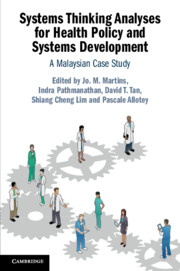
Systems Thinking Analyses for Health Policy and Systems Development
A Malaysian Case Study
Edited by Jo. M. Martins, International Medical University, Malaysia, Indra Pathmanathan, United Nations University – International Institute for Global Health, David T. Tan, United Nations Development Programme, Shiang Cheng Lim, RTI International, Pascale Allotey, United Nations University – International Institute for Global Health
While the internet and wireless communication technologies have been connecting people in new ways, it has also been linking together our products. The development of complex products requires bigger teams and greater specialization, and coordinating that effort is its own systemic challenge. As the complexity and interconnectedness of products rises, so does the need for an approach that guarantees that your products deliver the best experiences. In this course, Walter Zesk, professor and cofounder of Conform Lab, shows you how to apply systems thinking to product design. Walter points out several benefits of systematic product design, then steps you through how to analyze product mechanisms as systems. He explains how to identify innovative trends and optimize functionality in your designs., including functional conflict resolution. Plus, Walter goes over distributed products, experiential products, and network products.
Continues in source: Systems Thinking for Product Designers
Once the whole is divided, the parts need names. There are already enough names. One must know when to stop. Knowing when to stop averts trouble. Tao in the world is like a river flowing home to the sea. Lau Tsu, Tao Te Ching.
This Working Paper offers a revised version of a talk that was given to the staff and the Ph.D. students of the Lincoln School of Management on January 16, 1997. The author’s research programme, ‘Critical Systems Thinking for Citizens’, was explained and discussed with special regard to its goal of contributing to the revival of civil society. The author argued that critical systems thinking has a potential of giving citizens a new sense of competence, and that this new competence will also alter our notion of competent management.
SFI Complexity Interactive (SFI-CI) combines the dynamic interactions of an in-person course with the flexibility to learn from anywhere in the world. This three-week, part-time, online course offers participants a theory- and applications-based view of complexity science. Complexity Interactive provides a foundation for thinking broadly about complex systems, encouraging participants to explore syntheses across systems in an open dialog with SFI faculty. The program’s size is limited to ensure everyone has ample opportunity to discuss with faculty and with each other.
In 2022, the curriculum will explore scaling, robustness, and feedbacks, with a particular focus on sustainability and climate change.
Originally published in Values20 Policy Briefs in October 2021. The Values 20 Group (V20) is a global community of values experts and practitioners who seek to actively engage with the Group of Twenty (G20) to advance its vitally important multilateral work. V20 was launched in 2020 with the purpose of deepening understanding of how values can strengthen public policy. In 2021, the V20 calls upon the G20 to promote values-based institutional decisions and human-centered policies given their unique, untapped power to contribute to overcoming global challenges.
SOLIDARITY TASK FORCE POLICY BRIEF
CHAPTER 2: REIMAGINING POLICY TO ENABLE CULTURAL AND INSTITUTIONAL TRANSFORMATION
Fedor Ovchinnikov, Evolutionary Futures Lab, USA, f.ovchinnikov@evolutionaryfutures.com
Dr. Marco Tavanti, University of San Francisco, USA, mtavanti@usfca.edu
Pablo Villoch, Glocalminds, Chile, pablo@glocalminds.com
Tatiana Vekovishcheva, Flourishing Enterprise Innovation Team, USA, tatiana@flourishingbusiness.org
Najla Alariefy, Big Data Analyst & Policy Consultant, Saudi Arabia, najlaalariefy@gmail.com
Lina Constantinovichi, Innovation 4.4, USA, lina@innovation44.com
Manuel Manga, Leadership Development Consultant, USA, manuelobserver@gmail.com
To adequately address the increasingly complex global challenges, from climate change to inequality, we recommend allocating resources to capacity building for policy-makers at all levels through targeted values-based programs about working with complexity and through grassroots-level experimentation that involves diverse actors in designing new values-based institutions and cultural practices.
Continues in source: Reimagining Policy to Enable Cultural and Institutional Transformation
For more videos and information from Philip Clayton click here http://bit.ly/1CCgAsD For more videos on how emergence can explain reality click here http://bit.ly/1CClRAD How does Emergence work? What does it say about reality?
The word “emerging” is often used colloquially to mean something like “giving rise to” or “becoming apparent”. But emerging, emergent, and emergence are also technical terms. In this video, I want to explain what physicists mean by emergence, which is also the way that the expression is often, but not always, used by philosophers.
Is reduction always a good scientific strategy? Does it always lead to a gain in information? The very existence of the special sciences above and beyond physics seems to hint no. Previous research has shown that dimension reduction (macroscales) can increase the dependency between elements of a system (a phenomenon called “causal emergence”). However, this has been shown only for specific measures like effective information or integrated information. Here, we provide an umbrella mathematical framework for emergence based on information conversion. Specifically, we show evidence that a macroscale can have more of a certain type of information than its underlying microscale. This is because macroscales can convert information from one type to another. In such cases, reduction to a microscale means the loss of this type of information. We demonstrate this using the well-understood mutual information measure applied to Boolean networks. By using the partial information decomposition, the mutual information can be decomposed into redundant, unique, and synergistic information atoms. Then by introducing a novel measure of the synergy bias of a given decomposition, we are able to show that the synergy component of a Boolean network’s mutual information can increase at macroscales. This can occur even when there is no difference in the total mutual information between a macroscale and its underlying microscale, proving information conversion. We relate this broad framework to previous work, compare it to other theories, and argue it complexifies any notion of universal reduction in the sciences, since such reduction would likely lead to a loss of synergistic information in scientific models.
AdaptivePurpose is launching a new workshop series titled “Tools for Transformation”. This series is geared to nonprofits, NGOs, social enterprises and other change agents seeking to affect transformative change. The two-hour online workshops will introduce participants to a powerful approach to addressing the complex, and urgent challenges we are facing through a mix of presentations and participatory, experiential activities. The workshops will provide participants with a foundation in systems thinking and will introduce participants to tools they can apply in their own work. Participants will better understand the systems they are part of; what/who influences these systems and where leverages for change may be.
Systems thinking is one of the most powerful tools we have to understand and change the world around us. Many of the most persistent, complex problems we are facing today (poverty, inequality, climate change and environmental degradation) are systems problems. Systems thinking can help us develop the mindset and facilitate the profound, transformative change that is necessary to fully address these issues.
This two-hour, online workshop is the first in the Tools for Transformation series of workshops AdaptivePurpose is developing to advance the applications of systems thinking and adaptive, complexity-aware practices in the social change sector. The workshop is open to anyone interested in transformative change with little or no knowledge of systems thinking and its applications.Learn more and Register
Systems are all around us. In fact, we cannot exist without systems. Life itself is a system, a complex-adaptive system. Systems exist at many levels and can range from simple to complex. In order to affect system change, it is critical that we understand the dynamics and interdependencies of systems better because they often don’t behave as their stated purpose. This workshop will introduce you to the fundamentals needed to understand systems and systems thinking as a process for transformation. This is the second workshop in AdaptivePurpose’s Tools for Transformation series of workshops. The workshop follows Systems Thinking for Transformation: an Introduction, however, that is not a prerequisite. The workshop is geared towards change agents on the ground seeking to engage in systems change and analysis. It is the prerequisite for AdaptivePurpose’s subsequent System Mapping workshops.Learn more and Register
Redefining Evaluation to Support System Change: Theoretical and Practical Insights
Thursday 9th December 2021, 13:00 – 14:00 GMT
Presenter: Emily F. Gates, Assistant Professor of Evaluation in the Measurement, Evaluation, Statistics, and Assessment Department at Boston College
You are warmly invited to join us for the following CECAN Webinar…Webinar Overview: What role should evaluation play in systems change and transformation? How must we rethink evaluation itself to adapt to this role? Emily Gates, assistant professor at Boston College, will share her thoughts on these questions grounded in theoretical scholarship and a case study. She draws on her work with Thomas Schwandt in their new book, Evaluating and Valuing in Social Research, to argue that the way we define evaluation needs to expand. Evaluating has conventionally been framed as an assessment of the value of a discrete intervention (i.e. policy, program) at a single point in time. Evaluating traditionally assumes relative clarity and agreement on the boundaries of an intervention, the underlying problem it addresses, and what constitutes success, such that the evaluation scope and methods focus primarily on evidence generation. For efforts to change systems amidst complexity, evaluating needs to expand to address boundary and value conflicts and support ongoing learning and adaptation. This calls for shifting evaluation from a determination of the value of an intervention to an ongoing process of co-developing the value of initiatives as they unfold in changing environments. To illustrate this shift, she will share a case study of evaluation within the Rippel Foundation’s ReThink Health initiative to change the systems that influence health and wellbeing in the U.S. The case provides support that these two ways of seeing evaluation are not mutually exclusive but rather complementary for leaders who simultaneously work on discrete interventions and ongoing initiatives. The case study is featured in the summer issue of New Directions for Evaluation focused on systems- and complexity-informed evaluation. Presenter Biography: Emily F. Gates is an assistant professor of evaluation in the Measurement, Evaluation, Statistics, and Assessment department at Boston College. Her research focuses on the role of evaluation in addressing complex problems and changing systems. Driven by a democratic vision for evaluation, she advances evaluation theory, methods, and practice that use systems thinking and approaches, make values explicit, and center equity. Her work has been published in the American Journal of Evaluation, Evaluation and Program Planning, and Evaluation: The International Journal of Theory, Research, and Practice as well as handbooks of evaluation, systems thinking, and qualitative research. She teaches graduate courses in evaluation, mixed methods research, and theory of change and currently serves as co-chair of the Systems in Evaluation group within the American Evaluation Association. Prior to joining Boston College, Gates was an evaluation fellow at the US Centers for Disease Control and Prevention and a former teacher. How to Join: This talk will take place via a Zoom Webinar – please click here to register for a place. After registering, you will receive a confirmation email containing information about joining the webinar. In case you are unable to attend, a recording of the webinar will be uploaded to our website following the event.
At 15:00 (UK time) on 3 November 2021, I will give a seminar, hosted by the Health Science Faculty of the University of the Free State, South Africa. This is entitled: “Systemic Intervention: Developing Services with Young People (Under 16) Missing from Home or Care”. My abstract is pasted below the link.
At 15:00 (UK time) on 3 November 2021, I will give a seminar, hosted by the Health Science Faculty of the University of the Free State, South Africa. This is entitled: “Systemic Intervention: Developing Services with Young People (Under 16) Missing from Home or Care”. My abstract is pasted below the link.There is no need for signing up, and the link is: https://teams.microsoft.com/l/meetup-join/19%3ameeting_NjU2MmIyNmEtNTYxNi00MjFjLWJhZmQtZTMzOWEzOWM3Y2Zk%40thread.v2/0?context=%7b%22Tid%22%3a%228efc1bb9-b90f-4a48-bf6c-ba0686193b80%22%2c%22Oid%22%3a%22a8e40218-fc06-4cae-b653-bd4df81d22ba%22%7dIn this seminar, Gerald Midgley will discuss the systemic intervention methodology that he has been developing over a thirty-year research program. He will focus on key aspects of this methodology, such as the need for critical reflection on ethical and boundary judgements, and the value of mixing methods from a wide variety of sources to ensure that intervention is flexible and responsive to stakeholders’ concerns. The methodology will then be illustrated with a case study of an intervention conducted in Central Manchester (UK) in which young people and a variety of agencies developed new ideas to support children missing from home or care. The emphases will be on (i) how systemic intervention directs attention to the need to amplify the voices of marginalized stakeholders (such as, in this case, children); and (ii) the value of mixing a variety of methods to promote co-operation and mutual learning in a situation where multi-agency working was highly problematic.
An evolving space for co-learning with prominent thinkers and practitioners of our time
Bayo Akomolafe | Nora Bateson | Chong Kee Tan | Phoebe Tickell | Mich Levy | Arturo Escobar | Levy Odera | Mansi Kakkar | Cleofash Alinaitwe & Ignatius Ahumiza | Christiana Gardikioti | Rani Langer-Croager | Antony Upward | Michelle Holliday | Tamsin Woolley-Barker | Gil Friend | Jacqueline McGlade | Ben Roberts | Bert-Ola Bergstrand | David Hodgson | Alyona Yuzefovich | Kathy Jourdain & Jerry Nagel | Mary Alice Arthur | Dave Snowden | Graham Leicester | Chris Corrigan & Kelly Poirier | Ria Baeck
Note: The number of confirmed teachers/sessions will depend on the registration fees we will collect before the registration deadline (see our financial model for more details)
WHO SHOULD ATTEND: Systems transformation practitioners across all domains and levels of experience.
KEY OBJECTIVE: Broaden awareness of available approaches, tools, and practices that can support systems transformation.
REGISTRATION FEES: Pay What You Wish (it shouldn’t be a stretch for you, but the more you pay, the more money we’ll have in the budget to confirm sessions with guest teachers).
REGISTRATION DEADLINE: January 25, 2022
STARTING DATE: February 16, 2022
DURATION: 4-54 weeks depending on the number of confirmed sessions (see our financial model for details).
SCHEDULE:
Opening session: Wednesday, February 16 from 9 am to 12 pm Pacific Time.
Peer learning sessions: Every second Wednesday from 9 am to 11 am or 12 pm (depending on group size) Pacific Time.
Group calls with guest teachers: Every second Friday from 9 am to 10 am Pacific Time unless schedule adjustment is requested by the teacher.
Closing session: TBD depending on the number of guest teachers/sessions we will confirm.
TIME COMMITMENT:
Minimum time commitment:
5-7h of self-study + 6-7h of calls (if you only attend the opening session and engage with one guest teacher).
General time commitment:
3h opening session + 8-12h every 2 weeks (5-7h of self-study, 2-3h of peer learning, and a 1h group call with a guest teacher).
Participants will be required to attend the opening session (3h) on February 16 to be able to attend other sessions.
Participants will be able to choose which group calls with guest teachers (1h each) and related peer learning sessions (2-3h each) they want to attend.
Attending related peer learning sessions will be required to join group calls with guest teachers.
continues in source: Thought Leadership for Systems Transformation
I’m excited about the field called “complex systems” because it reflects of best of science’s inherent humility: everything affects everything, and we oughtn’t pretend that we know what we’re doing. I think of that as a responsible perspective, and I think it protects science from being abused (or being an abuser) in the sociopolitical sphere. So imagine my surprise to discover that the “everything affects everything” rhetoric of complex systems, ecology, and cybernetics was leveraged by tobacco companies in the 1990s to take attention away from second-hand smoke in office health investigations. Second-hand smoke wasn’t causing sickness, the hard-to-pin-down “sick building syndrome” was. For your reading pleasure, I’ve pulled a lot of text from “Sick building syndrome and the problem of uncertainty,” by Michelle Murphy. I’ve focused on Chapter 6, “Building ecologies, tobacco, and the politics of multiplicity.” Thanks to Isaac.
continues in source: POLITICAL USE OF THE RHETORIC OF COMPLEX SYSTEMS




 Systems Community of Inquiry
You must be logged in to post a comment.