Five Lessons on Complex Adaptive Systems — Angie Cross, HumanCurrent podcast

Five Lessons on Complex Adaptive Systems

My last blog explored how earning my BA in Organizational Communication deepened my understanding of systems and described three system thinking approaches. Since earning my BA, and while continuing to use system thinking approaches, I expanded my curiosity and understanding into the world of complexity thinking. One of my mentors, Douglas Drane, has been a key influencer of my expansion in this field. Doug’s life work has been focused on his Complexity Model for business development, which presents an understanding of business as a complex adaptive system. The Model was based on decades of collaboration with brilliant minds across many disciplines to understand how small teams of aligned, high performance individuals can change the workplace for everyone. Doug and I have had countless inspiring conversations of how the world would be a better place if more people were complexity thinkers, which became the spark that brought The HumanCurrent podcast to life.

Three amazing years since starting the complexity podcast, I continue to learn about complexity science and grow as a complexity thinker. My curiosity to further understand and apply complexity thinking at work and in other areas of my life led me back to school, this time to expand my complexity thinking lens as a leader. I experienced metanoia from earning my MA in Leadership from Royal Roads University; it was a transformational experience that shifted my mindset and understanding of the world and the complex adaptive systems that exist in the world.
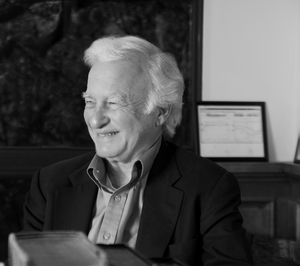
 Douglas Drane, Mentor & Co-founder of the HumanCurrent

Douglas Drane, Mentor & Co-founder of the HumanCurrent

As a systems thinker, I don’t ever recall a time that I couldn’t see systems. However, as I was learning about the various complexity terms and aspects, light bulb after light bulb went off, and having the words that explained what I understood gave me more confidence. What I learned from my MA was rich and invaluable, and while it did not result in me being fluent in “complexity speak”, the following are some of the terms that have especially resonated with me and continually show up in my work, life, and all the things I do.

Complicated versus complex. This was one of my first ah-has—a big light bulb. Understanding that a process or situation in a complicated system has a solution, even if it is confusing and involves many steps, is different than a complex system. Take an organizational chart for example. The flow of who reports to who can seem confusing, but one way or another it can be mapped out. However, taking the same organizational chart and adding the personalities, relationships, and history to those on the chart reveals a complex situation. I like to think of it as complicated situations can be solved or figured out; whereas, complex situations are something you navigate through. The “complex” part of a system implies there are layers of interconnectedness and interdependencies. Navigating through complexity requires a greater level of understanding, flexibility, and curiosity.

I’ll also note that there are complexity scientists who are working on new mathematical models to work through today’s complexity. You can learn more and hear about some examples through our interviews with people like Yaneer Bar-YamJean Boulton, and Melanie Mitchell.

Complex ADAPTIVE systems. I had just grasped the understanding between complicated and complex systems when another light bulb moment happened with adding “adaptive” to the system. This was big for me. I had this epiphany that by understanding what complex adaptive system meant I was understanding the foundation of ‘complexity speak’. YAY me! All of a sudden, everywhere I looked I could see complex adaptive systems—systems that were always there, but it was like I saw them with a new lens. For example, the ecosystem, politics, global economics and socioeconomics, families and communities, and so forth. By adding “adaptive” to complex systems, it implies that systems are dynamic, that there is constant change, evolution and movement within the system.

“Often used in ‘adaptive systems’, the term ‘adaptive’ refers to interacting entities that individually or together are able to respond to environmental changes or changes between the interacting parts. The term can refer to a temporary modification to meet a changing context, or a long-term, permanent modification.”

— Complexity Explorer

Emergence. The New England Complex Systems Institute stated that “emergence refers to the existence or formation of collective behaviors — what parts of a system do together that they would not do alone.” While earning my MA, emergence was a key theme as I coded data for my thesis. Here at the HumanCurrent, my co-host and I have trusted and embraced emergence to guide our work forward. We continue to be in awe when the perfect guest presents him/herself at the perfect time. On the podcast we have talked about how we trust the process, which we believe allows for emergence or for us to recognize and appreciate emergence. I would even go as far to say that the HumanCurrent is successful because of our philosophy and value of emergence.

“Emergence describes a process whereby component parts interact to form synergies, these synergies then add value to the combined organization which gives rise to the emergence of a new macro-level of organization that is a product of the synergies between the parts and not simply the properties of the parts themselves. ”

— Complexity Labs

Feedback loops. While earning my MA I read countless articles and books, many of which I still refer to regularly. Peter Senge’s The Fifth Discipline is one of the books at the top of my list, especially when I think of systems thinking, personal mastery, and feedback loops. In my attempt to synthesize Senge’s definition of feedback loops, I’d say that feedback is a reciprocating flow of influence, which is both cause and effect. Of course for a more in depth description, I would strongly recommend grabbing a copy of Senge’s book.

A significant ah-ha from my studies and Senge’s book was that feedback loops can be reinforcing and balancing (negative and positive), which are influenced by patterns and behaviors. I especially recommend Senge’s book if you’re interested in learning more about how feedback loops affect behaviors within a system and how those behaviors can influence a system’s behaviors.

“Human beings, viewed as behaving systems, are quite simple. The apparent complexity of our behavior over time is largely a reflection of the complexity of the environment in which we find ourselves. ”

— Herbert A. Simon, The Sciences of the Artificial

Interdependencies. As a lifelong systems thinker and growing complexity thinker, seeing and understanding interdependencies came fairly easy. However, a big ah-ha for me with understanding interdependencies was not in knowing the definition, but rather in appreciating what my understanding had to offer to a situation. I’ll explain. I had this impression that seeing and understanding interdependencies would make navigating through a situation or relationship easier. Boy was I wrong. You know that saying, “ignorance is bliss”? I think that in many cases, before I had an understanding of interdependencies, my ignorance made things easier to an extent. I could just “keep it real”, do what I thought was best, and say what I wanted to say. With that mindset came all kinds of unintended consequences (and a great example of a feedback loop).

Because interdependencies exist within complex adaptive systems, there is no ‘easy button’. In fact, it’s not about finding a solution; it is about navigating through a situation. While having an understanding of interdependencies doesn’t provide a magic formula or easy button, it does provide a deeper level of understanding and appreciation to navigate through situations in a meaningful way. This requires a mind shift and, I believe, leads to a heightened level of mindfulness where we appreciate the collective whole, not just the parts.

“The whole is greater than the sum of its parts.”

— Aristotle

These five lessons —complicated versus complex, complex adaptive systems, emergence, feedback loops, and interdependencies— have fundamentally fostered my complexity thinking. As a result, I believe I am a better co-host, employee, friend, and human. Another ah-ha just happened. Doug was right, the more complexity thinkers there are, the better the world will be. Thank you, Doug!

You can listen to the HumanCurrent podcast here and don’t forget to subscribe in iTunes. Be sure to listen to our recent episode where we share our interview with Data Scientist & Professor at NECSIAlfredo Morales

Source: Five Lessons on Complex Adaptive Systems — HumanCurrent
Improvisation Blog: Transactions and Transduction modelling in the Redesign of Institutions – Mark Johnson

Monday, 23 April 2018

Transactions and Transduction modelling in the Redesign of Institutions

When we draw systems diagrams, we usually draw boxes with labels in them and lines between the boxes which detail the communication between different functions or services. Software development is then a process of turning these labels and boxes into interfaces, functions, user privileges and so on. When the software is implemented, inevitably it has a subtle effect in changing the human organisation of whatever process it is designed for. One of the problems with the design process is that it exercises a kind of tyranny by programmers and systems designers over the existing practices of individuals in an organisation: putting it crudely, it is the geeks who determine what everyone else’s job should be.

Individual job functions are distinctions which emerge naturally in the pattern of transactions those people have with other people in the organisation. Often the nature of these transactions is hard to codify – particularly in a work environment already full of technology, where each individual can see themselves doing many different kinds of things and switching from one thing to another all the time.

Transactions of this sort are usually communications or conversations. Extending the logic of Coase’s theory of the firm, each job function exists by virtue of the transactions which others have with them.

Transduction is a technical term for a process which maintains a distinction between two different forms of representation: for example, between the environment of light and the images in the eye, or between the vibrations in the air and the perception of a melody. All distinctions – including the distinctions which are made in systems modelling diagrams – are the product of transduction processes. More importantly, transactions are the outward sign of transductions: we can look at the words of a conversation, or the accounts ledger of a business and know that these signs of communication indicate a deeper process of coordination going on.

I’m increasingly convinced that our software design processes start from the wrong end: inevitably, software design models the transduction processes of the software designer and then impose those transduction processes on everyone else. What it we were to model the actual transductions within an organisation? What if we were to look at the way distinctions are actually maintained within a business?

All transduction processes can create organisational problems. Every transduction maintains a distinction, and in so doing determines the inside and outside of that distinction. Sometimes, what is excluded in a distinction is the source for more distinctions to be made, and quite often we see that there is a conflict between different organisational functions at different levels. To be able to analyse the transductions in an organisation is to have a map for possible interventions which might look to change the configurations of transductions in the organisation.

A simple example is self-publishing. I’m self-publishing my book, and have decided to do so because the transductions created by publishers are pathological (retaining copyright, setting outrageous prices, doing very little in terms of editorial control, etc). To understand the pattern of these transductions in the publishing system is to identify the intervention point where problems that arise from those transductions might be addressed. Equally, I am interested in the transductions of assessment in education. I’m interested in things like Adaptive Comparative Judgement precisely because it is a way of reconfiguring the transductions of assessment which then affect other transductions in education (for example, educational quality). Or we might look at the transductions of the curriculum. My interventions in Vladivostok are precisely about overcoming the transduction between different subjects in the curriculum, and targeting the primary transduction on the relationship between the individual and the phenomena of the world, rather than the individual and specific ‘subjects’.

The key to being able to specify existing tranductions is to consider each distinction as a means of managing uncertainty. If the distinction concerns somebody’s job (e.g. academic quality, teaching) then the transduction will perform the function of managing the uncertainty of that person maintaining their job. The key question in redesigning the transduction is whether there is a better way of managing uncertainty in the organisation. Obviously, designing a system which removes a person’s job (which is what software designers often do) only increases uncertainty in the organisation; the trick is to reorganise things so that everyone is able to manage their uncertainty better. The pathology of current approaches to technology are that it ramps up uncertainty, and as a consequence, it creates the conditions for increasingly complex technology which tries to fix the uncertainties generated by the previous technology.

Source: Improvisation Blog: Transactions and Transduction modelling in the Redesign of Institutions

STREAMS Wiki – Systems Thinking, Real Enterprise Architecture and Management Science – Ian Glossop

What is STREAMS?

STREAMS is an acronym that stands for:

 Systems Thinking, Real Enterprise Architecture and Management Science.

It is a set of ideas about how to build and manage an Enterprise based on a common, rigorous STREAMS Philosophy. It leads to methodologies, methods and techniques for building, managing, evolving and innovating Enterprises that can be applied in practice but, like an Engineering approach, its methods are grounded in rigorous research and understanding.

Common to the three main strands, or tributaries, of STREAMS is the Use of Models: conceptual models of a variety of descriptions and characteristics ranging from highly complex mathematical models informed by volumes of quantitative data grounded in empirical observation and measurement to simple qualitative models expressing some simple truth. The purpose of the models is to guide Decision Making.

STREAMS is a set of ideas that are both transdisciplinary and integrative of theory and practice. It is “Trans-disciplinary” in the sense that it eclectically draws on ideas, theories, principles and methods from a range of academic disciplines – deliberately paying no heed to the traditional divisions in universities – or similar academic institutions. It is “Integrative” in the sense that is seeks to blend these ideas into a coherent, well-founded theoretical framework – but also incorporate emrpically grounded and proven ideas and practices from Practice, not just academic theory. STREAMS is not intended to be an academic exercise in the social science but theoretically-sound ideas and methods for practitioners in engineering enterprises.

much much more in source: STREAMS – STREAMS Wiki

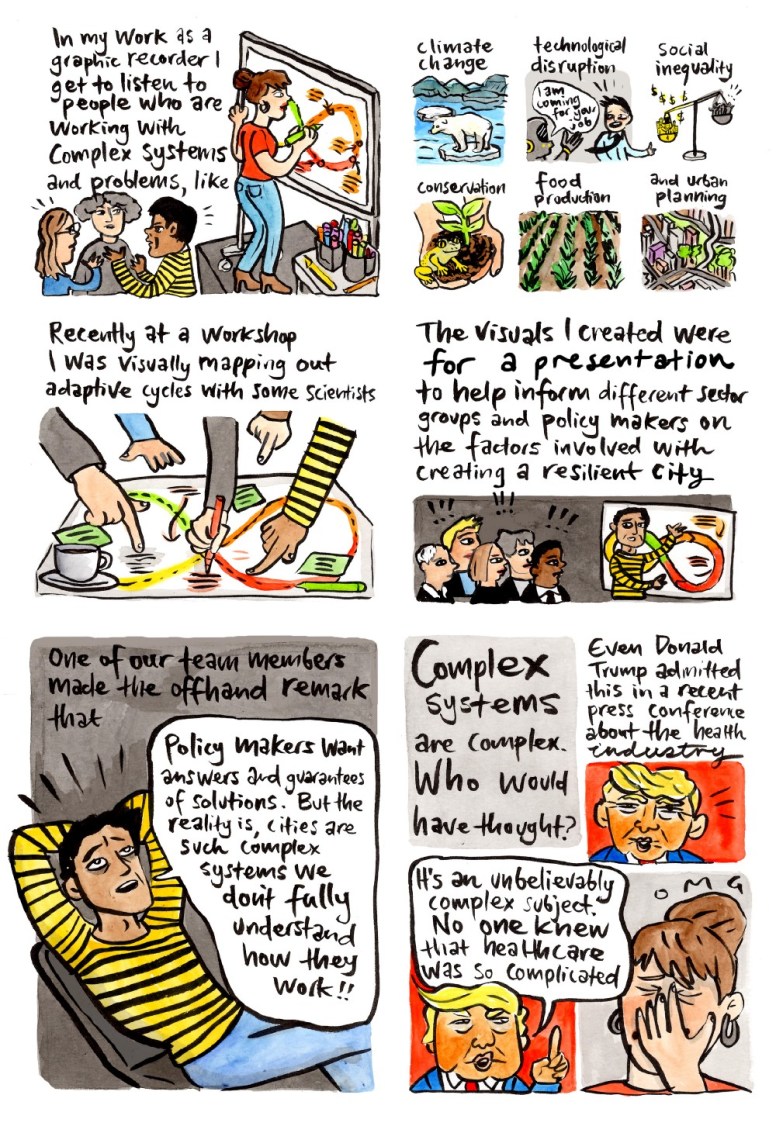
Making Sense Of Complexity – Sarah Firth graphics on medium

Sarah Firth

Making Sense Of Complexity

Continues in source: Making Sense Of Complexity – Extra Newsfeed

FORMWELTen-Institute for renewing systemic research | Larnaca Conferences – 28 May, 10am, Larnaca

Research / News | 

Larnaca Conferences

  • Meeting in Larnaca, Cyprus on Monday 28 May.
  • Starting at 10 am local time.

The meeting is an ‘ideas creation’ and brainstorming event between System Thinkers of different backgrounds.

Aims

  • To discuss how a complex approach to science is needed in order to overcome some of today’s bottlenecks
  • To explore transdisciplinary synergies between experts, and establish a common position statement
  • To look for EU funding and/or consider a Start-up
  • To set up a Think Tank and discuss how to implement our thinking in practice

Details

Information flowing in our modern complex social system (between human brains, brains to computer and computer to computer) creates new realities which have an immense impact on our society, biology and evolution as humans. A formal thematisation of systems thinking needs to be developed in order to avoid negative outcomes such as degenerative disease, conflict, lack of cooperation and bad communication.

The meeting will bring together expert system thinkers in areas such as language, communication, ageing, cognition, complex systems, resilience and mathematics.

An example where our thinking may be applied is neuro-resilience: “The inherent characteristics of the brain as a complex system, the long term and short-term adaptation strategies of the individuals, and finally the quality of management strategies of the collective and the embedded environment in steering individuals away from undesired brain’s health related outcomes such as depression, dementia, Alzheimer’s disease, and other neurodegenerative diseases” (Shima Beigi).

The multiple, complex and overlapping network transactions in a virtual or a real environment need to be studied. Another example in this respect is PolySocial Reality (PoSR) which is a “conceptual model for the global interaction context within which people experience social interactions whether immediate or mediated by technology. PoSR defines relations across the aggregate of all the experienced ‘locations’ and ‘communications’ of and between all individual people, people/machines and machines/machines in multiple networks and/or locales at the same or different times. PoSR is based upon the core concept that dynamic relational structures emerge from the aggregate of multiplexed asynchronous or synchronous data creations of all individuals within the domain of networked, non-networked, and/or local experiences” (Fisher and Applin).

How can systems theory and research create significant differences in real systems and everybody’s daily life? How can a transdisciplinary systemic discourse become of value to people, politics, economy, ecology, global solutions and integrate direct feedback from real systems and people into the discussion? Questions like these culminate in the ongoing task of a systemic language and should lead to building an exchange platform for researchers to evolve with their research and the systems they analyze, and for laymen and normal people to be systemically integrated into the discussion thus being enabled to use research and systemic concepts to keep up with the complexity of globalization and to participate actively in scientific progress.

“Systemic thinking can change the world, but how? Through people who learn how to think systemically, who learn how to interact with each other systemically and through those people who learn to act as a system in the environment of other systems.”
Gitta and Ralf Peyn, FORMWELT developer

The discussion and exchange of ideas will continue over the course of the day. It is hoped that this meeting will become a trend-setting, yearly event.

Source: FORMWELTen-Institute for renewing systemic research | Larnaca Conferences

How To Be a Systems Thinker | Edge.org – A Conversation With Mary Catherine Bateson

How To Be a Systems Thinker

Mary Catherine Bateson [4.13.18]

Until fairly recently, artificial intelligence didn’t learn. To create a machine that learns to think more efficiently was a big challenge. In the same sense, one of the things that I wonder about is how we’ll be able to teach a machine to know what it doesn’t know that it might need to know in order to address a particular issue productively and insightfully. This is a huge problem for human beings. It takes a while for us to learn to solve problems, and then it takes even longer for us to realize what we don’t know that we would need to know to solve a particular problem. 

How do you deal with ignorance? I don’t mean how do you shut ignorance out. Rather, how do you deal with an awareness of what you don’t know, and you don’t know how to know, in dealing with a particular problem? When Gregory Bateson was arguing about human purposes, that was where he got involved in environmentalism. We were doing all sorts of things to the planet we live on without even asking what the side effects would be and the interactions, although, at that point we were thinking more about side effects than about interactions between multiple processes. Once you begin to understand the nature of side effects, you ask a different set of questions before you make decisions and projections and analyze what’s going to happen.

MARY CATHERINE BATESON is a writer and cultural anthropologist. In 2004 she retired from her position as Clarence J. Robinson Professor in Anthropology and English at George Mason University, and is now Professor Emerita. Mary Catherine Bateson’s Edge Bio

HOW TO BE A SYSTEMS THINKER

At the moment, I’m asking myself how people think about complex wholes like the ecology of the planet, or the climate, or large populations of human beings that have evolved for many years in separate locations and are now re-integrating. To think about these things, I find that you need something like systems theory. So, I went back to thinking about systems theory two or three years ago, which I hadn’t for quite a long time.

…continues in source, and concludes rather wonderfully with:

The tragedy of the cybernetic revolution, which had two phases, the computer science side and the systems theory side, has been the neglect of the systems theory side of it. We chose marketable gadgets in preference to a deeper understanding of the world we live in.

Source: How To Be a Systems Thinker | Edge.org

The Systems Studio newsletter 16 April 2018 – loads of events, links

alt_text
alt_text Email alt_text Tweet alt_text Share
TOP LINKS & INSPIRATION ON SYSTEMS CHANGE
Hello from sunny San Francisco!

The Systems Sanctuary, our peer-learning program for systems leaders is well underway, and we are already hearing stories of the patience it takes to stick with systems change and just how alone people feel whether they’re in Nova Scotia, Auckland or London.

IFAC’s Committee meeting explored how technology is disrupting the accountancy profession and how this is shaping who gets hired. Accountants with coding skills are becoming hugely valuable commodities.

Tatiana and I continue to design  The Systems Sisterhood, a program of support for women of systems change who are in transition. We’ve had huge interest in this. We will let you know when applications are open.

Finally I am on the Advisory Committee for a very exciting gathering of systems change field builders, taking place at Wasan Island, Canada in June. We are hoping to apply our own tools to ourselves, to raise up the field of systems change globally.

Warm wishes,

Rachel Sinha, Founder, The Systems Studio

LINKS FROM THE FIELD OF SYSTEMS CHANGE 

EVENTS

JOBS

Have a story we should include in this newsletter? Get in touch
rachel@thesystemstudio.com
alt_text
The Systems Studio exists to accelerate the evolution systems that allow humans and nature to flourish.
Our clients are trying to change professions, institutions and industries in service of people and planet.We do this by creating experiences where people can truly connect andstrategize about the things they really care about. Working with us always feels focused and fun.

We do three things:

Create community for systems leaders.
Craft and facilitate gatherings that change everything.
Teach strategy and leadership for systems change.

CAN WE HELP YOU?
Get in touch
rachel@thesystemstudio.com


Source: Top Inspiration, Events and News on Systems Change 

The Thoughts of a Spiderweb | Quanta Magazine

The Thoughts of a Spiderweb

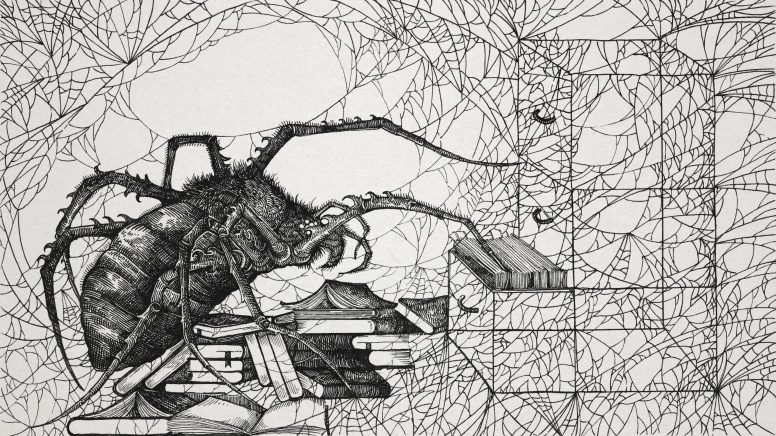
Spiders appear to offload cognitive tasks to their webs, making them one of a number of species with a mind that isn’t fully confined within the head.
36

Is a spiderweb part of the animal’s mind?

Millions of years ago, a few spiders abandoned the kind of round webs that the word “spiderweb” calls to mind and started to focus on a new strategy. Before, they would wait for prey to become ensnared in their webs and then walk out to retrieve it. Then they began building horizontal nets to use as a fishing platform. Now their modern descendants, the cobweb spiders, dangle sticky threads below, wait until insects walk by and get snagged, and reel their unlucky victims in.

In 2008, the researcher Hilton Japyassú prompted 12 species of orb spiders collected from all over Brazil to go through this transition again. He waited until the spiders wove an ordinary web. Then he snipped its threads so that the silk drooped to where crickets wandered below. When a cricket got hooked, not all the orb spiders could fully pull it up, as a cobweb spider does. But some could, and all at least began to reel it in with their two front legs.

continued in source: The Thoughts of a Spiderweb | Quanta Magazine

Keys to Unlocking Systems-Level Change – Susan Misra and Jamaica Maxwell (anticlickbait: systems mindset, tools, understanding of human dynamics)

Three Keys to Unlocking Systems-Level Change

Developing a systems mindset, identifying the right tool for the job, and paying attention to human dynamics can help leaders move from theory to action when facing complex social problems.

The first step to solving an intractable social problem is to understand the system in which it sits. If you don’t, you might find yourself investing in a solution that is ineffective, takes more time or resources to implement, or even makes a problem worse. To reduce the global incidence of HIV, for example, global health leaders must look beyond developing treatments for symptoms; they must address patients’ access to health services, and how culture, economics, and politics affects who benefits in the current system. Taking in the bigger picture—what many of us in the social sector call systems thinking—requires that we understand a system’s many stakeholders, how they interact, and what influences them. Systems thinking means understanding the web of interrelations that create complex problems and rethinking assumptions about how change happens.

This approach isn’t new. Much has been written on thinking systemicallyleading systemically, and collaborating systemically. Yet the social sector leaders and grantmakers who are actively integrating the tools and practices of systems thinking into their day-to-day work are few and far between.

So what does it take to move from theory to practice when working on systems?

The David & Lucile Packard Foundation and Management Assistance Group, a nonprofit that supports movement building, partnered together to answer this question. Given our organizations’ history of influencing systems and commitment to impact, we embarked on a project to understand and overcome the barriers to creating system-level change that grantmakers and others in the social sector face. We reviewed more than 175 websites, articles, books, and videos; conducted more than 30 interviews with systems experts and philanthropic leaders; and ultimately identified three ingredients necessary for overcoming common barriers and positively influencing systems:

1. A systems mindset

2. The right tool for the job

3. An understanding of human dynamics

Full details in source: Three Keys to Unlocking Systems-Level Change

Redesigning Freedom : Metaphorum 2018 Tickets, Fri, Nov 2, 2018 at 4:00 PM

NOV 02

Redesigning Freedom : Metaphorum 2018

by Mark Lambertz

£99 – £149

Event Information

An experimental, self-organising conference, exploring liberating new forms of social organisation.

While there are many innovative proposals on new forms of organisation that could potentially support a great societal transformation, few of us have had the opportunity of experiencing and replicating the experience. In this conference we will explore again Stafford Beer’s cybernetic theories to “design freedom” in organisations, communities, regions and nations. We are inviting examples of radical and innovative organisational and societal transformation based on non-hierarchical, adaptive, self organising structures.

Programme

Day 1, Friday 02.11.2018

4:00 p.m. Pre-Opening & Reception at the Co-Working location super7000 “A Cybernetic Impromptu Networking Session, Drinks & Snacks”

End. 8 p.m.

Day 2, Saturday 03.11.

@sipgate

8.30 a.m Check-in & Open Doors and a Breakfast Buffet

9:30 a.m. Start, welcome, guided tour through sipgate – and how they redesigned their freedom.

10:15 First curated impulse / “Day Starter” incl. Q&A (no ranks, no titles, no Keynote Speakers), tbd.

11:00 Barcamp – Explanation of the Rules of the Game, Session Planning for the whole day, per Slot 45 minutes in max. 4 rooms/areas (more infos about the nature and purpose of a Barcamp: http://barcamp.org/w/page/405173/TheRulesOfBarCamp)

11:30 Start of the first round of parallel sessions

12:15 Lunch break for one hour

1:15 p.m. Barcamp Sessions – Continue Parallel Sessions 2, 3

2:45 p.m. Coffee Break, 15 Minutes

3:00 p.m. Barcamp Sessions – Continue Parallel Sessions 4, 5

4:30 p.m. Coffee Break, 15 Minutes

5:15 p.m 124ALL – “What should be the guiding question for tomorrow?” & “9x Why?

5:45 p.m End of the sessions

6:00 p.m. Second curated impulse, perhaps a”cybernetic nano concert” incl. Q&A ->

6:30 p.m Start of the Get together, finger food, drinks, music & communication

Closing around 22.00/23.00 o’clock

Day 3, Sunday 04.11.

09:00 Breakfast

09:30 Start, short welcome

09:35 Taste of Team Syntegrity: A hacked version of the original Syntegration protocol, with all the participants of the Metaphorum

12:30 Lunch Break

1:30 p.m Planning Session for the next metaphorum (format and interaction structure tbd).

From 2:30 p.m. Closing, Farewell & Official End

KPIs Measurement via lines/strokes on a flipchart (scale from 1 to 5):

Time well invested?

Gained an understanding on how to redesign freedom?

The Barcamp & Syntegration were engaging?

3:30 p.m. Leaving time

Price

Included in the price of £149.-

(Early Bird £99.-, if you buy a ticket before 31.07.2018):

Conference Fee, Breakfast, Lunch and a lot of exchange.

Travel

Düsseldorf (DUS) has an international airport with many direct connections within Europe and also some flights from overseas.

Airport Info:

https://www.dus.com/en

From the airport we recommend the following connections to the city (the ride takes about 15-20 minutes):

Bus 721 (Terminal A/B/C), Single Ticket EUR 2,70

Official website of the Rheinbahn (public transportation service):

http://www.rheinbahn.com/Seiten/default.aspx

Taxi, one ride about EUR 20.-

You will find the cabs right in front of the entrance (just follow the signs in the airport)

Accommodation

The following hotels and hostels are close to the main venue (Saturday and Sunday):

Holiday Inn Düsseldorf Hafen

Radisson Blue

This hostel is cheap, even though it takes 15 minutes with the bus to get to sipgate and 25

Minutes by feet.

http://www.backpackers-duesseldorf.de/en/

Source: Redesigning Freedom : Metaphorum 2018 Tickets, Fri, Nov 2, 2018 at 4:00 PM | Eventbrite

Pervasives and the VSM algedonic link – Tom Graves / Tetradian

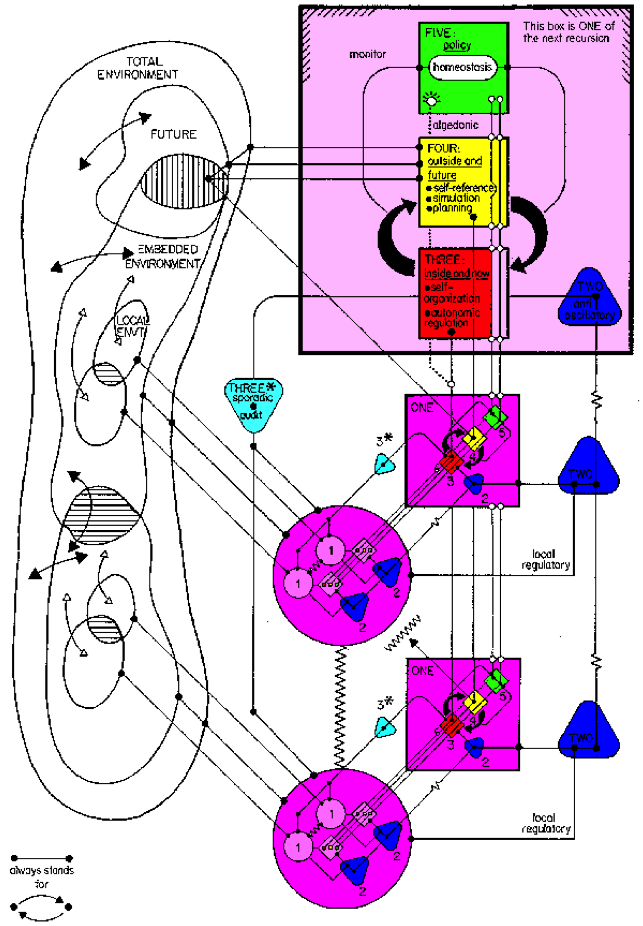
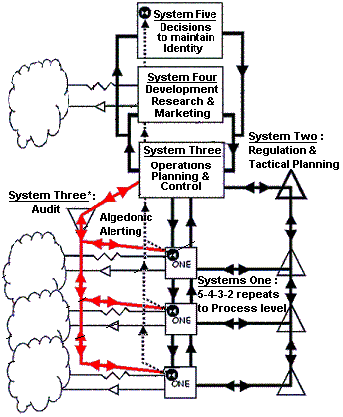
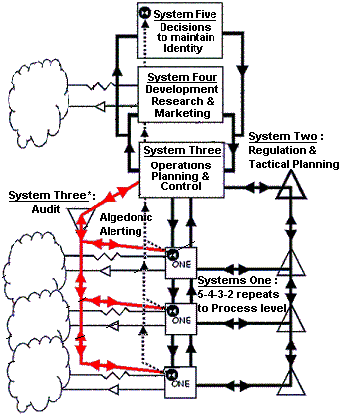
To me, one of the keys here is the perhaps least-known part of the Viable System Model (VSM) – the algedonic link.

‘Algedonic’ literally means ‘of pain/pleasure’, and, as the Wikipedia entry for VSM explains:

Algedonic alerts … are alarms and rewards that escalate through the levels of recursion when actual performance fails or exceeds capability, typically after a timeout.

In classic VSM, examples might include a ‘stop-the-line’ signal on an assembly-line, or an error-message percolating up the code-hierarchy within a computer-application.

For various practical reasons, descriptions of algedonic signal-channels are often absent from standard VSM reference diagrams…

Which can lead to serious gaps in system-design, or even misinterpretation of VSM as just another Taylorist top-down hierarchy. But some versions of the VSM base diagram do illustrate algedonic links, such as in this example by Nick Green

…showing ‘Algedonic Alerting’ as a black dotted-line link from VSM system-1 to systems-3, -4 and -5:

Even there, it somewhat misses the point, because algedonic signals won’t traverse solely to the ‘direction’ elements (systems-3, -4, -5) of the current recursion, but may be sourced anywhere, and likewise need to be vectored to and/or picked up anywhere. For example, if the ship is in danger, and the danger has been spotted only by the most junior-ranking crew-member, that message needs to go as quickly as possible to where it needs to go – not trickle slowly up and down the respective hierarchies.

Which, with a bit of exploration around this, kinda indicates that algedonic-signals may not only need to break the hierarchy, but may go not just upward but in any direction – up, down, sideways, round – and also may need to be

Source: Pervasives and the VSM algedonic link – Tom Graves / Tetradian

Understanding Systems Science: A Visual and Integrative Approach – Andreas Hieronymi – 2013

Abstract

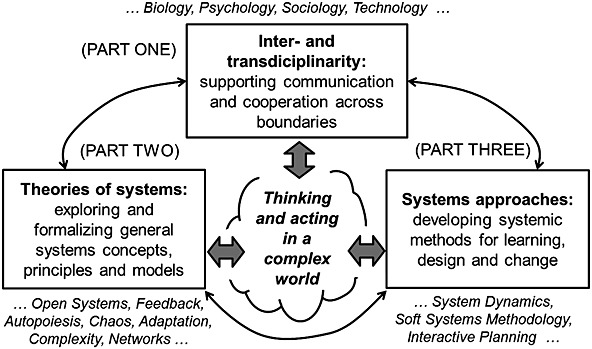
Systems thinking is considered a much‐needed competence to deal better with an increasingly interlinked and complex world. The many streams within systems science have diversified perspectives, theories and methods, but have also complicated the field as a whole. This makes it difficult to understand and master the field. Short introductions to fundamental questions of systems science are rare. This paper is divided into three parts and aims to do the following: (1) to provide a broad overview of the structure and purpose of systems science; (2) to present a set of key systems principles and relate them to theoretical streams; and (3) to describe aspects of systems‐oriented methodologies within a general process cycle. Integrative visualizations have been included to highlight the relationships between concepts, perspectives and systems thinkers. Several new attempts have been made to define and organize system concepts and streams in order to provide greater overall coherence and easier understanding. © 2013 The Author. Systems Research and Behavioral Science published by John Wiley & Sons, Ltd.

INTRODUCTION: BACKGROUND AND PROBLEM

What skills are needed for the 21st century that have been neglected in the past? It has become increasingly clear that the problems and challenges we face are highly interlinked, complex and multidisciplinary. A comparative study (Wiek et al., 2011) came to the conclusion that one of five key competencies for a sustainable future is ‘systems thinking competence’. Peter Senge, one of the key promoters of organizational learning and systems thinking in management (1990), argues that three core capabilities are necessary: We need to increase ‘collaboration across boundaries’, ‘see systems’ as a part of larger systems and learn to ‘create a desired future’ (Senge et al., 2010, p. 44). These three challenges are closely related to the three foundational aspects of systems science explored in this paper.

The goal of this paper is to make key perspectives and concepts of systems thinking and systems science more understandable to researchers and to persons involved practically in fields such as education, consulting or management. To achieve this goal in the limited space of this paper, emphasis will be on visual maps that help us to integrate systemic knowledge from diverse streams and to highlight relations. More detailed descriptions of the concepts mentioned can be obtained in the cited references. Troncale (1985, p. 30) states ‘There is a need to make general systems theory more user‐friendly’. Among other solutions, he recommends overcoming obstacles by use of graphic techniques.

Complete paper in source:Understanding Systems Science: A Visual and Integrative Approach – Hieronymi – 2013 – Systems Research and Behavioral Science – Wiley Online Library

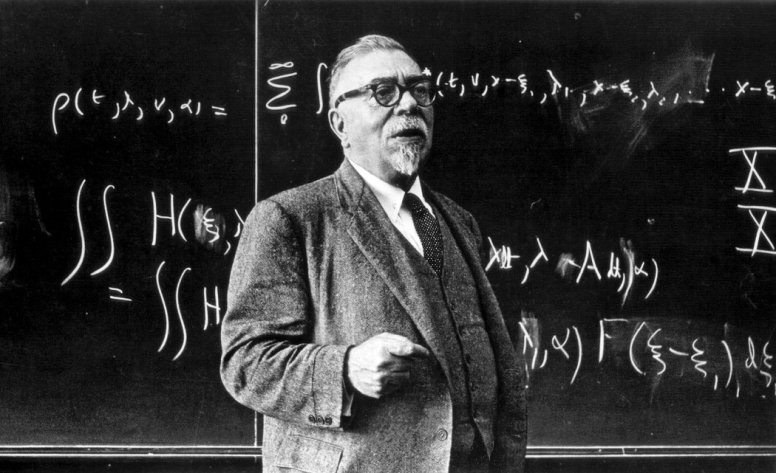
Norbert Wiener’s 1949 Essay on Machine Age Is Found – The New York Times

In 1949, he imagined the age of robots


The Beyond Partnership Nora Bateson – Liminal Leadership – 13 & 14 June 2018 – The Beyond Partnership

Nora Bateson – Liminal Leadership – 13 & 14 June 2018

Liminal Leadership

Early Bird Price: £395+VAT= £474 includes lunches and refreshments
(Booked and paid by 16th May 2018)

Standard Price: £435+VAT= £522
(Booked and paid after 16th May 2018)

Venue: Hilton Hotel, Bath

Join the wonderful Nora Bateson for this special two day exploration into the further reaches of a new leadership.

“Whatever leadership used to be — it used to be. Now, it has to be something different. Now, we all have to be more than we were. The kind of leadership that I want to explore may not be identifiable as leadership at all.  I am interested in a kind of mutually alert care and attention to the well-being of all people and ecological systems. This kind of leadership cannot be found in individuals, but rather between them. It cannot be found in organizations, nations, religions or institutions, but rather between them. I have called it Liminal Leadership to highlight the relational characteristics.”
Nora Bateson.

Liminal Leadership – The Workshop

This is the era of the in-between. In this workshop we will be attending to what keeps us stuck and trapped and what will enable us forward to fresh and more rewarding possibilities. Some of the ideas and themes we will be exploring are:

Liminal realms: the era of the in-between. We are between cultures, between the ways of living of the past, and the ways of living of the future. We have old habits that cast shadows across the visions for new becomings. Old ways of living that are premised upon exploitation of human and ecological rights are not yet gone, and new ways of living have not yet manifested. The word liminal refers to this ripe, but confusing state, mid-transformation.

What is change?: mechanistic and linear notions of change are susceptible to mechanistic and linear solutions, what other change might there be?

Symmathesy: Looking at living systems as contexts of mutual learning.

Who are we now?: Mythology of heroes, leaders and the crisis of perception. Redefining these roles for the pathways ahead.

Identity in complexity: You are an ecology of selves. Identity is at the core of our perception process. Bringing complexity to identity makes it more possible for the complexity of others to be more visible.

The Paradox of Agency: You are you, and you are your contexts.

Ecology of institutions: The institutions of our world have formed an inter-dependency that we are having difficulty extracting from. Economy, technology, medicine, education, politics, religion—these institutions are woven into each other now, and woven into our lives.


Please read this beautifully written, bold and provocative article on Liminal Leadership by Nora,

it will describe to you the territory of this workshop and the importance of  this liminal approach moving forward

www.kosmosjournal.org/article/liminal-leadership


“Gregory Bateson was the great systemic thinker of the 20th Century and his daughter Nora Bateson is one of the greatest systemic thinkers of the 21st century, helping many of us to undertake the much needed shift in human consciousness. Wish I was able to come to the workshop – I will contact you if something cancels.”
Peter Hawkins, Professor of Leadership at Henley Business School

“It’s hard to know where to start in engaging with Nora Bateson’s work.  But that matters not one jot, as long as we do just, actually, start. It seems practically impossible to achieve new ways of seeing and describing and enacting the connections and behaviour that will serve our emerging times. Nora is a pioneer in inviting us into this space, incorporating and moving beyond her inheritances from her father and other seminal, edge-place thinkers.  But you have to be prepared to catch yourself doing what you always do, so don’t leave your sense of humour at home.”
Julie Allan

“Nora Bateson’s work needs to be experienced to even begin to integrate the richness it contains. The result is like being given a special lens which offers you the opportunity to see the world differently. It is truly an aesthetic form of wisdom.”
Penny Tompkins and James Lawley, authors of Metaphors in Mind


Booking Your Place

To book please email info@thebeyondpartnership.co.uk with your name and invoicing address.


Nora Bateson
 describes herself as an “interdisciplinary interloper” she travels between conversations in different fields and with different audiences bringing multiple perspectives into view to reveal larger patterns.

She teaches internationally, leading conversations and seminars. Currently she is developing her next film and has recently published a book about the practical application of systems thinking and complexity theory in everyday life entitled, “Small Arcs of Larger Circles”.

Nora is also a filmmaker, lecturer, writer, as well as director & producer of the award-winning documentary film, An Ecology of Mind, a portrait of her father Gregory Bateson’s way of thinking, follow link here.

She is the president of the International Bateson Institute,(IBI), in Stockholm Sweden. The IBI brings together the sciences, arts and vocational wisdoms, to projects from around the world, that require interdisciplinary research reaching into and beyond the academic frame.

You can view Nora’s Blog postings here, these include, Practicality in Complexity and one introducing Symmathesy.

Her previous workshops for us have focused on  Symmathesy: Learning & Change. We are working with her to create a new event working with Warm Data to address ‘Wicked Problems’.

Other Comments about Nora

“Brilliant.”

“Really delightful and inspiring.”

“Exceptional, extraordinary”

 “Wonderful on so many levels.”

“Thought provoking and challenging…..”


Integrated Care Systems: Finding inspiration in unexpected places. – Systems Thinkers Anonymous

This post recounts an email discussion a few of us had about an article Chris Ham of the the Kings Fund published last month on the subject of “Integrated Care Systems”, an NHS evolution of the concept of “Accountable Care Organisations”.  I shared an anonymised version of the email string with a friend in the systems/complexity community, who has an interest in the topic and he suggested I post it as a blog, so here it is.

The article in question can be found here:

https://www.kingsfund.org.uk/blog/2018/02/what-does-future-hold-integrated-care-systems

It’s a good article and our critique was not of the article or the author, but rather on the approach it describes and lessons we might learn from elsewhere.  As ever, the views expressed here are personal and not necessarily those of our employers, or any other organisations we’re involved with.

A conversation began

We were first made aware of the article when a group member shared it and said:

“It’s getting hard to keep up with all the changes!”

continues in source: Integrated Care Systems: Finding inspiration in unexpected places. – Systems Thinkers Anonymous

s
search
c
compose new post
r
reply
e
edit
t
go to top
j
go to the next post or comment
k
go to the previous post or comment
o
toggle comment visibility
esc
cancel edit post or comment