Design Lead at The Children’s Society (but on Medium, I’m just me — views my own).
From service design to systems change
Reshaping what’s desirable, feasible and viable using ‘Systems Leverage Maps’.
“The end goal of a design thinking work process is to create a solution that is desirable, feasible and viable.” A quick reminder of what that means in practice:
Desirable — your service satisfies the people using it
Feasible — it’s technically possible to implement
Viable — it’s got a sustainable business model
There’s not much to disagree with there. Every service should aim for these characteristics, and a successful design process should achieve them.
So where’s the problem?
It’s arguably becoming harder and harder to fulfill these requirements meaningfully — especially for non-profits and the public sector, which are attempting to support vulnerable populations in a context of austerity. The needs of people accessing key services are growing, to a point where it is often not possible to adequately meet them. Simultaneously, the resource to develop and maintain services is under pressure.
Of course desirable, feasible and viable services can still be created — tight constraints can be the prompt for ingenious solutions. Nonetheless, the terrain for service design is more challenging.
There has been a lot of talk recently about how ‘systems thinking’ approaches can help us navigate this new, more challenging terrain. A recent RSA reportshows how systems thinking and design thinking can be integrated. Systems analysis at the ‘front end’ of service design can help us to better understand complex social problems and identify opportunities to respond more effectively and profoundly. Equally, systems thinking provides tools and mindsets to understand the power structures and ‘system immune responses’ which so often kill new solutions before they get off the ground.
I’ve found this model helpful, together with guidance produced by Lankelly Chase and NPC which aims to nudge traditional design practice towards systemic change.
But in building the case for this way of working, I’ve sometimes struggled to articulate how we might expect the ‘result’ to look different in practice when compared to what exists already.¹ As a consequence, I worry sometimes that there’s a danger of embracing the theatre of systems thinking — using it to position services and to navigate what’s desirable, feasible and viable within the existing system — without actually reshaping the system itself.
With no apologies, this is a straight-up pasting of an advert for Barry Oshry’s books. Barry is (whisper it) more than 40 years old, but is a truly valuable thinker for those of us who value human freedom, human systems, and the insight that systems thinking can offer. Please share.
“Oshry, one of the truly great management educators of the era, has offered a whole generation a new way of thinking about leading human systems. Every manager, executive, and leader benefits from the insights that jump out of his provocative writings. His ideas will still be sparkling decades from now.”
Kenwyn Smith,
Professor, Wharton Business School and the Fels School of Government.
SPECIAL DEALS AND CELEBRATORY PROMOTIONS FROM POWER + SYSTEMS!
With your purchase you receive:
Copies autographed by the author
The Organic Systems Perspective
Oshry’s provocative pamphlet describing the theory of human systems underlying all of his work.
Between A Rock and A Hard Place and Other Joys of Being In The Middle
The illustrated e-book relating the transformation of a harried Middle from frustration and despair to empowerment and contribution.
Exclusive for teachers of Organizational Behavior and related subjects:
A one-hour on-line seminar with Barry and your graduate student class.
A limited number of these class dialogues are available. There is no cost for this session. The sole requirement is that one of the following books be purchased for or by each student. The book chosen, its implications and applications, will become the subject of the dialogue. Contact Barry directly to arrange for a seminar.
Context Context Context Systems Letter Seeing Systems Leading Systems Possibilities of Organization In The Middle
Faculty examination copies
We offer faculty a 55% discount on all of these titles.
Faculty members can order one copy of any or all books and receive this discount by placing the word “Systemo” in the promotional code box at the check-out.
Please note that the delivery address for the book must be an academic institution.
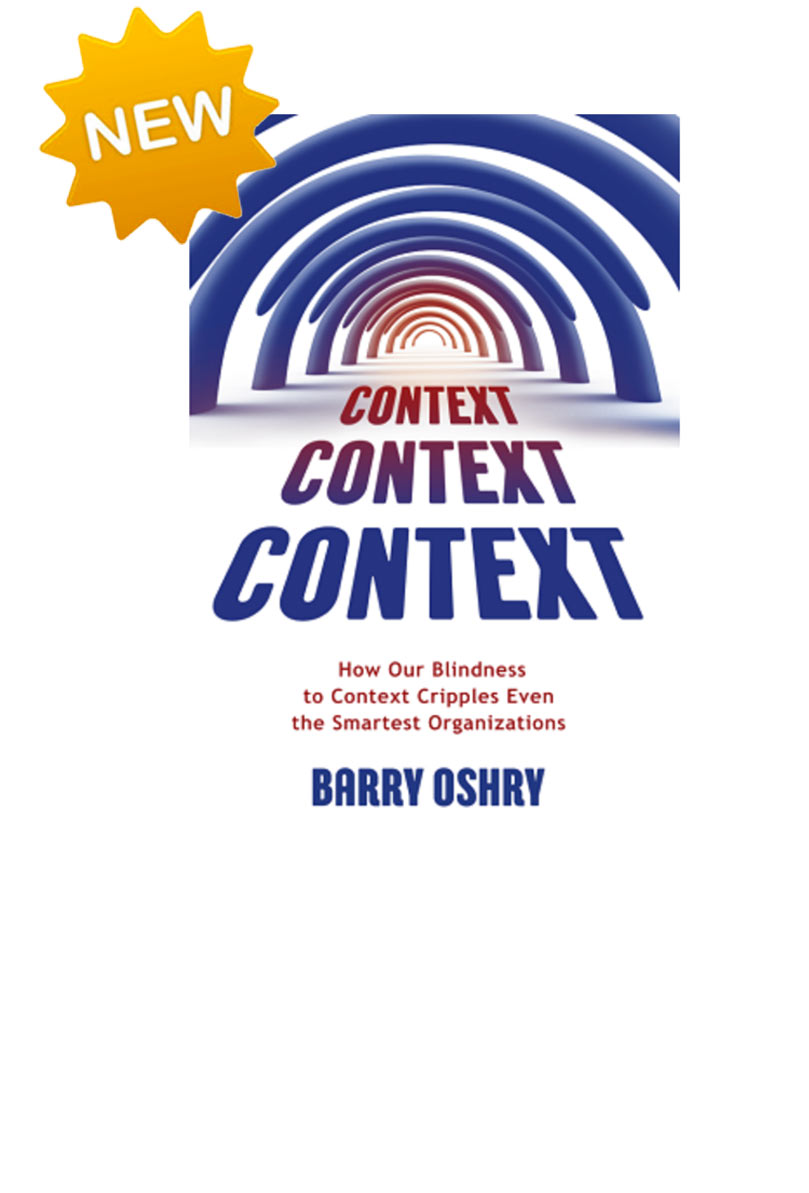
Context Context Context (153 pages)
by Barry Oshry
New. Using the tale of an organization in its struggle to achieve excellence, Oshry illuminates the power that comes from transforming system blindness into system sight. Witnessing the dialogue between mentor and mentee, the reader gets to the core of the awareness and choices underlying individual and organizational transformation. It is a tale with the potential to transform any organization – to bring insight into who we are and what we can become in all the systems of our lives.
“With immense care and great clarity, (Oshry) sets out a powerful language to describe and understand whole systems. The concepts not only help us to grasp more securely the profound personal and organisational consequences of our blindness to the contexts in which we live our lives but also grant us fresh perspectives from which to appreciate those contexts anew.”
Martin McNamara, Professor and Associate Dean for External Relations
UCD School of Nursing, Midwifery and Health Systems
Early in his career, Barry Oshry felt dismissed and disregarded by an organization that had meant so much to him. Rather than simmer and sulk, he struck back with a a systems letter aimed at illuminating a whole system in all of its complexity. While it was addressed to specific individuals and sub-groups, to leaders and members, it was also addressed to all who have ever suffered indignities at the hands of their organizations. It offers invaluable insight for both the oppressors and the oppressed, while providing hope and inspiration to all those who have felt diminished, dismissed, and disrespected by their organizations.
“Barry is a true systems wizard, and The Systems Letter offers a unique glimpse of how he applied his own ideas in the messiness of real life. It’s a captivating story and a powerful glimpse of a whole system from multiple angles, shared with remarkable humility, vulnerability, openness, and poignancy.”
Seeing Systems 2nd Edition (266 pages)
by Barry Oshry
BEST SELLER. A critical antidote to the personal bias that dominates much of our thinking about life in the organization. Oshry demonstrates how many of our costly relationship breakdowns are systemic – not personal – and how they develop out of our blindness to the human systems of which we are a part. Using a lively mix of cases, dialogues, poetry, and cartoons, he shows how we can develop productive partnerships when we recognize and develop system sight.
“Precious few business books reveal know-how that fundamentally changes the way we operate and experience our world of work. Seeing Systems helps us grasp what really happens beneath the surface in organizations. Regardless of whether you are an executive, executive coach, middle manager or individual contributor, Seeing Systems provides powerful insights and applications for enhancing your effectiveness.”
Julian D. Kaufmann,
Senior Advisor at G100 Companies
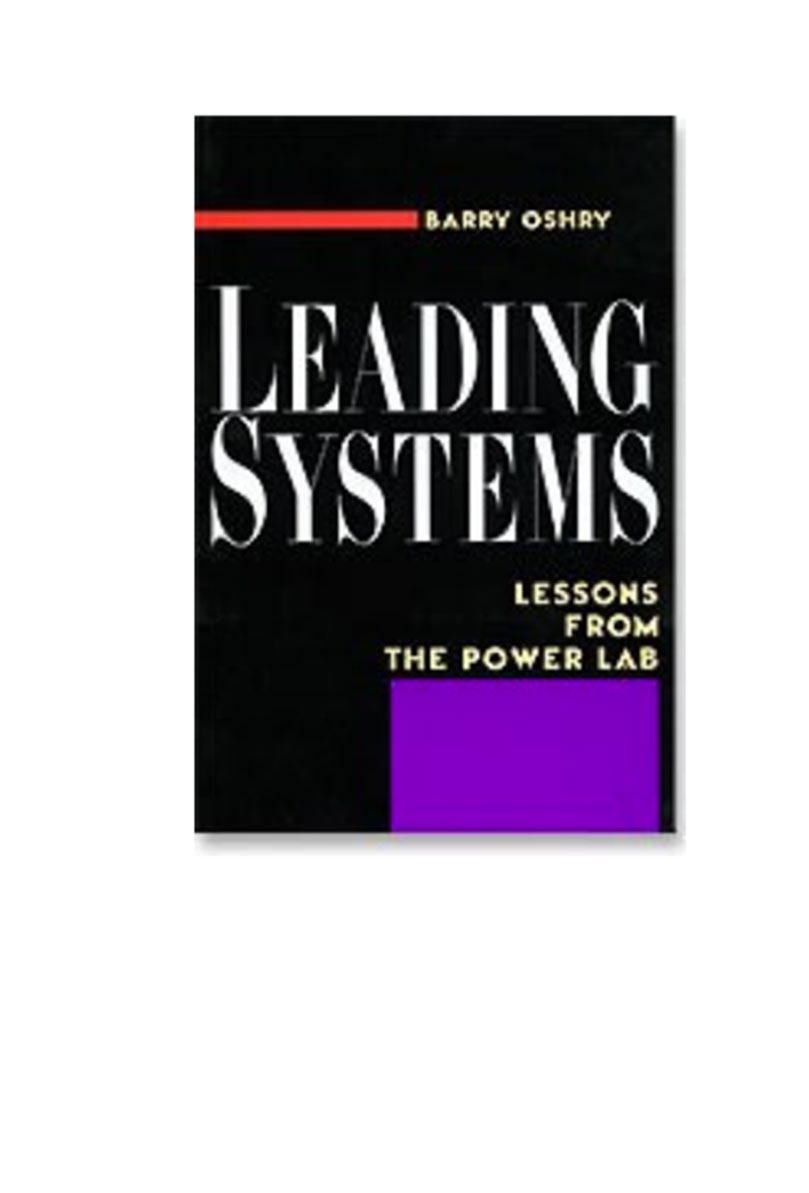
Oshry shares the lessons he’s derived from his decades of work with the Power Lab, the leadership program that’s an intense microcosm of system life. He challenges conventional thinking by shedding light on the limitations of consensus, the importance of unilateral action, the restrictions our values can place on our power. He demonstrates what it takes to break out of familiar destructive patterns and elevate ourselves and our systems to higher levels of possibility.
“Oshry has succeeded in bringing to life the emotional consequences of being in different positions of power within the social system. I found this an exciting and illuminating book. It is vivid and creative in its highly personal way, and its message is highly provocative. It should be read by all levels within an organization.”
Edgar Schein
Sloan Fellows Professor of Management Emeritus, MIT Sloan School of Management
Possibilities of Organization (208 pages)
by Barry Oshry
THE BOOK THAT STARTED IT ALL. In this disarmingly simple book, Oshry strips away the mystery and mythology of organizational life. Part I deals with “Internal Warfare”, a painfully familiar scenario in which organizations go to war with themselves. Part II demonstrates how misunderstandings and conflict develop across organizational lines. And Part III confronts us with our blindness to our own worlds and the critical choices we face daily that can transform our lives and the lives of our organizations.
“Anyone working with (or in) an organization can benefit from this book. The power is in its simplicity. But don’t let the simplicity fool you. It is the real deal. Good, effective writing and presentation. I’m director of a nonprofit that does training, and I’ll be using these principles within our organization, and with clients, every day. Thank you, Barry Oshry, for making them so accessible.”
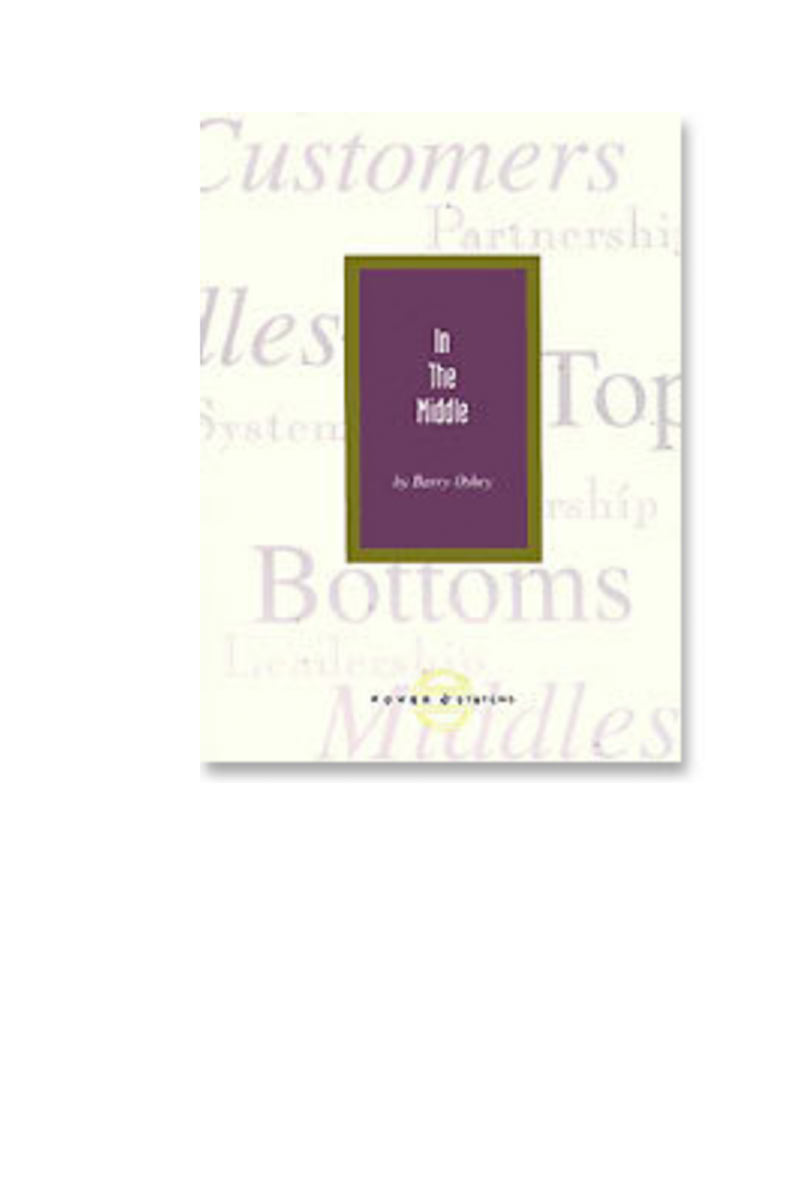
THE book for those who regularly find themselves torn and pulled between the conflicting needs, demands, and priorities of others. Oshry demonstrates how the blindness to systemic forces diminishes individual effectiveness and contribution in the middle and limits the collective contribution of middle peers. It lays out strategies that enable Middles to become more confident, effective, and respected contributors to their organizations.
“Ever wish you could have a ton of experience dealing with exactly the problem you need to solve next? Well, here is a “laboratory-in-a-book” for you to jump into, feel all the queasiness of making exactly the wrong move, and jazzed about doing it right. This will elevate your consciousness on how management really works (and doesn’t work) and why. After reading this, you won’t be irritated at uncooperative coworkers. You’ll see it’s the system, not them, and not you – and you’ll see a way to fix the problem.”
In a recent story on Medium called “One Man’s Quest to Rid Wikipedia of Exactly One Grammatical Mistake: Meet the Ultimate WikiGnome,” Andrew McMillen tells the story of Wikipedia editor “Giraffedata”—beyond the world of Wikipedia, a software engineer named Bryan Henderson—who has edited thousands of Wikipedia pages to correct a single grammatical error and is one of the 1000 most active editors of Wikipedia. McMillen describes Giraffedata as one of the “favorite Wikipedians” of some employees at the Wikimedia Foundation, the umbrella organization that funds and organizes Wikipedia along with other projects. The area he works on is not controversial (at least not in the sense of hot topics like GamerGate or climate change); his edits are typically not reverted in the way that substantive edits to such controversial topics frequently are. While the area he focuses on is idiosyncratic, his work is extremely productive. As such he is understood by at least some of the core Wikipedians to exemplify the power of crowds, the benefits of “organizing without organization,” the fundamental anti-hierarchical principles that apparently point toward new, better political formations.
McMillen describes a presentation at the 2012 Wikimania conference by two Wikimedia employees, Maryana Pinchuk and Steven Walling:
Walling lands on a slide entitled, ‘perfectionism.’ The bespectacled young man pauses, frowning.
“I feel sometimes that this motivation feels a little bit fuzzy, or a little bit negative in some ways… Like, one of my favorite Wikipedians of all time is this user called Giraffedata,” he says. “He has, like, 15,000 edits, and he’s done almost nothing except fix the incorrect use of ‘comprised of’ in articles.”
A couple of audience members applaud loudly.
“By hand, manually. No tools!” interjects Pinchuk, her green-painted fingernails fluttering as she gestures for emphasis.
“It’s not a bot!” adds Walling. “It’s totally contextual in every article. He’s, like, my hero!”
“If anybody knows him, get him to come to our office. We’ll give him a Barnstar in person,” says Pinchuk, referring to the coveted virtual medallion that Wikipedia editors award one another.
Walling continues: “I don’t think he wakes up in the morning and says, ‘I’m gonna serve widows in Africa with the sum of all human knowledge.’” He begins shaking his hands in mock frustration. “He wakes up and says, ‘Those fuckers — they messed it up again!’”
Neither the presenters nor McMillen follow up on Walling’s aside that Giraffedata’s work might be “a little bit negative in some ways.” But it seems arguable to me that this is the real story, and the celebration of Henderson’s efforts is not just misplaced, but symptomatic. Rather than demonstrating the salvific benefits of non-hierarchical organizations, Giraffedata’s work symbolizes their remarkable tendency to turn into formations that are the exact opposite of what the rhetoric suggests: deeply (if informally) hierarchical collectives of individuals strongly attached to their own power, and dismissive of the structuring elements built into explicit political institutions.
This is a well-known problem. It has been well-known at least since 1970 when Jo Freeman wrote “The Tyranny of Structurelessness”; it is connected to what Alexander Galloway has recently called “The Reticular Fallacy.” These critiques can be summed up fairly simply: when you deny an organization the formalpower to distribute power equitably—to acknowledge the inevitable hierarchies in social groups and deal with them explicitly—you inevitably hand power over to those most willing to be ruthless and unflinching in their pursuit of it. In other words, in the effort to create a “more distributed” system, except in very rare circumstances where all participants are of good will and relatively equivalent in their ethics and politics, you end up creating exactly the authoritarian rule that your work seemed designed specifically to avoid. You end up giving even more unstructured power to exactly the persons that institutional strictures are designed to curtail.
That this is a general problem with Wikipedia has been noted by Aaron Shaw and Benjamin Mako Hill in a 2014 paper called “Laboratories of Oligarchy? How The Iron Law Extends to Peer Production.” Shaw and Mako Hill are fairly enthusiastic about Wikipedia and peer production, and yet their clear-eyed research, much of which is based on empirical as well as theoretical considerations, forces them to conclude:
Although, invoking U.S. Supreme Court Justice Louis Brandeis, online collectives have been hailed as contemporary “laboratories of democracy”, our findings suggest that they may not necessarily facilitate enhanced practices of democratic engagement and organization. Indeed, our results imply that widespread efforts to appropriate online organizational tactics from peer production may facilitate the creation of entrenched oligarchies in which the self-selecting and early-adopting few assert their authority to lead in the context of movements without clearly defined institutions or boundaries. (23)[1]
In the current case, what is so striking about Giraffedata’s work is that, from the perspective of every reasonable expert angle on the question, Giraffedata is just plain wrong.
We live in an age of heterogenous anarchism. Contingency is king. Fluidity and flux win over solidity and stasis. Becoming has replaced being. Rhizomes are better than trees. To be political today, one must laud horizontality. Anti-essentialism and anti-foundationalism are the order of the day. Call it “vulgar ’68-ism.” The principles of social upheaval, so associated with the new social movements in and around 1968, have succeed in becoming the very bedrock of society at the new millennium.
But there’s a flaw in this narrative, or at least a part of the story that strategically remains untold. The “reticular fallacy” can be broken down into two key assumptions. The first is an assumption about the nature of sovereignty and power. The second is an assumption about history and historical change. Consider them both in turn.
(1) First, under the reticular fallacy, sovereignty and power are defined in terms of verticality, centralization, essence, foundation, or rigid creeds of whatever kind (viz. dogma, be it sacred or secular). Thus the sovereign is the one who is centralized, who stands at the top of a vertical order of command, who rests on an essentialist ideology in order to retain command, who asserts, dogmatically, unchangeable facts about his own essence and the essence of nature. This is the model of kings and queens, but also egos and individuals. It is what Barthes means by author in his influential essay “Death of the Author,” or Foucault in his “What is an Author?” This is the model of the Prince, so often invoked in political theory, or the Father invoked in psycho-analytic theory. In Derrida, the model appears as logos, that is, the special way or order of word, speech, and reason. Likewise, arkhe: a term that means both beginning and command. The arkhe is the thing that begins, and in so doing issues an order or command to guide whatever issues from such a beginning. Or as Rancière so succinctly put it in his Hatred of Democracy, the arkheis both “commandment and commencement.” These are some of the many aspects of sovereignty and power as defined in terms of verticality, centralization, essence, and foundation.
(2) The second assumption of the reticular fallacy is that, given the elimination of such dogmatic verticality, there will follow an elimination of sovereignty as such. In other words, if the aforementioned sovereign power should crumble or fall, for whatever reason, the very nature of command and organization will also vanish. Under this second assumption, the structure of sovereignty and the structure of organization become coterminous, superimposed in such a way that the shape of organization assumes the identical shape of sovereignty. Sovereign power is vertical, hence organization is vertical; sovereign power is centralized, hence organization is centralized; sovereign power is essentialist, hence organization, and so on. Here we see the claims of, let’s call it, “naïve” anarchism (the non-arkhe, or non foundation), which assumes that repressive force lies in the hands of the bosses, the rulers, or the hierarchy per se, and thus after the elimination of such hierarchy, life will revert so a more direct form of social interaction. (I say this not to smear anarchism in general, and will often wish to defend a form of anarcho-syndicalism.)At the same time, consider the case of bourgeois liberalism, which asserts the rule of law and constitutional right as a way to mitigate the excesses of both royal fiat and popular caprice.
We name this the “reticular” fallacy because, during the late Twentieth Century and accelerating at the turn of the millennium with new media technologies, the chief agent driving the kind of historical change described in the above two assumptions was thenetwork or rhizome, the structure of horizontal distribution described so well in Deleuze and Guattari. The change is evident in many different corners of society and culture. Consider mass media: the uni-directional broadcast media of the 1920s or ’30s gradually gave way to multi-directional distributed media of the 1990s. Or consider the mode of production, and the shift from a Fordist model rooted in massification, centralization, and standardization, to a post-Fordist model reliant more on horizontality, distribution, and heterogeneous customization. Consider even the changes in theories of the subject, shifting as they have from a more essentialist model of the integral ego, however fraught by the volatility of the unconscious, to an anti-essentialist model of the distributed subject, be it postmodernism’s “schizophrenic” subject or the kind of networked brain described by today’s most advanced medical researchers.
Why is this a fallacy? What is wrong about the above scenario? The problem isn’t so much with the historical narrative. The problem lies in an unwillingness to derive an alternative form of sovereignty appropriate for the new rhizomatic societies. Opponents of the reticular fallacy claim, in other words, that horizontality, distributed networks, anti-essentialism, etc., have their own forms of organization and control, and indeed should be analyzed accordingly. In the past I’ve used the concept of “protocol” to describe such a scenario as it exists in digital media infrastructure. Others have used different concepts to describe it in different contexts. On the whole, though, opponents of the reticular fallacy have not effectively made their case, myself included. The notion that rhizomatic structures are corrosive of power and sovereignty is still the dominant narrative today, evident across both popular and academic discourses. From talk of the “Twitter revolution” during the Arab Spring, to the ideologies of “disruption” and “flexibility” common in corporate management speak, to the putative egalitarianism of blog-based journalism, to the growing popularity of the Deleuzian and Latourian schools in philosophy and theory: all of these reveal the contemporary assumption that networks are somehow different from sovereignty, organization, and control.
To summarize, the reticular fallacy refers to the following argument: since power and organization are defined in terms of verticality, centralization, essence, and foundation, the elimination of such things will prompt a general mollification if not elimination of power and organization as such. Such an argument is false because it doesn’t take into account the fact that power and organization may inhabit any number of structural forms. Centralized verticality is only one form of organization. The distributed network is simply a different form of organization, one with its own special brand of management and control.
Consider the kind of methods and concepts still popular in critical theory today: contingency, heterogeneity, anti-essentialism, anti-foundationalism, anarchism, chaos, plasticity, flux, fluidity, horizontality, flexibility. Such concepts are often praised and deployed in theories of the subject, analyses of society and culture, even descriptions of ontology and metaphysics. The reticular fallacy does not invalidate such concepts. But it does put them in question. We can not assume that such concepts are merely descriptive or neutrally empirical. Given the way in which horizontality, flexibility, and contingency are sewn into the mode of production, such “descriptive” claims are at best mirrors of the economic infrastructure and at worse ideologically suspect. At the same time, we can not simply assume that such concepts are, by nature, politically or ethically desirable in themselves. Rather, we ought to reverse the line of inquiry. The many qualities of rhizomatic systems should be understood not as the pure and innocent laws of a newer and more just society, but as the basic tendencies and conventional rules of protocological control.
We are happy to announce that OECD Secretary-General Angel Gurría launched OPSI’s report “Embracing Innovation in Government: Global Trends 2018” today at the World Government Summit! The event in Dubai is the largest annual gathering in the world focused on shaping the future of governments through innovation. The report is the result of a global […]
World Government Summit and OECD
Embracing Innovation in Government Global Trends 2018
Governments are using innovation to lead a paradigm shift in the way they provide services. The most innovative approaches refrain from layering one reform on top of another, instead repacking them in ways that allow them to get to the real purpose of the underlying change.
Systems approaches step back and view the entire operation of government as an interconnected system rather than
disparate pieces. They transform and re-align the underlying processes and methods to change the way government works in a cross-cutting way, while involving all of the affected actors both inside and outside government. In so doing, they leverage a number of tools and enabling conditions to succeed.
SEVERAL THEMES HAVE BEEN OBSERVED IN THIS AREA:
Innovators are embracing systems approaches to tackle complex problems, while also transcending administrative boundaries.
Countries are getting better at problem diagnostics to
initiate systems change.
Systems approaches involve trade-offs which must be evaluated.
Systems innovators are looking for scale: From incremental to radical.
Innovators use systems approaches to transform the public sector itself.
KEY RECOMMENDATIONS
1. Focus on a problem, not a method.
2. Apply new problem diagnostic tools.
3. Analyse the potential systemic effects and value trade-offs of innovations.
4. Stay open to emergent, bottom-up change.
5. Experiment with transformative change inside
government.
Highlights
Systems approaches and enablers
7
CASE STUDY: APEX – Singapore
APEX is a whole-of-government platform which
establishes common application programming interfaces
(APIs) that allow public agencies to share data with other
agencies and private entities. APEX enables different
government data programmes to talk to each other,
providing uniform governance, consistency and reliable
performance. It enables innovation through a central
catalogue and self-service portal where innovators can
easily leverage common APIs as building blocks to create
new services and experiences for citizens. One of the
initial pilots is MyInfo, a service that removes the need for
citizens to repeatedly provide their personal information
to government services. APEX addresses a major systemic
challenge: systems interoperability.
CASE STUDY: Predictiv – United Kingdom
Predictiv is an online platform for running behavioural
experiments. It enables governments to run randomised
controlled trials (RCTs) with an online population of
participants, and to test whether new policies and
interventions work before they are deployed in the real
world. Predictiv has the potential to profoundly change
governments’ working methods by drastically reducing
the time needed to test new interventions. In addition,
while time constraints and political realities sometimes
make it hard to run “field trials” on live policy, Predictiv
makes experimental methods more accessible.
CASE STUDY: Free Agents and GC Talent Cloud
– Canada
Canada has been testing several models for recruiting and
mobilising talent within the public service in the digital
age. The most ambitious of its projects is the Talent Cloud,
which aims to become a validated, searchable repository
of cross-sector talent. It envisions a digital marketplace
where workers have access to rights, benefits and union
representation, while retaining the flexibility to choose
work inside and outside government, as offered. It
represents a departure from the permanent hiring model
in the public service, instead organising talent and skills
for project-based work. While still at the visionary stage,
Talent Cloud has produced several spin-off projects, such
as Free Agents, that are innovative and successful in their
own right.
Trend 2: Systems approaches 45
Case Study: APEX – Singapore 62
Case Study: Predictiv – United Kingdom 67
Case Study: Free Agents and GC Talent Cloud
– Canada 71
Many of societies’ most pressing social policy problems are wicked problems. While complex adaptive systems theory has been recognised as an appropriate way to address this type of problem, complexity-accepting strategies are difficult for public administrations because they are at odds with their current dominant logic. This paper describes the development and implementation of a diagnostic tool for tackling wicked problems that is underpinned by complex systems leadership theories and takes into account the current needs of government. The diagnostic tool was reasoned during a research project that investigated how best to increase the social impact of an active citizenship education program in the City of Onkaparinga, South Australia. The research project identified that while the program developed the active citizenship characteristics desired by the three levels of government in Australia, graduates from the program encountered systemic blocking factors when they attempted to put what they had learned during the program into practice. To increase the program’s impact, the diagnostic tool addresses these systemic blocking factors by focusing on nine leverage areas that enable systemic innovation and change to occur in communities.
Relaunch of London Systems Thinking – What It’s All About
Friday, May 25, 2018, 6:00 PM
RedQuadrant Above the British Interplanetary Society London, GB
2 Systems Thinkers Attending
This Meetup is chance to find out what types of systems thinking there are and how they can help us to understand the systems in our environment whether that be at work or elsewhere. We’ll have a look at what people already know about systems thinking – and what they want to find out, and why. Directions Map https://www.google.com/maps/@51.4842419,…
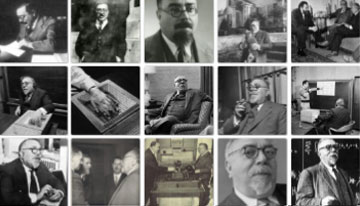
A resource about cybernetics and the work of Norbert Wiener
“The world of the future will be an ever more demanding struggle against the limitations of our intelligence,
not a comfortable hammock in which we can lie down to be waited upon by our robot slaves.” — Norbert Wiener
Inspired by the development of new information and communication technologies, Norbert Wiener was a pioneer in the development of what he called cybernetics, the study of “control and communication in the animal and the machine.” Later he came to realize that “the cybernetic circle of ideas, from being a program for the future and a pious hope” to “a working technique in engineering, in biology, in medicine, and in sociology,” had “undergone a great internal development.” Wiener came to understand that the social consequences of cybernetics demanded immediate attention.
Norbert Wiener’s concern about the man-machine relationship and its social implications is explored in this website. The teachings of Wiener and those inspired by him form the beginning of what we hope will be a growing collection of multi-media materials that attempt to inform and inspire dialogue during this pivotal moment in human history when electronic communications challenge humanity’s control of its destiny . Read More
Conference Videos
View presentations from the 2014 IEEE Conference – “Norbert Wiener in the 21st Century”
Introductory Video
Watch the introductory video “Remaining Human”, created exclusively for this website
Audio and Transcripts
All conference videos include transcripts and downloadable audio files for offline listening
Streaming Audio Player
Listen to the conference presentations using the customized MP3 player
Art Gallery
Art Gallery of digital paintings inspired by the work and ideas of Professor Wiener
Photo Gallery
View and download images from our extensive gallery of historical photographs.
“It is easy to make a simple machine which will run toward the light or run away from it, and if such machines also contain lights of their own, a number of them together will show complicated forms of social behavior…”
In my talks about ‘commissioning’, ‘leadership’, ‘transformation’, and ‘systems thinking’, I often show people a picture of a bridge and a river – to start a conversation about how we are dealing with living systems rather than mechanistic ones. And to get people to think about the dangers of creating ‘improvements’ that depend on intentional, ‘rational’ control in a system where complexity and the ecosystemic nature has been destroyed by the demand for legibility. (And, since people come up with their own ideas, it often illustrates a lot more).
This example from David Chapman is a brilliant illustration of what this is actually about – a likely ‘water improvement scheme’, destroying a sustainable, beautiful (I presume) beaver dam has created an unsustainable system – but one shaped
It is so clear to us in our culture that we must be clear. If we want to achieve anything we must be clear about our purpose. We can have a coach to help us be clear.[1] We can make precise plans to show just how that clarity delivers our goals. Why would anyone not want to be clear? Sounds like motherhood and apple pie.
To get a little critical distance we can as usual turn to some great minds. Gregory Bateson had a problem with conscious purpose: he thought it was often self-defeating. Carl Jung spent half his professional life escaping the collective unconscious that otherwise controlled his purpose in ways he was unaware of. Stafford Beer talked about the Purpose Of a System Is What It Does (POSIWID): why is there a gap between the purpose of a system and what people’s purposes in and for that system are? And Humberto Maturana knew that any organism that is not coupled to its environment is dead, so there is a sense in which our purposes are highly constrained by the ecosystem we serve.
All of these great minds point to the necessary humility of listening first: deep listening. What are all the connections we have with our worlds that we don’t pay attention to? How does our world change when we pay sustained attention with our minds wide open? How does a dose of sheer awe and wonder change who we are? What, after all, is the deeper context for what we might want to be clear about?
In these blogs we generally do a little riff like: everyone knows nurses are kind so they are very often cruel; everyone knows the law is there to protect us so it often betrays us; and everyone knows you go to school to get an education, that so often leaves you fundamentally uneducated. “Everyone knows” is of course the collective unconscious of Jung. But you can easily do the analysis of the problem from any of the great mind perspectives listed.
Maybe the topic of this blog is just coming into focus. There is identity and there is the other side of identity. There is the identity that you must have in order to be seen at all in our society and there is the identity that can emerge like the Delphic Oracle: “know thyself”. How fascinating is it that the automatic, culturally located identity can be so far from what we discover when we listen! The purpose that we must be clear about to satisfy social pressures is so far from the purpose we can discover given a life of reflection and contemplation. Who the hell are we?
If we are located within a system that does not make sense, trying to make sense of our roles within it may make us ill. Illness is often the body part of our bodymind rudely interrupting our conscious stupidity. And normally and consciously we suppress (“manage”) the symptoms of illness so they don’t interrupt us. That is why breakfast cereal kills us: what do you want your liver to say, for heaven’s sake? It is cruel to fatten geese for foie gras and yet we do it to ourselves? We can see the two identities here: the one that does what you are supposed to do, and “gets on”, and the one that says there must be a better way. Remember Christopher Robin dragging Pooh down the stairs.[2]
In a series of results reported in the journals Physical Review Letters and Chaos, scientists have used machine learning — the same computational technique behind recent successes in artificial intelligence — to predict the future evolution of chaotic systems out to stunningly distant horizons. The approach is being lauded by outside experts as groundbreaking and likely to find wide application.
“I find it really amazing how far into the future they predict” a system’s chaotic evolution, said Herbert Jaeger, a professor of computational science at Jacobs University in Bremen, Germany.
The findings come from veteran chaos theorist Edward Ott and four collaborators at the University of Maryland. They employed a machine-learning algorithm called reservoir computing to “learn” the dynamics of an archetypal chaotic system called the Kuramoto-Sivashinsky equation. The evolving solution to this equation behaves like a flame front, flickering as it advances through a combustible medium. The equation also describes drift waves in plasmas and other phenomena, and serves as “a test bed for studying turbulence and spatiotemporal chaos,” said Jaideep Pathak, Ott’s graduate student and the lead author of the new papers.
Johnny Miller/Unequal Scenes/Thomson Reuters Foundation
Ciudad Nezahualcóyotl, part of greater Mexico City, 2016
Geoffrey West spent most of his life as a research scientist and administrator at the Los Alamos National Laboratory, running programs concerned not with nuclear weapons but with peaceful physics. After retiring from Los Alamos, he became director of the nearby Santa Fe Institute, where he switched from physics to a broader interdisciplinary program known as complexity science. The Santa Fe Institute is leading the world in complexity science, with a mixed group of physicists, biologists, economists, political scientists, computer experts, and mathematicians working together. Their aim is to reach a deep understanding of the complexities of the natural environment and of human society, using the methods of science.
Scale is a progress report, summarizing the insights that West and his colleagues at Santa Fe have achieved. West does remarkably well as a writer, making a complicated world seem simple. He uses pictures and diagrams to explain the facts, with a leisurely text to put the facts into their proper setting, and no equations. There are many digressions, expressing personal opinions and telling stories that give a commonsense meaning to scientific conclusions. The text and the pictures could probably be understood and enjoyed by a bright ten-year-old or by a not-so-bright grandparent.
The title, Scale, needs some clarification. To explain what his book is about, West added the subtitle “The Universal Laws of Growth, Innovation, Sustainability, and the Pace of Life in Organisms, Cities, Economies, and Companies.” The title tells us that the universal laws the book lays down are scaling laws. The word “scale” is a verb meaning “vary together.” Each scaling law says that two measurable quantities vary together in a particular way.
We suppose that the variation of each quantity is expressed as a percentage rate of increase or decrease. The scaling law then says that the percentage rate for quantity A is a fixed number k times the percentage rate for quantity B. The number k is called the power of the scaling law. Since the percentage changes of A and B accumulate with compound interest, the scaling law says that A varies with the kth power of B, where now the word “power” has its usual mathematical meaning. For example, if a body is falling without air resistance, the scaling law between distance fallen and time has k=2. The distance varies with the square of time. You fall 16 feet in one second, 64 feet in two seconds, 144 feet in three seconds, and so on.
Another classic example of a scaling law is the third law of planetary motion, discovered by the astronomer Johannes Kepler in 1618. Kepler found by careful observation that the time it takes for a planet to orbit the sun scales with the three-halves power of the diameter of its orbit. That means that the square of the time is proportional to the cube of the distance. Kepler measured the periods and diameters of the orbits of the six planets known in his time, and found that they followed the scaling law precisely. Fifty-nine years later, Isaac Newton explained Kepler’s laws of planetary motion as consequences of a mathematical theory of universal gravitation. Kepler’s laws gave Newton the essential clues that led to the theoretical understanding of the physical universe.
There is a scaling law in biology as important as Kepler’s third law in astronomy. It ought to have the name of Motoo Kimura attached to it, since he was the first to understand its importance, but instead it is known as the law of genetic drift. Genetic drift is one of the two great driving forces of evolution, the other being natural selection. Darwin is rightly honored for his understanding of natural selection as a main cause of evolution, but he failed to include genetic drift in his picture because he knew nothing about genes.
Seeing bare tree branches silhouetted against a sunset sky is one of the best things about winter. Bereft of leaves, the trees reveal their intricate skeletons—almost fractal, reminiscent of neurons, or the network of blood vessels that perfuse the body. These complex patterns of growth and branching are produced by an invisible algorithm—less a blueprint than a computer program—encoded in the tree’s DNA, optimized over millions of years of evolution. Taking data on sunlight, airflow, and proximity to other branches, the tree regulates the expression of growth hormones to ensure that it’s making the most of its space. With all the care that goes into their creation, it’s no surprise that the patterns they produce come out so marvelously complex.
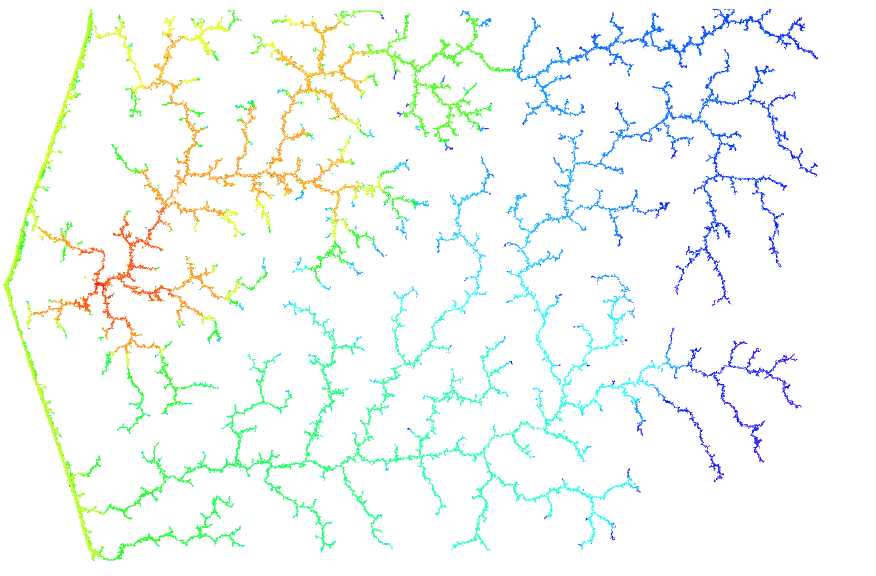
What is surprising, and even more marvelous, is when similarly complex patterns emerge almost out of nowhere, in the fractures running through an ice sheet, or glass, or—in the Complex Flow Laboratory at Swansea University—something as seemingly mundane as air in wet sand.
The winding cracks in this image were created naturally by compressed air injected into wet sand, with color denoting when they formed—red is earliest, violet is latest. Image Credit:Campbell, Ozturk, & Sandnes (2017). Physical Review Applied.
How does a system of nothing more than mud and air mirror the fractal beauty of biological life? Dr. Bjornar Sandnes and the students under his direction at Swansea have spent years figuring out how these patterns arise, injecting compressed air into narrow glass cells, tightly packed with sand and saturated with water.
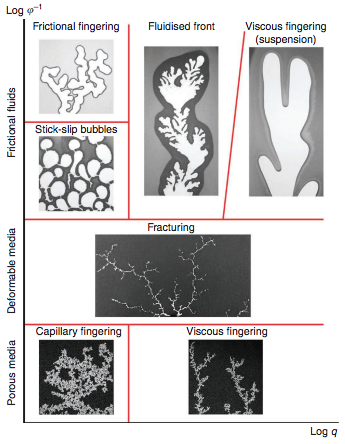
These cells create a “window” that lets the researchers study how the gas works its way through the mixture—sometimes bubbling, sometimes forming fingerlike projections, or labyrinths of cracks.
This figure, from an earlier work by Sandnes and his collaborators, shows how the gas’ behavior depends on the density of the grains (on the y-axis), and the gas injection rate (on the x-axis). Image Credit:Sandnes, et al. Nature Communications (2011).
“We study these flow patterns because they are important in many natural and industrial systems,” explains Sandnes, “but first and foremost because we are curious to discover how such beautiful structures can grow spontaneously…and what physical mechanisms shape their form and function.”
By measuring and analyzing the properties of these complex flow patterns, Sandnes and his students have developed mathematical tools to describe the interplay among forces that gives rise to these entrancingly organic-looking structures, sharing their findings near the end of last year in the American Physical Society’s journal Physical Review Applied.
“Physically, the spatial density of the patterns are so striking that it begs to be investigated,” says Deren Ozturk, a PhD student in the Complex Flow Lab. “It’s why I joined the team—non-biological natural patterns are particularly fascinating to me.”
For all their complexity, though, the principle that governs the formation of these fractures turns out to be surprisingly simple.
As air is pushed into the system, the sand’s fractures grow in a “stick-slip” fashion, spreading in short bursts interspersed with periods where nothing seems to be happening. During those “stick” periods, though, gas is still being injected, and the air pressure inside the fractures rises. When that pressure becomes great enough, it pushes aside grains of sand, expanding into the space that they had occupied—a “slip”. But the displaced grains, forced out into the surrounding bulk, create a denser region surrounding the newly formed fracture. In that region around the fracture, called a compaction front, the extra-dense packing of the sand makes it harder for the air to create a new inroad.
When the gas manages to spread out, it tends to follow the path of least resistance, pushing aside the least-densely-packed grains to sprout a new branch of the fracture from an existing one. As a result, the compaction fronts around existing fractures create a sort of shield that causes new branches to shy away from them, to spread out into their own space instead. Since following the path of least resistance means giving other fractures a wide berth, the result is a design that naturally strikes a balance between spreading out and filling the space efficiently—a little like the branches of a tree.
If you’re a science enthusiast, you might feel a sense of déjà vu watching the fractures spread through the cell in that video—it looks a lot like a stop-motion version of a Lichtenberg figure being etched into wood, as high-voltage electricity tries to find a path to ground.
Made by applying a conductive solution to the surface of the wood, then applying an extremely high voltage, Lichtenberg figures are as dangerous to create as they are beautiful.
This similarity isn’t a coincidence—the burnt wood in a Lichtenberg figure forms a conductive channel for electrons, allowing them to flow easily into that space the same way that air flows into the fractures. But the high concentration of charge in those established channels pushes away the charges in neighboring ones, causing them to spread out from one another.
The rule also applies in air, as seen in this ultra-slow-motion shot of lightning finding its way to ground.
It’s the same story as the sand’s compaction fronts, only with voltage rather than mechanical pressure. It’s no surprise, then, that voltage in wires is commonly described as being closely analogous to fluid pressure in pipes, in the “hydraulic analogy” of electricity.
worldwide map of systems thinking learning opportunities
https://www.google.com/maps/d/viewer?mid=1KiZfEQGwEaAsOiEBjTdPN9LC5Pk&hl=en_US&ll=47.71313449732236%2C-119.22949348028959&z=4
Please send updates to Nick Ananin at nick.online@foresters.org
Open University system thinking courses – one ‘gold standard’ (I think) and very accessible.
There is a FREE course at http://www.open.edu/openlearn/science-maths-technology/mastering-systems-thinking-practice/content-section-overview?active-tab=description-tab
more free courses at the OU:
http://www.open.edu/openlearn/science-maths-technology/engineering-technology/systems-thinking-free-courses
And the full courses are:
https://www.open.ac.uk/choose/ou/systemsthinking





















You must be logged in to post a comment.