The design of a complex regulator often includes the making of a model of the system to be regulated. The making of such a model has hitherto been regarded as optional, as merely one of many possible ways.
In this paper a theorem is presented which shows, under very broad conditions, that any regulator that is maximally both successful and simple must be isomorphic with the system being regulated. (The exact assumptions are given.) Making a model is thus necessary.
This may be the most misleading title and summary I have ever seen on a math paper. If by “making a model” one means the sort of thing people usually do when model-making – i.e. reconstruct a system’s variables/parameters/structure from some information about them – then Conant & Ashby’s claim is simply false.
What they actually prove is that every regulator which is optimal and contains no unnecessary noise is equivalent to a regulator which first reconstructs the variable-values of the system it’s controlling, then chooses its output as a function of those values (ignoring the original inputs). This does not mean that every such regulator actually reconstructs the variable-values internally. And Ashby & Conant’s proof has several shortcomings even for this more modest claim.
This post presents a modification of the Good Regulator Theorem, and provides a reasonably-general condition under which any optimal minimal regulator must actually construct a model of the controlled system internally. The key idea is conceptually similar to some of the pieces from Risks From Learned Optimization. Basically: an information bottleneck can force the use of a model, in much the same way that an information bottleneck can force the use of a mesa-optimizer. Along the way, we’ll also review the original Good Regulator Theorem and a few minor variants which fix some other problems with the original theorem.
Wonder what makes a Search Conference so different from the seemingly similar Future Search? The latter claims to extend the former, but have left out core parts to make it suit a terrible individualiatic and non-systemic thinking. Here’s a comparison by M Emery.#OpenSystems
Wonder what makes a Search Conference so different from the seemingly similar Future Search? The latter claims to extend the former, but have left out core parts to make it suit a terrible individualiatic and non-systemic thinking. Here's a comparison by M Emery.#OpenSystemspic.twitter.com/QAKiJrJPx9
It was only after enquiring with Trond about the technical language that I realised what an advocate for STS he has been (along of course with Merrelyn Emery herself), particularly in the IT/Agile space.
Also the evolving six important psychological criteria for job satisfaction, on Twitter
They where identified in the 60s and have been tuned to the six presenterd here. We can start off by naming them: 1. Elbow Room 2. Continual Learning 3. Variety 4. Mutual Support and Respect 5. Meaningfulness 6. Desirable Future Their original form: https://t.co/wGT9U9Fe0y
Frontiers in Complex Systems publishes rigorously peer-reviewed quantitative research on Complex Systems, either theoretical, experimental, mathematical, computational or data description. Field Chief Editor Maxi San Miguel at the Institute for Cross-Disciplinary Physics and Complex Systems (IFISC) in Spain is supported by an outstanding Editorial Board of international experts. This open-access journal is to become the reference and natural publication outlet for the Complex Systems community at large, and to be at the forefront of disseminating and communicating scientific knowledge and technological innovation in the field to researchers, academics, entrepreneurs, companies, policy makers and the public worldwide.
Frontiers in Complex Systems covers fundamental questions, theories and general methodologies on complex systems as well as the cross-disciplinary application of these concepts and methods, often giving rise to new disciplines. It provides a forum for cross-disciplinary communication and welcomes quantitative research from different fields including Physics, Mathematics, Computer Sciences, Artificial Intelligence, Engineering, Climate…
Toward a Critical Technical Practice: Lessons Learned in Trying to Reform AI
Philip E. Agre Department of Information Studies University of California, Los Angeles Los Angeles, California 90095-1520pagre@ucla.edu http://polaris.gseis.ucla.edu/pagre/This is a chapter in Geof Bowker, Les Gasser, Leigh Star, and Bill Turner, eds, Bridging the Great Divide: Social Science, Technical Systems, and Cooperative Work, Erlbaum, 1997.
The Nondesignability of Living Systems: A Lesson from the Failed Experiments in Socialist CountriesJixuan HuCato Journal, 1991, vol. 11, issue 1, 27-46
[NB first I’ve heard of this, and very fiddly to sign up – not sure if I succeeded but if I did it was apparently as a delegate from Beijing Planetarium?]
Beijing and Online, February 21-24, 2023Register
The 2023 SESC-IFSR Systems Thinking Symposium aims to discuss and explore systemic impacts arising from the pandemic and explore how they are handled by drawing upon diverse, multiple, and systemic perspectives. Systemic impacts of the pandemic within crisis management, digital economy, education, industrial supply chains and trade, life and health, scientific development and technological innovation, and societal governance, will be explored. The Symposium is expected to illustrate both the multi-disciplinary approach as well as systems thinking perspectives toward the COVID-19 pandemic and to facilitate dialogue among different systems modelers, practitioners and thinkers, for the purpose of aggregating knowledge and insights for future change and improvements in complex and chaotic decision-making contexts.
The Systems Engineering Society of China (SESC) is joined by the International Federation for Systems Research (IFSR) to organize the Symposium, which will be held by online-offline hybrid mode. Worldwide influential scholars will be invited to give keynotes on Systemic impacts of the pandemic in the perspectives of diverse systems. Considering the time difference, all keynotes talk will be arranged in the afternoon or evening of Beijing Time for convenient participation during February 21-24, 2023.
SysThink2023 welcomes abstracts relevant to the theme of the Symposium, especially to above mentioned systems. Please submit your abstract with 200~400 words of systems impacts of the Covid-19 towards crisis management, digital economy, education, industrial supply chains and trade, life and health, scientific development and technological innovation, societal governance, etc. If specific sessions are planned to be organizied, please directly send proposal by email.
To celebrate our 10th anniversary, we’re excited to share a lecture from SFI President David Krakauer sectioning the concept of complexity and exploring complexity epistemology and emergence. https://www.complexityexplorer.org/co…
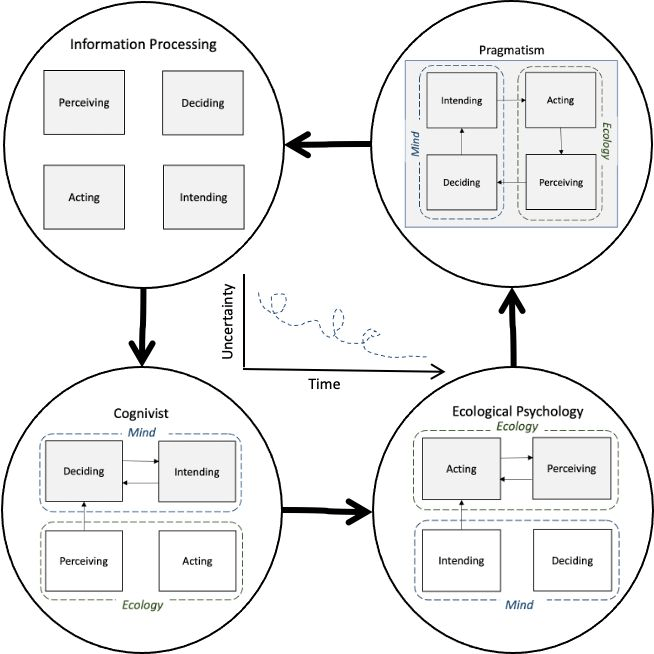
Four approaches to parsing a cognitive system. Classically, the information processing approach has parsed the cognitive system into a series of independent stages; others have focused on cognition as a computational system (computer, neural net) but have tended to diminish the components involved in perception and action; ecological psychologists have reacted by emphasizing perception and action – sometimes to the exclusion of computations. However…


 Systems Community of Inquiry
You must be logged in to post a comment.