The Words We Use Can Change Our Reality – Shifting to a Systems View
This morning I spoke to a highly accomplished, bi-lingual woman who works in software. We agreed that the words we use when we work can have an enormous impact. For example, in her environment, the word “project” has acquired a stigma because of the pain associated with it so now she talks about “initiatives”. This small changed has helped.
The fact is that we create our reality through language. The words we use express and reinforce our mental models. They reflect a culture and a worldview.
When we want to introduce change it’s important to support the effort with the words that will encourage new behaviours. At Intelligent Management we help organizations introduce and adopt a systems view so they can improve and accelerate all the flow, from the input of suppliers and the market all the way through to their products and services and the feedback they receive from customers for continuous improvement and innovation. Working with a systems view means having the words that help you to do that.
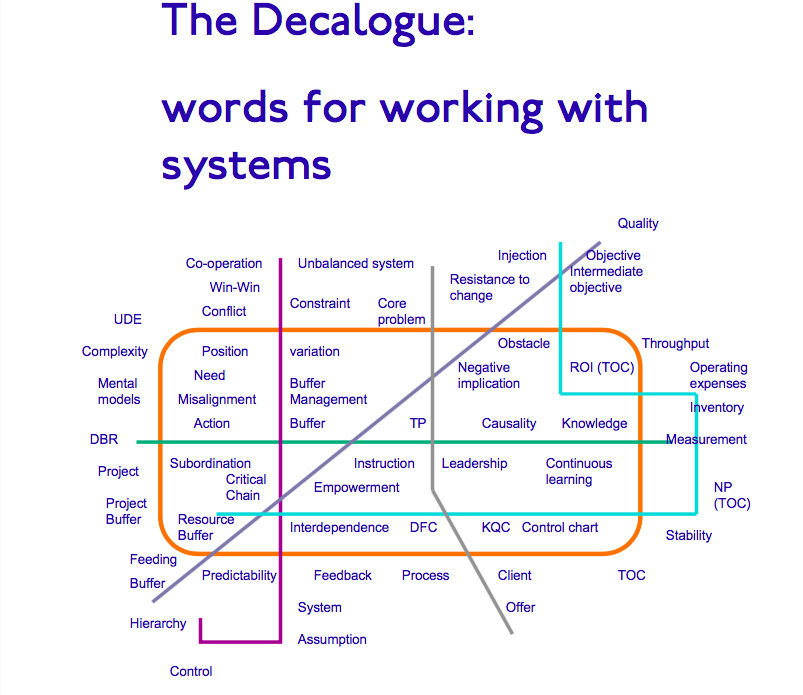
To sum up the key terms that indicate how we can work within and on systems and the field of knowledge required, we produced a word map to accompany our glossary for ‘The Decalogue’ methodology that encompasses the approaches of W. Edwards Deming and the Theory of Constraints. That was a few years ago. It’s time to add a new “line” to the map; since we produced it we have continued to evolve ‘The Decalogue’ and true to our scientific origins, we have looked to science for our basis. Here we look at some new terms to add to our word map.
Working with a systems view: Complexity, networks, emergence
Nature is not homogenous. Most of the universe is complex and composed of various subsystems — self-contained systems within a larger whole. Microscopic cells and their surroundings, for example, can be divided into many different subsystems: the ribosome, the cell wall, and the intracellular medium surrounding the cell.
The Second Law of Thermodynamics tells us that the average entropy of a closed system in contact with a heat bath — roughly speaking, its “disorder”— always increases over time. Puddles never refreeze back into the compact shape of an ice cube and eggs never unbreak themselves. But the Second Law doesn’t say anything about what happens if the closed system is instead composed of interacting subsystems.
New research by SFI Professor David Wolpert published in the New Journal of Physics considers how a set of interacting subsystems affects the second law for that system.
“Many systems can be viewed as though they were subsystems. So what? Why actually analyze them as such, rather than as just one overall monolithic system, which we already have the results for,” Wolpert asks rhetorically.
The reason, he says, is that if you consider something as many interacting subsystems, you arrive at a “stronger version of the second law,” which has a nonzero lower bound for entropy production that results from the way the subsystems are connected. In other words, systems made up of interacting subsystems have a higher floor for entropy production than a single, uniform system.
All entropy that is produced is heat that needs to be dissipated, and so is energy that needs to be consumed. So a better understanding of how subsystem networks affect entropy production could be very important for understanding the energetics of complex systems, such as cells or organisms or even machinery
Wolpert’s work builds off another of his recent papers which also investigated the thermodynamics of subsystems. In both cases, Wolpert uses graphical tools for describing interacting subsystems.
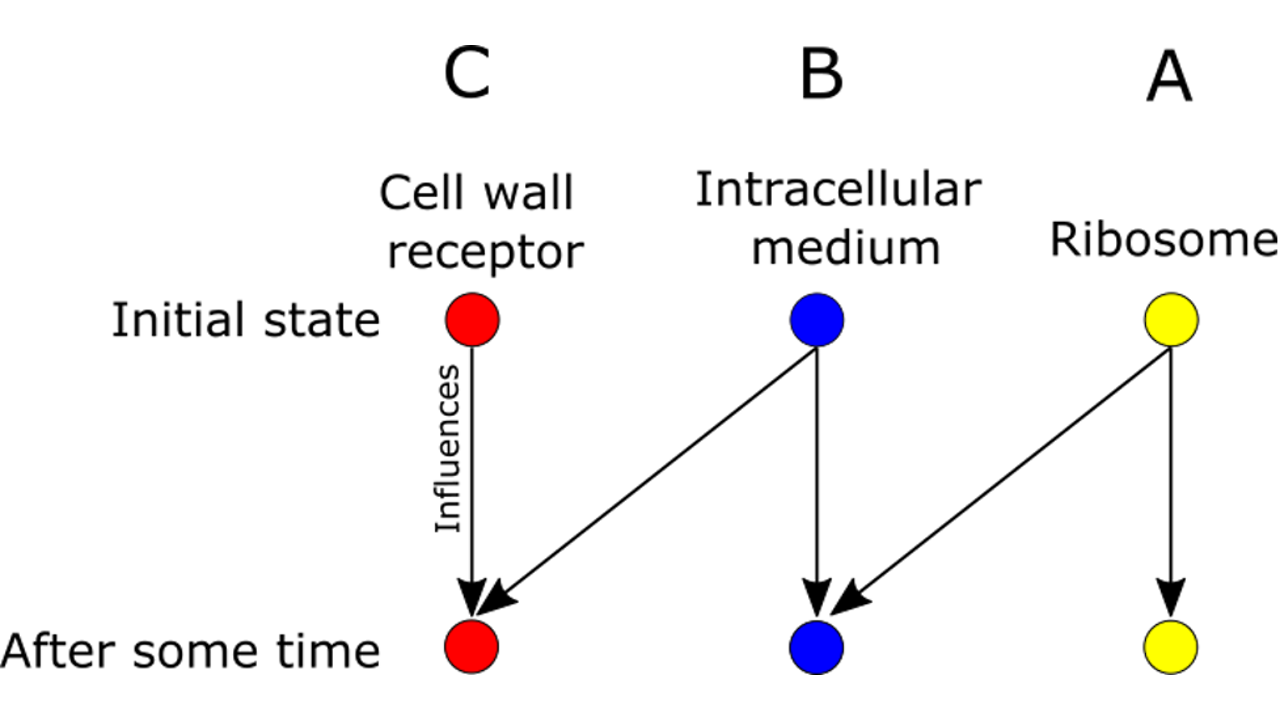
For example, the following figure shows the probabilistic connections between three subsystems — the ribosome, cell wall, and intracellular medium.
Like a little factory, the ribosome produces proteins that exit the cell and enter the intracellular medium. Receptors on the cell wall can detect proteins in the intracellular medium. The ribosome directly influences the intracellular medium but only indirectly influences the cell wall receptors. Somewhat more mathematically: A affects B and B affects C, but A doesn’t directly affect C.
Why would such a subsystem network have consequences for entropy production?
“Those restrictions — in and of themselves — result in a strengthened version of the second law where you know that the entropy has to be growing faster than would be the case without those restrictions,” Wolpert says.
A must use B as an intermediary, so it is restricted from acting directly on C. That restriction is what leads to a higher floor on entropy production.
Plenty of questions remain. The current result doesn’t consider the strength of the connections between A, B, and C — only whether they exist. Nor does it tell us what happens when new subsystems with certain dependencies are added to the network. To answer these and more, Wolpert is working with collaborators around the world to investigate subsystems and entropy production. “These results are only preliminary,” he says.
Many systems are composed of multiple, interacting subsystems, where the dynamics of each subsystem only depends on the states of a subset of the other subsystems, rather than on all of them. I analyze how such constraints on the dependencies of each subsystem’s dynamics affects the thermodynamics of the overall, composite system. Specifically, I derive a strictly nonzero lower bound on the minimal achievable entropy production rate of the overall system in terms of these constraints. The bound is based on constructing counterfactual rate matrices, in which some subsystems are held fixed while the others are allowed to evolve. This bound is related to the ‘learning rate’ of stationary bipartite systems, and more generally to the ‘information flow’ in bipartite systems. It can be viewed as a strengthened form of the second law, applicable whenever there are constraints on which subsystem within an overall system can directly affect which other subsystem.
The challenges facing public services and non-profit organizations are complex and multi-faceted, confounding the orthodoxies of bureaucratic public administration and New Public Management approaches. This article discusses the merits and potential of the emerging ‘Human Learning Systems’ (HLS) approach to the funding, commissioning and management of public services as an alternative management logic. Building on prior introductory work, the authors analyse the current state of development, content and operation of HLS and its collaborative process, involving more than 300 organizations. Drawing on the experience of public and non-profit service professionals in adopting and experimenting with this approach, the authors found that HLS can provide a helpful and innovative conceptual frame to promote constructive engagement with complexity in public management theory and practice.
IMPACT
Current approaches to public management based on principles of marketization, management and measurement are increasingly being seen to fail when faced with the complex world of public services. The Human Learning Systems (HLS) concept represents an alternative approach which embraces the complexity of the real world of organizations working to deliver services. Produced in collaboration with an emerging community of funders, managers and commissioners of services, HLS offers a framework which bridges academic complexity theory and the diverse contexts of practice. This article introduces HLS as a means to enable organizations, practitioners and service users to work together more effectively.
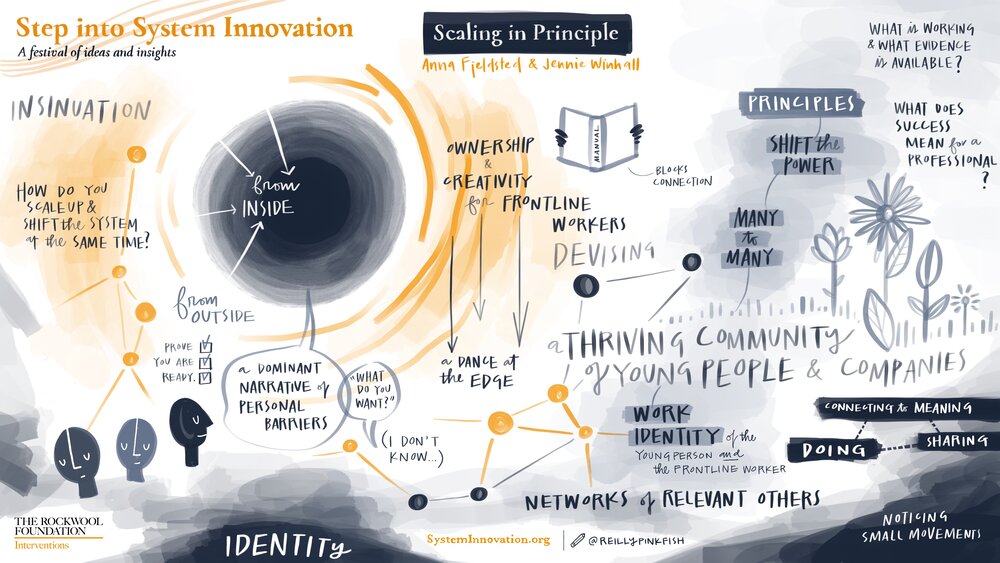
Anna Fjeldsted begins tackling challenges in a brilliant way, “well I don’t know how we could do that, but I’d really like to take the risk.” This was the premise with which Jennie Winhall opened our fascinating discussion, as she introduced her colleague Anna and began diving into the complexities of how to scale solutions, while ensuring those solutions stay true to their core purpose. Read More
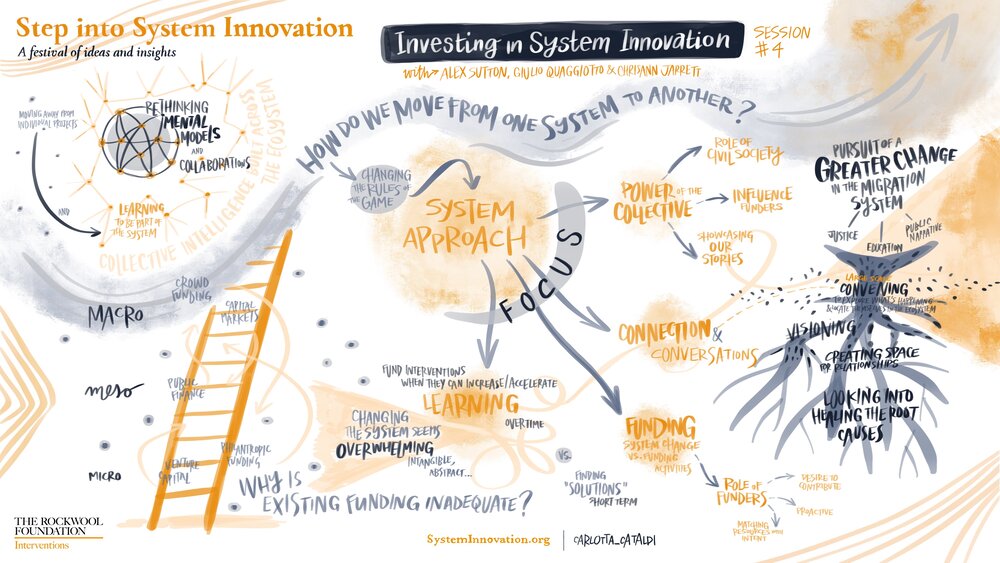
Chrisann Jarrett, Alex Sutton and Guilio Quaggiotto provided us with a thought-provoking snapshot of the funding side of the equation to Systems Innovation. As far-sighted funders themselves, both Guilio and Alex showed us why it’s essential we invest in continuous learning, experimentation and collaboration, rather than single-point solutions.Read More
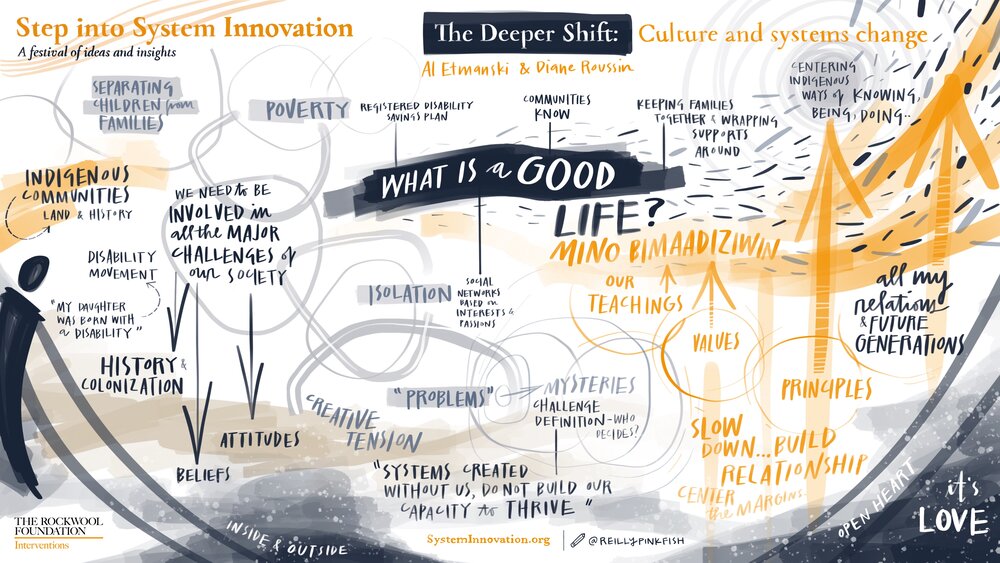
As Immy Kadeep wonderfully put it, there is a “beautiful dance” that must be learned as we interact both with the current system and operate outside of it, while also acknowledging wisdoms, histories, truths, marginalised communities and future generations. Immy, and I think all of us, can see this dance being performed with finesse by both Al Etmanski and Diane Roussin, who successfully navigate through systems while also working to radically change the values, principles and mindsets that those systems were built on. Read More
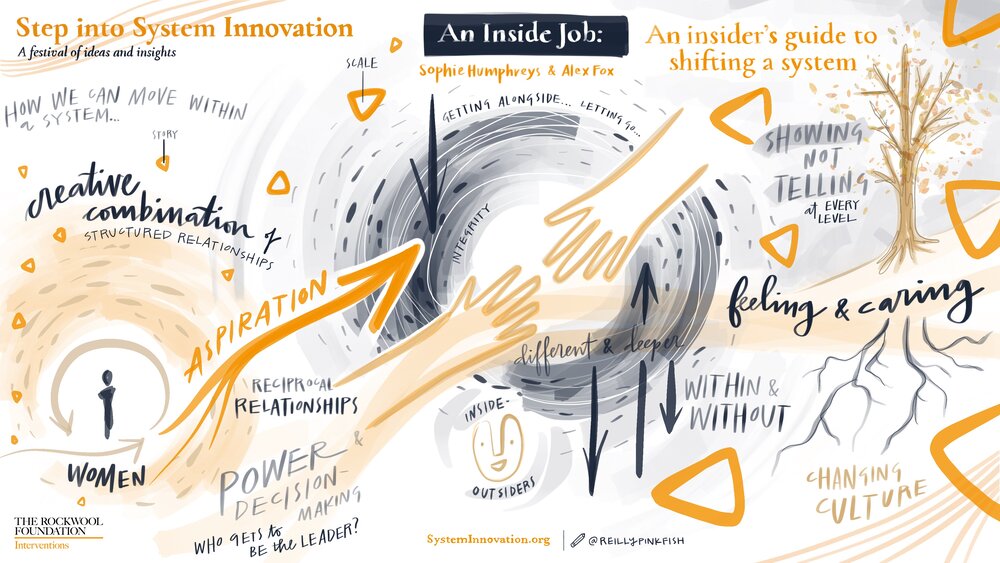
Caring is self-realisation brought about through the growth of others. That is how Milton Mayeroff defines care in his classic account On Caring. Mayeroff’s definition of care came back to me after spending more than an hour in conversation yesterday with Sophie Humphreys and Alex Fox. Our discussion highlighted a distinction central to our work at the Rockwool Foundation on systems innovation: scaling an innovation is not the same as shifting a system.Read More
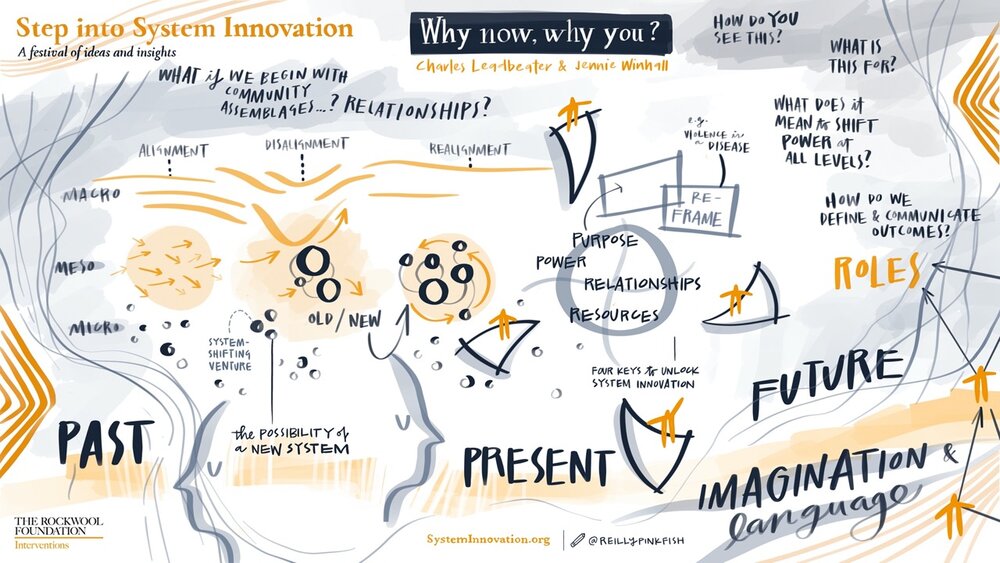
Donnella Meadows, the doyenne of systems thinking, famously said that shifting purpose is the most powerful lever to transform a system. Yesterday, in the opening session of our Systems Innovation Festival, Jennie Winhall guided us through an explanation of the four keys to unlock system change: power, purpose, relationships and resources. We then asked the hundreds of participants for their view, and the majority said that the most important way into systems innovation was through relationships. These were the full results…Read More
This is a compilation of resources for people interested in exploring the Human Learning Systems approach to leading, funding and managing all forms of social intervention and public service.
The Human Learning Systems approach starts with the belief that public service exists to create the conditions which enable each person to create good outcomes in their lives. To do this, we believe that public service must embrace the complex reality of the 21st Century world.1.00
We believe that…Thinking in systems – understanding things as connected and interdependent – leads to better outcomes for all.READ MORE
We believe that…Focusing on the relationships between people creates better ways of working and better places to work.READ MORE
We believe that…Prioritising learning together over deliverology creates the safe space for innovation and lasting improvement.READ MORE
We believe that…Thinking in systems – understanding things as connected and interdependent – leads to better outcomes for all.READ MORE
We believe that…Focusing on the relationships between people creates better ways of working and better places to work.READ MORE
FIND THE PIONEERS
“Human Learning Systems is the most insightful and helpful work that I have come across. It challenges stale approaches of top down and provider centred services and encourages us to work with people – listening to them and understanding what matters to them – acting with authenticity and integrity and working together.”KEN JARROLD CBE DIRECTOR @ OTHER PEOPLES SHOES LTD
“Outstanding new report: A “must read” for those interested in the delivery of large-scale change.”HELEN BEVAN CHIEF TRANSFORMATION OFFICER @ NHS HORIZONS
“It’s unquestionably a better way to do business.”GARY WALLACE COMMISSIONER @ PLYMOUTH COUNCIL AND CCG
EVENTS & RESOURCES
We are continuously updating our event listings and resource library.
Come here for easy access to the latest and greatest from the world of Human Learning Systems.
My dad emigrated from Colombia to North America when he was 18 looking looking for a better life. For my brother and I that meant a lot of standing outside in the cold. My dad’s preferred method of improving his lot was improving lots, and my brother and I were “voluntarily” recruited to help working on the buildings we owned.
That’s how I came to spend a substantial part of my teenage years replacing fences, digging trenches, and building flooring and sheds. And if there’s one thing I’ve learned from all this building, it’s that reality has a surprising amount of detail.
Prof Andrew Pickering is an emeritus professor of philosophy and sociology and a Fellow of the Cybernetics Society. In the 50th Annual Conference of the Cybernetics Society he spoke of BRITISH CYBERNETICS AS A NONMODERN PARADIGM. In doing so he gives a history of various accomplishments in alternative robotics, art, psychology, architecture and social affairs and the way these reflect another way of thinking. He argues for the “ontology” of cybernetics and not just the “epistemology” — describing some ways in which the early explorers put it into active practice. He argues it has potential to solve world problems.
The hippocampal-entorhinal system is important for spatial and relational memory tasks. We formally link these domains, provide a mechanistic understanding of the hippocampal role in generalization, and offer unifying principles underlying many entorhinal and hippocampal cell types. We propose medial entorhinal cells form a basis describing structural knowledge, and hippocampal cells link this basis with sensory representations. Adopting these principles, we introduce the Tolman-Eichenbaum machine (TEM). After learning, TEM entorhinal cells display diverse properties resembling apparently bespoke spatial responses, such as grid, band, border, and object-vector cells. TEM hippocampal cells include place and landmark cells that remap between environments. Crucially, TEM also aligns with empirically recorded representations in complex non-spatial tasks. TEM also generates predictions that hippocampal remapping is not random as previously believed; rather, structural knowledge is preserved across environments. We confirm this structural transfer over remapping in simultaneously recorded place and grid cells.
We’re writing this blog post to continue our series on growing the community of Directors committed to collective leadership, co-creation and building cultures that support collaboration.
Leading public services has always been tough — we have to tackle complex societal issues which no single organisation can face alone, especially during these times. As public sector leaders, Directors are at the forefront of this, wrestling with the systemic and interrelated nature of many issues.
We had our fourteenth breakfast call in early November, where we were joined by Alex Thomas from the Institute for Gov, who responded to the question:
How might we lead in the context of government in the 21st century?
Below is a summary of our discussions.
How might we lead in the context of government in the 21st century?
Are the current challenges we face as profound, or different to, past challenges? What are the risks and opportunities?
We have been in crises before. However, being collaborative is hard when you’re sitting in front of screens all day, every day. Our days feel the same — and we haven’t yet figured out to how collaborate in a world of virtual work. COVID-19 response initially saw us overcome bureaucratic barriers, taking more measured risks. Now, there is an increasing sense of people returning to a normative risk-aversion.
Our deeply held ideas are colliding with new ways of leading that are more distributed, relational, and interdependent. But our systems and processes are not set up for this. The challenge of balancing urgency and importance is felt most acutely right now. Without careful, intentional action, our linear, siloed approaches will keep exerting themselves.
We do not have to be a fully fledged systemic thinkers… to work systemically.
We need a different approach and thinking across the Civil Service. We exist as part of many complex systems— interconnectedness is the order of the day. As leaders and public sector professionals we sit alongside other actors, rather than above or at the centre and we need to change the relationships with have with people, communities, markets and more in order to take advantage of diversity of experience in order to solve the biggest problems.
Perhaps we need to take a less transactional, more relational approach, and build genuine connection and relationships?
How are you and the teams you lead feeling, from a personal and leadership perspective? How can we lead ourselves and our teams?
The mix of COVID-19 and business as usual has been a difficult juggling act — a balancing of urgency and importance. The things that directly affect us are sometimes out of our control. It can sometimes feel impossible to join up across the existing siloes, which is frustrating. We see areas getting narrower, more cautious, and not working across government. Despite this, there seems to be an increased appetite to be more adaptive within our teams. We must build across boundaries, draw on local expertise, and work with outside partners when moving forward.
COVID-19 has been catalyst for an enhanced focus on wellbeing, both ourselves and people we work for, not just as another ‘task’ on the to-do list. What we are asking people to do is really, really difficult. We are seeing a 24/7 culture, where people are on call all the time as a result of prolonged working from home, become increasingly normalised. Things are tougher in the world of virtual work; we are in danger in being on the hamster wheel and not getting off it. It is a cause for concern.
The teams we lead are feeling burned out. They haven’t had enough time off, and may have worked long hours over long periods, sustaining the response effort alongside their public sector colleagues.
The levels of underlying anxiety are much higher now. People have worries they carry with them, not just their work, but also their families, communities, sickness, and increasingly visible inequality — amongst many other things.
This, coupled with high levels of vacancies and redeployment of staff, has resulted in people having high workloads. What can we do about this? We must role model taking a more intentional approach to leadership — starting with taking time off ourselves, checking-in with our teams, being open about how we feel, and making space for informal discussions.
Reflection
This space gives us the time and space to think about the things that are on our minds. We must be open, brave, and bold in how we approach leading ourselves and our teams. However, moving to a different approach requires curiosity, courage, and passion — and we all can play a role in this shift.
MOL can be used to enhance the effectiveness of treatments for specific problems and mental disorders, and also to address issues in the delivery of treatment such as lack of engagement, poor motivation, and resistance.
https://www.methodoflevels.com.au/what-is-mol/
What Sort of Therapy is MOL?
MOL is a flexible and powerfully effective and efficient transdiagnostic cognitive therapy. MOL engages each person’s internal resources to promote their own recovery in an enduring and generative way. The starting point for MOL is the subjective experience of the individual and, by assisting people to expand their awareness and increase the interconnectedness of their internal worlds, they are able to make different sense of their difficulties and forge new and more contented lives. By providing treatment from the individual’s perspective. As a transdiagnostic therapeutic approach MOL is well suited to complex cases as well as addressing some of the more difficult problems in therapy such as noncompliance, lack of engagement, and poor motivation.
Using MOL
MOL has been used in the UK and Australia in primary care, secondary care, and private practice with good results. MOL focusses on the distress underlying symptom presentations rather than the symptoms themselves so, instead of helping people overcome symptoms, MOL helps people understand and resolve psychological distress.
The Theory Behind MOL
MOL is based on an understanding that the neurocircuitry of the brain is organised according to control system architecture. This architecture is described in a theory called Perceptual Control Theory (PCT). PCT suggests that these hierarchically arranged negative feedback loops ensure that the world is experienced as the individual intends it to be. Control is fundamental to satisfactory and contented day-to-day living. People experience psychological distress when their neural control systems work in opposition to each other. One control system might try to create a sense of safety, for example, while another is striving for excitement and risk. Or one control system might seek social approval at the same time that another is pushing for autonomy and independence.
MOL Therapists
MOL therapists recognise that they can’t ever really “walk a mile” in another person’s shoes so they don’t even try. Instead, they spend all of their time helping the other person examine in detail the shoes they are wearing, and finding out about the miles the person would like to walk in them. How do they fit? Do they have the right shoes for the job? Where do they plan to walk? What might be up ahead? MOL therapists understand that, fundamentally, people get themselves better when they are psychologically distressed and they work hard at being therapeutically useful by facilitating the “getting better process”.
This paper provides a basic introduction to using method of levels (MOL) therapy with people experiencing psychosis. As MOL is a direct application of perceptual control theory (PCT), a brief overview of the three main theoretical principles of this theory—control, conflict, and reorganization will be outlined in relation to understanding psychosis. In particular, how these principles form the basis of problem conceptualisation and determine what an MOL therapist is required to do during therapy will be illustrated. A practical description of MOL will be given, using case examples and short excerpts of therapeutic interactions. Some direct contrasts will also be made with cognitive behaviour therapy for psychosis (CBTp) and psychodynamic approaches (PA) in order to help illustrate the theory and practice of MOL.
Scientists are working across disciplines to render complex reality to scientific understanding.
It has been the great triumph of the sciences to find consistent means of studying phenomena hidden by both space and time, overcoming the limits of cognition and material culture. To hide in space means that phenomena lie beyond the scope of our everyday senses because they are either too small or too distant to be detected without amplification. Things can be hidden in time by being too fast for us to perceive or too slow for a single lifetime to encompass.
The scientific method is the portmanteau of instruments, formalisms, and experimental practices that succeed in discovering basic mechanisms despite the limitations of individual intelligence.
There are, however, on this planet, phenomena that are hidden in plain sight. These are the phenomena that we study as complex systems: the convoluted exhibitions of the adaptive world — from cells to societies. Examples of these complex systems include cities, economies, civilizations, the nervous system, the Internet, and ecosystems.
Paradoxically, the complex world is one that we can, in many senses, perceive and measure directly. Unlike distant stars or nearby minerals that require a significant increase in optical capability to arrive at insights into their elementary properties, behavior — both individual and collective — seems to present itself in ways that can be investigated rather modestly through observation or experiment.
But the way in which complex phenomena are hidden, beyond masking by space and time, is through nonlinearity, randomness, collective dynamics, hierarchy, and emergence — a deck of attributes that have proved ill-suited to our intuitive and augmented abilities to grasp and to comprehend.
Over the course of thirty-five years, the Santa Fe Institute has been looking into this proximal, near-invisible reality, working in highly diverse, nondisciplinary teams to invent new concepts to render up complex reality to science; searching for order in the complexity of evolving worlds.
THE Singapore Institute of Management (SIM) has launched a Centre for Systems Leadership to train youths, professionals and organisational leaders to lead more successfully through systems thinking.
The centre, to be located in the existing SIM Management House in Namly Avenue, will run an 18-day programme for working professionals, spread over six months. It will also offer bespoke programmes, tailored for leadership teams in organisations and enterprises.
This is in addition to the 30-hour programmes it will run for youth leaders and final-year undergraduates from February. The centre is also planning its first systems leadership conference that same month.
Learning programmes will be run on-site. However, the centre is also working with collaborators to roll out online options from the first quarter of next year, said Seah Chin Siong, SIM’s president and chief executive.
Josephine Teo, Minister for Manpower and Second Minister for Home Affairs, officiated at the centre’s launch event on Thursday evening.
She said: “The more complex our problems, the more leaders need the skills and discipline of systems thinking.” She added that the new centre can help to build capacity in Singapore to emerge stronger from the Covid-19 pandemic, and to develop resilience against future disruptions.
Systems thinking and leadership gained prominence in the 90s as a way of approaching issues and problem statements holistically, as part of interconnected systems and not disparate parts. Dr Peter Senge, an American systems scientist, is credited for popularising the concept as a management strategy.
SIM’s Mr Seah told The Business Times: “The pandemic has shown people across the world the stark reality of how life can become when existing systems and structures, which we take for granted, no longer function properly.
“In a post Covid world, leaders and organisations will have to strive to better understand the complexities and inter-connectedness underlying the systemic structures which we have built over the years.”
He added that systems thinking has helped organisations and companies overcome disruptions brought about by market shifts, new technologies and low-cost startups. He cited Barnes & Noble as an example of a company that used systems thinking to reinvent their business model; others, like Kodak, failed to comprehend how changes in the industry’s ecosystem would eventually undermine their own innovation efforts
In this Global Strike for Our Future initiative , the organizers (Fridays For Future and Earth Strike from Lucca) propose a reflection on the link between the Coronavirus crisis and the ecological crisis. The point is essential: as fact discuss or to t the beginning of the pandemic of This Magazine, the spread of the virus and its many ramifications are essentially part of a deep crisis in the relationship between us and the nature of which we are a part. Many contribut e stud i have since been published and we can take a cue from these, other jobs, and the most recent events to reflect on the kind of bonds that we are often tempted not to try to understand and recognize.








You must be logged in to post a comment.