Recent Updates Page 285

u/arimeffie on reddit: I made a flow chart to figure out what world map projection you are looking at
Brilliant example of the importance of perspective and framing (and the inevitability of modelling and situated rationality – good #systemsthinking points

via I made a flow chart to figure out what world map projection you are looking at : Maps
Skoll | SIGNAL: Fostering the Emergence of System Leadership Worldwide – online 4:00-5:30pm BST, April 1, 2020
via Skoll | SIGNAL: Fostering the Emergence of System Leadership Worldwide
SESSION DESCRIPTION
In this informative and interactive virtual session, you’ll learn about SIGNAL, a global initiative to foster the system leadership needed to address the toughest challenges faced by our communities, countries, and society.
A uniquely diverse and collaborative research initiative, SIGNAL is designed to understand the real needs of people leading systemic change around the world AND build a powerful system of learning and support to foster their success. Speakers from Forum for the Future, Ashoka, Mastercard Foundation, Catalyst 2030, Garfield Foundation, Vibrancy Network, Social Innovation Canada, and CoCreative will share why they’re contributing to SIGNAL and why they’re investing in building system leadership.
During the session, you’ll learn about SIGNAL’s research objectives, hear some of the early insights from the research so far, discover our plan for collaboratively expanding SIGNAL research across countries and regions, and join a conversation about how SIGNAL research can be leveraged to build a powerful ecosystem of learning and support to foster systems leadership.
Join us as we leverage interactive polling technology to engage in a creative and dynamic discussion to explore system leadership, expand insights into what the field needs, and think together how we might more deeply collaborate to expand the new leadership that the world sorely needs.
TIME & LOCATION
HOST & RSVP
From an isolated laboratory to a world where “context is everything” | Marco Valente on LinkedIn
via From an isolated laboratory to a world where “context is everything” | LinkedIn

From an isolated laboratory to a world where “context is everything”

Marco Valente
Support for Decision-Making | Facilitator | Strategic Sustainability Consultant |Founder of Plecter
Why is it so difficult to replicate stories of success?
Why is it so difficult to “scale” good solutions when we find them?
Why there are no simple recipes for solving today’s biggest challenges?
You might have indulged in questions of this kind before. Why when something goes really well in one situation, it is so hard to apply the learning points from that solution in another context / domain / in another country’s offices? And yet we see that a lot of time when we ask this kind of questions, the answers are either a seemingly vague “It depends” which sounds reasonable to some and frustrates others; or a well-meaning “Of course it will work here too” which will fail the moment this assumption exits the realm of textbooks and nice-looking theories and meets the real world.
In this blog post I explore our temptation for “rollout strategies”; then we will take a look at a complexity framework to understand the role of context in different situations; we will see the journey that context has travelled through over the last decades; and how this could have very practical consequences in our work when we deal with complex situations like environmental sustainability, climate change, aid and development.
Let’s start from where this is all too familiar.
The need to “scale up” good solutions is evident (see climate crisis) and the temptation for quick wins and highly replicable solutions is strong in us. Institutions around us are geared to reward this potential to ‘scale things up’, be it an accelerator for start up’s (first question they asked to my consultancy: “how will you scale your product?”) a government grant (“could this be replicated and positively impact more people?”) or aid money (“let’s roll out this new technology in other countries”). Now, the temptation is for a linear pathway made of: testing out something -> looking for what works -> identifying a recipe of sorts -> do a big roll-out implementation. Progress is achieved, the world is changed, we are all happy. This is fine in situations where replication is easy -except that in the most complex scenarios we have to forgo this hope that a copy-paste approach to roll-out solutions be a viable option.
The whole notion of scale implies ‘standardization’ and comes from the idea that you do a replica of your successful project elsewhere. The trick with a standardization is that it minimizes (or better say: bypasses) the importance of context. We get excited about scaling an idea that works: it becomes a trend on twitter and makes the headlines and we all get excited around flashy headlines of the type
“this [new technical solution] could end [systemic problem] in [developing country we are addicted to mention]!”.
Other than some obvious considerations like the lack of a systemic approach to the challenge, at times ignoring the context could be the most troubling of all blunders. This “theory of action” usually works well in a mechanical/technical system, where the level of adaptation to a local context is minimal. The reality though is that when we apply a solution to a rich, complex human system, context becomes everything and the solution we devise needs to be emergent: an answer that is so context-specific that will only work in that context, with at best the possibility to teach us something about a blue-print for actions in other context, but that can never give us a manual with the inspiring headline “here is how you can initiate change in your community!”
Continues in source: From an isolated laboratory to a world where “context is everything” | LinkedIn
Mastering the dance – Systems thinking
via Mastering the dance – Systems thinking
Mastering the dance

Last autumn, I was part of a small team of volunteers from the Department for Education (DfE), HMRC and the Department for International Development (DfID) who spent some time working with the Systems Unit in the Cabinet Office.
We wanted to explore what systems leadership meant.
If you’d asked me before we started what I thought a system leader was, I would have said someone who took a more ‘elevated’ view than a traditional leader, someone able to see further and wider. Someone able to work more effectively across a wider landscape.
I came to find that while those are features of systems leadership, they’re not the most interesting features. Nor are they what truly differentiate it from other forms of leadership.
In this post, I’ll share what we found out about systems leadership – from humility to ‘mastering the dance.’ Yes. It surprised me too.
Systems leadership: in theory
Advocates of systems leadership see it as the only viable response to so-called ‘wicked’ problems – those that are complex, messy and longstanding. They don’t fit neatly into a single organisation’s remit. They need cross-cutting action.
Some examples include tackling obesity, reducing violent crime, giving children the best possible start in life, levelling up the economy, and tackling climate change. There are lots of smaller examples too. The issues are different in every case, but they share one thing in common – solutions will only be found if we recognise that we are dealing with complex systems.
We talked to experienced systems leaders and observed one of the System Unit’s pilot programmes. We reviewed literature about systems leadership. Others have been exploring systems approaches for a while. There are lots of great case studies already out there, and we tapped into those.
We liked this particular definition of systems leadership: ‘the collaborative leadership of a network of people in different places and at different levels in the system creating a shared endeavour and cooperating to make a significant change.’
It captured important elements of systems: that it looks wider than usual so that every part of the system is identified and involved. Geography matters, not least because local factors often influence ‘what works’ in a system. Hierarchy isn’t that important, it’s about getting the right people involved. It’s also about outcomes, a positive result for the citizen.
…and in practice
Although the definition appears to be straightforward, there are significant barriers to being a systems leader.
Firstly, there are strong incentives to operate with a silo mentality.
Secondly, the “day job” gets in the way and so there’s just a lot to do and little time to think in a systems way, let alone think about systems leadership. I know the Systems Unit would argue this doesn’t have to be the case!
Additionally, it can seem this work is less important than work closer to core departmental or organisational objectives. Funding arrangements can push resources into silos.
Individuals may lack the levers of action and/or accountability. Then there is short-termism, possible tensions and misunderstandings. Even if none of the above were the case, it would still be hard work!
Overcoming the challenges of systems leadership
Systems leadership really captured our imagination when we realised it was about accepting the limits of traditional leadership reach, about being pushed into terrain that is too difficult to control.
Each leader is just one leader among many. Only through collaborating with others can anyone make progress. One early challenge is to agree on a shared goal – the ‘North Star’ to guide collective endeavour.
Simple solutions are also entirely out. You will need to test and iterate before you implement. Systems thinking tools and techniques can help here but the biggest challenge for leaders may be simply to create the space to understand the problem – going slowly at first to go fast later. Avoiding the rush to launch initiatives demands a counter cultural approach. It may never be possible to understand the system in its entirety. Hence cycles of learning and staying humble are the order of the day.
As Donella Meadows, an early systems thinker put it, systems can’t be controlled but they can be envisioned, designed and carefully brought into being. It just demands another way of doing. She called this ‘the dance’ because to dance well you have to bring your full self and respond to feedback of the other dancers and to the rhythm, much as you do when engaging with a complex system.
Experience from local government and healthcare shows systems leadership can play real dividends.
Whole systems can be moved forward where people in leadership positions:
- acknowledge the complexity of systems;
- take time to explore the problem;
- lead with others;
- iterate towards shared solutions;
- act as catalyst for change, and
- play a stewardship role over time.
From good to great
One way through all these challenges is to put the citizen front and centre. Engaging with a complex system you need help to work your way through to solutions – being guided by user needs can provide just the assistance needed. The number one suggestion from our work – included as the first tip in our top tips for systems leaders, see earlier blog – was therefore to spend time with citizens, with those directly affected by the problem. If we do that, we also won’t be able to bear not responding.
Finally, what makes a great systems leader? We concluded that systems leaders aspire to be strategic, collaborative, listening, humble, self-reflective, passionate, courageous, and inspiring. Systems leaders see themselves as a leader in a system rather than the leader of a system. They identify and galvanise other leaders, leaving their ego at the door. They believe – in line with an oft-quoted proverb: ‘If you want to go fast, go alone. If you want to go far, go together.’
It would be great to hear what you think systems leadership is, so please leave a comment below.
Take a look at the Ten Tips for Systems Leaders which we developed following our work with the Systems Unit.
COMMENT AT ORIGINAL LINK: Mastering the dance – Systems thinking
Three month Systemic Leadership Summit – unprecedented times, unprecedented leadership, March 30-June 28, 2020
A nice offer from Jennifer Campbell, the force behind the Systemic Leadership Summit –
[declaration – I’m one of the speakers – but although I previously had a franchise link for the summit I was directly involved in, I have no commercial interest in this one]
via 3 month Systemic Leadership Summit
The UK’s coronavirus policy may sound scientific. It isn’t | Nassim Nicholas Taleb and Yaneer Bar-Yam | Opinion | The Guardian
The UK’s coronavirus policy may sound scientific. It isn’t
Dominic Cummings loves to theorise about complexity, but he’s getting it all wrong
When, along with applied systems scientist Dr Joe Norman, we first reacted to coronavirus on 25 January with the publication of an academic note urging caution, the virus had reportedly infected fewer than 2,000 people worldwide and fewer than 60 people were dead. That number need not have been so high.
At the time of writing, the numbers are 351,000 and 15,000 respectively. Our research did not use any complicated model with a vast number of variables, no more than someone watching an avalanche heading in their direction calls for complicated statistical models to see if they need to get out of the way.
We called for a simple exercise of the precautionary principle in a domain where it mattered: interconnected complex systems have some attributes that allow some things to cascade out of control, delivering extreme outcomes. Enact robust measures that would have been, at the time, of small cost: constrain mobility. Immediately. Later, we invoked a rapid investment in preparedness: tests, hospital capacity, means to treat patients. Just in case, you know. Things can happen.
The error in the UK is on two levels. Modelling and policymaking.
First, at the modelling level, the government relied at all stages on epidemiological models that were designed to show us roughly what happens when a preselected set of actions are made, and not what we should make happen, and how.
The modellers use hypotheses/assumptions, which they then feed into models, and use to draw conclusions and make policy recommendations. Critically, they do not produce an error rate. What if these assumptions are wrong? Have they been tested? The answer is often no. For academic papers, this is fine. Flawed theories can provoke discussion. Risk management – like wisdom – requires robustness in models.
But if we base our pandemic response plans on flawed academic models, people die. And they will.
This was the case with the disastrous “herd immunity” thesis. The idea behind herd immunity was that the outbreak would stop if enough people got sick and gained immunity. Once a critical mass of young people gained immunity, so the epidemiological modellers told us, vulnerable populations (old and sick people) would be protected. Of course, this idea was nothing more than a dressed-up version of the “just do nothing” approach.
Individuals and scientists around the world immediately pointed out the obvious flaws: there’s no way to ensure only young people get infected; you need 60-70% of the population to be infected and recover to have a shot at herd immunity, and there aren’t that many young and healthy people in the UK, or anywhere. Moreover, many young people have severe cases of the disease, overloading healthcare systems, and a not-so-small number of them die. It is not a free ride.
This doesn’t even include the possibility, already suspected in some cases, of reccurrence of the disease. Immunity may not even be reliable for this virus.
Worse, it did not take into account that the duration of hospitalisation can be lengthier than they think, or that one can incur a shortage of hospital beds.
Second, but more grave, is the policymaking. No 10 appears to be enamoured with “scientism” – things that have the cosmetic attributes of science but without its rigour. This manifests itself in the nudge group that engages in experimenting with UK citizens or applying methods from behavioural economics that fail to work outside the university – yet patronise citizens as an insult to their ancestral wisdom and risk-perception apparatus. Social science is in a “replication crisis”, where less than half the results replicate (under exact same conditions), less than a tenth can be taken seriously, and less than a hundredth translate into the real world.
So what is called “evidence-based” methods have a dire track record and are pretty much evidence-free. This scientism also manifests itself in Boris Johnson’s chief adviser Dominic Cummings’s love of complexity and complex systems (our speciality) which he appears to apply incorrectly. And letting a segment of the population die for the sake of the economy is a false dichotomy – aside from the moral repugnance of the idea.
As we said, when one deals with deep uncertainty, both governance and precaution require us to hedge for the worst. While risk-taking is a business that is left to individuals, collective safety and systemic risk are the business of the state. Failing that mandate of prudence by gambling with the lives of citizens is a professional wrongdoing that extends beyond academic mistake; it is a violation of the ethics of governing.
The obvious policy left now is a lockdown, with overactive testing and contact tracing: follow the evidence from China and South Korea rather than thousands of error-prone computer codes. So we have wasted weeks, and ones that matter with a multiplicative threat.
• Nassim Nicholas Taleb is distinguished professor of risk engineering at New York University’s Tandon School of Engineering and author of The Black Swan. Yaneer Bar-Yam is president of the New England Complex System Institute
Ecology and Economy: Systems Changes Ahead? – Coevolving Innovations – David Ing
A series of pieces on coevolving.com from January-March of this year, which I’ll be linking out one per week (but all are on the blog). Here is 1/5
via Ecology and Economy: Systems Changes Ahead? – Coevolving Innovations
Ecology and Economy: Systems Changes Ahead?
Following the workshop at 2019 CANSEE Conference, cohosted with David L. Hawk, we were invited to contribute an article to a special issue of WEI Magazine. Here’s the abstract for the workshop in May:
[HEADINGS ONLY]
Systems Changes, Environmental Deterioration
This dialogue-oriented workshop will be framed by two short position papers (< 30 minutes each) towards energizing a discussion on the prospects for systems thinking and ecological economics.
(1) Systems Changes research program
(2) Environmental Deterioration: What have we learned about systems change(s) over the past 50 years?
(3) Dialectic: Group Discussion
Ecology and Economy: Systems Changes Ahead?
By: David Ing
One doesn’t recognize the really important moments in one’s life until it’s too late. — Agatha Christie
Living in a world where systems changes are omnipresent, where do we focus our attention? We read every day about climate change and economic change as major forces that are impacting our world. These forces — partially under human control and partially not — are perplexing in their plurality: systems changes as beyond stable states we have enjoyed, and beyond the limits that we have previously expected. Action by individuals and groups range from (i) dealing with imminent systems changes when the evidence cannot be denied, to (ii) anticipating negative and positive systems changes on the horizon with proactive foresight.
Let’s step through three ideas: (a) three attitudes towards systems changes; (b) human responses to impending tragedy; and (c) surfacing the values that we appreciate.
A. Three attitudes towards systems changes
B. Human responses to impending tragedy
C. Surfacing the values we appreciate
David Ing, “Ecology and Economy: Systems Changes Ahead?“, WEI Magazine, Volume 100/101, pp. 59-62
People and Systems — Creating Networks of System Leadership and Practice – Keyes, Khela, Storr, and Walsh (2019)
pdf: https://www.ijhrdppr.com/wp-content/uploads/2019/03/2-IJHRDPPR-Vol-4-No-1-Keyes-et-al.pdf
International Journal of HRD Practice, Policy and Research 2019, Vol 4 No 1: 7-24
doi: 10.22324/ijhrdppr.4.105
People and Systems — Creating Networks of System Leadership and Practice
Steve Keyes, Organisational Development Lead for Leeds UK
Manraj Singh Khela, Head of Partnerships, Health Partnerships Team Leeds UK
Frances Storr, Director, Levati, Bradford UK
John Walsh, Organisational Development Lead, Leeds Community Health NHS Trust UK
Our health systems are under pressure from increasing demands within a challenging and changing landscape. There is a need for new approaches that are joined up, relational, co-created and co‑delivered. Without them there is a risk of poor experiences, a worsening of health and social outcomes and inefficient use of increasingly scarce resources. This paper reports a move towards a system leadership culture with an approach and a methodology for creating that. This requires people from different organizations with different cultures and governance to work together as if they were one organization.
This paper focuses on a major Organizational Development initiative in the city of Leeds, England to create the conditions and framework for such an approach. It reports on a methodology for creating a community of system leaders who work across the system for the benefit of the people of Leeds. A complementary aspiration of this paper was to propose a new field of theory — Dynamic System Theory — which is a derivation of Organization Development and which would benefit from further research.
One of the key achievements of this work has been an increasing distributed leadership across localities which is the key to the leadership of a complex evolving system. This has focused on people, communities and relationships, discovering common ground and connection to a bigger aim.
Key words: organization development, systems theory, system leadership, networks
A Framework for Systemic Design – Ryan (2014)
via [PDF] A Framework for Systemic Design | Semantic Scholar
Corpus ID: 56245403
A Framework for Systemic Design
As designers move upstream from traditional product and service design to engage with challenges characterised by complexity, uniqueness, value conflict, and ambiguity over objectives, they have increasingly integrated systems approaches into their practice. This synthesis of systems thinking with design thinking is forming a distinct new field of systemic design. This paper presents a framework for systemic design as a mindset, methodology, and set of methods that together enable teams to learn, innovate, and adapt to a complex and dynamic environment. We suggest that a systemic design mindset is inquiring, open, integrative, collaborative, and centred. We propose a systemic design methodology composed of six main activities: framing, formulating, generating, reflecting, inquiring, and facilitating. We view systemic design methods as a flexible and open-ended set of procedures for facilitating group collaboration that are both systemic and designerly.
Freaking Out Is Part of Systems Change – Faster Than 20
Situated cognition – Wikipedia
Legitimate peripheral participation – Wikipedia
“If You Want to Understand the Big Issues, You Need to Understand the Everyday Practices That Constitute Them.” Lucy Suchman in Conversation With Dominik Gerst & Hannes Krämer | Suchman
Lucy Suchman: https://en.wikipedia.org/wiki/Lucy_Suchman
Simon’s ant & system complexity – The Seemingly Unrelated
Also: https://everything2.com/title/Simon%2527s+ant
https://www.gamasutra.com/blogs/LuisGuimaraes/20131204/205979/Simons_Ant_On_The_Beach.php
via Simon’s ant & system complexity – The Seemingly Unrelated
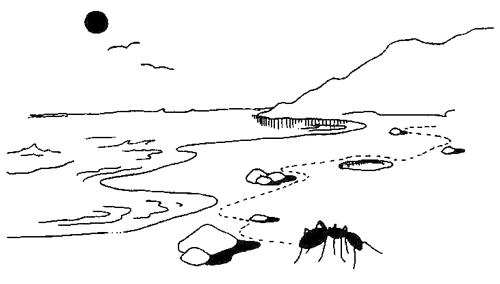
Simon’s ant & system complexity

Following
Jan 18, 2015 · 2 min read
Where is the complexity? Just because a system’s environment is complex does not mean that the systems operating within it must be complex as well.
“An ant, viewed as a behaving system, is quite simple. The apparent complexity of its behavior over time is largely a reflection of the complexity of the environment in which it finds itself.” — Herbert Simon (Simon’s Law)
Simon’s Law is about an ant on a beach looking for food. If you were to graph the ant’s path it would look swervy and complex.


If you saw this line with no other context, you’d think to yourself: “some ant.” If however you had in your possession a corresponding picture of the beach, you would realize that there is nothing special about the ant at all.


In complex terrain even a simple robot can mimic the ant’s path with only a few simple rules. That robot could be programmed to change course when the strait path is blocked. There are Arduino kits designed for middle schoolers that do this.
Simon’s Ant reminds us to always take the environment into consideration when analyzing a problem. In other words: understand both the content and context of any problem. Most people believe that complex problems require equally complex solutions. But the inverse is often more accurate when context is considered.
A complex problem often signals a simple solution’s existence because the problem contains all the complexity. A seemingly simple problem may indicate that only complex solutions exist.
Be wary of simple problems.
via Simon’s ant & system complexity – The Seemingly Unrelated


You must be logged in to post a comment.