“Why” we should start with “What”

Systems Ninja's avatarSystems Ninja

Simon Sinek is an inspirational speaker, writer and one of my favourite people (to be clear I don’t know him).

However, when it comes to service design I will (briefly) challenge Simons assertion to “Start with Why” (great book by the way).

With a career in public and military services, at the “sharp end” for the majority, I note that rarely is the “Why” missing, at least in meetings, debates and decisions making.

Many times you will hear “We need to protect ……” or “We have to help….”. The why is there ever present in decisions and projection of reasoning. In fact I would argue it is often used as the “emotional hammer” to drive home a particular change, or keep a particular service.

What is missing is the “What”.

Why Chicken

Most managers can tell you quite clearly “Why” a service, process, policy exists and “How” (perhaps slightly less) it is…

View original post 900 more words

Systematic comparison between methods for the detection of influential spreaders in complex networks

cxdig's avatarComplexity Digest

Influence maximization is the problem of finding the set of nodes of a network that maximizes the size of the outbreak of a spreading process occurring on the network. Solutions to this problem are important for strategic decisions in marketing and political campaigns. The typical setting consists in the identification of small sets of initial spreaders in very large networks. This setting makes the optimization problem computationally infeasible for standard greedy optimization algorithms that account simultaneously for information about network topology and spreading dynamics, leaving space only to heuristic methods based on the drastic approximation of relying on the geometry of the network alone. The literature on the subject is plenty of purely topological methods for the identification of influential spreaders in networks. However, it is unclear how far these methods are from being optimal. Here, we perform a systematic test of the performance of a multitude of heuristic methods…

View original post 172 more words

A Power Law Keeps the Brain’s Perceptions Balanced

cxdig's avatarComplexity Digest

Researchers have discovered a surprising mathematical relationship in the brain’s representations of sensory information, with possible applications to AI research.

Source: www.quantamagazine.org

View original post

Recovering systemic sensibility – investing in systems literacy and STiP capability – Professor Ray Ison at UK Systems Innovation, London, 6-7th September 2019 

via https://systemsinnovation.io

Source (pdf): Systems Innovation Final compressed.pdf – Google Drive


Recovering systemic sensibility – investing in
systems literacy and STiP capability
Ray Ison
Professor of Systems, Applied Systems Thinking in Practice
(ASTiP) Group, The Open University, Milton Keynes, UK
Systems Innovation, London, 6-7th September 2019 (Friday 6th
@ 12:10 – 1:05)

job opportunity – Executive Director of the System Dynamics Society


Source: Search

Executive Director of the System Dynamics Society


The System Dynamics Society is a non-profit organization that publishes the System Dynamics Review, runs an annual conference, and supports the activities of educators and practitioners in the field around the world. We are looking for an Executive Director who can help us fulfill this mission* by:

  • Helping define and deliver member benefits in order to retain and grow our membership
  • Overseeing outreach and contact activities to help keep members and the broader System Dynamics community up to date on what is happening
  • Keeping track of conference program activities to make sure the work advertising the conference, developing the schedule, and delivering the final program is kept on schedule
  • Coordinating with the Executive Editor and Publisher for the System Dynamics Review on logistic and content issues
  • Determining the needs of Chapters and SIGs within the Society and providing guidance on how best to fulfill them
  • Evaluating, planning, and making recommendations on product and service delivery opportunities in support of Society goals
  • Maintaining contact in the community for Society and conference sponsorship
  • Supporting the governance of the Society by scheduling meetings and providing information to Society Officers as needed
  • Working with the VP Finance to develop and follow budgets.

The Society is in a period of transition, and during this time the Executive Director will also be partly responsible for defining the role of the Executive Director. We are looking for someone who is up to this bootstrapping challenge, whether just for the transition or for the long term.

The Society currently maintains its operations in Albany, New York, USA. But the Executive Director position is one that can be taken on remotely so there are no real geographic restrictions. Ideas and attitude are far more important than location.

If you are interested please contact search@systemdynamics.org.


Notes

*From our Articles of Incorporation (https://www.systemdynamics.org/assets/PolicyCouncil/articles.htm), the objectives of the System Dynamics Society are:

  • to identify, extend and unify knowledge contributing to the understanding of feedback control systems
  • to promote the design of structures and policies to improve the behavior of such systems
  • to promote the development of the field of system dynamics and the free interchange of information about systems as they are found in all fields of endeavor
  • to promote the dissemination of information on such topics to the general public, and
  • to encourage and develop educational programs in the behavior of systems.


London Space – Systems Innovation – register now (begins in 158 days and counting)


Source: London Space – Systems Innovation

Si London

Starting in 2020 we will be launching Systems Innovation groups for specific geographies, what we call “Spaces”. These are locations for hosting regular meetups that will involve presentations and networking for those interested/involved in systems thinking and systems change. The first one will be in London UK. The ideas of system innovation and systems change are quite new and growing in popularity but London is emerging as a key location when it comes to systems change; with a host of academics, individuals and organizations interested in systems thinking/change London has a critical mass of people to build a robust community over time.

Source: London Space – Systems Innovation

REARRANGED – Systems Thinking Ontario – 2019-12-09, Book Launch: Stafford Beer, The Father of Management Cybernetics – with the author, Dr Allenna Leonard (book illustrated by Vanilla Beer)

Rearranged date:

Source: Systems Thinking Ontario – 2019-12-09


2019-12-09

December 9 (the second Monday of the month) is the 74th meeting for Systems Thinking Ontario. The registration is on Eventbrite at https://stafford-beer-book-launch.eventbrite.com.

Book Launch: Stafford Beer, The Father of Management Cybernetics (plus a Metaphorum Debriefing)

We are celebrating the fall release of Stafford Beer, The Father of Management Cybernetics: Big Data Analysis including Cybernetic Glossary.

  • Stafford Beer worked in industry and his analytical methods grew out of his experiences there. In an attempt to explain his Viable System Model (the VSM) and other ideas the authors have described the route by which he arrived at his solutions. This was Staffords preferred teaching method, contextualizing his thinking.There is nothing theoretical about his solutions – they are all grounded in practice. Their successful application caused him to be invited to work for Salvador Allende in Chile and for many other companies and governments. His insistence that hierarchical models will fail the people whom they are supposed to serve is axiomatic to his thinking.
  • Vanilla Beer is an artist and Staffords daughter : Dr Allenna Leonard is a practicing cybernetician and Staffords life partner.

Allenna will be present to speak about how the book came about, and her experiences with the Cybernetics movement.

In addition, Allenna will just returned from Metaphorum 2019, “Ctrl+Shift+Del – Rebooting Society”, Nov. 1-3 in Amsterdam, and will provide us with a debriefing.

Venue:

Suggested pre-reading:

There’s a “Look Inside” for the book listing on Amazon at https://www.amazon.ca/Stafford-Beer-Father-Management-Cybernetics/dp/1073031217

There. Is. So. Much. Stuff.

So much stuff.

R4S – Resilience Nexus – Resilience for Systems guidebook

[see below for the guidebook]

http://resiliencenexus.org/about_us/

About Us

Our Work

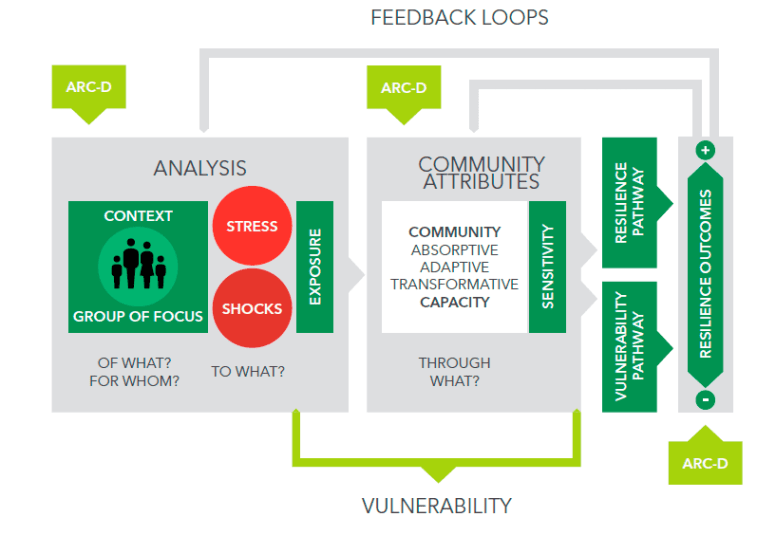
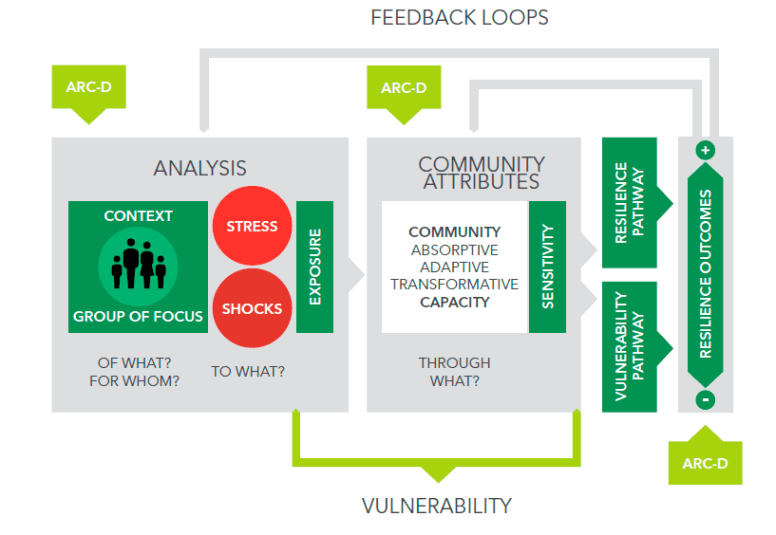
GOAL´s works in resilience measurement commenced in Honduras during 2009 while developing the “Study of Indigenous Disaster Preparedness and Response Practices in Gracias a Dios” funded by OFDA. Its findings, combined with GOAL’s wide experience in Disaster Risk Reduction (DRR), from then on, shaped the foundation of our resilience expertise. Following a series of trial examinations on the topic, GOAL by 2016 designed and published the ARC-D (Analysis of Resilience in Communities to Disaster) Toolkit; over this time, it was also extensively field tested and rolled-out across 11 countries in Africa, Asia, Central America and the Caribbean.

The second and enhanced version of the ARC-D issued at the end of 2016 has triggered GOAL’s important progress in being recognized as a leading expert in disaster resilience and is now being widely used.


In Honduras and Haiti, additional progress has been made in approaches such as “Barrio Resiliente”, which offers a more holistic vision of what it means to build resilience in communities. Going further, GOAL Global Research Fund financed during 2016, an initial guidance for the “Resilience for Social Systems (R4S) Toolkit”, a set of resources for mapping and analyzing the resilience of socioeconomic systems. Please see the Resources section for more information on the R4S.

Our Resilience Framework answers four key questions: Resilience of whom? –the target group we intend to strengthened through resilience programming in the context it is immersed in; Resilience to what? –to the shocks and stresses that the target population is exposed to; Resilience of what? –the systems and levels we plan to work with; and Resilience through what? –by strengthening/building the absorptive, adaptive and transformative capacities of the target group and systems.


Source: R4S – Resilience Nexus

R4S

R4S

Resilience for Systems

The R4S Approach was developed in 2016 by GOAL’s Resilience, Innovation and Learning Hub (RILH) to inform a resilience approach to the implementation of humanitarian and development interventions by improving the understanding of socio-economic systems and how they react to shocks and stresses. GOAL strives to strengthen understanding of these dynamics, to enable better programming that addresses root causes of vulnerability rather than symptoms alone.The R4S intends to provide mechanisms for analysing the current resilience state of critical socio-economic systems and leads to recommendations on how to build or strengthen the resilience of these systems, ultimately contributing to more inclusive and resilient societies.

The R4S approach applies and combines Systems Thinking, Network Theory, Scenario Thinking, Social and Behaviour Change, Inclusion and Resilience tools to provide a practical and structured step by step process. One of the central innovations of the R4S, that will characterize the way we work, is its mapping tool which aims to improve understanding and analysis of complex socio-economic systems and how they would react to different shocks and stresses. At least, but not last, the R4S provides new guidance on analysing the six Determinant Factors of Resilient systems: Connectivity, Diversity, Redundancy, Governance, Participation and Learning. Finally, we encourage you to join us in this journey of building more inclusive and resilient societies by learning and hopefully, implementing the R4S approach in your programming.

Source: R4S – Resilience Nexus

Conversation Theory (Gordon Pask) – InstructionalDesign.org


Source: Conversation Theory (Gordon Pask) – InstructionalDesign.org

Conversation Theory (Gordon Pask)

The Conversation Theory developed by G. Pask originated from a cybernetics framework and attempts to explain learning in both living organisms and machines. The fundamental idea of the theory was that learning occurs through conversations about a subject matter which serve to make knowledge explicit. Conversations can be conducted at a number of different levels: natural language (general discussion), object languages (for discussing the subject matter), and metalanguages (for talking about learning/language).

In order to facilitate learning, Pask argued that subject matter should be represented in the form of entailment structures which show what is to be learned. Entailment structures exist in a variety of different levels depending upon the extent of relationships displayed (e.g., super/subordinate concepts, analogies).

The critical method of learning according to conversation theory is “teachback” in which one person teaches another what they have learned. Pask identified two different types of learning strategies: serialists who progress through an entailment structure in a sequential fashion and holists who look for higher order relations.

Application

Conversation theory applies to the learning of any subject matter. Pask (1975) provides an extensive discussion of the theory applied to the learning of statistics (probability).

Example

Pask (1975, Chapter 9) discusses the application of conversation theory to a medical diagnosis task (diseases of the thyroid). In this case, the entailment structure represents relationships between pathological conditions of the thyroid and treatment/tests. The student is encouraged to learn these relationships by changing the parameter values of a variable (e.g., iodine intake level) and investigating the effects.

Principles

  1. To learn a subject matter, students must learn the relationships among the concepts.
  2. Explicit explanation or manipulation of the subject matter facilitates understanding (e.g., use of teachback technique).
  3. Individual’s differ in their preferred manner of learning relationships (serialists versus holists).

References

  • Pask, G. (1975). Conversation, Cognition, and Learning. New York: Elsevier.

Related Websites

http://pangaro.com/pask-pdfs.html
http://web.cortland.edu/andersmd/learning/Pask.htm

CONVERSATIONAL AI: THE IMITATION MACHINE – Towards Data Science


Source: CONVERSATIONAL AI: THE IMITATION MACHINE – Towards Data Science

CONVERSATIONAL AI: THE IMITATION MACHINE

Naomi Lea
Naomi Lea
Nov 12, 2018 · 12 min read

1. Introduction

1.1. Background

The development of conversational AI has been underway for more than 60 years, in large part driven by research done in the field of natural language processing (NLP). In the 1980s, the departure from hand-written rules and shift to statistical approaches enabled NLP to be more effective and versatile in handling real data (Nadkarni, P.M. et al. 2011, p. 545). Since then, this trend has only grown in popularity, notably fuelled by the wide application of deep learning technologies. NLP in recent years finds remarkable success in classification, matching, translation, and structured prediction (Li, H. 2017, p. 2), tasks easier accomplished through statistic models. Naturalistic multi-turn dialogue still proves challenging, however, which some believe will remain unsolved until we develop an artificial general intelligence that is capable of “natural language understanding” (Bailey, K. 2017).

1.2. Objectives

To investigate effective system architecture for designing conversational AI, this abstract gives careful consideration to methodologies described in autopoietic theory and conversation theory. Building on the intersection of these theories and other multidisciplinary studies, it argues that conversation construction requires systematic representations of the world, especially those based on situated understanding. Furthermore, the sufficiency of a conversational AI should not be measured from its commonsense cognitive abilities, but from how well it imitates interchanges between human beings. This assertion readily alludes to the definition of intelligence by G.Pask (1976, p.7–8): “Intelligence is a property that is ascribed by an external observer to a conversation between participants if, and only if, their dialogue manifests understanding.” In this light, if a conversational AI displays situated understanding during a successful exchange, it could be said to have demonstrated intelligence.

The approach shown in this abstract aims to provide a new direction for tackling naturalistic multi-turn dialogue and to expand the benefit of contemporary NLP technologies. It suggests designing conversational AI as a self-referred system (Maturana, H.R. & Varela, F.J. 1980, p. xiii) that participates in “a process of understanding, retaining and learning that goes on” (Pask, G. 1972, p.212). This is highly achievable if deep learning methods were leveraged. The abstract also gives a nod to the “imitation game” famously incepted by A. Turing (1950, p. 433), which he proposed as a favourable alternative to asking the question “Can machines think?”

Continues in source:  CONVERSATIONAL AI: THE IMITATION MACHINE – Towards Data Science

Large scale and information effects on cooperation in public good games

cxdig's avatarComplexity Digest

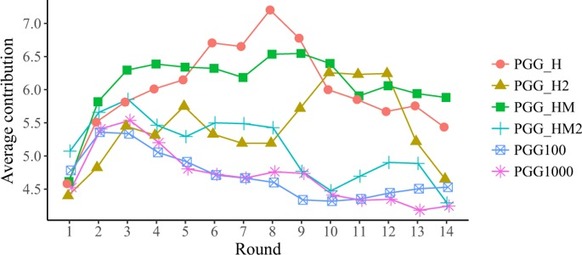
The problem of public good provision is central in economics and touches upon many challenging societal issues, ranging from climate change mitigation to vaccination schemes. However, results which are supposed to be applied to a societal scale have only been obtained with small groups of people, with a maximum group size of 100 being reported in the literature. This work takes this research to a new level by carrying out and analysing experiments on public good games with up to 1000 simultaneous players. The experiments are carried out via an online protocol involving daily decisions for extended periods. Our results show that within those limits, participants’ behaviour and collective outcomes in very large groups are qualitatively like those in smaller ones. On the other hand, large groups imply the difficulty of conveying information on others’ choices to the participants. We thus consider different information conditions and show that they have…

View original post 93 more words

Why I Am Not A Technocrat | RadicalxChange


Source: Why I Am Not A Technocrat | RadicalxChange

Why I Am Not A Technocrat

In the months leading up to the RadicalxChange conference in March, I wrote a series of critiques of prominent contemporary ideologies (capitalism, statism and nationalism) as well as an attempt to sketch the positive beliefs of the RxC movement. Since this time, however, it has become apparent that I omitted a critical contemporary ideology, perhaps the one with which RxC is most likely to be confused by outsiders (and which most RxC participants previous subscribed to): technocracy. Myself, I was socialized into a highly technocratic culture. In this blog post I try to fill this lacuna.

By technocracy, I mean the view that most of governance and policy should be left to some type of “experts”, distinguished by meritocratically-evaluated training in formal methods used to “optimize” social outcomes. Many technocrats are at least open to a degree of ultimate popular sovereignty over government, but believe that such democratic checks should operate at a quite high level, evaluating government performance on “final outcomes” rather than the means of achieving these. They thus believe the intelligibility and evaluability of technocratic designs by the broader public is of little value. Within these broad outlines, technocracy comes in many flavors. A couple of notable and less democratic version are the forms adopted by the Chinese communist party, the “neoreactionary” movement and its celebration of Lee Kwan Yew’s Singapore.

Yet perhaps the most prominent version, especially in democratic countries, is a belief in a technocracy based on a mixture of analytic philosophy, economic theory, computational power and high-volume statistical analysis, often using experimentation. This form of technocracy is a widely held view among much of the academic and high technology elites, among the most powerful groups in the world today. I focus on this tendency as I assume it will be the form of technocracy most familiar and attractive to my readers, and because the neoreactionary and Chinese Communist technocracies have much conceptually and intellectual historically in common with it. Some examples of more extreme versions of this view, likely to be popular among my readers, are common in the “rationalist” community and projects adjoining it such as effective altruism, mechanism design, artificial intelligence alignment and, to a lesser extent, humane design. I will critique each of these tendencies in detail as archetypes of technocracy.

Such rationalist projects are generally “outcome oriented” and utilitarian, have great faith in formal and quantitative methods of analysis and measurement. Their standard operating procedure is to take abstract goals related to human welfare, derive from these a series of more easily-measurable target metrics (ranging from gross domestic product to specific village level health outcomes) and use optimization tools and empirical analysis derived from economics, computer science and statistics to maximize these outcomes. This process is imagined as taking place overwhelmingly outside the public eye and is viewed as technical in nature. The public is invited to judge final outcomes only, and invited to offer input into the process only through formalisms such as “likes”, bets, votes, etc. Constraints on this process based on democratic legitimacy or explicability, “common sense” restrictions on what should or shouldn’t be optimized, unstructured or verbal input into the process by those lacking formal training, etc. are all viewed as harmful noise at best and as destructive meddling by ill-informed politics at worst.

The fundamental problem with technocracy on which I will focus (as it is most easily understood within the technocratic worldview) is that formal systems of knowledge creation always have their limits and biases. They always leave out important consideration that are only discovered later and that often turn out to have a systematic relationship to the limited cultural and social experience of the groups developing them. They are thus subject to a wide range of failure modes that can be interpreted as reflecting on a mixture of corruption and incompetence of the technocratic elite. Only systems that leave a wide range of latitude for broader social input can avoid these failure modes. Yet allowing such social input requires simplification, distillation, collaboration and a relative reduction in the social status and monetary rewards allocated to technocrats compared to the rest of the population, thereby running directly against the technocratic ideology. While technical knowledge, appropriately communicated and distilled, has potentially great benefits in opening social imagination, it can only achieve this potential if it understands itself as part of a broader democratic conversation.

My argument proceeds in six parts:

  1. Formal social systems intended to serve broad populations always have blind spots and biases that cannot be anticipated in advance by their designers.
  2. Historically, these blind spots often lead to disastrous outcomes if they are left unchecked by external input. If this input is left to the outcome stage, disasters must occur before the system is reconsidered rather than biases being caught during the process.
  3. Failures of technocracy in managing economic and computational systems today bear significant responsibility for widespread feelings of illegitimacy that threaten respect for the best-grounded science that technocrats believe is most important for the public to trust.
  4. Technical insights and designs are best able to avoid this problem when, whatever their analytic provenance, they can be conveyed in a simple and clear way to the public, allowing them to be critiqued, recombined, and deployed by a variety of members of the public outside the technical class.
  5. Technical experts therefore have a critical role precisely if they can make their technical insights part of a social and democratic conversation that stretches well beyond the role for democratic participation imagined by technocrats. Ensuring this role cannot be separated from the work of design.
  6. Technocracy divorced from the need for public communication and accountability is thus a dangerous ideology that distracts technical experts from the valuable role they can play by tempting them to assume undue, independent power and influence.


Continues in source: Why I Am Not A Technocrat | RadicalxChange

Excellent tweet stream for #RSD8 conference

https://twitter.com/hashtag/rsd8?src=hashtag_click

SystemViz Project by Elanica

THE PROJECT

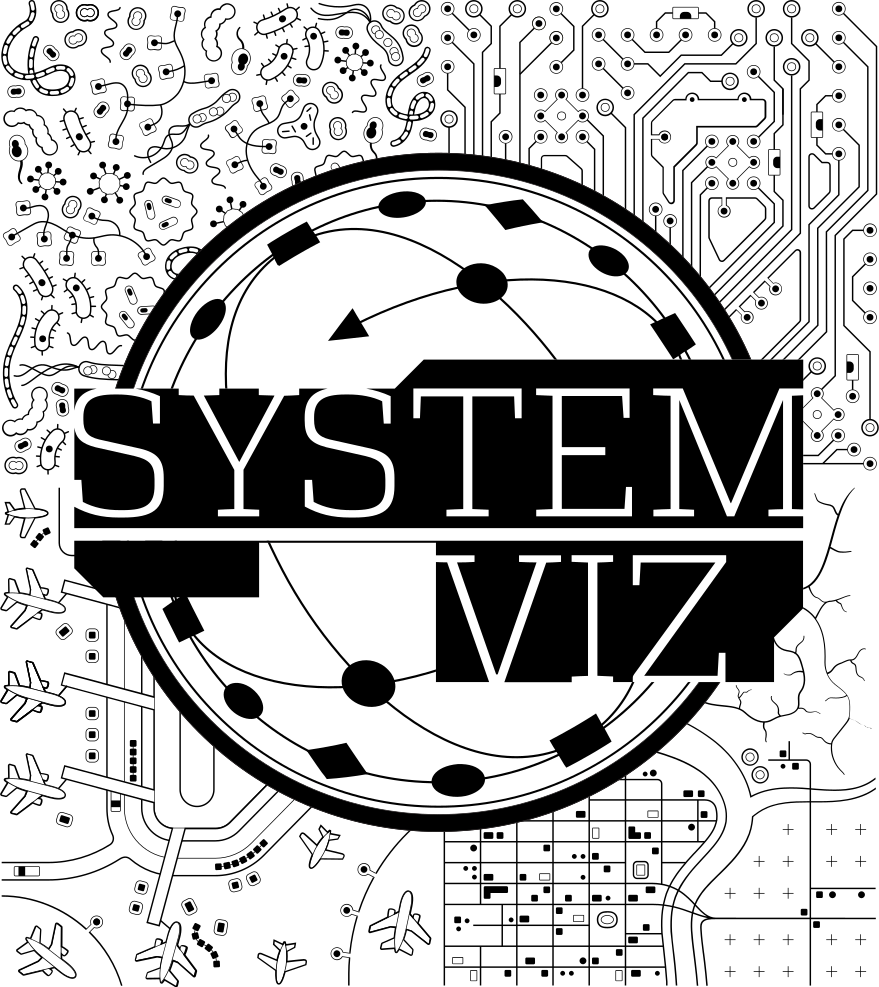
SystemViz is a research project exploring how visuals can enhance systems thinking, especially as it relates to inter-disciplinary, collaborative design. Findings are expressed as visual codexes and other applied tools. Phase One of the project is an exploration of the visual notation techniques used to express systems across disciplines. Phase Two is an exploration of the theoretical literature of various disciplines—in the natural science, social sciences, design disciplines, and managerial disciplines—to distil the basic elements and dynamics. These elements and dynamics are then abstracted into generic types and displayed with an illustrative icon. This is called a Visual Vocabulary, which is being released under a Commons Free Culture license for all to use and modify. Watch this space in the coming days for kits to download. In the meantime, look at the first codex poster which can be downloaded here

Source: SystemViz Project by Elanica


s
search
c
compose new post
r
reply
e
edit
t
go to top
j
go to the next post or comment
k
go to the previous post or comment
o
toggle comment visibility
esc
cancel edit post or comment